
Checkups & Cleanings · Promenade Dental Care, Murrieta
Dental Exam in Murrieta: What a Checkup Includes and How Often You Need One
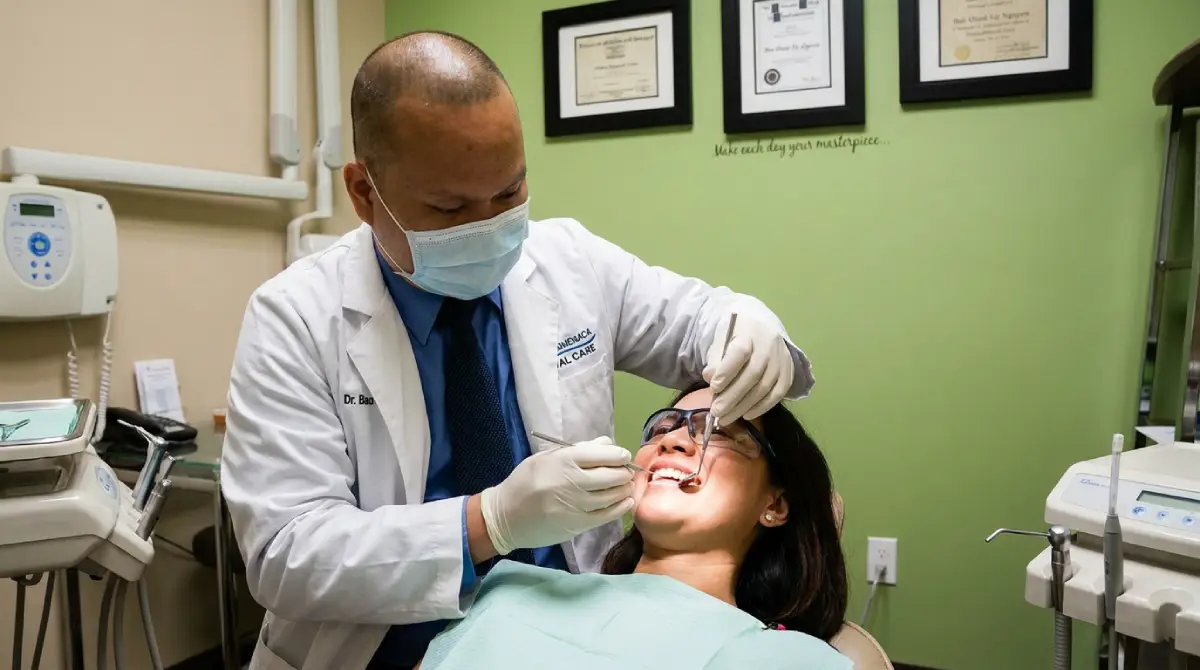
A dental exam is the visit where I look for problems before they hurt. I take digital X-rays when they're due, check every tooth, measure your gums, look at your bite and jaw joints, and screen the soft tissue for oral cancer. For a new patient the exam and X-rays are $20 without insurance. Most healthy adults do well coming in twice a year, but I set your schedule from what I find, not from the calendar.
The basics
What is a dental exam, and how is it different from a cleaning?
The exam is the diagnosis. The cleaning is the treatment that removes tartar and stain. People blur them together because they usually happen in the same chair on the same morning, but they answer different questions. The exam asks what's going on in your mouth and what, if anything, needs doing. The cleaning takes off the hardened buildup a toothbrush can't. Insurance bills them as two separate preventive services, which is why your statement lists both.
Most of what I find at an exam doesn't hurt yet. A cavity starting between two back teeth, gums that bleed when they're measured, a filling that's begun to leak at its edge, a white patch on the side of the tongue: none of these announce themselves. That's the whole reason the visit exists. Pain is a late signal, and by the time a tooth aches, a fifteen-minute filling has often turned into a root canal and a crown.
- What it includes
- Digital X-rays when they're due, a tooth-by-tooth check, gum measurements, bite and jaw joint check, review of existing fillings and crowns, and an oral cancer screening
- Chair time
- About 20 to 40 minutes for the exam alone; about an hour with a cleaning added
- Cost
- $20 for a new patient, digital X-rays included, without insurance
- Usual interval
- Every 6 months for most adults, sooner for higher risk, sometimes longer for very low risk
- Who examines you
- Me. Promenade Dental Care is a one-dentist office.
Your schedule
Who needs a checkup, and how often should you come in?
Every adult with natural teeth, implants, or a partial needs one, and most do well on a six-month schedule. Six months is a sensible default, not a rule. A large Cochrane review of recall intervals found that for adults in regular care, a schedule set by risk did about as well as a fixed six-month schedule. So I'd rather look at your teeth and gums and set the interval with you than hand everyone the same postcard.
I ask people to come in every three or four months when one of these is true:
It cuts the other way too. If your gums measure healthy, you haven't had a new cavity in years, and your fillings are stable, I'll tell you that once a year may be plenty. Coming in more often than your mouth needs doesn't make you healthier. It just costs you mornings.
Decision boundaries
When don't you need a routine exam, or not the usual one?
You don't need a routine checkup when something is already wrong, and you don't need every part of it at every visit. These are the situations where I'll steer you to a different appointment or skip a step.
| Your situation | What I'd do instead | Why |
|---|---|---|
| A tooth hurts, your gum is swollen, or something broke | An emergency visit the same day, not a routine slot weeks out; see the emergency dentist page | Pain and swelling need an answer today, and the visit focuses on that tooth |
| You had a full set of X-rays recently | No new X-rays this visit | I take images when the diagnosis calls for them, not on a timer |
| Your gums measure 4 mm or deeper and bleed | A full mouth deep cleaning rather than a routine one | A routine cleaning doesn't reach tartar that far under the gum |
| Very low risk, no new decay in years | A longer interval, often 12 months | The evidence doesn't show a benefit from coming more often at low risk |
| Another office gave you a big treatment plan | Bring your X-rays and the plan; I'll look at the teeth in question | A second opinion is about checking specific findings, not starting over |
If you're not sure which appointment you need, call and describe what's going on. My front desk will book the right one, and nobody will talk you into a longer visit than you need.
Step by step
What happens during a dental exam?
It runs in the same order every time, so nothing gets skipped. You can stop me at any step and ask what I'm looking at.
1Your health history
I go over your medications, any new diagnoses, and anything you've noticed: a sensitive tooth, gums that bleed when you floss, a spot that traps food, a clicking jaw. Blood thinners, pregnancy, and dry mouth all change what I look for.
2Digital X-rays, if they're due
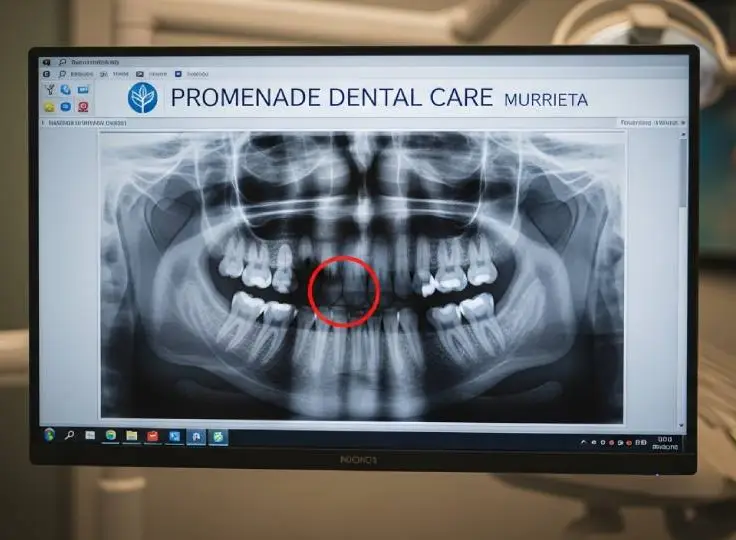
Bitewings show decay between back teeth and the bone level under the gums. I take them only when they'll change a decision, which is the point of the American Dental Association's 2024 radiography recommendations: justify every image and keep the dose low.
3Every tooth, one at a time
I check each surface for decay, cracks, and wear, and every filling and crown for a gap at its edge. The intraoral camera puts a close-up on the screen so you see what I see.
4Gums and bone
A thin probe measures the pocket around each tooth. Healthy gums measure 1 to 3 millimeters and barely bleed. Deeper numbers, with bleeding, are how gum disease shows up before teeth get loose.
5Bite, jaw joints, and wear
Flattened edges and small chips tell me who's grinding at night. I also feel the jaw joints and the chewing muscles for tenderness.
6Oral cancer screening
I look at and gently feel the lips, cheeks, tongue, floor and roof of the mouth, and throat. It takes about a minute and a half. The oral cancer screening page covers what I'm feeling for.
7What I found, in plain words
You get the findings, what can wait, what can't, and a written price for anything I recommend. Often the answer is that everything looks good.
How I decide
How do I decide what a finding needs?
I'm conservative by habit. Ten years as a Navy dentist taught me to be thorough and direct with people who couldn't easily come back next week, and to say plainly when something doesn't need treatment. A finding goes into one of three piles: fix it now, fix it soon, or watch it and look again next visit. Here's how the common ones usually sort out.
| What I find | What it usually means | What I usually recommend |
|---|---|---|
| A chalky spot in the enamel, no shadow into the tooth on the X-ray | Very early decay that can still harden again | Watch it, better cleaning at that spot, fluoride; no drilling yet |
| A shadow past the enamel on a bitewing | A cavity that won't reverse | A tooth-colored filling, often the same day |
| A large old filling with a crack line or a broken cusp | A tooth at risk of splitting | A same-day CEREC crown before it breaks |
| Bleeding gums, pockets of 1 to 3 mm | Gingivitis, which reverses | A routine cleaning and better daily cleaning at those spots; see gingivitis treatment |
| Pockets of 4 mm or more with bleeding or bone loss | Periodontitis | Full mouth deep cleaning, $320 without insurance |
| A sore, patch, or lump that's been there more than two weeks | Unknown until it's tested | Recheck in two weeks, then a biopsy referral if it's still there |
The watch pile matters. A small enamel spot I could drill today might never become a cavity if you clean that spot better, so I'd rather photograph it, note it, and compare at your next visit.
Cost
What does a dental exam cost in Murrieta?
For a new patient, the exam with digital X-rays is $20 without insurance. A routine cleaning is $95 if you want it the same visit. These are my published prices:
New-patient exam with digital X-rays
$20
Without insurance; includes the oral cancer screening
Ultrasonic teeth cleaning
$95
For gums that measure healthy, without insurance
Full mouth deep cleaning
$320
Only when your gum measurements call for it, without insurance
If the exam finds something that needs treatment, you get a written price for it before anything starts, and nothing is done that day unless you want it done. Returning patients without insurance can ask the front desk for the recall exam fee when they book.
Insurance and payment
Does dental insurance cover a checkup?
Usually, yes. Most PPO plans treat the exam, X-rays, and a routine cleaning as preventive care and cover them at a high percentage, often twice a year. I accept PPO plans and I'm in network with Delta Dental PPO, Cigna, MetLife, Guardian, Aetna, and United Concordia. My team checks your benefits before the visit so you know what you'll owe.
I don't quote insured fees on this page because they depend on your plan's coverage percentage, deductible, and copay. Without insurance, the prices above are what you pay. I take cash, Visa, Mastercard, American Express, Discover, and CareCredit.
Limits
What can a checkup miss?
An exam is very good at finding decay, gum disease, failing fillings, and suspicious tissue. It isn't perfect, and you should know where its edges are.
Honest limits: a hairline crack often doesn't show on any X-ray until it spreads, which is why a tooth that hurts when you release a bite gets its own workup (see cracked tooth). An oral cancer screening finds tissue that needs testing; it can't tell you what that tissue is, and only a biopsy can. X-rays use a small dose of radiation, which is why I take them only when they'll change a decision. And an exam can't help a tooth if the problem it finds gets put off for two years.
If something changes between visits, a new sore, a tooth that starts reacting to cold, gums that suddenly bleed, don't wait for your six-month date. Call and come in for that one thing.
Alternatives
Routine checkup, emergency visit, or a first visit after years away: which do you need?
| Visit | Best for | What to expect |
|---|---|---|
| Routine checkup | Nothing hurts and you're due | The full exam on this page, usually with a cleaning |
| Emergency visit | Pain, swelling, a broken or knocked-out tooth | A focused exam and X-ray of the problem, treatment the same day when possible; no surcharge on weekdays during business hours, $85 for an after-hours visit including the exam and X-rays |
| New-patient visit | Your first time here, or your first checkup in years | The $20 exam and X-rays, a full baseline, and a plan sorted into what's urgent and what can wait |
| Second opinion | Checking another office's treatment plan | I look at the teeth in question and tell you which items I agree with |
After your exam
What happens after the exam?
There's no recovery from an exam, so the question is what comes next. You leave with three things: what I found, a written price for anything I recommend, and your next visit date at the interval that fits your mouth. If the exam turns up something small, a single filling for example, and the schedule has room, I can often do it the same morning.
- Office hours
- Mon, Tue, Thu 9 AM–5 PM · Wed, Fri 9 AM–3 PM · not open on weekends
- Saturday checkups
- About one Saturday a month I come in for checkups, cleanings, and routine treatment when three or four patients have asked for one; tell the front desk you'd like a Saturday and they'll book it ahead
- Address
- 26957 Date St, Suite B4, Murrieta, CA 92563
- Phone
- (951) 412-0127
- Languages
- English, Spanish, and Vietnamese are spoken in the office
Patients come in from all over Southwest Riverside County: Murrieta, Temecula, Menifee, French Valley, Winchester, Wildomar, Lake Elsinore, and Canyon Lake. The Murrieta office page has directions and what to expect on a first visit.
Routine visits
What else is part of routine care here?
The exam is the center of routine care. These pages cover each piece in more detail.
Teeth cleaning
What happens at a $95 ultrasonic cleaning, and when a routine cleaning is the wrong appointment.
Air polishing
Stain and plaque off with a fine powder spray instead of gritty paste.
Oral cancer screening
The minute and a half of every exam that matters most.
Full mouth deep cleaning
When pocket measurements show gum disease, $320 for all four quadrants.
Sensitive teeth
Why teeth react to cold, and which causes need treatment.
Gingivitis
Bleeding gums that still reverse, and what reverses them.
Reading
What should you read between checkups?
These articles cover the everyday habits a checkup can only point out. Each one links back here when it's time to book.
Back after years away
What the first visit looks like when it's been a long time, and how a big plan gets sorted.
Daily oral hygiene routine
Brushing, flossing, and the tools most people skip, morning to night.
Electric toothbrushes
Whether an electric brush is worth it, and which features matter.
Stronger enamel
How acid wears enamel down, and what actually helps it harden again.
10 worst foods for your teeth
The snacks and drinks behind most of the cavities I fill.
Alcohol and your teeth
Wine, beer, and cocktails ranked by what they do to enamel and gums.
Gingivitis
Bleeding gums that still reverse, and what reverses them.
Facts about dentists and teeth
4,500 years of dentistry, and the myths that still get repeated.
Your dentist
Who does your exam?
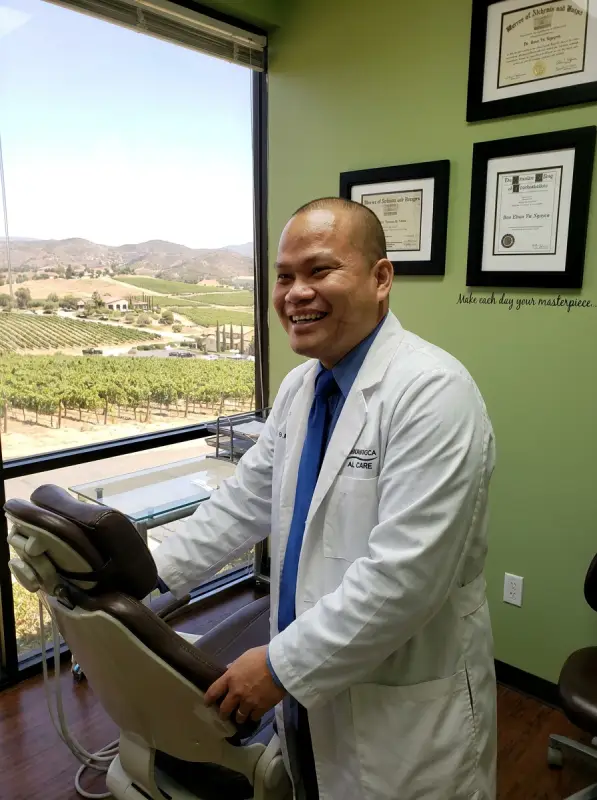
I do. Promenade Dental Care is a one-dentist office on Date Street, and I've practiced in Murrieta since 2010. I earned my DDS at the UCLA School of Dentistry, then spent ten years as a U.S. Navy dentist, including an Advanced Education in General Dentistry residency at Naval Hospital Camp Pendleton and deployments to Kuwait and Iraq.
That's 26 years of clinical practice. I take about 40 hours of continuing education a year, and I'm a member of the ADA, the California Dental Association, and the Tri-County Dental Society. The office has digital X-rays, an in-office 3D cone-beam scanner, an intraoral camera, and CEREC for same-day crowns, so most of what an exam finds can be handled here.
Patient reviews
What do checkup patients say?
After putting off a broken tooth for over a year, eventually the pain became too much. Dr. Nguyen met me for a consultation on a Sunday, his day off. He was able to suggest some pain relief and then got me in 2 days later, first thing in the morning. He did a root canal and crown in about 3 hours. Pain during procedure was minimal and I've recovered well. I would highly recommend him. Just had 2nd visit (March 2018) for 2nd broken tooth eating a Skittle candy. Within 2 hours of coming in had new crown and 2 filings down. Great and timely service. (February 2026) Just went in for my bi-annual cleaning and checkup. Dr. Nguyen is always friendly, thorough and does a great job. Never pressures me into unnecessary procedures. He and his staff are true "advocates" for my dental health.
— Tom Haynes · Google review
Excellent Dentist! Dr. Nguyen never keeps me waiting. My last checkup and cleaning, I was in and out in about 20 minutes. Had a crown replaced last year and am very happy with the result. Highly recommend Dr. Nguyen!
— Kevin Wooll · Google review
I’ve been to a lot of different dentists through the years and have had several fillings/crowns done. I often times experience pain and pressure during procedures even after the anesthetic. This time, zero pain, zero pressure, no nonsense. I’ll be coming back for regular cleanings and any needed procedures. They have my business indefinitely!
— Dominic Schmidt · Google review
FAQ
What else do patients ask about checkups?
Do I need a dental exam if nothing hurts?
Yes. Small cavities, early gum disease, and early oral cancer almost never hurt. By the time a tooth aches, decay has usually reached the nerve or infection has reached the bone, and the fix is bigger and more expensive. Feeling fine and being fine are two different findings, and only the exam tells you which one you have.
How much chair time should I plan for a checkup?
About 20 to 40 minutes for the exam alone, depending on whether X-rays are due. With a routine cleaning added, plan on about an hour. A first visit runs longer because I'm recording a full baseline: every tooth, every gum measurement, and a complete set of images.
Are dental X-rays safe, and why don't you take them every visit?
Digital dental X-rays use a very small dose of radiation, and I keep it smaller still by taking them only when they'll change a decision. A low-risk adult may need bitewings every year or two; someone with frequent cavities needs them more often. The American Dental Association's 2024 recommendations make the same point: every image should be justified by what it will show.
Can I decline X-rays?
You can, and I'll respect it. I'll tell you plainly what I can't see without them, mainly decay between back teeth and bone loss under the gums, and I'll note in your chart that you declined. If something on the visual exam makes an X-ray necessary to treat you safely, I'll explain why before going further.
Will you tell me if something can wait?
Always. I sort findings into what needs doing now, what can be scheduled, and what I'd rather watch. Early enamel spots, small worn areas, and old fillings that are still sealed often go on the watch list with a photo so we can compare next visit. You get a written plan with prices either way, and nothing is done that day unless you want it.
Can I get a filling the same day as my exam?
Often, yes. If the exam finds a small cavity and the schedule has room, I can usually fill it the same morning. A cracked tooth that needs a crown can often be done the same day too, because I make CEREC crowns here. Larger work gets its own appointment so it has the time it needs.
Does the $20 exam include a cleaning?
No. The $20 covers the new-patient exam, digital X-rays, and the oral cancer screening. A routine ultrasonic cleaning is $95 without insurance. Most new patients with healthy gums have both at the same visit. If your gums measure deeper, I'll recommend a deep cleaning instead and explain why.
Why do my gums bleed when you measure them?
Healthy gums barely bleed when they're gently probed. Bleeding means the gum tissue is inflamed, usually from plaque sitting at the gumline. It's one of the most useful things I record, because a spot that bleeds today and doesn't bleed in six months tells us your home care is working there.
Can a dental exam show problems outside my mouth?
Sometimes. Worn, flattened teeth point to grinding at night. Enamel eroded on the inside of the upper teeth can point to acid reflux. A suddenly dry mouth is often a medication side effect. When I see something like that, I tell you and suggest you mention it to your physician. I don't diagnose medical conditions, but I'll tell you what your mouth is showing.
What should I tell you before the exam starts?
Any change in your health or medications since your last visit, especially blood thinners, diabetes, pregnancy, or a new heart condition. Also anything you've noticed in your mouth, even if it seems minor: a tooth that's started reacting to cold, a spot that catches floss, a sore that hasn't healed. Those details tell me where to look first.
Due for a checkup?
Call to book. New patients start with the $20 exam and digital X-rays, and you'll know what I found and what it costs before anything is done.
Add a $95 cleaningPromenade Dental Care · Dr. Bao Nguyen, DDS
26957 Date St, Suite B4, Murrieta, CA 92563
Mon, Tue, Thu 9 AM–5 PM · Wed, Fri 9 AM–3 PM · not open on weekends