
Oral Cancer Screening in Murrieta: What It Is and What to Expect
Oral cancer is dangerous mostly because it hides. The earliest lesions are painless, and by the time something hurts, the disease has often already moved. That is why Dr. Bao Nguyen builds a full oral cancer screening into every exam at Promenade Dental Care — including the $20 new-patient exam with digital X-rays.
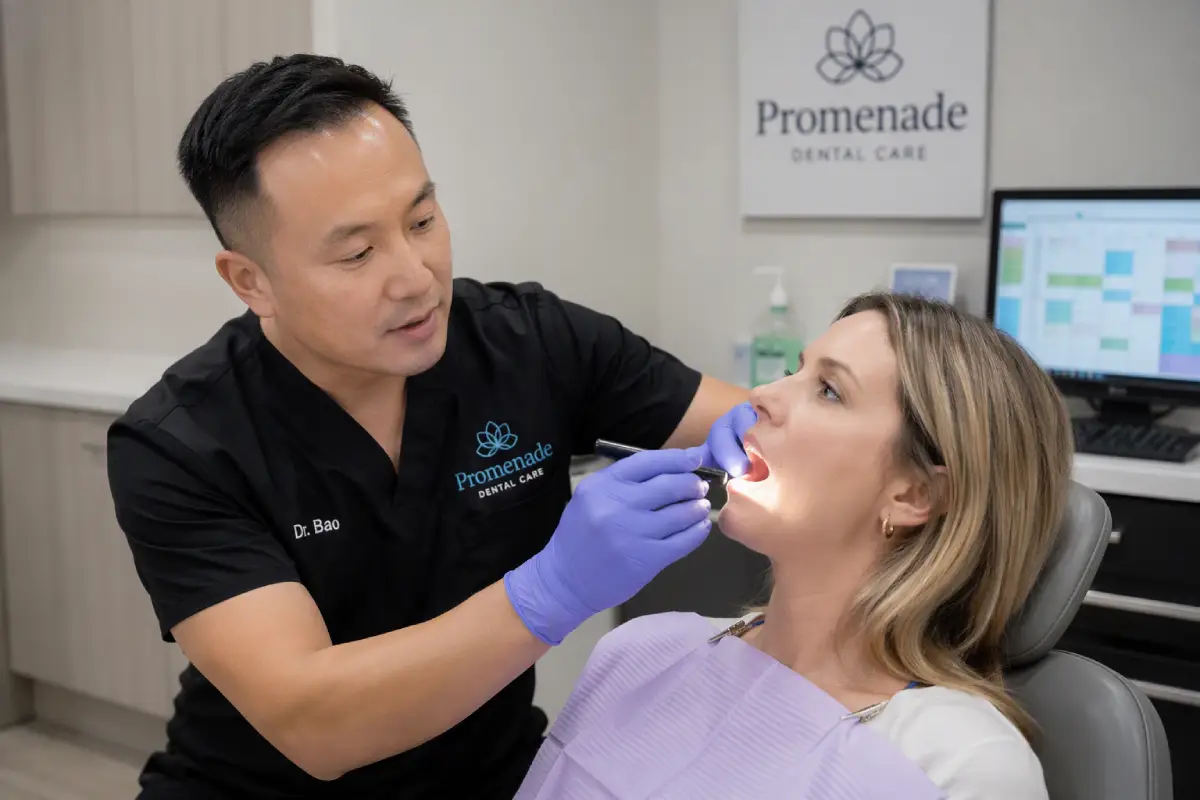
What Is an Oral Cancer Screening?
An oral cancer screening is a short, painless examination of every soft-tissue surface in and around your mouth — lips, tongue, cheeks, gums, the floor and roof of the mouth, the tonsil area, the jaw, and the lymph nodes of the neck — performed by a dentist looking for cancer or precancerous change before it causes any symptom at all. It takes about five minutes. It requires no needles, no dye, and no instrument beyond a mirror, good light, and a piece of gauze.
Almost nobody walks in complaining of oral cancer. They walk in for a cleaning, and someone happens to be looking.
That is the entire logic of screening. A trained set of eyes on your soft tissues twice a year remains the most reliable early-warning system we have for this disease — and unlike most cancer screening, it costs nothing extra and adds no time to your visit.
- What it is
- Visual and hands-on exam of the mouth, throat, jaw, and neck
- How long
- About five minutes, inside your regular exam
- Does it hurt
- No — nothing invasive, no needles, no scraping
- What it costs
- $0 extra — included in every exam, including the $20 new-patient visit
- How often
- Every six months for most adults; never skip a recall if you are higher risk
- Who performs it
- Dr. Bao Nguyen, DDS, personally — at every appointment
What Happens During an Oral Cancer Screening at the Dentist
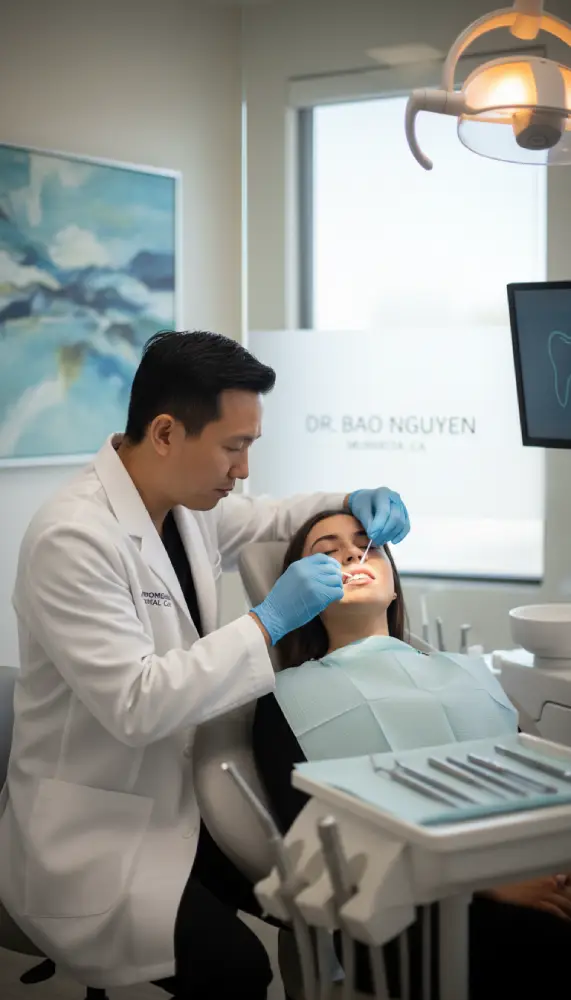
If you have ever wondered what your dentist is doing when he lifts your tongue with gauze or presses along the side of your neck, you have already had an oral cancer screening. Here is exactly what happens at our Date Street office, in order.
1Visual examination
Under bright light, Dr. Nguyen works through a fixed sequence: lips and the vermilion border, cheek lining, gums, all surfaces of the tongue including the sides and underside, the floor of the mouth, the hard and soft palate, and the tonsil area. He is looking for red patches, white patches, ulcers, and any change in texture or symmetry.
2Palpation
Next he gently feels the floor of the mouth, the jaw, and the lymph nodes of the neck for lumps, firmness, or tenderness. Some early lesions can be felt before they can be seen, which is why the hands-on half of the exam matters as much as the visual half.
3Documentation
Anything unusual gets photographed with the intraoral camera and measured, so the next visit has a real baseline instead of a memory. Most findings are ordinary — a cheek bite, denture rub, a canker sore — so the standard protocol is a two-week recheck.
4Referral, if needed
If a lesion is still there in two weeks, Dr. Nguyen refers you for a biopsy. A dentist can find suspicious tissue; only a pathologist can diagnose cancer. We coordinate the oral surgery referral and follow up on the result with you.
Why the exam is done the same way every time
A screening that wanders is a screening that misses things. Following an identical route through the mouth at every appointment is what makes a small change visible — not because any single look is remarkable, but because the twentieth look can be compared to the nineteenth.
It also means the exam is fast. Patients often do not notice a screening happened until Dr. Nguyen says everything looks healthy.
I love coming to Promenade Dental Care. Dr. Nguyen and Edith are the best. They’re friendly and I love that I’m taken care of right away. Dr. Nguyen is thorough and efficient. He answers any questions I have and explains things clearly. I actually look forward to my biannual dentist visits now because they’re the best. Can’t recommend a dentist more!
— Kamilah C. | Google Review
Early Signs of Oral Cancer to Watch For Between Visits
Screenings happen twice a year; oral cancer does not keep a calendar. Knowing what to look for between appointments is the other half of early detection. Call us about any of the following that lasts longer than two weeks.
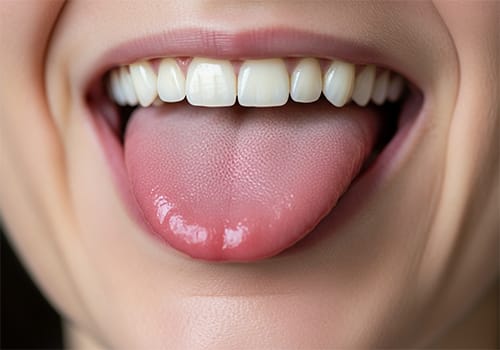
Two things are true at once here, and both matter. Most of these findings turn out to be benign — cheek biting, denture irritation, and canker sores are far more common than cancer. And the only way to know which one you have is to have it looked at.
Why Two Weeks Is the Number That Matters
Irritation heals. Suspicious tissue does not. That single distinction is the backbone of every screening protocol in dentistry, and the National Institute of Dental and Craniofacial Research uses the same two-week threshold we do.
| What you noticed | Usual explanation | What we do |
|---|---|---|
| Sore on the inside of the cheek | Accidental bite or a sharp filling edge | Smooth the cause, recheck in two weeks |
| Sore under a denture | Pressure point from an ill-fitting appliance | Adjust the denture, recheck in two weeks |
| White patch that wipes away | Fungal overgrowth, not leukoplakia | Treat the infection, confirm it clears |
| White patch that does not wipe away | Leukoplakia — usually benign, sometimes not | Photograph and measure, recheck in two weeks |
| Red patch or mixed red-and-white patch | Erythroplakia — the finding with the highest concern | Prompt referral for biopsy |
| Anything unchanged after two weeks | No longer explainable as irritation | Referral to an oral surgeon for biopsy |
Very knowledgable and good prices. Does only what is necessary. Does not just look for stuff to charge for. Got an appointment quickly when I thought it was an emergency. My favorite dentist ever!!
— Sheila O. | Google Review
How Often Should You Get an Oral Cancer Screening?
For most adults the answer takes care of itself: at every routine dental checkup. If you see us every six months for an exam and ultrasonic cleaning, that is two screenings a year without ever scheduling one.
The standard schedule
Every six months, built into your recall exam. Six months is short enough to catch change while it is still small, which matters because many of these lesions grow silently for months before they produce a symptom anyone would notice.
The higher-risk schedule
If you use tobacco in any form, drink heavily, have known HPV exposure, spend significant time in the sun without lip protection, or have a history of oral cancer or a precancerous lesion, do not stretch your recall intervals. Patients on three- or four-month periodontal maintenance are screened even more often — again, at no additional charge.
If it has been years
No lecture. The $20 exam with digital X-rays is the easiest way to get caught back up, and the screening is part of it. New patients are welcome without insurance.
Dr. Nguyen does a great job. He is always on time and very honest. Never has you do unnecessary treatments, just to make extra money. I love that he is a solo practitioner and runs his own shop. That keeps his overhead costs low and he knows you more personally as a patient. All my family comes to see him. Best dentist I’ve ever had.
— Tom H. | Google Review
Who Needs an Oral Cancer Screening?
Every adult, honestly — but some patients should be especially consistent about it. The CDC and the Oral Cancer Foundation identify these as the major risk factors.
Tobacco users
Cigarettes, cigars, pipes, chewing tobacco, and snuff all raise risk sharply. Smokeless products are particularly associated with cancers of the cheek and gum tissue where the product sits.
Heavy drinkers
Heavy alcohol use raises risk on its own, and combined with tobacco the two compound each other rather than simply adding up. We wrote more about alcohol and oral disease here.
Adults with HPV exposure
HPV-16 is now behind a large share of oropharyngeal cancers, often in younger adults who have never smoked. This is the single biggest reason screening is no longer just for older smokers.
Adults over 40
Risk climbs with age, and the average age at diagnosis is in the sixties. If you are over 40, twice-a-year screening should be non-negotiable.
Sun-exposed lips
Outdoor workers and anyone who spends Southern California weekends outside face elevated lip cancer risk. Dr. Nguyen checks the lip border at every screening.
Everyone else
Cases continue to rise among people with no traditional risk factors at all. That is precisely why we screen universally instead of by profile — a policy that only works if it is free.
Oral Cancer Prevention: What You Can Actually Control
Screening finds problems early. Prevention keeps a share of them from starting. The habits with real payoff are short and unglamorous:
Parents: HPV vaccination conversations start in the preteen years, and dental habits start earlier than that. Our kids dentist page covers how we build those habits for Murrieta families.
Real Google Reviews from Promenade Dental Care Patients
These are unedited reviews posted by patients on Google Maps. The recurring theme — honest recommendations, no invented treatment plans — is the same philosophy behind including cancer screening in every exam instead of billing it as an add-on.
I love coming to Promenade Dental Care. Dr. Nguyen and Edith are the best. They’re friendly and I love that I’m taken care of right away. Dr. Nguyen is thorough and efficient. He answers any questions I have and explains things clearly. I actually look forward to my biannual dentist visits now because they’re the best. Can’t recommend a dentist more!
— Kamilah C. | Google Review
Very knowledgable and good prices. Does only what is necessary. Does not just look for stuff to charge for. Got an appointment quickly when I thought it was an emergency. My favorite dentist ever!!
— Sheila O. | Google Review
Dr. Nguyen does a great job. He is always on time and very honest. Never has you do unnecessary treatments, just to make extra money. I love that he is a solo practitioner and runs his own shop. That keeps his overhead costs low and he knows you more personally as a patient. All my family comes to see him. Best dentist I’ve ever had.
— Tom H. | Google Review
Very comfortable office. Dr. Bao N. is AMAZING! He is gentle, straight to the point and HONEST.
— Sharma Kliche LLP | Google Review
Your Next Checkup Is Also Your Next Screening
One call gets you the $20 exam, digital X-rays, and a complete oral cancer screening — five painless minutes that could make a life-saving difference.
Request an Appointment Online26957 Date St, Suite B4, Murrieta, CA 92563
Dr. Bao Nguyen, DDS • Serving Murrieta, Temecula, Menifee, French Valley, and Wildomar
Oral Cancer Screening FAQs
What is an oral cancer screening?
An oral cancer screening is a quick, painless visual and physical exam of your mouth, lips, tongue, cheeks, throat, jaw, and neck performed by a dentist to look for early signs of cancer or precancerous changes. At Promenade Dental Care it is built into every $20 new-patient exam and every routine checkup, takes about five minutes, and requires no needles, no discomfort, and no extra appointment.
What happens during an oral cancer screening at the dentist?
Dr. Nguyen visually inspects all the soft tissues of your mouth for red or white patches, sores, and unusual texture changes, then gently palpates your jaw, neck, and the floor of your mouth to feel for lumps or thickened areas. He also checks your tongue, tonsil area, and the roof of your mouth. If anything looks suspicious, he documents it, photographs it with the intraoral camera, and schedules a short follow-up to see whether it heals on its own.
How often should I get an oral cancer screening?
For most adults, once at every routine dental checkup, which works out to every six months at Promenade Dental Care. Higher-risk patients, including tobacco users, heavy drinkers, people with HPV exposure, and anyone over 40, should never skip a recall visit, because the screening is built into every exam at no extra charge.
Does an oral cancer screening hurt?
No. The screening is entirely non-invasive. It involves looking at the tissues of your mouth under good lighting and gently feeling your jaw and neck with gloved fingers. There are no needles, no scraping, and no instruments beyond a mirror and gauze to hold the tongue. Most patients do not even realize a screening happened until Dr. Nguyen tells them everything looks healthy.
What are the early signs of oral cancer?
Early signs of oral cancer include a mouth sore that does not heal within two weeks, a red or white patch on the gums, tongue, or cheek lining, a lump or thickening in the mouth or neck, unexplained numbness, difficulty chewing or swallowing, persistent hoarseness, and unexplained bleeding. Many early lesions cause no pain at all, which is exactly why routine screening by a dentist matters.
Why is two weeks the rule for a sore that will not heal?
Because ordinary irritation resolves in that window and abnormal tissue does not. A cheek bite, a denture rub, or a canker sore will be visibly better within two weeks. Anything still present after two weeks no longer has an easy explanation and should be examined by a dentist. The National Institute of Dental and Craniofacial Research uses the same two-week threshold.
Who is at higher risk for oral cancer?
Tobacco users of any kind, heavy alcohol drinkers, people with HPV (human papillomavirus) exposure, adults over 40, people with significant sun exposure to the lips, and anyone with a prior history of oral cancer. That said, rates among younger, non-smoking adults have been rising because of HPV, so screening is recommended for every adult, not just traditional risk groups.
How much does an oral cancer screening cost at Promenade Dental Care?
Nothing extra. The screening is included in every dental exam. New patients pay just $20 for a complete exam with digital X-rays, and the oral cancer screening is part of that visit. There is no separate screening fee and no upsell.
Can a dentist diagnose oral cancer?
A dentist can identify suspicious tissue changes and is often the first health professional to spot them, but a definitive diagnosis requires a biopsy evaluated by a pathologist. If Dr. Nguyen finds an area of concern that does not resolve in two weeks, he will refer you to an oral surgeon or specialist for a biopsy and coordinate the follow-up.
What does a white or red patch in my mouth mean?
White patches (leukoplakia) and red patches (erythroplakia) are the two most common precancerous changes found during screenings. Most turn out to be harmless irritation from cheek biting, dentures, or hot food, but red patches carry a higher chance of containing abnormal cells and are taken more seriously. Any patch that lasts more than two weeks should be examined by a dentist.
Why is early detection of oral cancer so important?
When oral cavity cancer is found while it is still localized, the five-year relative survival rate is roughly 86 percent according to American Cancer Society data. Once it spreads to distant parts of the body, survival drops sharply. A five-minute screening at each checkup is the single most effective way to catch it inside that early, highly treatable window.
Does HPV cause oral cancer?
Yes. HPV, particularly HPV-16, is now a leading cause of oropharyngeal cancers affecting the back of the throat, tonsils, and base of the tongue, especially in younger adults who have never smoked. This is one of the main reasons dentists now recommend routine oral cancer screening for all adults regardless of tobacco or alcohol history.
Is an oral cancer screening covered by dental insurance?
At Promenade Dental Care the question does not come up, because the screening is part of the exam rather than a separately billed service. Your exam is processed under your plan as it normally would be, and the screening adds nothing to it. We accept all PPO dental plans and are in-network with Delta Dental PPO, Cigna, MetLife, Guardian, Aetna, and United Concordia.
What should I do if I notice a sore that will not heal?
Call us at (951) 412-0127 and schedule an exam. Any mouth sore, patch, or lump that lasts longer than two weeks deserves professional evaluation. Most turn out to be benign, but the only way to know is to have it examined, and early evaluation is always easier, cheaper, and safer than waiting.