
TMJ & Jaw Pain · Murrieta, CA
TMJ Treatment in Murrieta, CA
Jaw pain, morning headaches, a click when you chew, teeth that keep cracking: the jaw joint is often the thing nobody has checked.
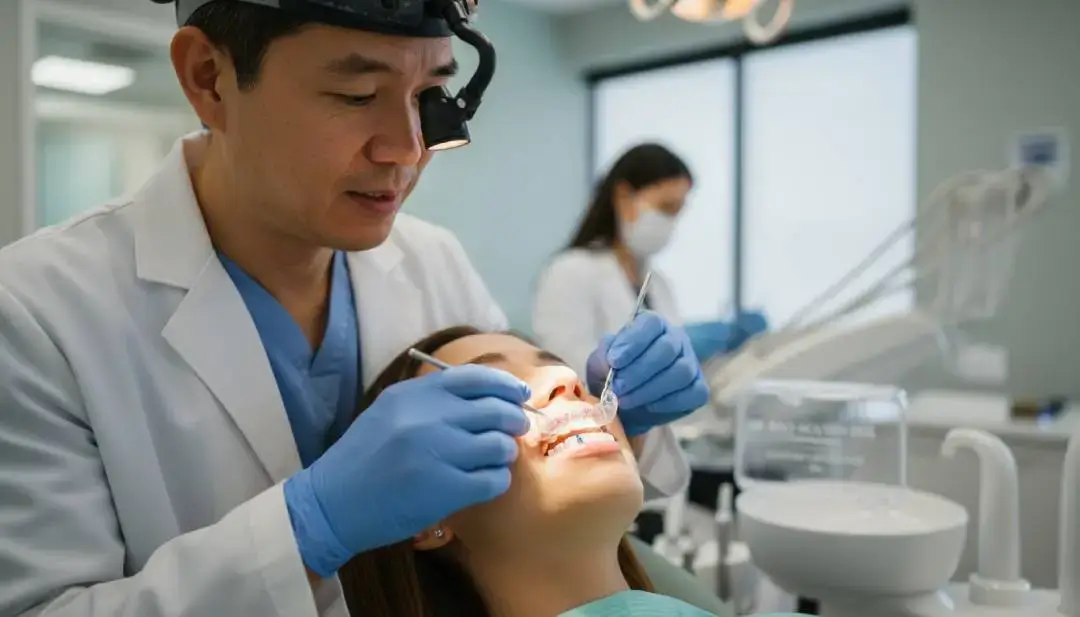
If your jaw aches in front of your ear, if you wake up with a headache in your temples, if your jaw pops or catches when you open, or if your partner hears you grinding at night, you may have a temporomandibular disorder. I evaluate TMJ problems at Promenade Dental Care the way the National Institutes of Health recommends: find the actual cause with a proper exam and 3D imaging, start with treatments that can be reversed, and put every cost in writing before anything happens. Most people who come to me for jaw pain leave with a nightguard and a plan, not a surgery referral.
Understanding the Joint
What Is TMJ Disorder (TMD)?
You have two temporomandibular joints, one on each side of your head just in front of your ears, and they are the most complicated joints you own. They hinge and they slide at the same time, and they carry every pound of force your jaw produces when you chew, talk, yawn, or clench. When something goes wrong with the joint itself, the cartilage disc inside it, the muscles that drive it, or the teeth that guide it, the result is a temporomandibular disorder. TMJ is the joint. TMD is the problem. Most people say "TMJ" for both, and I know what you mean.
The National Institute of Dental and Craniofacial Research estimates that somewhere between 5 and 12 percent of adults have some form of TMD, with women diagnosed roughly twice as often as men. The real number of people living with a jaw problem they have never connected to their teeth is almost certainly higher. I regularly meet patients who have spent years treating "headaches," "ear infections," or "stress" that turned out to be a jaw disorder wearing a disguise.
The causes overlap more often than not. Grinding and clenching, called bruxism, is the driver I see most. A bite that no longer fits together, whether from missing teeth, worn surfaces, old fillings that have changed shape, or natural misalignment, forces the jaw off its ideal hinge path every time you close. An old blow to the jaw can displace the disc and show up as clicking or locking years later. Arthritis wears the joint surfaces. Stress keeps the chewing muscles contracted for hours at a time. Most of the jaw-pain patients who walk into my Date Street office have two or three of these working together, which is why a careful evaluation matters more than a quick guess.
- What it is
- Pain or dysfunction in the jaw joint, the muscles that move it, or the bite that guides it. NIDCR groups more than thirty conditions under the label.
- Most common cause
- Nighttime grinding and clenching, usually combined with a bite that has drifted out of balance.
- First-line treatment
- Reversible care: a custom occlusal splint, jaw exercises, moist heat, and habit changes. Bite correction only when the bite is clearly loading the joint.
- Surgery
- Rarely needed. I refer to an oral surgeon only after conservative care has had a fair trial and imaging shows a structural problem that nothing else will fix.
- Where to start
- A $20 exam with digital X-rays, plus a 3D scan of the joint if the exam shows it is needed.
The Warning Signs
Common TMJ Symptoms
TMD symptoms run from mildly annoying to disabling, and the hard part is that most of them look like something else. Patients cycle through an ENT, a neurologist, and a chiropractor before anyone looks at the jaw. Here is what I check, grouped by where the symptom shows up.
In the jaw
In the head and neck
In the teeth
The Cleveland Clinic's TMD overview notes that many patients have symptoms from all three groups at once. If you recognize three or more of the items above, the jaw is worth a real look.
Finding the Cause
How I Diagnose a TMJ Problem
The most common mistake in TMJ care is choosing the fix before understanding the problem. A nightguard does not repair a displaced disc. A bite adjustment does not calm an inflamed muscle. The treatment has to match the cause, and the cause takes a systematic exam to find. I evaluate the disorder in layers, because it can start in any one of them or in all of them at once.
1Your history
Old injuries, stress, sleep, medications, how long the symptoms have been going, and what makes them better or worse. Half of the diagnosis is in this conversation.
2The joint
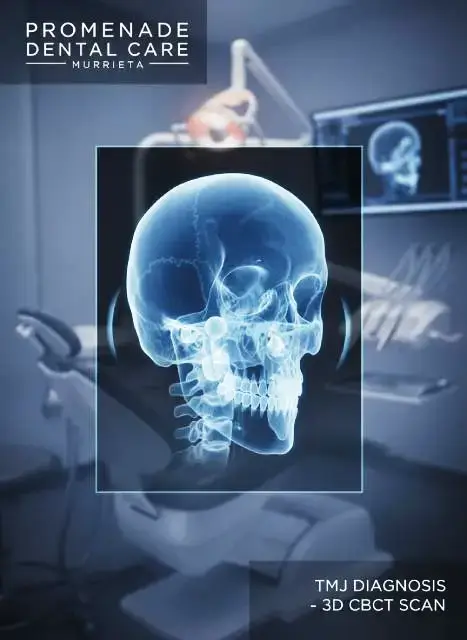
I feel and listen to both joints while you open, close, and slide. When the exam calls for it, an in-office 3D cone-beam CT scan shows the position of the condyle in its socket and any bone change from arthritis or degeneration. A standard 2D X-ray misses most of that.
3The muscles
The temporalis, masseter, and pterygoid muscles get palpated for tenderness, trigger points, and asymmetry. Muscle-based TMD feels different from joint-based TMD, and the treatment path is different.
4The bite
I check how your teeth meet, where the interferences are, and what the wear facets say about where force has been landing. Crowns and fillings that have changed shape, and missing teeth that let their neighbors drift, are part of the mechanical story.
Why the bite exam matters
This is where a dentist with restorative depth earns the visit. I read the relationship between the joint, the muscles, and the teeth as one system, not three separate complaints. That perspective comes from a decade of military dentistry and a lot of complex restorative work, and it is the difference between a diagnosis and a guess.
It also means I am honest about what I find. If your click is painless and your opening is normal, I will tell you it does not need treatment. If your headaches do not fit a jaw pattern, I will say so and point you to the right doctor rather than sell you a guard you do not need.
Conservative First
TMJ Treatment Options
NIDCR's guidance to patients is titled "Less Is Often Best in Treating TMD," and I agree with it. Start with treatments that can be undone, escalate only when they fail, and treat anything irreversible as a last resort. Most TMD patients improve significantly without ever getting past the first two steps.
1Self-care and habit changes
Moist heat, a soft-diet period, jaw relaxation exercises, and learning to notice daytime clenching. I give you a specific home protocol at the evaluation visit. For mild cases this is sometimes the whole treatment.
2Custom nightguard (occlusal splint)
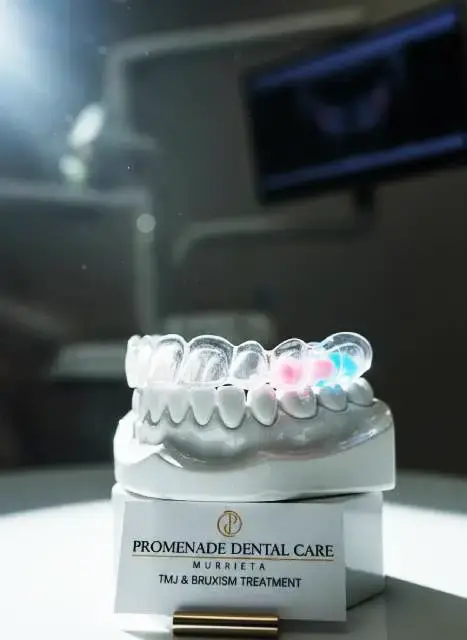
A hard acrylic splint worn at night that separates the teeth, unloads the joint, and lets the muscles rest. It is adjusted to your bite over a few visits. This is the first-line treatment when grinding is the driver, and it is fully reversible.
3Bite correction
When a high spot, a failing restoration, or a worn surface is forcing the jaw off its path, targeted reshaping or replacing that restoration rebalances the load. I do not adjust a bite on a first visit, and I do not adjust one at all unless the exam shows it is loading the joint.
4Restorative rebuilding
Missing, severely worn, or broken teeth remove the support the jaw needs. Rebuilding it with same-day crowns, bridges, or implant restorations addresses the mechanical cause. Because I do that work myself, the diagnosis and the fix happen in the same chair.
5Follow-up
Bites change. Teeth shift, restorations age, and grinding rises and falls with stress. I re-check symptoms, splint fit, and the bite after treatment, and adjust as the system settles rather than calling it done after one visit.
The Most Common Treatment
Custom Nightguards vs. Over-the-Counter Guards
Any pharmacy sells boil-and-bite guards for the price of lunch. They cushion the teeth, and that is all they do. Sometimes they make things worse: an over-the-counter guard is not calibrated to your bite, cannot be adjusted as your symptoms change, and can hold the jaw in a position that increases joint load instead of reducing it. NIDCR's patient guidance is specific that an oral appliance should not be designed to permanently change your bite, and that any device that increases pain should be stopped.
A custom guard from my office is made from a precise scan of your teeth and adjusted chairside so your jaw closes into a position that unloads the joint and lets the muscles release. Follow-up adjustments refine the fit as symptoms evolve. That iterative process is the clinical value a drugstore guard cannot provide.
I will also be straight about the research. A 2017 Cochrane review of occlusal interventions found the trials small and the evidence low-certainty, which is why I never promise a guard will cure anything. What I can tell you from my own chair is that patients whose TMD is driven by grinding usually report less morning soreness within a few weeks of wearing a properly fitted splint, and every one of them stops wearing their teeth down while we figure out the rest.
| Factor | Over-the-counter guard | Custom nightguard |
|---|---|---|
| Fit | Boil-and-bite approximation | Made from a digital scan of your exact teeth |
| Bite position | Uncontrolled | Adjusted chairside so the jaw closes in a position that unloads the joint |
| Adjustability | None after the first fitting | Refined at follow-up visits as symptoms change |
| Durability | Soft material wears through in weeks to months | Hard acrylic lasts years with normal use |
| Risk | Can shift teeth or worsen the bite over time | Reversible by design; does not alter your natural bite |
The guard I make for grinding and clenching is a hybrid: hard acrylic on the outside where your teeth meet, a softer liner on the inside against them. It's $505, and the full breakdown of fit, materials, and how it compares with a drugstore guard is on my custom night guard page.
The Cost Most Offices Miss
Why TMJ Problems Damage Your Teeth
Most TMJ pages stop at the joint and the muscles. What they rarely explain is that an untreated jaw disorder does not just hurt. It slowly takes apart the teeth, and that damage is cumulative and expensive to repair once it has progressed. It is the strongest reason to treat TMD early instead of waiting until the pain is unbearable.
This is where the restorative pipeline begins: untreated TMD leads to worn and cracked teeth, cracked teeth lead to crowns, root canals, and emergency visits, and those procedures cost many times what the nightguard that would have prevented them costs. Treating the jaw early is about protecting the teeth you still have.
The Silent Driver
Bruxism: The Grinding and Clenching Behind Most TMJ Problems
Bruxism, the habit of grinding or clenching your teeth, usually during sleep, is the single most common driver of TMD in this office. Most patients have no idea they do it until the wear shows up on an X-ray or a tooth finally cracks. Sleep clenching is not limited by the reflexes that protect your teeth when you chew, so the muscles can load the joint far harder, and for far longer, than any meal does. The American Dental Association's patient guide to teeth grinding lists the signs worth checking for: flat or chipped tooth edges, a scalloped tongue, and waking up with a sore jaw or a headache.
Bruxism and TMD feed each other. Grinding wears the teeth, worn teeth change the bite, the altered bite loads the joint unevenly, the joint and muscles protest with pain and clicking, the pain raises stress, and stress increases the clenching. Breaking the cycle takes both halves: protection tonight, with a splint that deloads the joint and stops the wear, and mechanics over time, rebuilding worn surfaces and correcting the bite once the joint has settled. Protect first, restore when stable. That sequence is what produces results that last.
The Cost of Waiting
What Happens When TMJ Disorder Goes Untreated
Untreated TMD does not hold steady. It compounds. The Mayo Clinic's TMJ overview describes a disorder that can progress from occasional discomfort to chronic pain, structural joint change, and real limits on chewing and speaking. Nighttime clenching keeps grinding the teeth down, which keeps changing the bite. The altered bite increases joint strain. The overstressed joint degenerates. Muscles that were sore become chronically tight. Headaches that were occasional become daily.
Not every jaw symptom is urgent. A painless click can be watched for years. But if your jaw has been clicking with pain for months, if you wake up most mornings with a headache or a sore jaw, or if you have been told you grind, an evaluation takes one visit and gives you a clear answer.
Money, Plainly
TMJ Treatment Cost and Insurance in Murrieta
TMJ treatment costs vary because the disorder varies. Someone who settles down with a nightguard and jaw exercises has a very different bill from someone who needs a bite rebuilt with crowns. Here is how the cost picture works here.
Promenade Dental Care accepts all PPO plans and is in-network with Delta Dental PPO, Cigna, MetLife, Guardian, Aetna, and United Concordia. A meaningful share of my TMJ patients have no dental insurance. For them the $20 exam removes the barrier to finding out what is wrong, and treatment is sequenced so the most impactful step, usually the nightguard, comes first and the rest is phased as budget allows. There is no production quota in this office driving the recommendation.
Who Wrote This
About Dr. Bao Nguyen, DDS
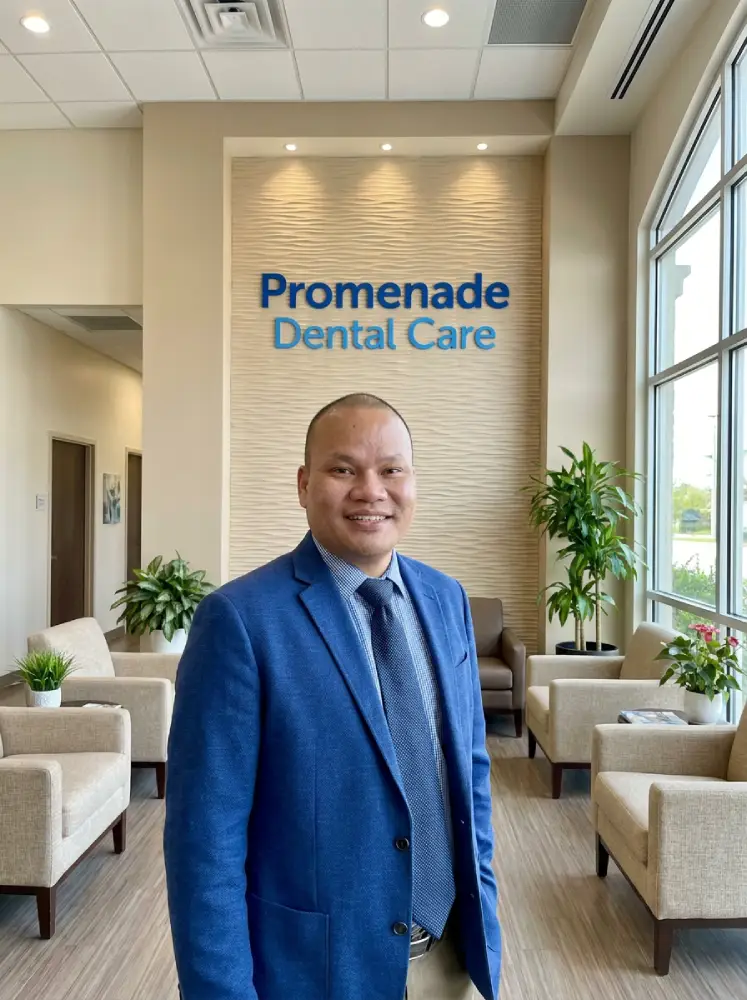
I graduated from the UCLA School of Dentistry and spent ten years as a U.S. Navy dentist, including an AEGD residency at Camp Pendleton and deployments to Kuwait and Iraq. Military dentistry runs on volume and complexity, and it builds a habit of reading occlusion carefully because there is no one to hand the hard cases to. I have practiced in Murrieta since 2010.
TMJ problems are often bite problems, and bite problems need a dentist who does crowns, bridges, implant restorations, and full-mouth rehabilitation every week. I do not just identify the bite issue and refer you across Riverside County. The CBCT scanner, the CEREC same-day crown mill, and the person adjusting your splint are all under one roof on Date Street.
The other thing you get here is restraint. Nightguards and exercises before bite adjustment. Bite adjustment before crowns. Surgery only when nothing else will do. Patients tell me they appreciate a dentist who does not jump to the most expensive answer, and I would rather be that dentist than a busy one.
TMJ Care for the Temecula Valley
Serving Murrieta and Surrounding Communities
Promenade Dental Care sits at 26957 Date St., Suite B4, Murrieta, CA 92563, in the shopping center at the Winchester Road and Murrieta Hot Springs intersection, minutes from the 215 freeway and the French Valley corridor. Patients come in from Murrieta, Temecula, French Valley, Menifee, Wildomar, and Winchester, often driving past larger offices on Clinton Keith and Rancho California Road, because most general practices in this valley do not combine 3D imaging, occlusal analysis, and in-house restorative work in one place. If you are calling about jaw pain, tell the front desk; the phone is monitored after hours for urgent problems.
Related Care
Pages That Connect to This One
Same-Day Crowns
Rebuilding cracked and worn teeth in one visit with CEREC.
Teeth Sensitivity
Why teeth zing with no cavity, and what grinding has to do with it.
From Our Google Reviews
What Patients Say
"I saw doctor Bao Nguyen at Promenade Dental Care on three occasions. In these visits, Dr Nguyen took time to carefully examine my dental concerns and explained very clearly to me what my conditions are, and what treatment options available. He advised me against immediate treatments for conditions that can be improved or maintained with good oral hygiene. He was very gentle with treatments, especially with the local anaesthetic injections. Greatly appreciate his professional care."
"Great dentist. No upselling, easy to make an appointment, and he told me exactly what was going on without trying to scare me into unnecessary work. The pricing was fair and upfront. I finally found a dentist I actually trust."
"I called Dr. Nguyen very early on a Saturday morning with an emergency. He fit me in first thing. I watched him use a computer to create a new crown — it was fascinating. Whether you need routine care or urgent attention, you can trust this man to deliver exceptional service."
Questions I Hear Every Week
TMJ Treatment FAQs
What causes TMJ disorder?
TMJ disorder has several possible causes, and they usually overlap: teeth grinding or clenching (bruxism), a bite that is out of balance, missing teeth that have let the bite shift, worn or broken restorations, arthritis in the joint, a displaced disc, an old injury to the jaw, and stress-related muscle tension. Most patients have more than one contributing factor, which is why I diagnose with a systematic clinical exam and imaging rather than a guess.
Can TMJ cause headaches?
Yes, frequently. TMD is one of the most underdiagnosed causes of chronic tension-type headaches, especially in the temples and behind the eyes. The muscles that move the jaw attach across the side of the skull, and chronic clenching keeps them contracted for hours. Many patients who were treated for "headaches" for years get relief once the jaw disorder is properly diagnosed.
Can TMJ symptoms go away on their own?
Mild symptoms sometimes resolve with self-care: a soft diet, warm compresses, jaw relaxation exercises, and stress management. Persistent or worsening symptoms rarely fix themselves, and the underlying cause keeps doing damage even when the pain eases for a while. If symptoms last more than two weeks, or include locking, severe pain, or limited opening, get evaluated.
Is teeth grinding related to TMJ?
Yes. Bruxism is the single most common driver of TMD. Clenching during sleep loads the joint far harder and longer than chewing does, fatigues the muscles, and wears the teeth down. The worn teeth then change the bite, which stresses the joint further. A custom nightguard breaks that cycle at its most destructive point.
Will a nightguard help TMJ pain?
For TMD driven by grinding, a custom-fitted occlusal splint is the most common first-line treatment and one of the most useful, because it protects the teeth and unloads the joint while being completely reversible. The research evidence is honestly mixed, so I do not promise a cure, but most of my grinding patients report less morning soreness within a few weeks. The key is a device calibrated to your bite, not an over-the-counter guard that can make alignment worse.
Can a bad bite cause TMJ problems?
Yes. When the teeth do not meet properly, because of missing teeth, worn surfaces, old restorations that have changed shape, or natural misalignment, the jaw is pushed off its ideal hinge path every time you close. That repeated deviation overloads the joint and keeps the muscles in compensatory tension. Correcting the bite with a targeted adjustment, a crown, or other restorative work can resolve the TMD at its mechanical source.
How much does TMJ treatment cost?
It depends on the type and severity of the disorder. A diagnostic evaluation starts at $20 for an exam with digital X-rays. A custom night guard is $505, and PPO plans often cover part of it. Bite correction and restorative work are quoted individually. We verify your insurance before treatment, offer CareCredit financing for qualified applicants, and put every number in writing before any work begins.
Do I need surgery for TMJ disorder?
Almost certainly not. NIDCR recommends conservative, reversible treatments first, and most patients improve significantly with a nightguard, self-care, and bite correction alone. I consider a referral to an oral surgeon only when those have had a fair trial and imaging confirms a structural joint problem that cannot be managed any other way.
Can a dentist treat TMJ?
Yes. A general dentist trained in occlusion and TMD diagnoses and treats most temporomandibular disorders, because TMD so often involves bite problems, worn teeth, missing teeth, or grinding, which are the things a restorative dentist evaluates every day. Severe or surgical cases are referred to an oral surgeon or an orofacial pain specialist.
What is the difference between TMJ and TMD?
TMJ is the temporomandibular joint itself, the anatomy. TMD is temporomandibular disorder, the condition affecting the joint, the muscles, or the bite. People commonly say "TMJ" when they mean "TMD." Clinically the terms are distinct, but your dentist knows what you mean either way.
Is TMJ treatment covered by dental insurance?
Coverage varies by plan. Many PPO plans cover nightguards and occlusal splints as therapeutic devices, and exams and diagnostic imaging are usually covered. Promenade Dental Care accepts all PPO plans and verifies your specific benefits before treatment. Patients without insurance get flat written pricing and CareCredit options.
How do I know if I need a TMJ evaluation?
If you have jaw pain, clicking or popping, headaches centered in the temples, ear pain without an infection, trouble chewing, teeth grinding, or a jaw that will not open fully, and especially if you have several of those at once, a TMJ evaluation is worth doing. A $20 exam with digital X-rays at Promenade Dental Care is the fastest way to find out what is causing your symptoms and what to do about them.
Jaw Pain Deserves a Real Diagnosis, Not a Guess
Start with a $20 exam, digital X-rays, and a proper look at your joint, muscles, and bite. You will leave knowing what is causing the pain and what it takes to fix it, in writing, with no pressure.
(951) 412-0127 Request an Appointment OnlinePromenade Dental Care · Dr. Bao Nguyen, DDS
26957 Date St., Suite B4, Murrieta, CA 92563
Serving Murrieta, Temecula, French Valley, Menifee, Wildomar & Winchester