
Missing a Tooth in Murrieta?
Murrieta Dental Bridges: The Honest Way to Close a Gap in Your Smile
Bridge, implant, or partial denture? I walk you through the decision the straight way. Gums checked first, every option priced in writing, no pressure to choose while you’re still in the chair.
Nobody researches dental bridges for fun. A tooth cracked, an extraction finally happened, or a gap you’ve been chewing around has started to move your bite. My job at that point is to lay out every path that fits your mouth, then let you pick the one you want.

Start Here
The Real Question Is Not What a Bridge Is. It Is What to Do About This Gap.
The decision in front of you has three or four possible answers, and a bridge is only one of them. At my office on Date Street, in the Aldi center near Winchester Road and Murrieta Hot Springs Road, I open every missing-tooth consultation with the whole picture. Sometimes a bridge is the right call. Sometimes a dental implant is worth the extra months. And sometimes the smartest first move is treating the gums and deciding once they’ve healed.
Patients drive here from French Valley, Winchester, and the Clinton Keith corridor, past a row of corporate offices, mostly to get that kind of answer. Plenty of good national guides explain how a bridge works. What none of them can tell you is whether your neighboring teeth, your gum health, and your budget point toward one. That’s what a $20 exam with digital X-rays is for, and it’s what the rest of this page is about.
- Procedure
- Fixed dental bridge: traditional, implant-supported, Maryland, or cantilever
- Visits
- Two visits about two to three weeks apart for a traditional bridge
- Typical lifespan
- 10 to 15 years, longer with healthy gums and daily cleaning under the replacement tooth
- Alternatives
- Dental implant, implant-supported bridge, or a removable partial denture
- Insurance
- Major restorative category. Most PPO plans pay about 50% after the deductible
- First step
- $20 exam with digital X-rays, a periodontal check, and a written quote for every option
- Dentist
- Dr. Bao Nguyen, DDS. UCLA School of Dentistry, ten years as a U.S. Navy dentist, practicing in Murrieta since 2010
Missing tooth replacement in Murrieta, in one visit of clarity: a complete exam, digital X-rays, a periodontal check, and a written quote for every option that fits your mouth. Bridge, implant, implant-supported bridge, or removable partial. Nobody will ask you to commit that day.
The Big Decision
Dental Bridge vs. Implant: The Comparison Most Offices Will Not Give You Straight
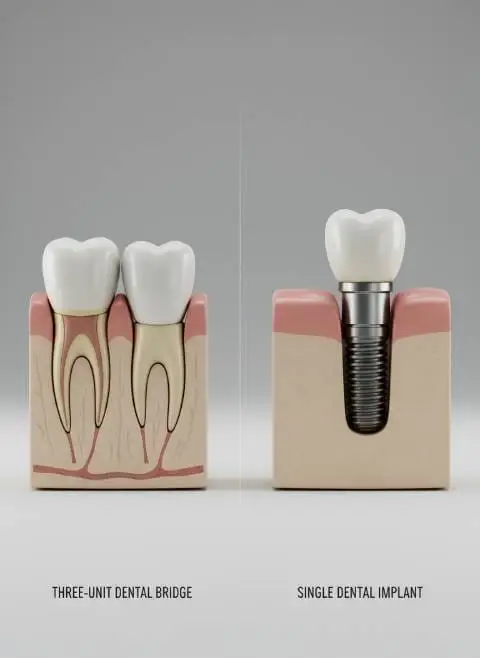
About half the people who call me about bridges ask the same thing within five minutes: should I just get an implant instead? Fair question. A bridge borrows strength from the teeth on either side of the gap. Those neighbors get reshaped and crowned, and the replacement tooth hangs between them as one connected piece. An implant leaves the neighbors alone. A titanium post takes over the job of the missing root, the bone fuses to it, and a crown goes on top. Both give you back a tooth you can chew on. They trade off differently in seven places.
| Factor | Dental Bridge | Dental Implant |
|---|---|---|
| Timeline | Faster. Two visits over two to three weeks, with a temporary in place from day one | Three to six months while the bone fuses to the post, longer if grafting comes first |
| Cost up front | Lower. Smaller initial fee, and insurance usually contributes more | Higher up front, though often cheaper per year of service across its lifespan |
| Neighboring teeth | Both teeth beside the gap get reshaped and crowned, healthy or not | Untouched. The post stands on its own in the bone |
| Bone under the gap | Nothing stimulates the ridge, so it keeps shrinking underneath | Preserved. The post acts like a root, and chewing force keeps the bone active |
| Typical lifespan | 10 to 15 years, longer with excellent hygiene and healthy gums | 25 years or more. The post often outlives the crown on top of it |
| Surgery | None. That matters when surgery is off the table for health reasons | A minor in-office procedure under local anesthetic |
| PPO coverage | Usually covered as major restorative work by most PPO plans | Coverage varies widely, and some plans exclude implants outright |
That table starts the conversation. It doesn’t finish it. Your exam tells us which column your teeth, your bone, and your calendar actually vote for. If you want the long version first, with what happens to the bone under each one and how the costs compare over fifteen years instead of on day one, I wrote it out on a separate page: dental bridge vs implant.
The Shortcut I Use in the Chair
If the teeth flanking your gap are already crowned, heavily filled, or headed for crowns anyway, the bridge is usually the smarter buy. You’re not sacrificing healthy enamel, and one restoration solves two problems at once. The crown work moves fast here, since we mill CEREC same-day crowns in the office.
If those neighbors are pristine, grinding them down to posts is a real cost that never shows up on the invoice. In that case I’ll tell you the implant is the better tooth, even though the bridge would have been the quicker appointment for both of us. Enamel doesn’t grow back, and I would rather you spend the extra months than the extra teeth.
If a Bridge Is the Answer
Which Type of Dental Bridge Fits Your Situation?
There are four kinds. Cleveland Clinic’s overview of dental bridges covers the textbook definitions if you want them. You don’t need to memorize the dictionary, though. You need to recognize which situation is yours.
Neighbors already need crowns
Traditional Bridge
The workhorse. If the teeth beside your gap are cracked, crowned, or carrying large aging fillings, crowning them to anchor a bridge costs almost nothing you weren’t going to spend anyway. Two visits, no surgery, finished inside a month. This is the scenario where a bridge beats an implant on value, and I’ll tell you when you’re in it.
Several teeth in a row missing
Implant-Supported Bridge
A traditional bridge stretched across three or four missing teeth overloads its anchors and fails early. Two implants carrying the span spread chewing force the way roots were designed to, keep the bone underneath alive, and leave every natural tooth alone. It takes months instead of weeks. For long gaps it’s the restoration still working fifteen years later.
Certain front teeth
Maryland Bridge
A conservative fix for a single missing front tooth in a light-bite zone. Thin porcelain or metal wings bond to the backs of the adjacent teeth with almost no drilling. The trade-off is strength, since a Maryland bridge isn’t built for molars or heavy bites. I use them where the bite is gentle and say no where it isn’t.
Limited situations only
Cantilever Bridge
Anchored on one side only, for gaps with a single usable neighbor. It works in specific low-force spots, but the lever mechanics load real stress onto that lone anchor, so I recommend it sparingly. If a cantilever is the only bridge that fits your gap, that’s usually a sign an implant deserves a hard look instead.
The Step Corporate Offices Skip
Why I Check Your Gums Before We Ever Talk Porcelain
Here’s something most patients have never been told. Bridges rarely fail because the porcelain breaks. They fail because the foundation under them, the gums and bone holding the anchor teeth, quietly gives out.
A Bridge Is Only as Strong as the Teeth Carrying It
A three-unit bridge asks two teeth to do the chewing work of three. Bolt that load onto an anchor sitting in inflamed tissue or softened bone and everything feels fine for a year or two. Then the anchor loosens, decay creeps in under its crown, and the patient who arrived missing one tooth is now missing three.
Gum disease is more common than people assume. The National Institute of Dental and Craniofacial Research reports that a large share of American adults over 30 have some form of it, and most have no idea, because it’s usually painless until it’s advanced. If your gums bleed when you floss, Mayo Clinic’s periodontitis overview is worth ten minutes of your time before your appointment.
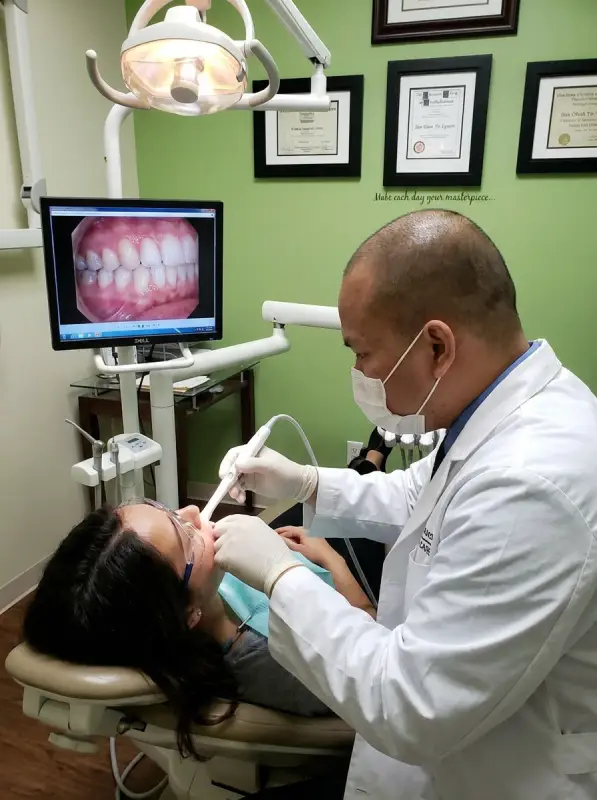
So every bridge candidate here gets a full evaluation of gum health, bone support, and anchor stability before I touch a tooth. If I find active disease, we treat it first. Our laser gum disease treatment usually takes a few weeks. Then I build the bridge on a foundation that will hold it. That occasionally pushes a bridge back by a month, and I’ve never once regretted the delay. I’ve regretted the bridges I inherited from offices that skipped it.
That same foundation is what you protect after I cement it. Plaque packs in under the replacement tooth where regular floss can't follow, and that's where anchor teeth quietly start to decay. I put the take-home version on one page, living with a dental bridge, which covers what the first week feels like, when you can chew normally, how to clean under the bridge, and which symptoms mean you should call me instead of waiting.
Meet Your Murrieta Dentist
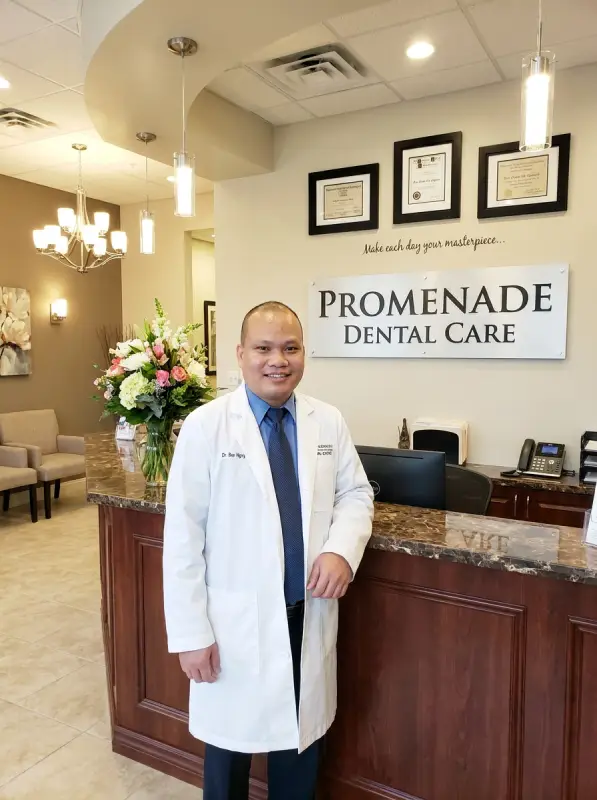
Dr. Bao Nguyen, DDS. Trained on the Hard Cases.
Restorative dentistry rewards volume, and bridges in particular reward a dentist who understands gums and bone as well as porcelain. I earned my DDS at the UCLA School of Dentistry, then spent ten years as a U.S. Navy dentist, including an Advanced Education in General Dentistry residency at Naval Hospital Camp Pendleton and deployments to Kuwait and Iraq. Military dentistry is a trial by caseload: complex extractions, full-mouth reconstruction, and trauma a private-practice dentist might see a handful of times a year. I brought that home to Murrieta and have practiced here since 2010.
For bridge patients that shows up in two ways. The crown preparation, the periodontal workup, the surgical placement when an implant is the better answer, and the grafting when bone needs rebuilding all happen under this roof, so nobody gets referred out mid-plan. And my treatment planning starts with the gum-and-bone evaluation that a lot of offices treat as a formality, because I’ve spent years repairing bridges built over failing foundations. If dental fear has kept you out of a chair, our care for anxious patients, sedation included, exists for exactly that.
The Cost of Waiting
What a Missing Tooth Quietly Does While You Put Off the Decision
I hear the same three reasons every week. It’s a back tooth, nobody sees it. I’m waiting for the insurance year to reset. It doesn’t hurt. Every one of them sounds reasonable, and every one of them gets more expensive the longer it runs, because the damage from a missing tooth is silent and structural. The CDC’s data on adult oral health tells the larger story: tooth loss compounds, and the people who act early keep more of their teeth for life.
Bone loss
Jawbone is use-it-or-lose-it. Without a root to stimulate it, the ridge under the gap starts shrinking within the first year. The longer the wait, the more likely grafting is required before an implant is even possible.
Drifting teeth
The neighbors tilt into the empty space and the opposing tooth grows down toward it. A one-tooth problem turns into a crowding and alignment problem.
Bite changes
As teeth migrate, your bite stops meeting the way it was built to. Uneven force chips and wears the teeth still doing the work, and jaw-joint soreness often follows.
Harder chewing
You compensate without noticing. Chewing on one side, skipping steak, swallowing food half-processed. The overworked side wears faster and digestion takes the hit too.
If a tooth just broke or came out and you’re reading this in pain: our Murrieta emergency dental line is monitored around the clock, with same-day appointments whenever the schedule allows.
The Difference
Why Patients Choose Promenade Dental Care for Murrieta Dental Bridges
Honest recommendations
When an implant serves you better than a bridge, you hear it from me. I own this practice, so the plan answers to your mouth and not to a production target somebody emails me on Monday.
No-pressure consultations
You leave your exam with options, a written quote, and zero obligation. Some patients decide in a week. Some take a year. The gap will still be here, and so will we, without a follow-up sales call.
Every option on the table
Bridge, implant, implant-supported bridge, or a removable partial denture. Each path laid out with its real timeline, trade-offs, and numbers, usually with your own X-rays up on the screen.
Transparent pricing
Costs in writing before treatment begins. A $20 exam with digital X-rays, $95 ultrasonic cleanings, cash-friendly rates, and CareCredit financing for qualified patients.
Gentle, pain-free care
Thorough numbing, a calm pace, sedation for anxious patients, and a small team that patients name personally in reviews going back a decade. Patients notice it inside the first twenty minutes.
Built for the uninsured too
A large share of my patients pay cash, and the pricing was built with them in mind. Nobody here meets a financing desk before they meet the dentist.
Money, Plainly
How Much Does a Dental Bridge Cost in Murrieta?
The honest answer is that it depends on four things, and any office quoting a number before examining you is guessing. Here’s what moves the price, so the quote you do get makes sense when you read it.
How many teeth are missing
A three-unit bridge, meaning one missing tooth and two anchors, is the baseline. Each additional missing tooth adds a unit, and longer spans sometimes force a switch to an implant-supported design. That changes the math, and it changes the lifespan along with it.
Materials
Full porcelain and zirconia cost more than porcelain-fused-to-metal, and they earn it in front-of-mouth esthetics and durability. For a molar bridge nobody sees, the less expensive material is often the rational pick, and I’ll say so rather than upsell you on a tooth that lives behind your cheek.
Your insurance
Bridges fall under major restorative coverage, which most PPO plans pay at roughly half after the deductible. We accept all PPO dental plans and verify your exact benefit before you commit, so the estimate you sign is the bill you get.
Whether implants are involved
An implant-supported bridge costs more up front because it includes surgical placement, plus grafting if bone has already been lost. Spread across its lifespan it’s frequently the cheaper restoration per year of service. I’ll put both totals side by side and let the numbers argue for themselves.
The first step costs $20: a complete exam with digital X-rays, a periodontal check, and a written, no-pressure quote for every option that fits your mouth. Call (951) 412-0127 and the front desk will get you scheduled, often within the week.
What Patients Say
Real Reviews from Murrieta and Temecula Valley Patients
Dr. Nguyen is an experienced and professional dentist! I needed 3 crowns and he was able to get insurance approval before my insurance ran out at the end of the year. Then, after approval he was able to get teeth prepped for the crowns and he made the crowns in the office!! I was in and out in less than 4 hours. My teeth look and feel great! Office staff is also professional! Highly recommend!
Diana T. · Google Review
Dr. Nguyen is a wonderful dentist. Very friendly and compassionate. Very skilled. I had a root canal done in less than 2 hours with the crown completed the same day. WOW!!!
Google Review · Same-day restorative patient
Gone are the days of dreading dental appointments! With Dr. Nguyen, you can rest assured you’re in kind, gentle, dental care hands. His state-of-the-art equipment and technology makes the entire experience efficient, comfortable, and dare I say, enjoyable. I’ve been going to Dr. Nguyen for years. I called him very early this Saturday morning with an emergency tooth repair and he fit me in first thing. I watched him use a computer to create a new tooth. It was fascinating to watch! Whether you’re in need of routine dental care, or require urgent attention, you can trust Dr. Nguyen to deliver exceptional service.
Jenny S. · Google Review
My name is Debby and I have been a patient of Dr. Nguyen's now for over a decade at Promenade Dental. Doctor and staff, which includes Edith, are incredibly wonderful, so kind, caring and compassionate, yet professional. They go above and beyond to care for their patients which includes painless treatments in a calming atmosphere. Dr. Nguyen met me at his office for an emergency visit during the height of COVID and I will forever be thankful for it! I refer family and friends who have a pleasant experience also.
Debby · Google Review · Patient for 10+ years
You can also read patients on Yelp and Wellness.com.
Where You’ll Find Us
Serving Murrieta, French Valley and the Temecula Valley
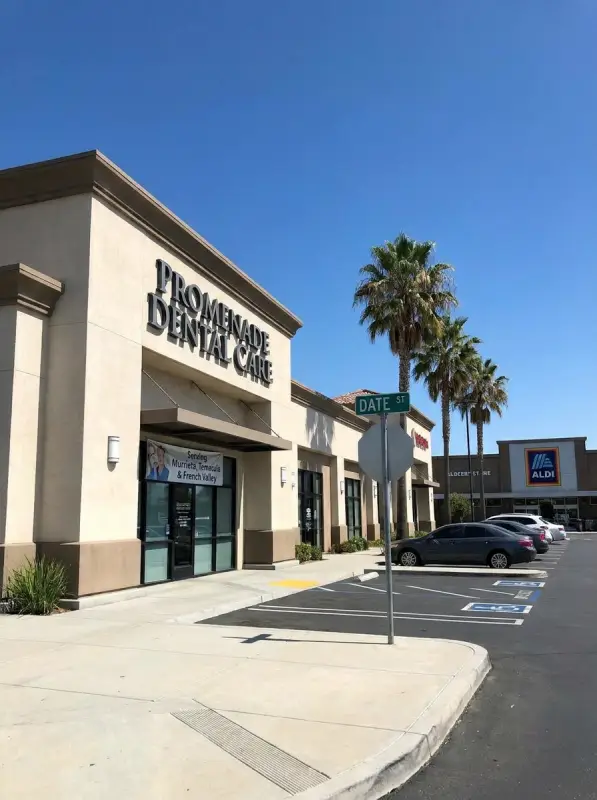
Promenade Dental Care is at 26957 Date St., Suite B4, Murrieta, CA 92563, in the Aldi shopping center just off the Winchester Road and Murrieta Hot Springs Road intersection, a couple of minutes from the 215. If you live in French Valley, we may be the closest full-service restorative office to your front door.
| Mon | 9:00 AM – 5:00 PM |
| Tue | 9:00 AM – 5:00 PM |
| Wed | 9:00 AM – 3:00 PM |
| Thu | 9:00 AM – 5:00 PM |
| Fri | 9:00 AM – 3:00 PM |
| Sat | By appointment & emergencies |
| Sun | Closed |
Questions We Hear Every Week
Murrieta Dental Bridges: FAQs
How long does a dental bridge last?
A well-made dental bridge lasts 10 to 15 years, and with healthy gums plenty of them go longer. Some of the bridges I placed in Murrieta back in 2010 are still doing their job. Porcelain is almost never what gives out first. The anchor teeth and the gum tissue underneath are. That’s why I check periodontal health before I prepare a single tooth, and why your cleaning visits after cementation matter as much as the lab work that built it.
Dental bridge vs. dental implant: which is better?
Neither one wins every case. A dental bridge borrows support from the teeth on both sides of the gap, so it’s finished in two visits and costs less up front. A dental implant replaces the root itself with a titanium post, leaves the neighboring teeth untouched, keeps the jawbone stimulated, and often lasts 25 years or more. If the teeth beside your gap already need crowns, I’ll usually point you to the bridge. If they’re healthy, I lean implant.
How much does a dental bridge cost in Murrieta?
Four things set the price: how many teeth are missing, the material, whether implants are involved, and what your plan pays. Most PPO plans treat a bridge as major restorative work and cover roughly half after the deductible. I won’t quote a number over the phone, because a guess helps nobody. A $20 exam with digital X-rays at Promenade Dental Care gets you a written estimate for every option that fits your mouth, with no obligation to start.
Is a bridge better than a partial denture?
For one to three teeth in a row, usually yes. A bridge is cemented in place, so it never shifts while you eat or talk and it never spends the night in a glass. A removable partial costs less at the start, but it feels bulkier and its clasps put pressure on the teeth holding it. Your budget, the condition of the remaining teeth, and the size of the gap decide it, and that’s what the exam sorts out.
Can a bridge replace two missing teeth in a row?
Yes. Two missing teeth side by side call for a four-unit bridge: two crowned anchors carrying two replacement teeth between them. The longer span puts more chewing force on each anchor, so the bone around those teeth has to be solid before I’ll do it. Past two teeth in a row, an implant-supported design holds up better over the years, and I’ll show you why on your own X-rays.
Does dental insurance cover a dental bridge?
Most PPO plans classify a bridge as major restorative care and pay about 50 percent after your deductible, up to the annual maximum. Promenade Dental Care accepts all PPO dental plans and is in network with Delta Dental PPO, Cigna, MetLife, Guardian, Aetna, and United Concordia. My front desk verifies your specific benefit before treatment starts, so the written estimate you sign is the number you actually pay. With no insurance, you get plain cash pricing and CareCredit financing.
Does getting a dental bridge hurt?
No. The anchor teeth are fully numb before I start, and most patients tell me it felt about like getting a filling. Mild sensitivity for a few days afterward is normal and fades on its own. If the real question behind this one is dental fear, and it often is, say so when you call (951) 412-0127. We take care of anxious patients every week, and sedation is available.
How long does the dental bridge process take?
A traditional bridge takes two visits, two to three weeks apart. At the first appointment I prepare the anchor teeth and take impressions, then fit a temporary bridge you wear while the lab builds the final one. The second visit is the fitting, the bite adjustment, and cementation. An implant-supported bridge runs three to six months, because the implants have to fuse to the bone before they can carry a load.
Can I get a bridge if I have gum disease?
Not until the disease is treated and stable. Cementing a bridge onto anchor teeth sitting in active periodontal infection is one of the most common reasons bridges fail inside a few years. The order never changes here: evaluate the gums and bone, treat the infection, confirm it has held, then restore. It adds a few weeks at the front end and saves you years of trouble later.
What is a Maryland bridge, and am I a candidate?
A Maryland bridge replaces one missing front tooth by bonding thin wings to the backs of the two neighboring teeth, with almost no drilling of healthy enamel. It’s the most conservative fixed option and it looks excellent in a light-bite zone. It isn’t strong enough for molars or for a heavy grinder. At your exam I check your bite and the adjacent teeth and tell you plainly whether it will hold in your case.
When is a cantilever bridge used?
A cantilever bridge is anchored on one side only, which makes it an option when a gap has just one usable neighboring tooth. It works in a few low-force spots in the mouth. The one-sided design loads extra stress onto that single anchor, so I recommend it sparingly. When a cantilever is the only bridge that fits your gap, that’s usually the moment to look seriously at an implant instead.
How do I clean under a dental bridge?
With a tool that gets underneath the replacement tooth, because regular floss can’t. My hygienist shows you how at the fitting appointment. The four tools that work, and the one mistake people make with a water flosser, are on my page on cleaning under a dental bridge.
How do I know if a dental bridge is failing?
A bridge that rocks when you bite or an anchor tooth that starts aching is worth a call to (951) 412-0127, not a wait-and-see. Caught early, a failing margin is often a repair instead of a new bridge. I sort the rest of the symptoms into normal, watch it, and call me on the bridge warning signs section of my aftercare page.
Can an old bridge be replaced with an implant?
Often, yes. When a bridge finally fails, a lot of patients would rather move to an implant or an implant-supported bridge than rebuild the same restoration on the same tired anchor teeth. The deciding factor is how much bone is left under the old bridge, and grafting can rebuild volume when it’s short. One exam with imaging gives you a definitive answer the same day.
Ready to Decide, With All the Facts in Front of You?
Start with a $20 exam and digital X-rays. You’ll leave knowing whether a bridge, an implant, or something else entirely is the right answer for your mouth. In writing, with no pressure to decide on the spot.
(951) 412-0127 Request an Appointment Online