
Murrieta Dental Veneers: What They Fix, What They Cost, How Long They Last
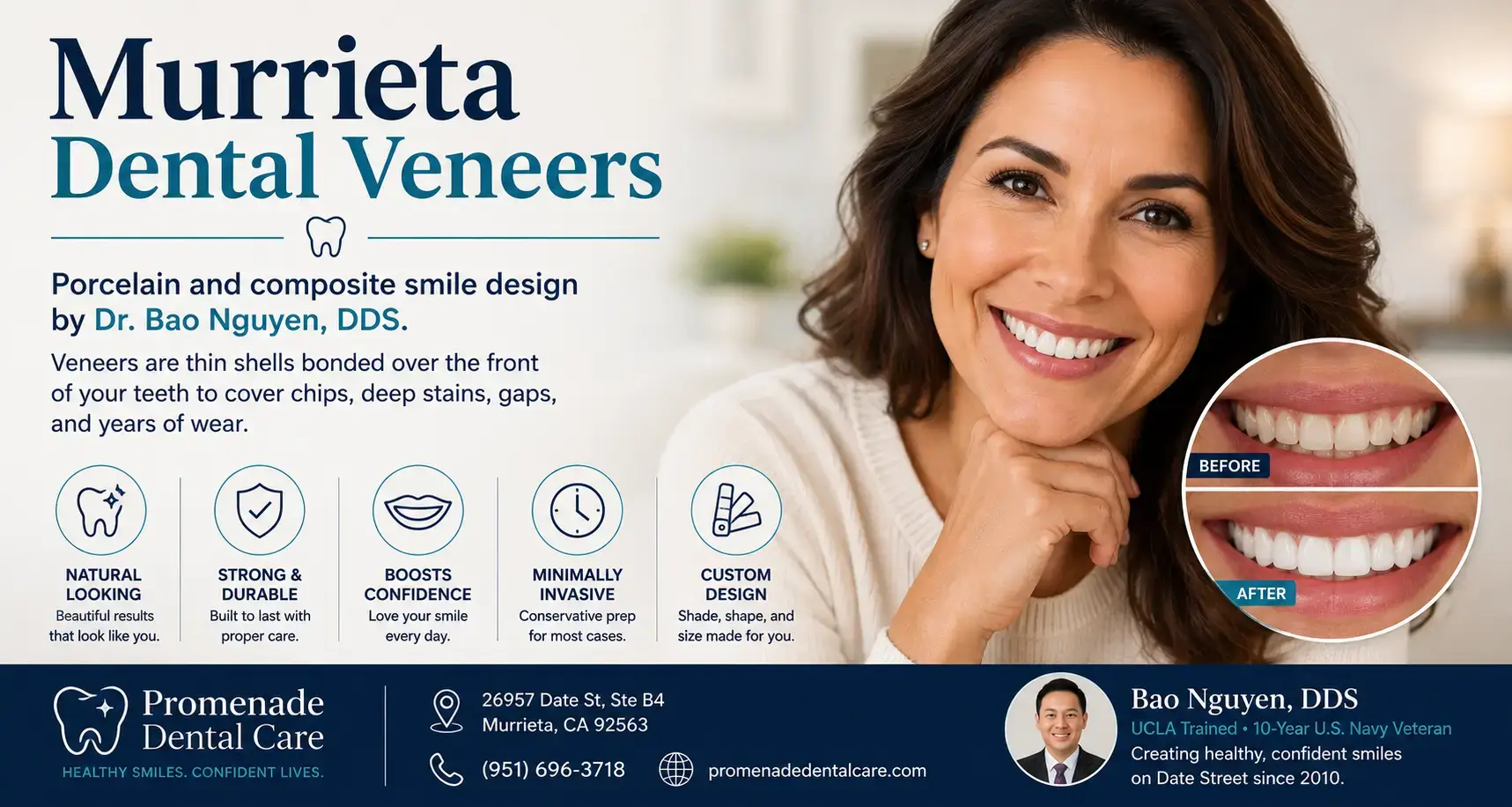
Porcelain and composite smile design by Dr. Bao Nguyen, DDS
Veneers are thin shells bonded over the front of your teeth to cover chips, deep stains, gaps, and years of wear. I'll tell you straight whether you actually need them, show you the estimate before I pick up a handpiece, and take off as little enamel as the case allows.
What Are Dental Veneers?
A dental veneer is a thin shell of porcelain or composite resin, roughly 0.3 to 0.7 millimeters thick, bonded permanently to the front surface of a tooth to change its color, shape, or length. It covers only the part people see when you talk and laugh. The tooth underneath stays where it is. The ADA's MouthHealthy guide makes the distinction that matters most: a veneer covers only the front surface, while a crown wraps the whole tooth. That is why I reach for a veneer when the problem is cosmetic and the tooth is otherwise sound.
Most people who sit down and ask me about veneers describe one of five things. Tetracycline banding that no amount of whitening has touched. A chip on a front tooth that bonding keeps popping off of. A gap they have disliked since they were fifteen. Front teeth that have ground down short and flat. Or one dark tooth after an old root canal that no longer matches its neighbors. Veneers solve those problems well. They do not solve every problem, and I will say so when they are the wrong tool.
Every veneer case here starts with a conversation, not a treatment plan. Some people who walk in asking for veneers walk out with a quote for teeth bonding instead. Some are genuinely ideal candidates. Either way you hear the real answer, which is the reason patients from Murrieta, Temecula, Menifee, and Winchester keep sending me their families.
I had an excellent experience at this dental office from start to finish. The staff was incredibly welcoming and made me feel comfortable right away, which really helped ease my nerves. The dentist was professional, thorough, and took the time to explain everything clearly. They made sure I understood my treatment options and answered all my questions without rushing.
What Veneers Can Fix, and What They Can't
This is the question I get asked earliest and answer most often, so it belongs near the top in plain language. A veneer changes the surface you see. It does not change the health of what sits underneath it, and it does not move a tooth. That one distinction settles most cases before cost or material ever come up.
Problems a veneer solves well
Problems a veneer is the wrong tool for
Why this matters more than it sounds. A veneer bonded over a problem does not fix the problem, it hides it while it keeps going. Decay under a beautiful shell is still decay, and you will pay twice: once for the veneer, once for the work that has to happen underneath it. The American Academy of Periodontology is blunt about the foundation part, and so am I: healthy gums are what every cosmetic result sits on. Anything on the second list gets handled first, in the right order, and you will see that sequence written out before you commit to anything. Gum disease is the one that stalls the most veneer plans in my chair, so I wrote the order out in full, with a mirror check you can do at home tonight, on my page about getting veneers when your gums aren't healthy.
Who Veneers Work Well For — and Who Should Wait
Candidacy is not a judgment call I make from a photo. It comes out of a $20 comprehensive exam with digital X-rays, where I look at how much enamel you have left, whether your gums are healthy, how your bite comes together, and what you actually want to change. Those four things get weighed together. A gorgeous veneer bonded to a tooth with active decay under it is a waste of your money.
- Enamel
- How much you have left, and whether there is enough of it for a bond to hold for years rather than months.
- Gums
- Whether the tissue is healthy and stable, because the margin of every veneer sits against it.
- Bite
- How your teeth come together, since edge-to-edge contact and grinding are what break ceramic.
- Goal
- What you actually want changed, in your words, before I decide how many teeth that takes.
Two people with nearly identical teeth often reach opposite decisions here, and both can be right. What separates them is usually budget, how much the appearance actually bothers them day to day, and how they feel about a change that cannot be undone. Those are yours to weigh. My job is to make sure the clinical picture you are weighing them against is accurate, and that anything on the second list above is handled first. You will get the sequence explained, not a sales pitch.
One warning worth repeating. In 2024 the ADA issued a public advisory about "veneer techs" advertising on social media. Preparing a tooth for a veneer is irreversible and it is the practice of dentistry. If you are comparing prices you found on Instagram, check the license first at the Dental Board of California. I would rather you go to another licensed dentist than to someone who is not one.
Porcelain vs. Composite Veneers
This is not purely a budget decision. It depends on what the tooth needs and how long you want the result to hold up. I place both. The British Dental Journal's clinical review of porcelain laminate veneers describes them as a conservative way to change appearance or contour without going to a full crown, which is exactly how I use them. Composite has a real place too, particularly on younger patients and single teeth.
| Feature | Porcelain Veneers | Composite Veneers |
|---|---|---|
| Material | Lab-made feldspathic or lithium disilicate ceramic | Resin composite sculpted chairside |
| Visits | Two — prep, then bonding | One, same day |
| Typical lifespan | 10 to 20 years | 5 to 7 years |
| Stain resistance | Excellent; the glazed surface sheds coffee and wine | Moderate; picks up color over time |
| Look | Translucent, reads like natural enamel | Good, slightly more opaque |
| Enamel removed | 0.3 to 0.7 mm | Minimal to none in many cases |
| If it chips | Usually replaced | Often patched or rebuilt in the chair |
| Best suited to | Multi-tooth smile design, heavy discoloration, long-term investment | One or two teeth, younger patients, lower upfront cost |
If you cannot decide, here is what I often suggest: do one composite veneer on the tooth that bothers you most. You live with the change for a while at a fraction of the commitment, and then you know whether a full porcelain set is worth it to you. For patients whose teeth are already well positioned with enough enamel to bond to, we can also talk about minimal-prep and prepless veneers, which take off almost nothing.
How I Place Veneers, Start to Finish
Two appointments, roughly two weeks apart. Patients driving up from Temecula or over from Menifee tell me the short timeline is half the reason they picked this office.
- Exam and smile design. At your $20 comprehensive exam I check the teeth and gums, take digital X-rays and photos, and ask what specifically bothers you. We go through shade and proportion together. If veneers are not the right answer, this is where you find out, and it costs you twenty dollars to find out.
- Conservative preparation. Under local anesthetic I remove 0.3 to 0.7 mm of enamel from the front of each treated tooth — thinner than a contact lens. If you deal with dental anxiety, ask about nitrous oxide beforehand. Temporaries go on the same visit so you never leave with prepped teeth showing.
- Impression and lab work. A digital scan or precise impression captures each prepared tooth and how your bite closes. A ceramist then builds every shell by hand to the shade, translucency, and contour we approved. That takes 10 to 14 days.
- Try-in, then bonding. I seat each veneer to check fit, color, and how it meets the opposing teeth. You look in the mirror and tell me what you think before anything is permanent. Once you approve, each one is bonded with light-cured resin, trimmed, and polished into the adjacent teeth.
- Follow-up. You come back in one to two weeks so I can confirm the bite is even and the gum tissue has settled against the margins. You leave with care instructions and, if you grind, a plan for a nightguard.
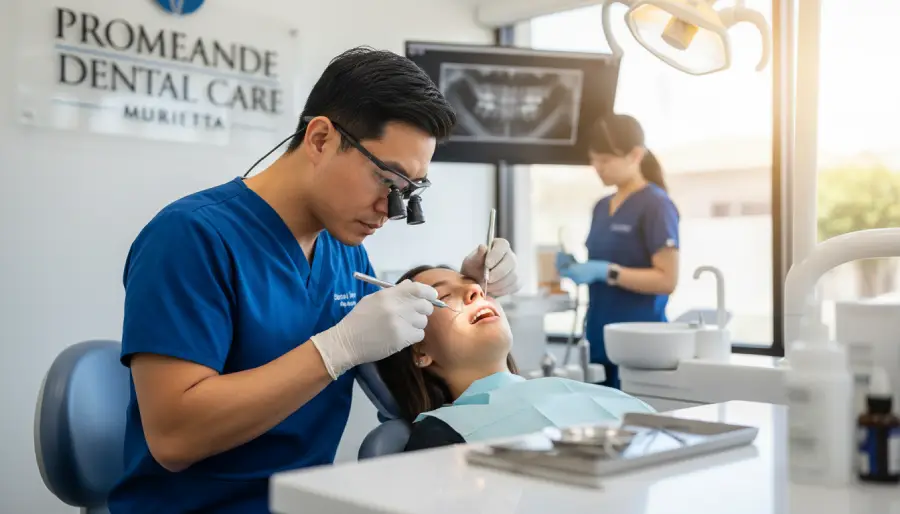
Great dentist. No upselling, easy to make an appointment, and he told me exactly what was going on without trying to scare me into unnecessary work. The pricing was fair and upfront. I finally found a dentist I actually trust.
Veneers Compared to Crowns, Bonding, and Implants
The right treatment depends on how much of the tooth has to change, what is actually wrong with it, and how long you need the result to last. My rule is simple: the most conservative option that gets you the result you asked for is the one I recommend.
Veneer or crown?
A veneer covers the front. A crown covers everything. Crowns belong on teeth that are structurally compromised — large decay, real fractures, teeth weakened after root canal treatment. If the tooth is sound and the complaint is cosmetic, a veneer keeps far more of your own tooth.
Veneer or bonding?
Bonding goes on in one visit, costs less, and removes little to no enamel. For a small chip or a minor shape change it is usually the better call. It stains sooner and lasts 5 to 7 years against 10 to 20 for porcelain.
Veneer or implant?
A veneer needs a tooth to bond to. If the tooth is already gone, the choice is between a fixed bridge and an implant crown, not a veneer. People occasionally combine them — an implant crown to replace the missing tooth, veneers on the neighbors so the whole front line matches.
Veneer or nothing at all?
Sometimes the honest answer is that the tooth is sound, the wear is minor, and nothing needs doing yet. Preparation is permanent, so there is no reason to start a replacement cycle before you want to be in one. If that is where you are, I will say so, and the visit still costs twenty dollars.
Aftercare and How Long Veneers Really Last
The first question almost everyone asks on bonding day is when they can eat normally again. The answer is better than people expect. The resin reaches full strength within minutes of light curing, so the veneers are functional before you walk out the door, and most patients are back to a normal diet within a day or two. Mild sensitivity to hot and cold for the first few days is expected and settles on its own.
Veneers do not need special products. They need consistency. Brush twice a day with a soft brush and a non-abrasive fluoride toothpaste, clean between the teeth daily along the veneer margins where plaque likes to sit, and retire your front teeth from tool duty. No tearing open packaging, no chewing ice, no cracking pistachio shells.

If you grind at night, budget for a custom nightguard in the same breath as the veneers. Grinding is the single biggest threat to how long they last. Left alone it will fracture even the strongest ceramic within a few years, and a well-fitted nightguard costs a fraction of one replacement veneer. That is not an upsell, it is arithmetic.
Keeping them bright: porcelain resists stain far better than your own enamel, but the bonding resin at the margins can pick up color over the years. A $95 ultrasonic cleaning every six months keeps both the veneers and the natural teeth around them looking like they belong together.
Not Sure Whether You Need Veneers?
That is exactly what the $20 exam is for. Bring your questions, get digital X-rays and a straight answer, and decide afterward.
What Veneers Cost in Murrieta
Veneer pricing moves with the material, the number of teeth, and how complicated the case is. I do not publish a single headline number, because whatever number I picked would be wrong for half the people reading this page. What you get instead is an itemized written estimate at the consultation, before any work starts, broken out by preparation, lab fabrication, and bonding, so you can see where each dollar goes. No fees appear later that were not on that sheet.
The tooth count is the number people guess wrong most often. Plenty of patients come in assuming they need ten, and a lot of them don't. Where your smile line sits and which teeth actually show when you talk decide it, and I explain how I choose between four, six, eight, and ten on how many veneers you actually need.
I also see a few patients every year who went to Tijuana or overseas for a cheaper set and came home with margins that trap stain or a bite that keeps chipping the edges. That isn't a lecture. Some of those cases need a small repair and some need the whole set redone, and repairing veneers done abroad covers how I tell the difference and what each one costs.
Most dental plans classify veneers as cosmetic and will not pay for them. There is one common exception: when a veneer is restoring a tooth that is fractured or structurally damaged, partial coverage sometimes applies under the restorative benefit. My front office verifies your specific plan and gives you the out-of-pocket figure in plain numbers before you commit. Healthcare.gov's dental coverage overview is a decent primer on what dental plans generally do and do not include. For patients who would rather spread it out, we accept CareCredit, which runs promotional interest-free periods for qualified applicants.
People almost always want a ballpark before they book, so here is the honest framing. The ranges published online for veneers are wide enough to be close to useless for planning, because they average single-tooth repairs together with full smile designs across markets whose costs have nothing to do with each other. Porcelain sits well above composite, and that is about as much as a national figure can honestly tell you. Your number comes from the material, the tooth count, and the complexity of your case, which is exactly what the itemized sheet breaks out.
One way people save real money here: veneer the upper front teeth that show. It costs less than a full arch and, done right, nobody can tell where the veneers stop.
Very knowledgeable and good prices. Does only what is necessary. Does not just look for stuff to charge for. Got an appointment quickly when I thought it was an emergency. My favorite dentist ever!!
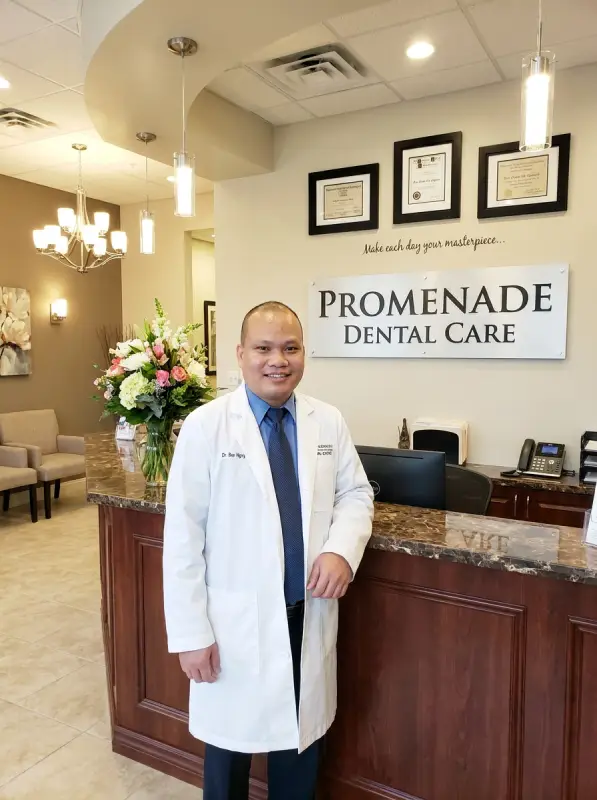
Dr. Bao Nguyen, DDS
I earned my Doctor of Dental Surgery degree at the UCLA School of Dentistry, then spent ten years as a United States Navy dentist. That included an Advanced Education in General Dentistry residency at Naval Hospital Camp Pendleton and deployments to Kuwait and Iraq. You learn to work carefully and explain yourself clearly in places where a patient has no second opinion to go get. That habit stuck.
I opened Promenade Dental Care in 2010 and have run it the same way since: tell people the truth, do only the work that is clinically justified, charge a fair price for it. Cosmetic cases are held to that standard too. I am not going to sell you a veneer on a tooth that bonding would fix, or eight veneers when four accomplish what you asked for.
More than 230 five-star Google reviews from patients across Murrieta, Temecula, Menifee, French Valley, Winchester, and Wildomar are the fairest summary of how that works out in practice. If you are planning something broader than a couple of teeth, the cosmetic dentistry page covers full smile design.
I have been a patient of Dr. Nguyen's for over a decade. The doctor and staff are incredibly wonderful — so kind, caring, and compassionate, yet completely professional. They go above and beyond to care for their patients.
He kept me informed, he was accommodating, and he actually listens. If you need competent, quality dental care performed using state-of-the-art equipment, all at a reasonable price, this is the place.
Veneers for the Temecula Valley
The office sits on the Date Street corridor between Clinton Keith Road and the I-215, about fifteen minutes from most of Temecula and Menifee. Patients come in for veneers from Murrieta, Temecula, Menifee, French Valley, Winchester, Wildomar, Lake Elsinore, Canyon Lake, and Fallbrook. If a veneer has already fractured or debonded, call rather than wait — my emergency dental line handles same-day and next-day appointments, and an intact veneer that comes off can often be re-bonded if you save it.
- Practice
- Promenade Dental Care — Dr. Bao Nguyen, DDS
- Address
- 26957 Date St, Suite B4, Murrieta, CA 92563
- Phone
- (951) 412-0127
- Consultation
- $20 comprehensive exam with digital X-rays; itemized veneer estimate before treatment
- Payment
- All PPO plans accepted • CareCredit financing • Cash, Visa, Mastercard, Amex, Discover
- Languages
- English, Español, Tiếng Việt
Office hours
| Monday | 9:00 AM – 5:00 PM |
| Tuesday | 9:00 AM – 5:00 PM |
| Wednesday | 9:00 AM – 3:00 PM |
| Thursday | 9:00 AM – 5:00 PM |
| Friday | 9:00 AM – 3:00 PM |
| Saturday | By appointment & emergencies |
| Sunday | Closed |
Murrieta Dental Veneer FAQs
What are dental veneers made of?
Porcelain veneers are ceramic, usually feldspathic porcelain or lithium disilicate, fabricated in a dental laboratory to a shade and contour approved in advance. Composite veneers are a resin material sculpted directly onto the tooth in a single visit. Porcelain is more translucent, resists staining better, and lasts longer. Composite costs less up front and is easier to repair in the chair. Both are bonded to the front surface of the tooth with a light-cured adhesive resin, and neither one replaces the tooth underneath.
How much do veneers cost in Murrieta?
There is no single price, because cost depends on the material, how many teeth are treated, and how complex the case is. At Promenade Dental Care you get an itemized written estimate at your consultation, before any work begins, broken out by preparation, lab fabrication, and bonding. Nothing is added later. Most dental insurance treats veneers as cosmetic and does not cover them, so CareCredit financing with promotional interest-free periods is available for patients who prefer monthly payments. The $20 comprehensive exam is what gets you an accurate number for your own mouth.
How long do porcelain veneers last?
Porcelain veneers typically last 10 to 20 years. What decides where you land in that range is grinding, home hygiene, diet, and whether you keep six-month cleanings. Dr. Bao uses feldspathic and lithium disilicate ceramics, which resist staining and chipping far better than the veneer materials used a generation ago. Composite veneers are a different story and usually need replacing at 5 to 7 years.
Do veneers ruin your natural teeth?
No, but the preparation is permanent, and that distinction matters. Placing a traditional veneer means removing 0.3 to 0.7 millimeters of enamel from the front of the tooth, roughly a fingernail's thickness. That enamel does not grow back, so the tooth will always need something covering it. The vast majority of your natural tooth structure stays intact, which is why a veneer is more conservative than a crown. Minimal-prep and no-prep options remove even less, and Dr. Bao checks whether you qualify for one at your exam.
Can I get veneers without shaving down my teeth?
Sometimes, yes. Prepless and minimal-prep veneers remove little to no enamel and work well when your teeth are already in good position and there is enough enamel to bond to. They are not right for everyone. Teeth that are rotated, crowded, or already large tend to look bulky when a veneer is added without any preparation, because the shell has nowhere to go but outward. Dr. Bao determines at the comprehensive exam whether a prepless approach will actually look natural on your teeth, and will tell you if it will not.
Does getting veneers hurt?
Most patients report little to no discomfort. The preparation appointment is done under local anesthesia, and the bonding appointment usually needs no anesthetic at all. Sensitivity to hot and cold for a few days afterward is normal and resolves on its own. Promenade Dental Care offers nitrous oxide (laughing gas) for patients with dental anxiety or a strong gag reflex, and it is better to arrange that when you book than to decide in the chair.
How many visits does getting veneers take?
Porcelain veneers take two appointments roughly two weeks apart. The first is preparation, an impression or digital scan, and temporaries. The second is try-in and bonding, where you approve the fit and color before anything becomes permanent. A short follow-up one to two weeks later confirms the bite is even and the gum tissue has settled at the margins. Composite veneers are usually finished in a single visit, because the material is sculpted directly on the tooth with no laboratory step. Either path starts with one $20 comprehensive exam.
Should I choose porcelain or composite veneers?
Choose porcelain if you are treating several front teeth, dealing with heavy discoloration, or want the result to last 10 to 20 years. Choose composite if you are fixing one or two teeth, want it finished in a single visit, or need a lower upfront cost and can accept a 5 to 7 year lifespan with more staining over time. Porcelain is lab-fabricated ceramic with better translucency; composite is resin sculpted directly on the tooth. A practical middle path is one composite veneer first, so you can live with the change before committing to a porcelain set.
How many veneers do I need?
It depends on how many teeth show when you smile and which ones bother you. Many smile makeover cases involve the six to eight upper front teeth that dominate a smile. Plenty of patients only need one or two. Dr. Bao plans around your smile line and facial proportions rather than selling a fixed package, so you pay for the teeth that actually need treatment and no more.
Can veneers fix crooked teeth?
Veneers can correct the appearance of mildly crooked, overlapping, or unevenly spaced front teeth without moving them at all, and for many patients that is the entire answer. There is a limit. Masking a badly rotated tooth with porcelain means either an unnaturally thick veneer or removing more enamel than the tooth can spare, so teeth that sit far enough out of position are better straightened first, and Dr. Bao will refer you to a specialist rather than force a cosmetic fix onto a case that needs tooth movement. Once the teeth are where they should be, veneers remain an option if you still want them.
Does dental insurance cover veneers?
Usually not. Most dental plans classify veneers as a cosmetic procedure and exclude them. The exception is when a veneer restores a tooth that is fractured or structurally damaged, in which case partial coverage may apply under your plan's restorative benefit. Promenade Dental Care accepts all PPO plans and is in-network with Delta Dental PPO, Cigna, MetLife, Guardian, Aetna, and United Concordia. The front office verifies your specific benefits and gives you the out-of-pocket figure before treatment starts.
Can you whiten veneers?
No. Porcelain does not respond to bleaching agents, so a veneer's shade is locked in when it is fabricated. This is why sequence matters: if you want a brighter overall smile, brighten your natural teeth first and let the shade stabilize, then have the ceramist match the veneers to that final color. Doing it the other way around leaves you with veneers that no longer match the teeth beside them. Routine six-month cleanings keep the veneers looking the way they did on day one.
What should I do if a veneer chips or falls off?
Save the piece, stop chewing on that side, and call (951) 412-0127 for a same-day or next-day appointment. A small chip can often be polished smooth in the chair. A veneer that has debonded intact can frequently be cleaned and re-bonded, which is far cheaper than a replacement, but only if you keep it and come in promptly. Leaving a prepared tooth uncovered exposes it to sensitivity and decay, so this counts as a dental emergency rather than something to schedule next month.
Can I get veneers if I grind my teeth?
Often yes, but only with a nightguard as part of the plan. Grinding is the leading cause of veneer failure and will fracture even lithium disilicate ceramic given enough time. Dr. Bao evaluates wear patterns and your bite at the exam, treats the grinding first where needed, and includes a custom nightguard in the treatment plan. Patients who grind heavily and refuse a nightguard are told candidly that veneers are a poor investment for them.
Are the "veneer techs" advertising on social media safe?
No. In 2024 the American Dental Association issued a public advisory warning about unlicensed "veneer technicians" promoting themselves on social media. Preparing a tooth for a veneer permanently alters tooth structure and is the practice of dentistry, which in California requires a license from the Dental Board of California. Work done by an unlicensed provider can cause irreversible damage, and no licensed dentist is obligated to warranty it. You can verify any provider's license for free on the Dental Board of California website before you book.
Your Best Smile Starts With One Honest Exam
Call Promenade Dental Care and book a $20 veneer consultation with Dr. Bao Nguyen. Clear pricing, conservative treatment, and a result that still looks like you.