
Dentist Recommended Electric Toothbrush Guide
What the research actually supports, what the marketing invents, and how to pick a brush you will still be using in a year.
Patients ask me about this almost every week, usually holding a phone with four tabs open. The short version: the evidence favors powered brushes by a modest margin, two features do nearly all of that work, and the $250 model is not meaningfully cleaner than the $40 one. Here is how I sort it out in the chair.
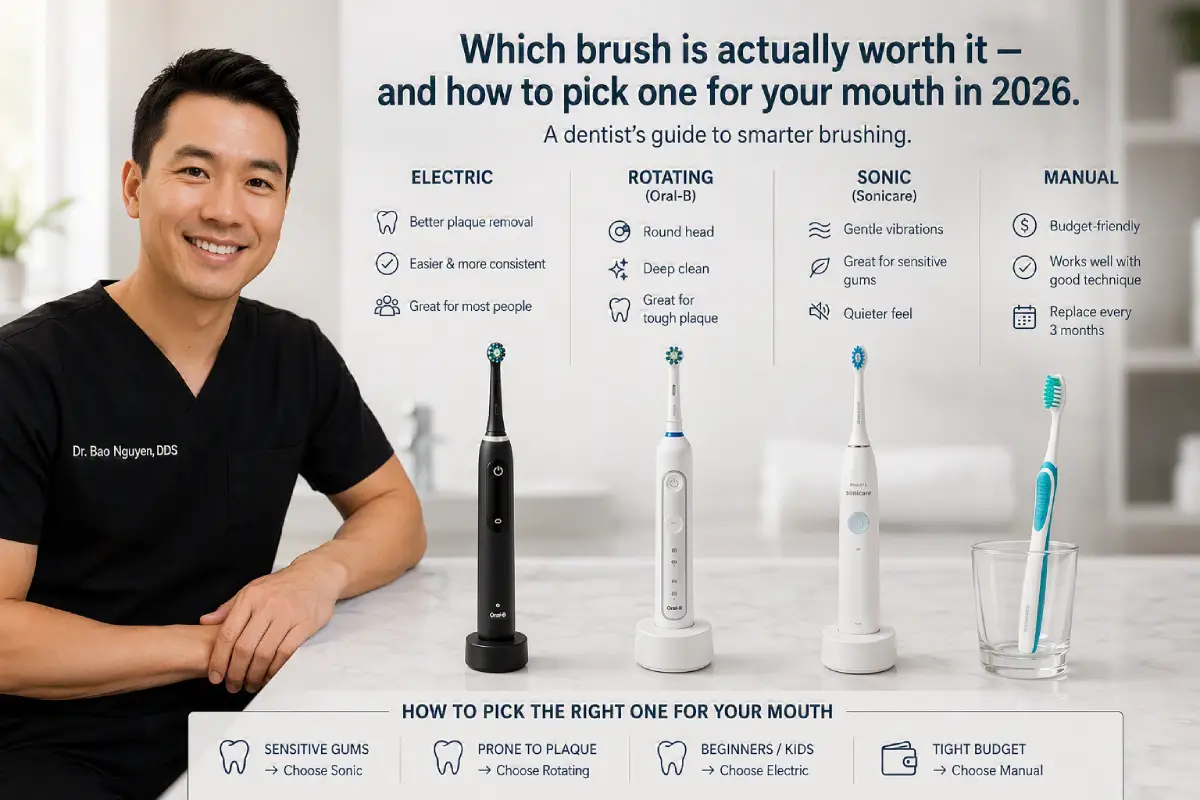
The Short Version
- Does it matter?
- Modestly, yes. Pooled trial data show powered brushes leave about 21% less plaque and 11% less gum inflammation after three months than manual brushing.
- What to look for
- A two-minute timer and a working pressure sensor. Everything else is comfort.
- What to skip
- Bluetooth apps, brushing maps, and whitening or intense modes. No strong evidence they clean better.
- Sensible budget
- Roughly $40 to $80 for the handle. Spend the difference on replacement heads.
- Oral-B or Sonicare
- Both work. Pick the sensation you will tolerate twice a day for two full minutes.
- Replace heads
- Every three months, or sooner once the bristles splay.
If you take nothing else from this page: the brush you use correctly beats the brush that reviews well. I would rather see a patient with a $30 handle and a fresh head than a flagship with bristles worn flat.
Electric vs Manual Toothbrush: Does It Actually Matter?
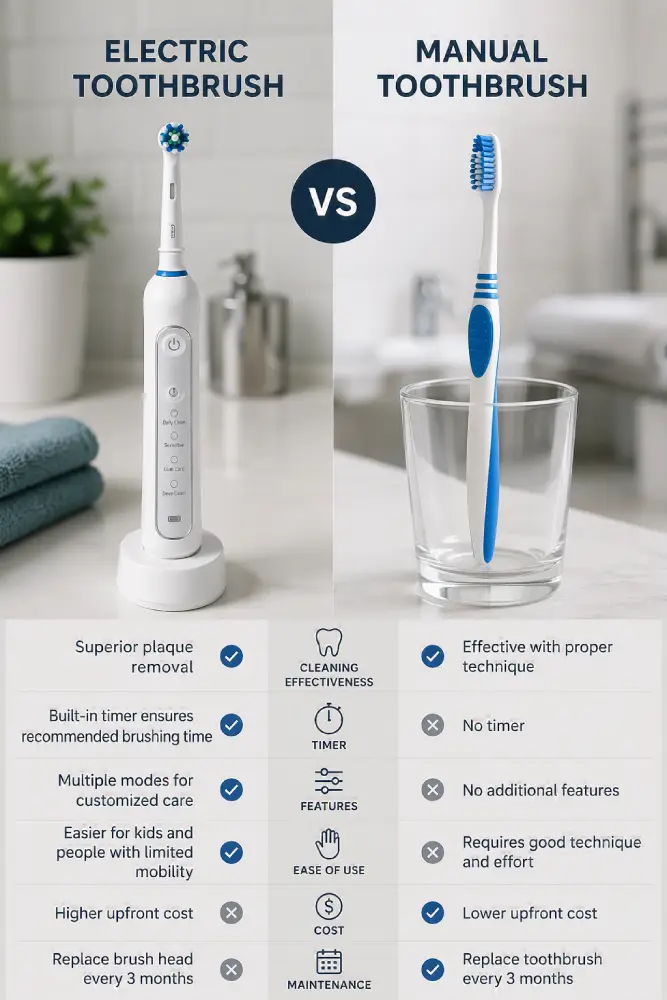
This is the first question patients ask, and the honest answer is that a manual brush used well will keep your mouth healthy. But the research does lean toward powered brushes. The 2014 Cochrane review pooled 56 trials and 5,068 participants and found powered brushes reduced plaque by about 11% at one to three months and about 21% beyond three months, with gum inflammation down about 6% and 11% over the same two windows.
I want to be straight about what those numbers mean, because most articles quote them without the footnote. The Cochrane authors themselves wrote that the clinical importance of the difference remains unclear. An 11% drop in a gingivitis index is real, but it is not the gap between healthy gums and gum disease. It is a nudge, not a rescue.
Why the nudge shows up anyway
In my chair the benefit comes from two unglamorous places. The timer means people brush for two minutes instead of the forty-five seconds they think is two minutes. And the moving head supplies the technique, so a rushed or heavy-handed brusher still gets a fairly even clean.
If you already brush thoroughly for two full minutes with a soft brush and a light hand, a manual brush is genuinely fine. The powered brush is most useful for the person who does not do that, which is most people.
Sonic vs Oscillating: What Is Actually Different
Nearly every brush worth buying uses one of two actions. Oscillating-rotating brushes, which is the Oral-B approach, use a small round head that rotates one way and then the other against each tooth. Sonic brushes, the Philips Sonicare approach, use a longer head that vibrates at high frequency and drives fluid between the teeth.
A separate Cochrane review compared powered types head to head across 17 trials and 1,369 participants and found the rotation-oscillation action reduced plaque and gingivitis somewhat more than a side-to-side action in the short term. The authors again flagged that the difference was small and its clinical importance unclear. So: a mild edge on paper for oscillating-rotating, not enough to override which one you will actually pick up every night.
| Consideration | Oscillating-rotating (Oral-B) | Sonic (Sonicare) |
|---|---|---|
| How it feels | A distinct scrub, tooth by tooth | A smooth, high-frequency buzz |
| Head shape | Small and round, easy to steer around crowded or rotated teeth | Longer and flatter, covers more surface per pass |
| Noise | Louder, more mechanical | Quieter, more of a hum |
| Pooled trial edge | Small short-term advantage over side-to-side action | No demonstrated advantage over rotation-oscillation |
| Best suited to | People who want to feel the clean, and heavy-handed brushers who need a firm sensor | People who find Oral-B too aggressive, or who dislike the noise |
Both brands have models carrying the ADA Seal of Acceptance, which means the manufacturer submitted evidence of safety and effectiveness at removing plaque and reducing gingivitis, and the ADA Council on Scientific Affairs reviewed it. Worth knowing that the Seal program is voluntary, so a brush without one is not automatically worse. It simply has not been through that review.
The Features That Actually Matter
You do not need to pay for every function on the box. After years of watching which features change what I see at the next cleaning, here is the split.
Worth paying for
Which Electric Toothbrush Is Worth Your Money
I do not sell brushes, take affiliate commissions, or accept anything from a manufacturer, so I am not going to hand you a model number that will be discontinued by spring. I would rather give you the three shapes the decision actually takes.
The sensible default
An entry-level to mid-range Oral-B with a genuine pressure sensor and a two-minute timer. Usually somewhere around $40 to $70. This is what I suggest to most adults, and the one I would buy for my own family.
If Oral-B feels too rough
A mid-range Sonicare. Same two features, gentler sensation, quieter. If you have tried an oscillating brush and disliked it, this is the switch to make rather than giving up on powered brushing.
If you know you brush hard
Step up to a model whose sensor is known to be sensitive and visible — one that lights up or cuts power rather than just beeping. This is the one situation where paying more buys something clinically useful.
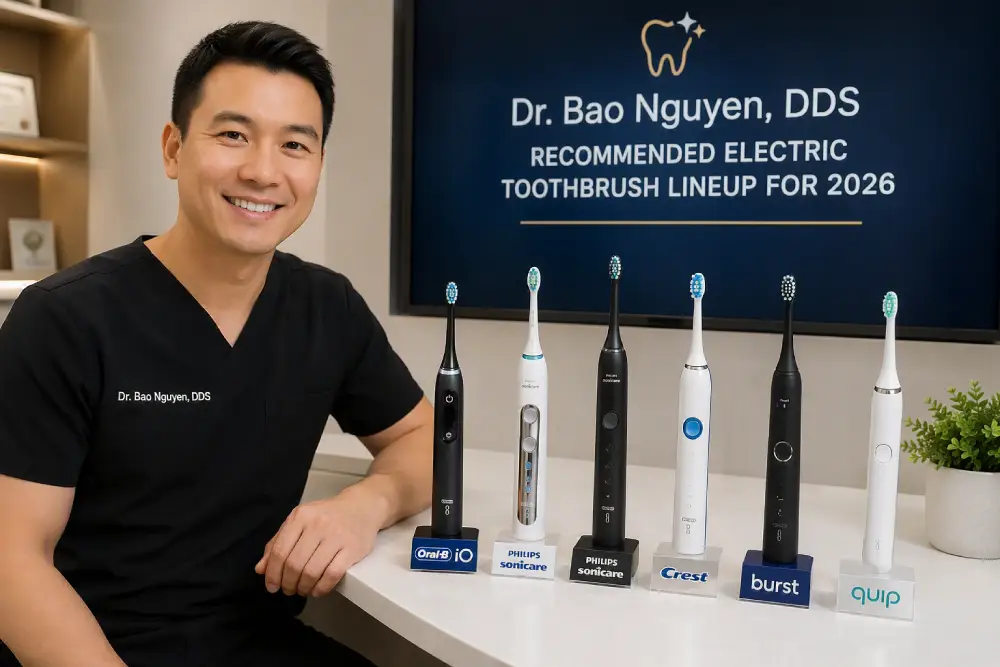
The head matters more than the handle
Whatever handle you pick, the head is the part that touches your teeth, and it wears out. A worn head on a $250 handle cleans worse than a fresh head on a $30 one. Before you buy, look up what a three-pack of replacement heads costs and whether you can find them at a normal store.
Best Electric Toothbrush for Sensitive Teeth
If cold water makes you wince, the feature that matters is not power. It is a responsive pressure sensor paired with a true low-intensity sensitive mode. A brush that pushes back when you lean on it will retrain a heavy hand within a couple of weeks, and that alone resolves a fair amount of everyday sensitivity.
But a toothbrush cannot fix the cause. Worn enamel, an exposed root surface, a cracked filling, and gum disease all produce the same cold-air twinge and all need different treatment. If your teeth have become newly sensitive, that is a reason to be examined, not a reason to buy a different brush. Receding gums in particular do not grow back, so catching the cause early genuinely changes the outcome.
One more thing worth saying plainly: a powered brush is maintenance, not repair. If you already have a cavity, it needs a filling; if decay has reached the nerve, it needs a root canal. Good brushing keeps small problems from becoming big ones. It does not reverse the ones already there. If something hurts right now, call the emergency line rather than waiting to see whether a new brush helps.
How to Use an Electric Toothbrush Properly
Most people brush a powered toothbrush as though it were a manual one, which throws away half the benefit. Four corrections cover almost everyone.
1Angle, then rest
Tip the bristles about 45 degrees toward the gum line. Set the head on one tooth, let it sit for two or three seconds, then move to the next. You are placing the brush, not sweeping it.
2Stop scrubbing
No back-and-forth motion and no pressure. If the sensor triggers or the motor changes pitch, you are pressing far too hard. Light enough that the bristles barely flare is correct.
3Work all four quadrants
Thirty seconds each: upper right, upper left, lower right, lower left. Cover outer surfaces, inner surfaces, and chewing surfaces. The inner surfaces of the lower front teeth are the spot nearly everyone misses.
4Spit, do not rinse
Spit out the excess and leave the fluoride on your teeth. Rinsing with water immediately afterward washes away the ingredient you just paid for.
What Murrieta Patients Say
230+ five-star Google reviews have come in since 2010. Three of them, unedited:
“Promenade Dental Care is fantastic! The staff is warm, professional, and genuinely cares about your comfort. The office is spotless and modern, and appointments always run on time. Dr. Nguyen explains everything clearly and makes sure you feel at ease. You leave with a bright smile and real confidence in your care.”
Sabrina C. · Google Review
“They are very professional and very honest; they don’t scam you like other places. The office is very clean, with a very comfortable waiting area. Doctor Nguyen is very efficient and does an excellent job. After going to several dentists in this area, I finally found a professional dentist like my Bay Area dentist. Absolutely THE BEST DENTIST in this area!”
Fangiegto · Google Review
“It’s safe to say that Dr. Nguyen is the best dentist I’ve ever visited in my life. He’s compassionate, patient, and works like an artist. I will highly recommend. Great dentist!”
Marguerite B. · Google Review
Electric Toothbrush FAQ
Is an electric toothbrush really better than a manual one?
Modestly, yes. The 2014 Cochrane review pooled 56 randomized trials covering 5,068 people and found powered brushes reduced plaque by about 11% at one to three months and about 21% beyond three months, with gum inflammation down about 6% and 11% over those same periods. The review authors noted the clinical importance of that difference is still unclear. In practice most of the gain comes from the built-in timer and the consistent motion, which quietly fix common brushing habits. A manual brush used well for two full minutes remains perfectly effective.
What is the best electric toothbrush for sensitive teeth?
Look for a responsive pressure sensor and a genuine low-intensity sensitive mode rather than raw power, and always use soft bristles. A brush that pushes back when you lean on it will retrain a heavy hand within a couple of weeks. If your teeth have become newly sensitive, though, see a dentist to find the cause. Worn enamel, an exposed root, a cracked filling, and gum disease all cause the same twinge and a toothbrush cannot fix any of them.
Oral-B or Sonicare, which is better?
Both clean effectively and both have models carrying the ADA Seal of Acceptance. Oral-B uses a small round oscillating-rotating head that gives a scrubbing sensation; Sonicare uses a longer sonic head with a smoother, quieter buzz. A Cochrane comparison of powered types found a small short-term advantage for the rotation-oscillation action over side-to-side brushing, but called the difference small and its clinical importance unclear. Pick the sensation you will actually tolerate twice a day for two full minutes.
Which electric toothbrush features are worth paying extra for?
Prioritize a two-minute timer, a working pressure sensor, roughly two weeks of battery life, soft bristles, and replacement heads that are cheap and easy to find. Bluetooth apps, on-screen brushing maps, and extra whitening or intense modes are pleasant extras without strong evidence that they clean teeth better, so they rarely justify a large jump in price.
How often should I replace an electric toothbrush head?
Every three months, or sooner if the bristles look frayed or splayed. Worn bristles clean poorly and can irritate the gums. Replacing on schedule matters far more than which premium model you own, so factor the ongoing cost of heads into the decision before you buy the handle.
How do I use an electric toothbrush properly?
Angle the bristles about 45 degrees toward the gum line, rest the head on one tooth for two or three seconds, then move to the next. Do not scrub and do not press; the motor supplies the motion. Spend about thirty seconds in each quarter of the mouth, covering outer, inner, and chewing surfaces, and pay attention to the inner surfaces of the lower front teeth, which almost everyone misses. Spit out the excess toothpaste afterward rather than rinsing, so the fluoride stays on your teeth.
Not Sure Your Brushing Is Doing the Job?
A $20 exam with digital X-rays shows exactly where plaque and gum trouble are hiding, and I will show you the technique that gets the most out of whatever brush you already own. No insurance required, no pressure to say yes to anything afterward.
(951) 412-0127 Call Promenade Dental Care26957 Date St, Suite B4, Murrieta, CA 92563
Mon, Tue, Thu 9:00 AM – 5:00 PM · Wed, Fri 9:00 AM – 3:00 PM · Sat by appointment & emergencies · Sun closed