
Gum Disease Treatment · Murrieta, CA
Gum Disease Treatment in Murrieta: From Bleeding Gums to Laser Therapy
Straight answers on whether you need treatment, what it involves, what it costs, and when you don't need it at all.
I'm Dr. Bao Nguyen. This page is the hub for everything on our site about gums. Each section answers one question patients ask me in the chair, in the order they usually ask it.
1 · The Short Answer
Do I Need Gum Disease Treatment?
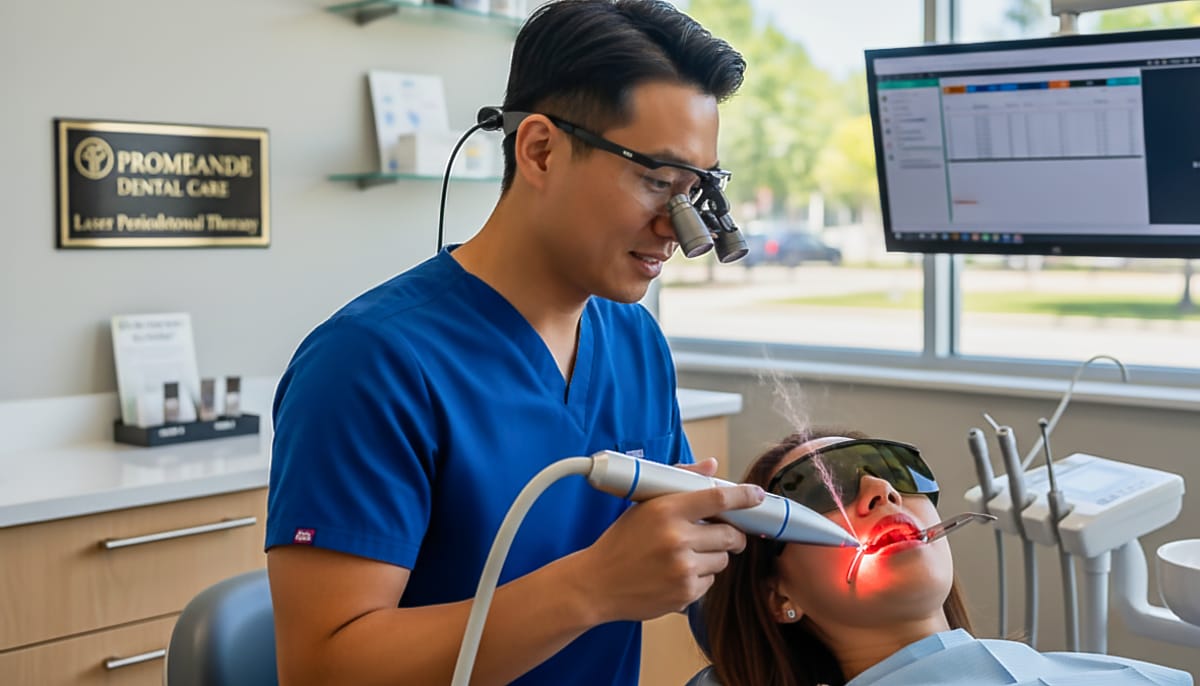
You need gum disease treatment if your gums measure 4 millimeters or deeper and your X-rays show bone loss. For most people that means a full mouth deep cleaning ($320 here), a re-check four to six weeks later, and cleanings every three months after that. If your gums bleed but the bone is intact, a regular cleaning and better home care usually reverse it, and you don't need a deep cleaning at all.
- Condition
- Periodontal (gum) disease: gingivitis is the reversible first stage; periodontitis means bone has started to go.
- How common
- About 42% of U.S. adults 30 and older have periodontitis, according to the CDC.
- First visit
- $20 new-patient exam with full-mouth digital X-rays and gum measurements.
- Main treatment
- Full mouth deep cleaning (scaling and root planing), $320 for all four quadrants.
- If pockets stay deep
- Laser gum therapy, $240 first treatment, $80 per follow-up; periodontist referral for surgery.
- Long term
- $95 maintenance cleaning every three months. Cash fees; insured fees depend on your plan.
2 · What It Is
What Is Gum Disease Treatment, in Plain English?
Gum disease is an infection in the narrow space between your gum and your tooth. Plaque collects there, hardens into tartar on the root, and the bacteria in it inflame the gum. Over time the infection works its way down the root and dissolves the bone that holds the tooth. The space it leaves behind is called a pocket, and the deeper the pocket, the more bone is gone.
Treatment has one job: clean the infection off the root surfaces so the gum can heal and tighten back against the tooth. That's what a deep cleaning, or scaling and root planing, does. I numb the area, remove the tartar from the roots below the gumline with an ultrasonic scaler and hand instruments, and smooth the roots so plaque has a harder time sticking. The Cleveland Clinic's overview describes the same procedure.
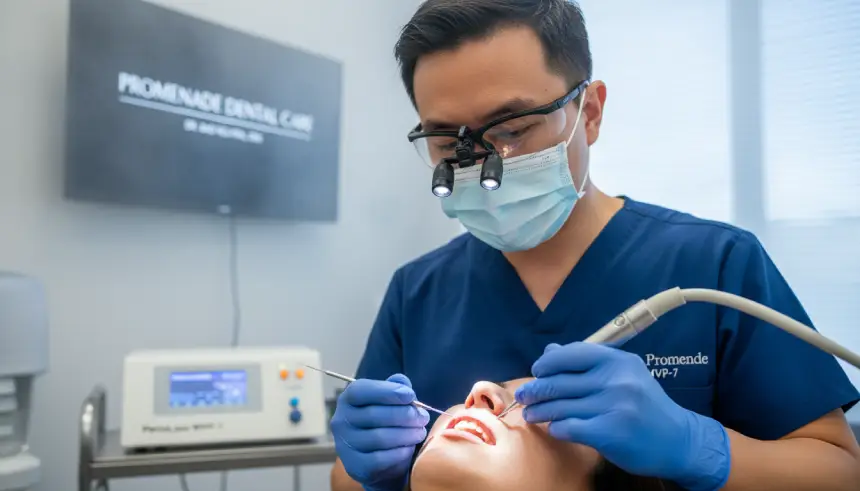
Laser therapy is a second tool for pockets that don't respond. The laser fiber goes into the pocket and removes the inflamed lining and some of the bacteria, which helps the gum reattach. It doesn't remove tartar, so it never replaces the deep cleaning. Maintenance cleanings every three months are the third piece, because the bacteria come back.
What treatment can't do is regrow bone that's already gone. It stops the damage. That's why catching it early matters so much.
3 · Who Needs It
What Symptoms Mean I Might Need Treatment?
Gum disease is usually painless, which is why most of my patients with it came in for something else. These are the signs I ask about:
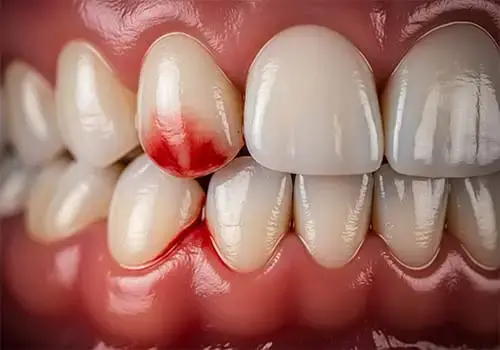
Some people are at higher risk even without symptoms. Smoking and vaping, diabetes, a parent who lost teeth to gum disease, going more than a year or two without a cleaning, and crowded teeth that are hard to clean all raise the odds. The American Academy of Periodontology lists the same warning signs and risk factors for patients. If any of these describe you, it's worth having your gums measured even if nothing hurts.
4 · When You Don't Need It
When Don't I Need Gum Disease Treatment?
A lot of patients come to me for a second opinion after another office recommended a deep cleaning. Often they do need it. Sometimes they don't. These are the situations where I'll tell you to skip it:
Your pockets are 1 to 3 mm
Healthy depth, even if your gums bled a little during the exam. You need a regular $95 cleaning, not a deep one.
It's gingivitis, not periodontitis
Bleeding with no bone loss on the X-ray is fully reversible with a regular cleaning and better home care. My gingivitis page covers that.
Only one or two spots are deep
An isolated 4 mm reading next to a crown or a wisdom tooth may need attention on that tooth only, not a full mouth deep cleaning.
Your pockets closed after the deep cleaning
Then you don't need laser therapy. I only recommend it for sites still deep and bleeding at the re-check.
Your gums receded but the pockets are shallow
That's usually from brushing too hard or a thin gum, not infection. The gum recession page covers it.
You're offered antibiotic chips "just in case"
Not part of how I treat gum disease. If a pocket doesn't respond, the next step is laser therapy or a referral, not a per-tooth medication charge.
If you've been told you need a deep cleaning and want a second look, bring your X-rays or have the office send them. I'll measure your gums and show you the numbers either way.
5 · What Happens
What Happens During Gum Disease Treatment, Step by Step?
1Exam and plan
Digital X-rays and gum charting at your $20 exam. You get a written plan with every fee before anything starts.
2Deep cleaning, first side
I numb one side of your mouth and clean the roots below the gumline. Plan on about an hour.
3Deep cleaning, second side
Usually a week or two later. The deep cleaning page covers the visits in detail.
4Re-check
Four to six weeks later I measure again. Most pockets shrink by a millimeter or two.
5Laser, only if needed
Pockets still deep and bleeding get laser therapy, with the fee shown before we do it.
6Maintenance
A $95 maintenance cleaning every three months, with the gums re-measured regularly.
Your part is daily: brush twice and clean between your teeth once a day with floss, picks, or a water flosser. I'll show you the spots where your plaque collects, because it's usually the same few places, and that's where your effort pays off.
6 · How I Diagnose It
How Does Dr. Nguyen Diagnose Gum Disease?
You can't diagnose gum disease by looking. Some of the worst bone loss I've treated was under gums that looked pink and tight, especially in smokers, because smoking hides bleeding. In the Navy I treated sailors and Marines who'd been deployed for months without a cleaning, and that's where I learned to trust the probe and the X-rays over appearance. Here's what I do at every new-patient exam:
Then I stage it. The 2017 international classification sorts periodontitis into stages I through IV by pocket depth and bone loss, and grades it by how fast it's moving.
| Stage | Pocket depth | What X-rays show | What I usually recommend |
|---|---|---|---|
| Gingivitis | 1 to 3 mm, but bleeding | No bone loss | Regular cleaning, home care coaching, recheck |
| Early periodontitis (Stage I) | Up to 4 mm | Slight bone loss near the top of the root | Deep cleaning where pockets are 4 mm or more, then 3-month cleanings |
| Moderate periodontitis (Stage II) | Up to 5 mm | Bone loss up to a third of the root | Full mouth deep cleaning, re-measure in 4 to 6 weeks |
| Advanced periodontitis (Stages III–IV) | 6 mm or deeper | Bone loss past a third of the root; teeth may be loose or missing | Deep cleaning, laser for stubborn sites, periodontist referral for surgery when needed |
A 35-year-old smoker with 5 mm pockets worries me more than a 70-year-old non-smoker with the same numbers, because the younger patient got there faster. I show you the chart and X-rays on the screen and tell you plainly which group you're in, including when the answer is "healthy."
7 · Cost
How Much Does Gum Disease Treatment Cost in Murrieta?
These are my published cash fees. I post them because new patients often tell me another office handed them a four-figure estimate without explaining it.
$20
New-patient exam
Digital X-rays and gum charting
$320
Full mouth deep cleaning
All four quadrants, not per quadrant
$240
Laser therapy, first visit
Then $80 per follow-up visit
$95
Maintenance cleaning
Every three months after treatment
A typical first year for moderate gum disease with no laser needed runs $20 for the exam, $320 for the deep cleaning, and four maintenance cleanings at $95. You'll get your own plan and total in writing before we start. CareCredit financing is available if you'd like to spread it out.
8 · Insurance
Does Dental Insurance Cover Gum Disease Treatment?
Most PPO plans cover part of it. Scaling and root planing is billed per quadrant under codes D4341 and D4342, and maintenance cleanings after treatment are billed as D4910, which many plans pay at a different percentage than a regular cleaning. Plans also commonly limit how often a quadrant can be deep cleaned, and some count maintenance visits against your regular cleaning allowance. Laser coverage varies the most.
Because of all that, I can't quote an insured fee until we've checked your plan. We verify your benefits before treatment and tell you your share up front. We work with Delta Dental PPO, Cigna, MetLife, Guardian, Aetna, and United Concordia, among others. If you don't have insurance, the cash fees above are what you pay.
9 · Risks and Limitations
What Are the Risks and Limits of Gum Disease Treatment?
Deep cleaning is a low-risk procedure, but it isn't nothing, and the results have limits. Here's what I tell every patient before we start.
Sensitivity
Cleaned roots are often sensitive to cold for a few weeks. Sensitivity toothpaste helps; it rarely lasts longer than a month or two.
Gums sit lower
As swelling goes down, gums shrink to where the bone really is. Spaces between back teeth can look bigger. That's the disease's damage showing, not new damage.
Teeth feel looser briefly
Tartar can act like a splint. Once it's gone, some teeth feel looser for a few weeks before the gums tighten.
Soreness
Gums are tender for a day or two. Over-the-counter pain relievers are usually enough.
The bigger limitations are about what treatment can do. Bone that's gone doesn't grow back on its own. Some deep pockets don't close, especially in smokers and people with poorly controlled diabetes. And the disease comes back without maintenance; patients who skip their three-month cleanings for a couple of years usually return with the pockets they started with.
The laser has limits too. When the American Dental Association reviewed the evidence for its guideline on nonsurgical gum treatment, the added benefit of a laser on top of scaling and root planing was small and the evidence was weak. That's why I use it selectively.
10 · Alternatives
What Are the Alternatives to a Deep Cleaning?
For periodontitis, scaling and root planing is the standard first treatment; the American Academy of Periodontology describes it that way. The alternatives are either add-ons, next steps, or ways of living with the disease.
| Option | When it makes sense | Its limits |
|---|---|---|
| Regular cleaning only | Gingivitis, or healthy pockets | Can't reach tartar in deep pockets, so periodontitis keeps going |
| Laser therapy alone | Not a stand-alone option here | Doesn't remove tartar from roots |
| Antibiotic chips or gels | Offered by some offices as an add-on | Small added benefit; not part of how I treat gum disease |
| Periodontal surgery | Pockets 6 mm+ that don't respond, or bone that can be rebuilt | Done by a periodontist; longer recovery |
| Extraction and replacement | A tooth that's past saving | Gum disease must be controlled first, or it attacks the implant or bridge |
| No treatment | Your choice to make | Bone loss continues; periodontitis is a leading cause of adult tooth loss |
I refer to a periodontist when pockets stay 6 mm or deeper after treatment, when bone loss needs regenerative surgery, when many teeth are involved, or when the disease is moving faster than it should. You can keep your maintenance cleanings with us. If a tooth can't be saved, we'll talk about dental implants or a bridge, often with a bone graft in the socket to keep the ridge.
11 · Recovery
What Is Recovery Like After Gum Disease Treatment?
The first day. Your mouth stays numb for two to four hours, so wait to eat until feeling returns. Gums are tender that evening. Most people go back to work the same day.
The first week. Eat softer food on the treated side, rinse with warm salt water, and keep brushing gently, even where it's sore. Some cold sensitivity is normal.
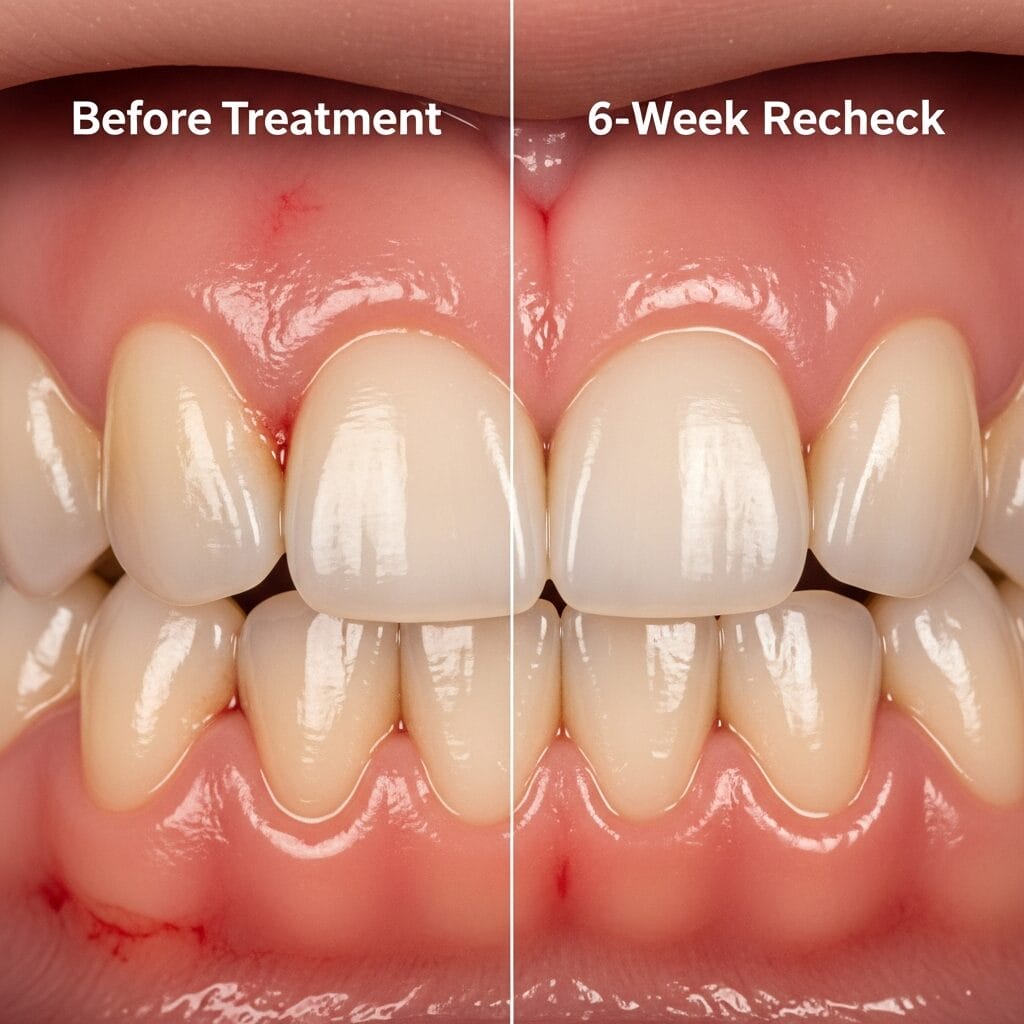
Two to six weeks. Bleeding drops off, gums turn paler and tighter, and breath usually improves. At the re-check I measure again and show you the change.
After that. Three-month maintenance cleanings. Patients who keep them tend to stay stable for years.
Call the office if swelling grows after the second day, you develop a fever, or pain gets worse instead of better.
12 · FAQ
Gum Disease Treatment: Questions Patients Ask Me
What are the first signs of gum disease?
Gums that bleed when you brush or floss are usually the first sign. After that come puffy or dark red gums, bad breath that comes back soon after brushing, and gums that look like they're pulling away from the teeth. Loose or shifting teeth show up much later. Since early gum disease rarely hurts, the measurements at a dental exam often find it before you notice anything.
Can periodontitis be cured, or only controlled?
It's controlled, not cured. Treatment stops the infection and lets the gums tighten back up, but bone that's already gone doesn't grow back on its own, and the bacteria return if they're not kept in check. With a deep cleaning, good home care, and cleanings every three months, most of my patients stay stable for many years.
How do I find out what stage of gum disease I have?
You need two things: gum measurements at six spots around every tooth and full-mouth X-rays to see the bone. Both are part of my $20 new-patient exam. I'll show you your numbers on the screen and tell you plainly whether you have gingivitis, periodontitis, or healthy gums.
Is laser gum treatment better than a deep cleaning?
No, it's a different job. A deep cleaning removes tartar from the roots, and the laser can't do that. I use the laser after a deep cleaning on pockets that are still deep and bleeding at the re-check. For most patients, the deep cleaning alone is enough.
Does laser gum therapy hurt?
Most patients find it more comfortable than they expected. Many need little or no numbing, and the gums are usually tender for a day or two rather than sore. Over-the-counter pain relievers are typically all anyone needs afterward.
How much does gum disease treatment cost without insurance in Murrieta?
At my office, the new-patient exam with X-rays is $20, a full mouth deep cleaning is $320 for all four quadrants, laser therapy is $240 for the first treatment and $80 per follow-up visit, and maintenance cleanings are $95. Those are cash fees. You'll get your plan and the total in writing before anything starts.
Will my insurance pay for laser gum therapy?
It depends on the plan. Some PPO plans pay for laser treatment of a pocket, some pay it at the scaling and root planing rate, and some don't cover it at all. We check your benefits before the visit and tell you your share. Without insurance, it's $240 for the first treatment and $80 per follow-up visit.
How often will I need cleanings once my gum disease is under control?
Usually every three months. The bacteria that cause periodontitis rebuild in the pockets in about that time, so six-month cleanings let the disease restart between visits. If your gums stay stable for a long stretch, we can sometimes stretch the interval a bit, but I'll go by your measurements.
Can I keep my teeth if I have periodontitis?
Most people can, especially when it's caught at the early or moderate stage. Even with advanced disease, many teeth can be kept for years with treatment and maintenance. I'll be honest about any tooth I think is past saving, and I'd rather keep a natural tooth when it's realistic.
Does smoking or vaping change how well gum treatment works?
Yes. Smoking is one of the strongest risk factors for periodontitis, and smokers usually heal more slowly and see less pocket shrinkage after a deep cleaning. Smoking also hides bleeding, so the gums can look healthier than they are. Quitting helps your gums whether or not you've been treated yet.
When do you refer gum disease patients to a periodontist?
When pockets stay 6 mm or deeper after treatment, when bone loss needs regenerative surgery, when many teeth are involved, or when the disease is progressing unusually fast. I'll tell you at the start if your case looks like one of those. You can still keep your maintenance cleanings with us.
Will my gums grow back after gum disease treatment?
Swollen gums shrink back to their real size, and pockets get shallower, but gum and bone that were lost don't regrow on their own. If exposed roots bother you or are getting worse, a gum graft can cover them, which is covered on the gum recession page.
Is gum disease linked to heart disease or diabetes?
There's a real two-way link with diabetes, and treating gum disease modestly improves blood sugar control in people who have both. With heart disease there's an association, but it hasn't been shown that gum disease causes heart attacks or that treating it prevents them. I wrote a separate page on what the research shows.
My tooth feels loose. Is that gum disease?
Often it is, because bone loss from periodontitis is the most common reason an adult tooth loosens. Grinding, an injury, or an infection at the root tip can do it too. A loose adult tooth is worth an exam soon, and if it came from an injury in the last hour, call right away.
Patient Reviews
What Murrieta Patients Say About Getting Honest Answers Here
These are real Google reviews from our patients. They're about the practice in general rather than gum treatment specifically, and they say what I hope you'll find too: no upselling.
Dr. Nguyen does a great job. He is always on time and very honest. Never has you do unnecessary treatments, just to make extra money. I love that he is a solo practitioner and runs his own shop. That keeps his overhead costs low and he knows you more personally as a patient. All my family comes to see him. Best dentist I’ve ever had.
Rated 5 out of 5 stars. — Tom H. | Google Review
Very knowledgable and good prices. Does only what is necessary. Does not just look for stuff to charge for. Got an appointment quickly when I thought it was an emergency. My favorite dentist ever!!
Rated 5 out of 5 stars. — Sheila O. | Google Review
I am completely terrified of the dentist. I neglected getting anything done for years and years because of bad experiences and just general fear and anxiety. Well I got sick of having an aching jaw everyday so I came in and got a x-ray and consultation and they told me what work needed to be done. The price was pretty much half of what comparable dentists wanted and they were really really nice to me. The doctor gave me some anxiety meds which completely relaxed me and I can honestly say I have way less fear and anxiety about going back to the dentist. So if you have any anxiety about going to the dentist, this is the place for you.
Rated 5 out of 5 stars. — Jay D. | Google Review
I love coming to Promenade Dental Care. Dr. Nguyen and Edith are the best. They’re friendly and I love that I’m taken care of right away. Dr. Nguyen is thorough and efficient. He answers any questions I have and explains things clearly. I actually look forward to my biannual dentist visits now because they’re the best. Can’t recommend a dentist more!
Rated 5 out of 5 stars. — Kamilah C. | Google Review
Find Out Where Your Gums Stand
Start with a $20 exam with X-rays and gum measurements. If you need treatment, you'll know the plan and the price before we begin. If your gums are healthy, I'll tell you that too.
(951) 412-0127 Request an Appointment OnlinePromenade Dental Care · Dr. Bao Nguyen, DDS
26957 Date St., Suite B4, Murrieta, CA 92563
Serving Murrieta, Temecula, French Valley, Menifee, Wildomar & Winchester
16 · Written and Reviewed By
Written and Reviewed by Dr. Bao Nguyen, DDS
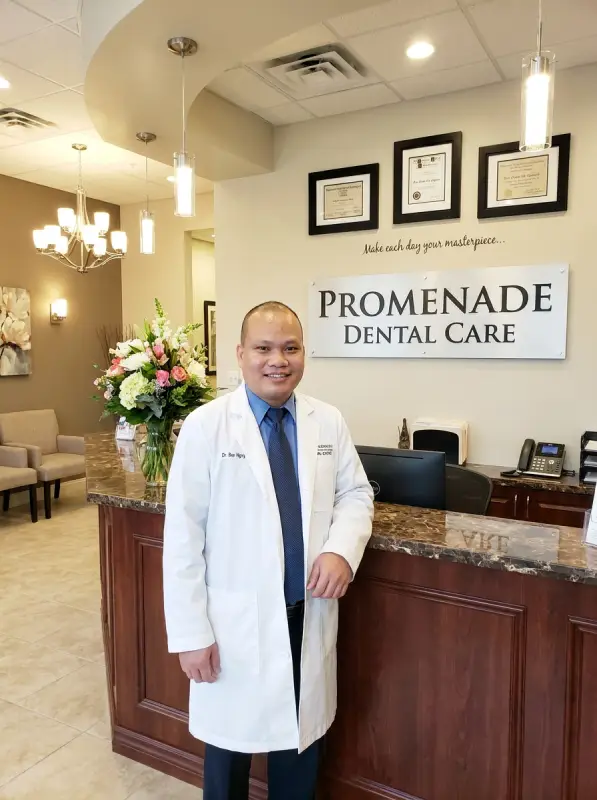
I trained at the UCLA School of Dentistry and then served ten years in the U.S. Navy Dental Corps, including an Advanced Education in General Dentistry residency at Naval Hospital Camp Pendleton and deployments to Kuwait and Iraq. Gum disease was a big part of my Navy work, and it taught me to measure before I recommend anything.
I opened Promenade Dental Care in 2010 and still see every patient myself. I take 40 hours of continuing education a year and I'm a member of the ADA, the California Dental Association, and the Tri-County Dental Society. I wrote this page and I review it whenever my fees, my methods, or the research change.
17 · Last medically reviewed
- Written by
- Dr. Bao Nguyen, DDS
- Medically reviewed by
- Dr. Bao Nguyen, DDS
- Last medically reviewed
- October 10, 2026
- Fees current as of
- October 2026