
Tooth Extraction Murrieta
Tooth Extraction in Murrieta, CA
Simple and surgical tooth removal, done only when the tooth truly cannot be saved.
Nobody wants a tooth pulled, and Dr. Bao Nguyen will not pull one that can be rescued. When a tooth is genuinely finished, he takes it out cleanly and comfortably. Either way, you find out which it is before he picks up an instrument. Simple and surgical extractions, sedation available, same-day emergencies welcome.
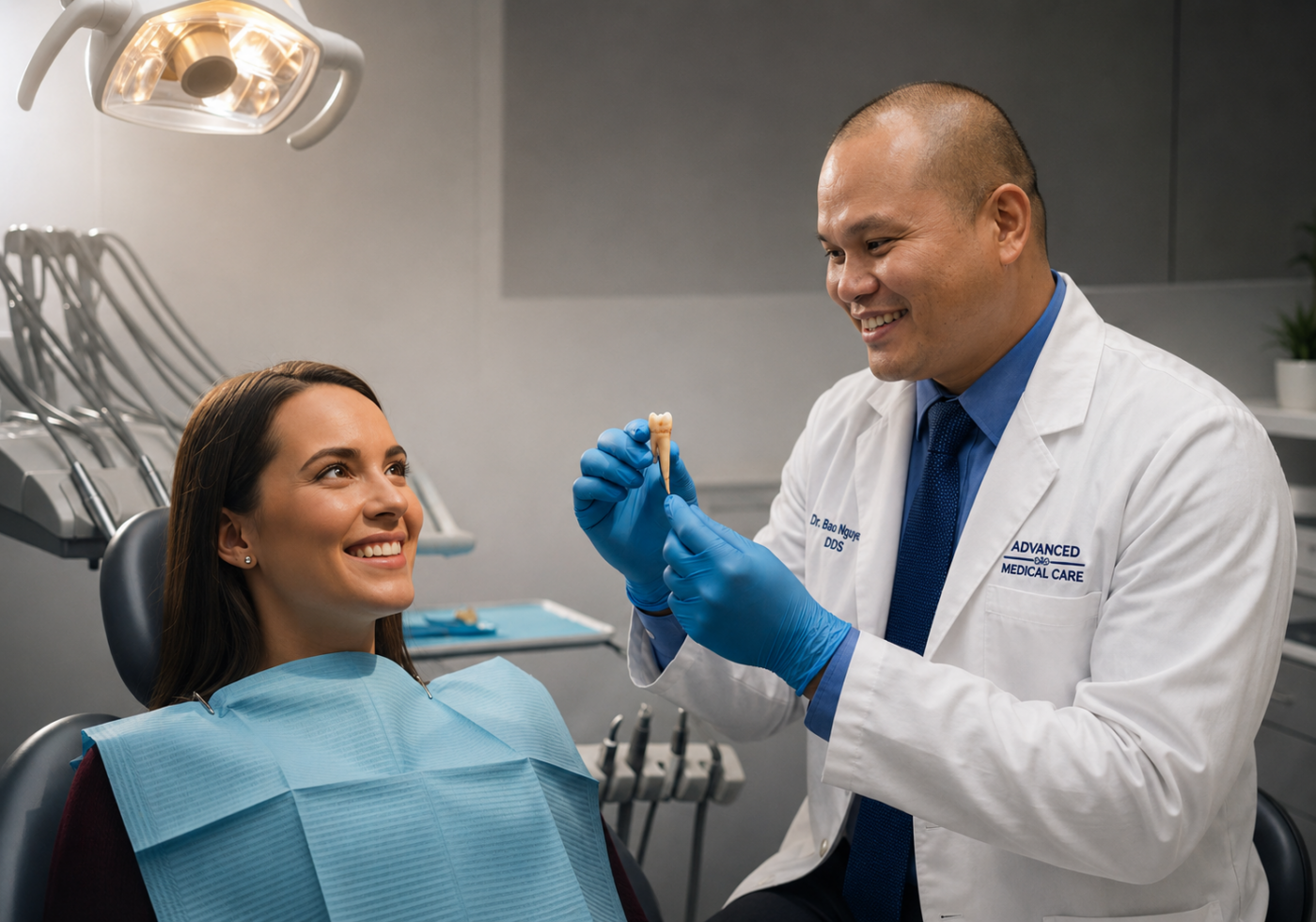
“I have pulled a lot of teeth that had to come out, and I have talked a lot of patients out of pulling ones that did not. Both conversations matter.” — Dr. Bao Nguyen
- Procedure
- Simple or surgical tooth extraction, both performed in-house
- Anesthesia
- Local anesthetic; nitrous oxide and oral conscious sedation available
- Chair time
- About 20–40 minutes simple, 40–60 minutes surgical
- Recovery
- Back to normal activity in 1–2 days; gum tissue closes in 1–2 weeks
- Cost
- Written estimate after a $20 exam with digital X-rays; all PPO plans accepted
- Emergencies
- Same-day appointments when the schedule allows; call (951) 412-0127
Saving the Tooth Comes First
When a Tooth Actually Needs to Come Out
An extraction is the last option on the list, not the first. A natural tooth outperforms anything we can put in its place, so before recommending removal Dr. Bao checks whether a white composite filling, a same-day crown, or a root canal would hold it. Plenty of teeth written off elsewhere are still salvageable. He will tell you which category yours falls into and point to the evidence on the X-ray.
Some teeth really are finished, though, and keeping them costs you more than losing them. Extraction is the right call when:
- Decay or a fracture has taken too much tooth structure for a restoration to grip
- Advanced gum disease has dissolved the bone anchoring the tooth and it has gone loose
- The tooth is cracked vertically, with the fracture running into the root
- Infection has spread past the point where root canal therapy can rescue the tooth
- A retained baby tooth or a crowded tooth is blocking the permanent bite from lining up
- A wisdom tooth is impacted, partially erupted, or repeatedly infected
The American Dental Association frames the decision the same way: preserve where preservation is realistic, remove where the tooth has become a threat to the teeth and bone around it.
What Our Patients Say
Real Reviews from Real Murrieta Patients
Dr. Nguyen is extremely knowledgeable and professional. His most fantastic quality, though, is that he genuinely cares about his patients. I would highly recommend him to anyone looking for a dentist who actually listens.
— Maria T. · Google Review
Great dentist. No upselling, easy to make an appointment, and he told me exactly what was going on without trying to scare me into unnecessary work. The pricing was fair and upfront.
— Jason R. · Google Review
I called Dr. Nguyen very early on a Saturday morning with an emergency. He fit me in first thing. Whether you need routine care or urgent attention, you can trust this man.
— Lisa C. · Google Review
I don't have dental insurance and was dreading the cost. Dr. Nguyen's office was completely upfront about pricing, no hidden fees and no pressure. Significantly less than the corporate offices in Temecula.
— Sandra L. · Google Review
Two Kinds of Extraction
Simple vs. Surgical Tooth Removal
Every extraction is one or the other, and knowing which one you are having takes most of the mystery out of the appointment. Dr. Bao does both at the Murrieta office, so you are not sent across town and told to wait three weeks for a consultation.
Simple Extraction
For a tooth that is fully erupted and visible above the gumline. Dr. Bao loosens it with an instrument called an elevator, then lifts it out with forceps. Once you are numb the removal itself often takes only a couple of minutes per tooth, and most patients are surprised by how little there is to it. Typical cases: a badly decayed but still intact tooth, a tooth loosened by gum disease, a stubborn baby tooth.
Surgical Extraction
For a tooth that is impacted, broken off at the gumline, or built with curved or fused roots that resist simple removal. Dr. Bao makes a small incision in the gum and often divides the tooth into sections so each piece lifts out on its own rather than forcing the whole tooth at once. The word surgical sounds bigger than the appointment feels: full local anesthesia, sedation available, and mild soreness for most patients.
| Simple Extraction | Surgical Extraction | |
|---|---|---|
| Best for | Tooth fully visible above the gum | Impacted tooth, broken at the gumline, or awkward roots |
| Technique | Loosened with an elevator, lifted with forceps | Small gum incision, tooth often sectioned into pieces |
| Anesthesia | Local; nitrous or oral sedation optional | Local; nitrous or oral sedation optional |
| Chair time | About 20–40 minutes | About 40–60 minutes |
| Sutures | Rarely needed | Usually placed, often dissolvable |
| Typical recovery | Normal activity in about a day | Normal activity in one to three days |
What to Expect
Your Tooth Extraction, Step by Step
1Exam and imaging
Dr. Bao examines the tooth and takes a digital X-ray to read the root shape, the position, and the bone around it. He confirms the tooth needs to come out, shows you why on the screen, and gives you a written estimate.
2Anesthesia
Local anesthetic numbs the tooth and the surrounding tissue. Nitrous oxide or oral conscious sedation is available if you want it. He tests the area and waits until you are fully numb. Pressure is normal; pain is not.
3Removal
A simple extraction is loosened and lifted out. A surgical extraction starts with a small incision, and the tooth may be sectioned so each piece releases on its own. Steady and unhurried beats fast every time.
4Socket care
The socket is cleaned and gauze goes in to control bleeding and let the protective clot form. Sutures are placed if the site needs them. That clot is the whole ballgame for comfortable healing.
5Aftercare
Dr. Bao goes through written aftercare instructions with you and, if the tooth needs replacing, lays out the options. Most patients are heading home within an hour of walking in.
Healing Well
Aftercare and How to Avoid Dry Socket
Recovery is usually uneventful and most patients are back to normal within a day or two. The one job that matters in the first 24 to 72 hours is protecting the blood clot sitting in the socket. Knock it loose early and you risk dry socket, which exposes the bone underneath and hurts considerably more than the extraction did. The Mayo Clinic puts smoking and disturbing the site at the top of the risk list, which is exactly what the rules below are guarding against.
No straws
The suction can lift the clot straight out of the socket. Drink from the cup for the first few days. Smoothies are fine, just eat them with a spoon.
No smoking
Smoking creates suction and slows tissue healing at the same time. Seventy-two hours is the minimum. Longer is better for the socket.
No vigorous rinsing
Skip mouthwash and forceful spitting for the first 24 hours. After that, gentle warm salt-water rinses keep the area clean without disturbing anything.
Soft, cool food
Yogurt, applesauce, mashed potatoes, scrambled eggs, lukewarm soup. Avoid crunchy, chewy, spicy, and hot food, and chew on the other side.
Rest and elevate
No strenuous exercise for 24 to 48 hours. Keep your head slightly raised when you lie down; it cuts down the throbbing and the swelling.
Manage soreness
Over-the-counter ibuprofen or acetaminophen covers most of it. A cold compress on the cheek for the first day keeps swelling down.
After the Tooth Is Gone
Should You Replace an Extracted Tooth?
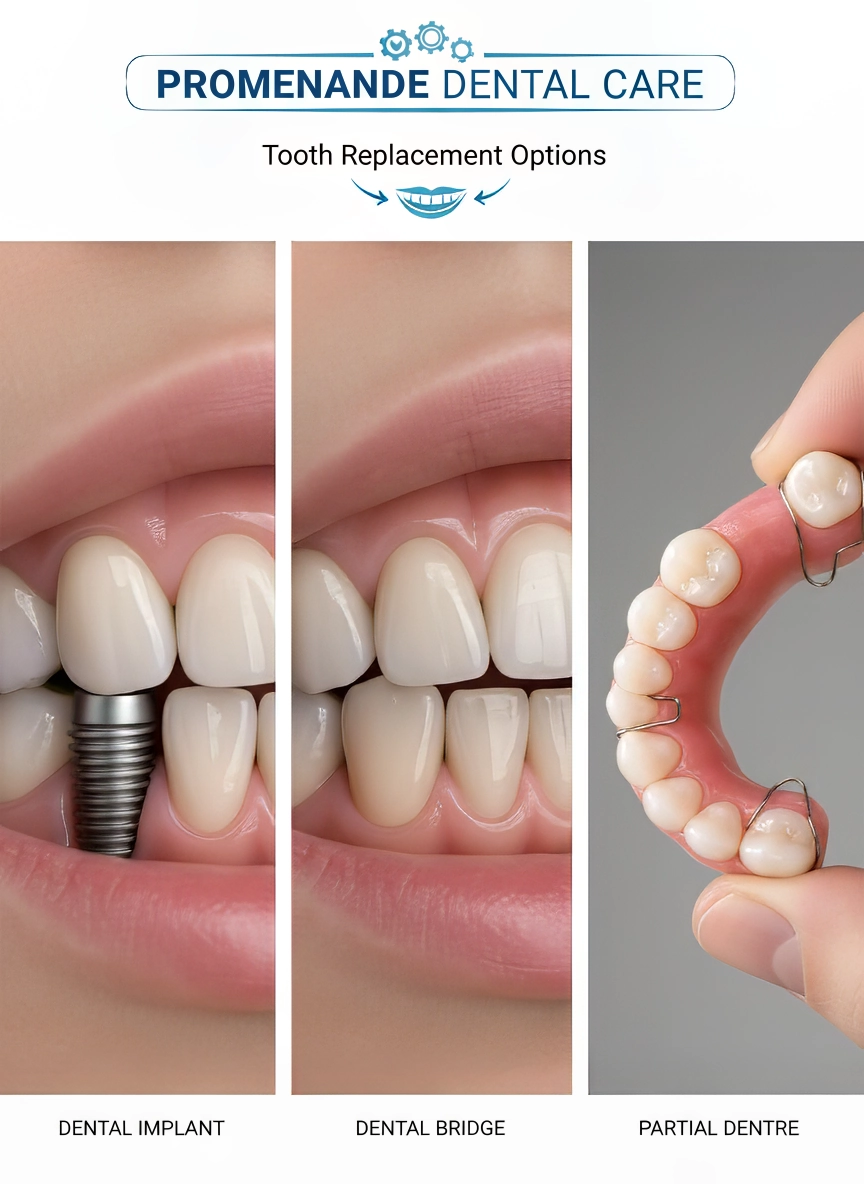
For everything except wisdom teeth, usually yes. A gap does not stay a tidy gap. The teeth on either side lean into the empty space over months, the tooth above or below drifts down looking for something to bite against, and the jawbone that used to carry chewing forces begins to resorb once nothing is stimulating it. One missing molar has a way of turning into a bite problem involving three or four teeth.
Dr. Bao handles replacement in-house and recommends the option that fits your mouth and your budget:
- Dental implant – closest to a natural tooth, preserves the jawbone, and stands on its own without altering the neighboring teeth
- Dental bridge – fills the gap using the adjacent teeth for support, generally faster and less expensive
- Partial denture – removable, and often the practical answer when several teeth are missing
Sometimes he will suggest a bone graft at the time of the extraction to hold the socket open for a future implant. He will also tell you when that is not worth the money in your case. Wisdom teeth are the exception to all of this: they sit at the back of the arch, so removing one leaves no functional gap to fill.
Patient Experience
Why Patients Trust Promenade for Extractions
First visit with Dr. Nguyen, and it was a great experience, yes really. He kept me informed, he was accommodating, and he actually listens. Competent, quality dental care at a reasonable price.
— William K. · Google Review
I have been a patient of Dr. Nguyen's for over a decade. The doctor and staff, including Edith, are incredibly wonderful, so kind, caring, and compassionate, yet completely professional.
— Debby M. · Google Review
Your Dentist
Dr. Bao Nguyen, DDS
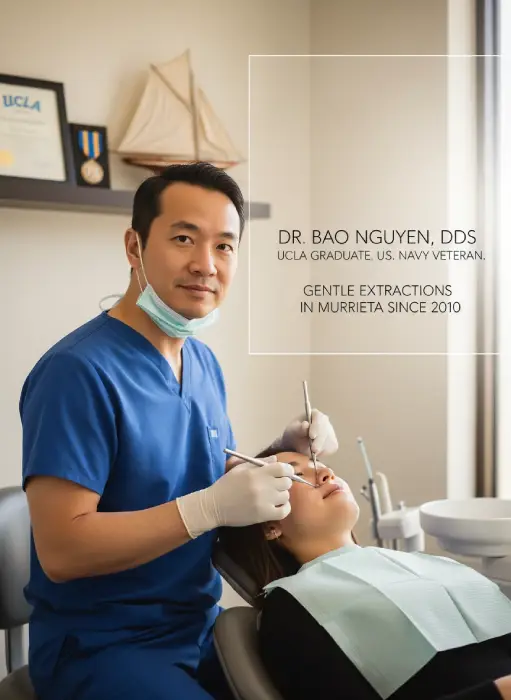
Dr. Bao graduated from the UCLA School of Dentistry and spent the next ten years in the U.S. Navy Dental Corps, with deployments to Kuwait and Iraq and an Advanced Education in General Dentistry residency at Naval Hospital Camp Pendleton. Navy dentistry meant treating whatever walked through the door, and that included a steady stream of surgical extractions on service members who needed teeth out before they shipped. That volume is where the unhurried, methodical technique came from.
He opened Promenade Dental Care in Murrieta in 2010 and has run it on one principle since: never pull a tooth that can be saved, and never make a patient keep a tooth that is hurting them. He performs simple and surgical extractions himself. For the occasional case that belongs with a specialist, such as a deeply impacted tooth sitting against the inferior alveolar nerve, he refers to a trusted oral surgeon and stays involved in the treatment plan.
Pricing and Insurance
What a Tooth Extraction Costs in Murrieta
Two things drive the price: whether the removal is simple or surgical, and which tooth is involved. Taking out a mobile front tooth is not the same job as sectioning an impacted lower molar, and quoting a single number for both would be dishonest. Instead you get a real figure after a short exam, in writing, before you commit to anything.
Most PPO plans treat extractions as a basic or oral surgery benefit, commonly covering 50 to 80 percent after the deductible. Because Promenade is in-network with all PPO dental plans, the share left to you is smaller than it would be out of network. Uninsured patients get published cash pricing, and a fair number of them mention it comes in well under the corporate offices along Clinton Keith and Winchester Road.
Visit Us
Tooth Removal for Murrieta and Southwest Riverside County
Promenade Dental Care is at 26957 Date Street, Suite B4, Murrieta, CA 92563, on the Date Street corridor near Clinton Keith Road inside the Aldi shopping center. Patients come to us for simple and surgical extractions from Murrieta, Temecula, Menifee, French Valley, Winchester, Wildomar, Lake Elsinore, Canyon Lake, Fallbrook, and Hemet.
| Monday | 9:00 AM – 5:00 PM |
| Tuesday | 9:00 AM – 5:00 PM |
| Wednesday | 9:00 AM – 3:00 PM |
| Thursday | 9:00 AM – 5:00 PM |
| Friday | 9:00 AM – 3:00 PM |
| Saturday | By appointment & emergencies |
| Sunday | Closed |

In Pain? Let's Get You Comfortable.
Book a $20 exam with Dr. Bao Nguyen. He will look at the tooth, tell you straight whether it can be saved, and if it has to come out, remove it gently with the price in writing first. Same-day emergencies welcome.
(951) 412-0127 Request an AppointmentFrequently Asked Questions
Common Questions About Tooth Extraction in Murrieta
Does getting a tooth pulled hurt?
No. The tooth and the tissue around it are fully numbed before Dr. Bao starts, so what you feel is pressure and movement rather than pain. Nitrous oxide and oral conscious sedation are available if you are anxious. Expect mild soreness for two to three days afterward, which over-the-counter ibuprofen or acetaminophen handles for most patients.
How much does a tooth extraction cost in Murrieta?
Cost depends on two things: whether the extraction is simple or surgical, and which tooth is involved. Promenade Dental Care gives you a written estimate after a $20 exam with digital X-rays, so you see the actual number before agreeing to anything. The office is in-network with all PPO dental plans, publishes cash pricing for uninsured patients, and offers CareCredit financing with up to six months at zero interest.
Do you offer emergency tooth extractions in Murrieta?
Yes. Call (951) 412-0127; the line is monitored around the clock. Dr. Bao sees urgent extraction cases the same day whenever the schedule allows, including teeth broken in an accident, teeth with spreading infection, and pain that will not settle. A same-day extraction at Promenade costs far less than an emergency room visit, which usually ends with antibiotics, a painkiller, and a referral back to a dentist anyway.
What is a surgical tooth extraction?
A surgical extraction is used when a tooth is impacted, broken off at the gumline, or has curved or fused roots that will not release with simple removal. Dr. Bao makes a small incision in the gum and often divides the tooth into sections so each piece lifts out on its own. It is a routine procedure done under full local anesthesia with sedation available, and most patients report mild soreness rather than significant pain. Dr. Bao performs both simple and surgical extractions at the Murrieta office.
Is a root canal or an extraction the better choice?
Keep the tooth whenever it can be kept. A root canal preserves the natural root and the bone around it, and no replacement performs quite as well as the tooth you were born with. Extraction becomes the better choice when the tooth is fractured down into the root, when decay has destroyed the structure a crown would need to grip, or when infection has already outrun what root canal therapy can fix. Dr. Bao shows you the X-ray and explains which situation you are in before you decide.
Will Dr. Bao try to save the tooth first?
Yes. He removes a tooth only when it cannot be saved. Before recommending extraction he checks whether a white composite filling, a same-day crown, or root canal therapy would preserve it, and he shows you the digital X-ray so you can see the reasoning for yourself.
What is dry socket and how do I avoid it?
Dry socket happens when the blood clot protecting the socket comes loose before the tissue heals, leaving bone exposed. It is painful and it is preventable. Skip straws, smoking, forceful spitting, and vigorous rinsing for the first 24 to 72 hours. If throbbing pain starts two to four days after the extraction, especially pain that spreads toward the ear, call (951) 412-0127. Treatment takes a few minutes and brings quick relief.
How long does a tooth extraction take?
A simple extraction usually takes 20 to 40 minutes from the time you sit down, and the removal itself is often only a few minutes once you are numb. A surgical extraction generally runs 40 to 60 minutes. Most patients are back in the parking lot within an hour of arriving.
How long does it take to recover from a tooth extraction?
The clot forms during the first 24 hours, the gum tissue closes over one to two weeks, and bone fills the socket over the following several months. Most patients return to normal activity within a day or two. Stick to soft food at first and skip strenuous exercise for 24 to 48 hours. Dr. Bao sends you home with written aftercare instructions.
Do I need to replace an extracted tooth?
For every tooth except wisdom teeth, usually yes. Leave the gap and the neighboring teeth tilt into it, the opposing tooth drifts out of position, and the jawbone under the empty socket gradually shrinks. The replacement options are a dental implant, a fixed bridge, or a partial denture, and Dr. Bao walks through which one suits your bite and your budget. Wisdom teeth sit at the back of the arch and do not need replacing.
Can I drive myself home after an extraction?
With local anesthesia only, yes. Nitrous oxide also clears within minutes, so most patients who choose it drive themselves home. Oral conscious sedation is the exception: arrange for someone to drive you and plan to rest for the remainder of the day.
What can I eat after a tooth extraction?
Soft, cool food for the first day or two. Yogurt, applesauce, mashed potatoes, scrambled eggs, lukewarm soup, and smoothies eaten with a spoon rather than a straw all work well. Avoid crunchy, chewy, spicy, and very hot food, and chew on the opposite side until the site closes over.
Does dental insurance cover tooth extraction?
Most PPO dental plans cover extractions as a basic or oral surgery benefit, commonly at 50 to 80 percent after the deductible. Promenade Dental Care is in-network with all PPO dental plans, which lowers the share you pay. Uninsured patients get published cash pricing, and CareCredit financing with up to six months at zero interest is available to qualified applicants.
Why does Dr. Bao perform extractions in-house?
Ten years in the U.S. Navy Dental Corps and an Advanced Education in General Dentistry residency at Naval Hospital Camp Pendleton gave him a high volume of surgical extraction experience. Handling both simple and surgical cases at the Murrieta office means you are not waiting weeks for an outside appointment. When a case genuinely exceeds general practice scope, such as a deeply impacted tooth sitting against a nerve, he refers to a trusted oral surgeon and coordinates the treatment directly.