
Emergency Dentist Murrieta · Promenade Dental Care
Emergency Dentist in Murrieta: What to Do Right Now
If a tooth is knocked out, broken, or throbbing, or your gum or face is swelling, call (951) 412-0127 now. Someone answers that line 24 hours a day. I hold chair time open every weekday for emergencies, and on a Saturday, a Sunday, or a holiday I can open the office for one. If swelling is spreading toward your eye or neck, or you have a fever or trouble swallowing, go to a hospital emergency room first.
Triage
Is this a dental emergency, and who should you call first?
It's a dental emergency if you're in pain you can't control, a tooth is out or loose from an injury, something is bleeding that won't stop, or an infection is making your gum or face swell. Call me for those. A few situations have stopped being tooth problems altogether, and those go to a hospital first.
Call 911 or go to the nearest emergency room first if: swelling is spreading toward your eye, under your jaw, or down your neck; you have a fever along with tooth pain; swallowing, breathing, or opening your mouth is getting harder; bleeding after a facial injury hasn't stopped after 20 minutes of firm pressure; or you may have broken your jaw. Mayo Clinic warns that an untreated tooth abscess can turn life-threatening. After the hospital, call (951) 412-0127, because the ER can treat the infection but can't fix the tooth that started it.
Most dental emergencies are urgent without being dangerous. This is the same sorting my front desk does on the phone.
Call me now
A toothache that wakes you up. A bump on the gum with swelling. A knocked-out permanent tooth. A break with pink or red showing in the middle of the tooth. A crown off a tooth that's sore. A deep cut inside the mouth. These need to be seen today.
Call today, be seen today or tomorrow
Sensitivity that got noticeably worse this week. A lost filling with a dull ache. A cracked tooth that doesn't hurt much yet. A broken denture. None of these heals, and every one costs less to fix this week than next month.
Book within the week
Mild sensitivity to cold. A small chip with no pain. A loose crown that isn't sore. Not emergencies, but worth an appointment before the small version turns into the expensive one.
Not sure which one you are?
Call and describe it. Nobody on my team will be annoyed that you called about something that could have waited. I'd much rather hear about a tooth on Monday than see it on Friday with a swollen face.
- Phone
- (951) 412-0127, answered 24 hours a day, including nights, weekends, and holidays
- Office hours
- Mon, Tue, Thu 9 AM–5 PM · Wed, Fri 9 AM–3 PM · weekends by arrangement for emergencies
- Same-day care
- Chair time held open every weekday for emergencies; call whenever it happens
- Weekends and holidays
- No regular hours, but I can come in for an emergency on a Saturday, a Sunday, or a holiday
- Address
- 26957 Date St, Suite B4, Murrieta, CA 92563, with free parking in front of the suite
- Languages
- English, Spanish, and Vietnamese spoken in the office
- Cost to be seen
- No emergency surcharge on a weekday between 8 AM and 5 PM, where new patients start with the $20 exam and digital X-rays. Before 8 AM or after 5 PM on a weekday, or on a weekend or holiday, the visit is $85. That covers only the exam and X-rays; treatment costs the same as on a weekday.
Before you get here
What should you do in the next ten minutes?
Call first, then deal with the tooth while someone else drives. What you do in the next few minutes matters most with a knocked-out tooth and with bleeding. Everything else on this list is about keeping things from getting worse until I can see you.
Call (951) 412-0127 before anything else
Tell us what happened and when. We'll tell you what to do at home, whether a hospital is the better first stop, and when to come in. Calling ahead also lets us have the room and the X-ray ready, so you aren't waiting behind someone's cleaning.
Stop bleeding with steady pressure
For a cut to the gum, tongue, lip, or cheek, press clean gauze or a folded cloth on it and hold it for a full 15 to 20 minutes without lifting to look. Every peek starts the clock over. If it's still bleeding after 20 minutes of real pressure, go to an emergency room.
Knocked-out tooth: hold it by the crown and keep it wet
Pick it up by the white chewing part, never the root. Don't scrub it, and don't use soap or alcohol. If it's dirty, rinse it briefly under cool water. Then slide it back into the socket if you can and bite gently on a cloth to hold it. If you can't, keep it in a little milk or saliva, or tucked between the lower lip and gum, which is what MedlinePlus recommends. Don't let it dry out. Baby teeth are the exception: they stay out.
Cover a broken tooth or an open crown
Keep hot, cold, and sweet off the exposed spot and chew on the other side. Drugstore dental wax over a sharp edge keeps it from cutting your tongue. Temporary cement from the same aisle can hold a crown for a day or two. Both are stopgaps, not repairs. If the crown came off, bring it with you.
Don't drive yourself if the pain is bad
Pain that's bad enough to distract you is bad enough to make you a worse driver. The office is at 26957 Date St, Suite B4, a few minutes from Winchester Road and Murrieta Hot Springs Road, and most of Murrieta, Temecula, and Menifee is 5 to 15 minutes away.

Until you're seen
How do you control pain and swelling until you're seen?
For most healthy adults, an anti-inflammatory like ibuprofen is the strongest thing you can take for tooth pain without a prescription, and it can be paired with acetaminophen. That isn't just my habit. It's what the American Dental Association's toothache guideline recommends as first-line treatment for adults and teenagers 12 and older when they can't get to a dentist right away. Follow the label, and skip ibuprofen if your physician has told you to avoid it because of your stomach, kidneys, blood pressure, or a blood thinner.
Things that make it worse: an aspirin held against the gum (it burns the tissue and does nothing for the tooth), a heating pad on a swollen face, poking or squeezing a bump on the gum, and starting leftover antibiotics from the medicine cabinet. Antibiotics don't remove the cause of a tooth infection. The ADA's antibiotic guideline, summarized by the CDC for dentists, says most tooth pain and swelling should be treated at the tooth instead, with antibiotics saved for infections that are spreading or for when treatment can't happen soon.
Everything in this section is a holding pattern. If the swelling grows, the pain gets past what the medicine touches, or a fever starts, call (951) 412-0127 at whatever hour it is.
Same-day care
What can I treat for you today?
Most dental emergencies end in my chair the same day: I find the cause, stop the pain, and either fix the tooth or stabilize it until the proper repair. These are the ones I see most, each with a page of its own when you want more detail.
Severe toothache
Deep, throbbing pain that wakes you up usually means the nerve inside the tooth is inflamed or dying. The fix is usually a root canal, which I do in this office, or an extraction when the tooth can't be saved.
Tooth abscess
A pocket of infection at the root tip or in the gum, often with a pimple-like bump, a bad taste, or swelling. I drain it and treat the tooth that caused it. Read what a tooth abscess is and what to do today.
Knocked-out tooth
The most time-sensitive thing that happens in a mouth. The sooner a permanent tooth goes back in, the better its odds, so follow step 3 above and call while you're on the way.
Broken or cracked tooth
Anything from a harmless chip to a crack running toward the nerve. Most broken back teeth get a permanent same-day CEREC crown. Front-tooth chips have their own page on smoothing, bonding, or a crown, and hidden cracks are covered under cracked tooth.
Lost crown or filling
The tooth underneath is tender and can shift within days. If the old crown still fits, I re-cement it. If not, I make a new one. See what to do when a crown falls off.
Tooth pushed out of place
A tooth knocked sideways or pushed up into the gum. Don't force it back yourself. Bite gently on soft gauze to keep it still and come in the same day. I move it back into position and splint it right here in the office.
Cuts to the lip, gum, or tongue
Control the bleeding first. Then I check whether it needs a stitch and whether the same blow cracked a tooth you haven't noticed yet.
Pain after an extraction
Sharp pain that starts two to five days after a tooth comes out, often reaching the ear, usually means dry socket. A dressing in the socket brings relief quickly.
One more that surprises people: pain after a new crown. Some soreness for a few days is normal. Pain that gets worse instead of better is worth a call.
What happens to a tooth that's been knocked out of place?
I put it back where it belongs and splint it, here in the office, the same day you come in. A splint is a thin, flexible strip bonded to the back of the injured tooth and the teeth on either side, so it holds still while the ligament around the root heals. The international dental trauma guidelines, endorsed by the American Academy of Pediatric Dentistry, call for short-term, flexible splints like this, with how long it stays on depending on the injury. It isn't visible from the front.
The follow-up visits matter as much as the splint. A tooth can look and feel fine after an injury while the nerve inside it is dying, so I see you back several times over the next few months and take X-rays to check how it's healing before we decide on anything more permanent. When an adult tooth has been pushed sideways, pushed up into the gum, or pushed well out of its socket, those same guidelines say a root canal soon afterward is usually the safer course. If that's where your tooth is heading, I'd rather tell you early than wait for an abscess to tell us both.
The visit
What happens when you come in for an emergency visit?
You get a focused exam and an X-ray first, a clear answer and a written price second, and treatment third. Nothing gets drilled or pulled before you know what it is and what it costs.
1The phone call
We ask what happened, when it started, what you've taken for it, and if you take a blood thinner. That decides how fast you need to be seen and whether the hospital comes first.
2Exam and digital X-ray
I look at the tooth, test it, and take a digital X-ray. When a crack or an infection could be hiding, I take a 3D cone-beam scan here in the office instead of sending you somewhere else for it.
3The answer and the price
I show you the image, tell you what I see, and give you your options with a written price for each. If one option is "leave it alone and watch it," you'll hear that too.
4Treatment today
Most emergencies are treated in the same visit: a root canal, a same-day crown, an extraction, re-cementing a crown, or draining an infection. If you're nervous, nitrous oxide is available for adults.
5The follow-up
You leave knowing what to expect tonight and what to call about. When a tooth needs a second step, like a crown after a root canal, we schedule it before you go.

How I find the cause
How do I find what's actually causing the problem?
Pain is a poor guide to which tooth is the problem. An upper molar can make a lower tooth ache, and a sinus infection can make three healthy upper teeth hurt at once. So I test before I treat. A cold test tells me whether the nerve responds and how long the pain lingers. Tapping and having you bite on a small instrument tells me whether the ligament around the root is inflamed or whether a crack opens under pressure. The digital X-ray shows decay, old fillings, and the bone at the root tip. A cone-beam scan shows things a flat X-ray can't, like an infection tracking toward the sinus.
| What I find | What it usually means | What I usually recommend |
|---|---|---|
| Sharp pain to cold that fades in seconds | Irritated but healthy nerve | Fix the cause (decay, a leaky filling, exposed root); no root canal |
| Cold pain that lingers, or pain that wakes you | Nerve that won't recover | Root canal or extraction |
| No response to cold, sore to tap, dark area at the root | Dead nerve with infection at the root tip | Drain and root canal, or extraction |
| Sharp pain when you release a bite | A crack | Crown, sometimes after a root canal |
| Several upper teeth sore, tooth tests normal | Sinus pressure, not the teeth | No dental treatment; see your physician |
That last row is why I won't treat a tooth because you pointed at it. Once in a while the most useful thing I do in an emergency visit is tell someone their teeth are fine.
Decision boundaries
When is it not an emergency?
It isn't an emergency if there's no swelling, no fever, no injury, and the pain is brief, comes from something you can name, and is getting better rather than worse. Those problems still deserve an appointment this week or next, just not a same-day slot.
| What you notice | Usually not an emergency because | Call sooner if |
|---|---|---|
| Quick zing with ice water | Short sensitivity often comes from exposed root surface or a worn spot | It lingers more than a few seconds or starts waking you up |
| Small chip with no pain | Enamel has no nerve | You see pink or red, or it hurts to bite |
| Food stuck between two teeth, gum sore | Floss and warm salt water often settle it in a day | The gum swells or you taste something bad |
| Jaw sore in the morning | Clenching and grinding, more often than a tooth; see TMJ evaluations | Your jaw locks or you can't open your mouth |
| Loose crown that doesn't hurt | The tooth is still covered | It comes off or the tooth gets sore |
If you're not sure, call anyway. Telling you it can wait until next week takes us two minutes, and we'd rather spend them than have you guess wrong about swelling.
Risks and limits
What can't be fixed the same day, and when do I refer you out?
I handle the large majority of emergencies here, but not all of them, and I'll tell you on the first visit when your case belongs with someone else. A severely calcified or curved root canal, or a tooth that's already had one and failed, goes to an endodontist I trust. An impacted or tangled extraction goes to an oral surgeon. I offer nitrous oxide and oral conscious sedation, not IV sedation or general anesthesia, and I don't sedate children. If you need to be fully asleep, you'll be referred.
Honest limits: some teeth can't be saved, and an abscess with spreading facial swelling needs a hospital alongside me, not instead of me. A permanent tooth that's been out of the mouth and dry for a long time may not take when it goes back in. And no extraction is minor. Even a straightforward one carries real risks, including bleeding, infection, dry socket, and nerve irritation, which is why I talk through the alternatives before a tooth comes out.
When something can't be finished the same day, I stop the pain first. That might mean opening and draining the tooth now and finishing the root canal at a second visit, or a temporary filling until the specialist appointment. You don't leave hurting while you wait for the next step.
Children's emergencies are covered in detail on the kids' dentistry page, including what to do with a knocked-out baby tooth.
Cost
What does an emergency dental visit cost?
On a weekday between 8 AM and 5 PM there's no emergency surcharge. New patients pay $20 for the exam with digital X-rays, the same as any first visit. If I come in for you before 8 AM or after 5 PM on a weekday, or on a weekend or a holiday, the visit is $85. That $85 covers the exam and the X-rays and nothing else; the repair itself costs exactly what it would on a Tuesday afternoon. What the repair costs depends on what the X-ray shows, and you get that number in writing before I start. These are my published prices without insurance:
New-patient exam with digital X-rays
$20
Weekday office hours, emergencies included, without insurance
After-hours emergency visit
$85
Weekdays before 8 AM or after 5 PM, weekends, holidays; exam and X-rays only, treatment priced as usual
Same-day CEREC crown
$1,200
Milled here, no temporary, without insurance
Extraction, not a wisdom tooth
$195–$450
Depends on difficulty, such as a gum flap or sectioning the tooth; without insurance
A root canal, draining an abscess, and repairing a filling are priced after the exam, because the fee depends on which tooth it is and what I find. You'll have a written quote before anything starts. My extraction fee runs lower than what's typical around here, but I'd still rather save a tooth than pull it when saving it makes sense, and I'll tell you when it doesn't.
Insurance and payment
Does insurance cover an emergency visit?
Usually, yes. Most PPO plans cover an emergency exam and X-rays, and part of the treatment that follows. I accept PPO plans and I'm in network with Delta Dental PPO, Cigna, MetLife, Guardian, Aetna, and United Concordia. My team checks your benefits while you're here so the figure you hear is close to what you'll actually pay.
I don't quote insured fees on this page because they depend on your plan's coverage percentage, your deductible, and your copay, and those differ from one policy to the next. Without insurance, the published prices above are what you pay. I take cash, Visa, Mastercard, American Express, Discover, and CareCredit, which lets you spread larger repairs over time.
Alternatives
Should you go to the ER, urgent care, or a dentist?
Go to the ER for anything that threatens your airway, your jaw, or your whole body. For everything else, a dentist is faster, costs far less, and can actually fix the tooth.
| Where | Best for | What it can't do |
|---|---|---|
| Hospital emergency room | Spreading facial or neck swelling, fever, trouble breathing or swallowing, a broken jaw, bleeding that won't stop | Root canals, extractions, or crowns; you'll still need a dentist afterward |
| Urgent care | After-hours pain medicine advice when you can't reach a dentist | Most aren't set up to examine or X-ray a tooth |
| Emergency dentist | Toothaches, abscesses without spreading swelling, broken or knocked-out teeth, lost crowns, dry socket | Airway emergencies and jaw fractures, which start at the hospital |
If you're torn between the two at night, call (951) 412-0127. The person who answers will tell you plainly which one you need.
Your dentist
Who will be treating you?
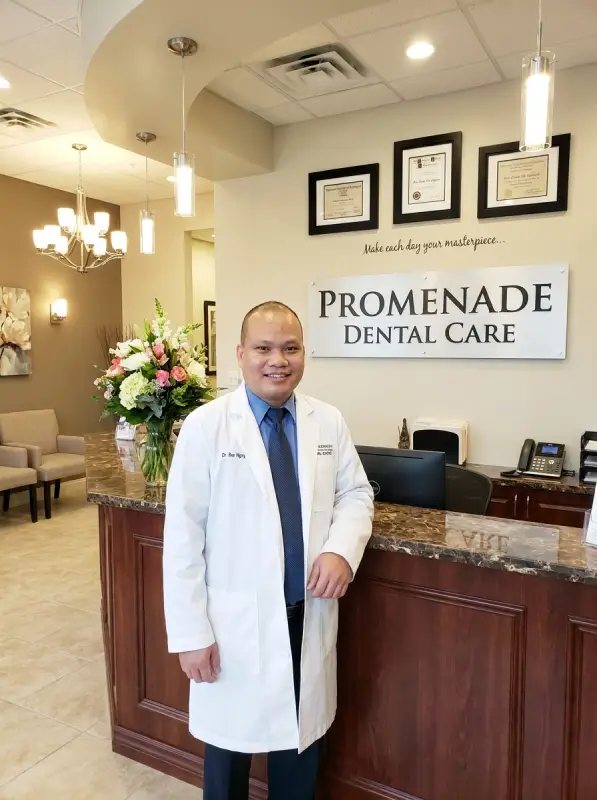
Me. Promenade Dental Care is a one-dentist office, so the person who answers your emergency is the person who examines you and does the work. I graduated from the UCLA School of Dentistry and spent ten years as a U.S. Navy dentist, including an Advanced Education in General Dentistry residency at Naval Hospital Camp Pendleton and deployments to Kuwait and Iraq. Broken teeth at bad hours were normal there. I opened the Date Street office in Murrieta in 2010.
That's 26 years of clinical practice. I take about 40 hours of continuing education a year, I'm a member of the ADA, the California Dental Association, and the Tri-County Dental Society, and I'm CEREC certified, which is how a broken tooth can leave here with a permanent crown the same day. I also hold a Dental Board of California oral conscious sedation permit.
Patient reviews
What do Murrieta emergency patients say?
I saw the Dr. this morning for a dental emergency. He was the only one willing to see me on a Sunday out of the dozen that I called. He was very polite and gentle, he even took care of my oral surgeon referral. I'm still pretty shocked that he called me back and saw me on a Sunday morning. I'm not even a patient of his, this just shows how much he cares for his community. Thank you.
— Jessica Villa · Google review
Great service. Great people. Called at 8 am on a Saturday and I was seen at 9:30 am same day!
— priscella guzman · Google review
Dr. Nyguen has been our family dentist for the past 4 years. This past weekend I was in an accident that resulted in my losing one tooth and damage to 3 others. He answered his phone on a Sunday and opened his office to ensure I received immediate care. His continued quality care and willingness to go over and beyond to ensure his patients are a top priority is why I fully recommend him and why he continues to be our family dentist!
— Corrine Garbani · Google review
I was in significant pain and Dr. Bao Nguyen was able to see me right away. The service was excellent and thorough. I needed a couple fillings done and it was quick, painless, and thorough. He made sure everything was done well and confirmed with imaging to ensure that I wouldn't have any troubles or pain with the filling. A truly exceptional dentist that I would highly recommend! Thank you Promenade Dental and Dr. Nguyen, you made an unexpected trip to the dentist feel a lot more comfortable and easy.
— Kim Vu · Google review
I had a dental emergency and the dentist called me immediately and was able to get me in within an hour of speaking to him. The front desk was extremely welcoming and kind. They went over options with me and without having dental insurance they were very affordable. Would recommend to everyone!
— brittani muiter · Google review
FAQ
What else do people ask me in an emergency?
How fast can I be seen for a dental emergency in Murrieta?
Usually the same day. I hold chair time open every weekday for emergencies, so call when it happens and we'll fit you in. Office hours are Monday, Tuesday, and Thursday 9 AM to 5 PM and Wednesday and Friday 9 AM to 3 PM. If you call after hours, we'll tell you what to do tonight and whether it can wait for the first opening in the morning. On a weekend or a holiday, I can come in for an emergency.
Is there a 24-hour dentist in Murrieta I can call at night?
The phone at Promenade Dental Care, (951) 412-0127, is answered 24 hours a day, including nights, weekends, and holidays. Nobody in Murrieta is doing root canals at 3 AM, and an office that implies otherwise is stretching it. What you get overnight is a person who tells you what to do at home, says plainly whether you need a hospital tonight, and either puts you in the first opening or gets me in to see you when it can't wait.
What if my dental emergency happens on a weekend or a holiday?
Call anyway. The office has no regular weekend hours, but I can come in on a Saturday, a Sunday, or a holiday for an emergency. That visit is $85, which covers only the exam and the X-rays. Any treatment costs the same as it would on a weekday, and it's quoted in writing before I start. A knocked-out permanent tooth or swelling that's spreading should never wait for Monday, and we'll say so on the call.
What should I do if a permanent tooth gets knocked out?
Move quickly. Pick the tooth up by the crown, not the root, rinse it briefly under cool water only if it's dirty, and try to slide it back into the socket. If that isn't possible, keep it in a little milk or saliva, or between your lower lip and gum. Don't scrub it and don't let it dry out. Call (951) 412-0127 while someone drives you over. A tooth that goes back in within the first half hour or so has the best chance. Once it's back in, I splint it to the teeth beside it so it can heal. Baby teeth are not put back, because that can damage the adult tooth underneath.
What will you do for a broken back tooth?
It depends on how deep the break goes, which the exam and X-ray tell me. A small break in the enamel may only need smoothing or a filling. A break into the layer under the enamel usually needs a crown so the rest of the tooth doesn't split. A break that reaches the nerve needs a root canal before the crown. Most broken back teeth get a permanent CEREC crown made here the same day.
Can I get a permanent crown in one visit during an emergency?
Usually, yes. I scan the tooth, design the crown, and mill it from a ceramic block here in the office while you wait, so there's no temporary to fall off three days later. A same-day CEREC crown is $1,200 without insurance. Not every tooth qualifies the same day, for example when the gum needs to heal first, but most single broken teeth do.
Can you see me today if I'm not a patient yet?
Yes. A lot of my emergency patients are new, often people who couldn't reach their own dentist. During weekday office hours, new patients start with the $20 exam and digital X-rays, the same as any first visit. Call first so we can hold a time for you.
Do you charge more for an emergency than for a regular visit?
Not on a weekday between 8 AM and 5 PM. A procedure costs the same whether you booked it a month ago or called an hour ago, and you get the price in writing before I start. Before 8 AM or after 5 PM on a weekday, or on a weekend or a holiday, there's an $85 fee for the visit. It covers only the exam and the X-rays; the treatment itself is priced exactly as it would be on a weekday.
What should I have with me when I come in for an emergency?
Bring any piece of tooth or crown that came off, a knocked-out tooth in milk or saliva, your insurance card if you have one, and a list of your medications. If you take a blood thinner, tell us on the phone. For warfarin I'll usually ask for a recent INR before any extraction.
What if the pain stops before my appointment?
Keep the appointment. A toothache that stops suddenly can mean the nerve inside has died, and a dead nerve often turns into an abscess weeks later. Pain that eases because swelling drained is the same story. The tooth still needs to be looked at, even though it feels better.
Can I have laughing gas if I'm nervous during an emergency visit?
Adults can. Nitrous oxide wears off within minutes, so you can usually drive yourself home afterward. For more anxious adults, I also offer oral conscious sedation, which needs a driver. I don't use sedation for children.
In pain right now?
Call and tell us what happened. Someone answers 24 hours a day, same-day time is held open every weekday, and I can come in on a weekend or a holiday when it can't wait.
Directions & office hoursPromenade Dental Care · Dr. Bao Nguyen, DDS
26957 Date St, Suite B4, Murrieta, CA 92563
Mon, Tue, Thu 9 AM–5 PM · Wed, Fri 9 AM–3 PM · weekend emergencies by arrangement · phone answered 24 hours a day
Serving Murrieta, Temecula, Menifee, French Valley, Winchester, Wildomar, Lake Elsinore, and Canyon Lake