
Cracked Tooth · Murrieta, CA
Cracked Tooth? Why It Hurts When You Let Go of a Bite, and How I Save It
The pain comes and goes, the X-ray looks clean, and you can't always point to the tooth. That's how cracks behave.
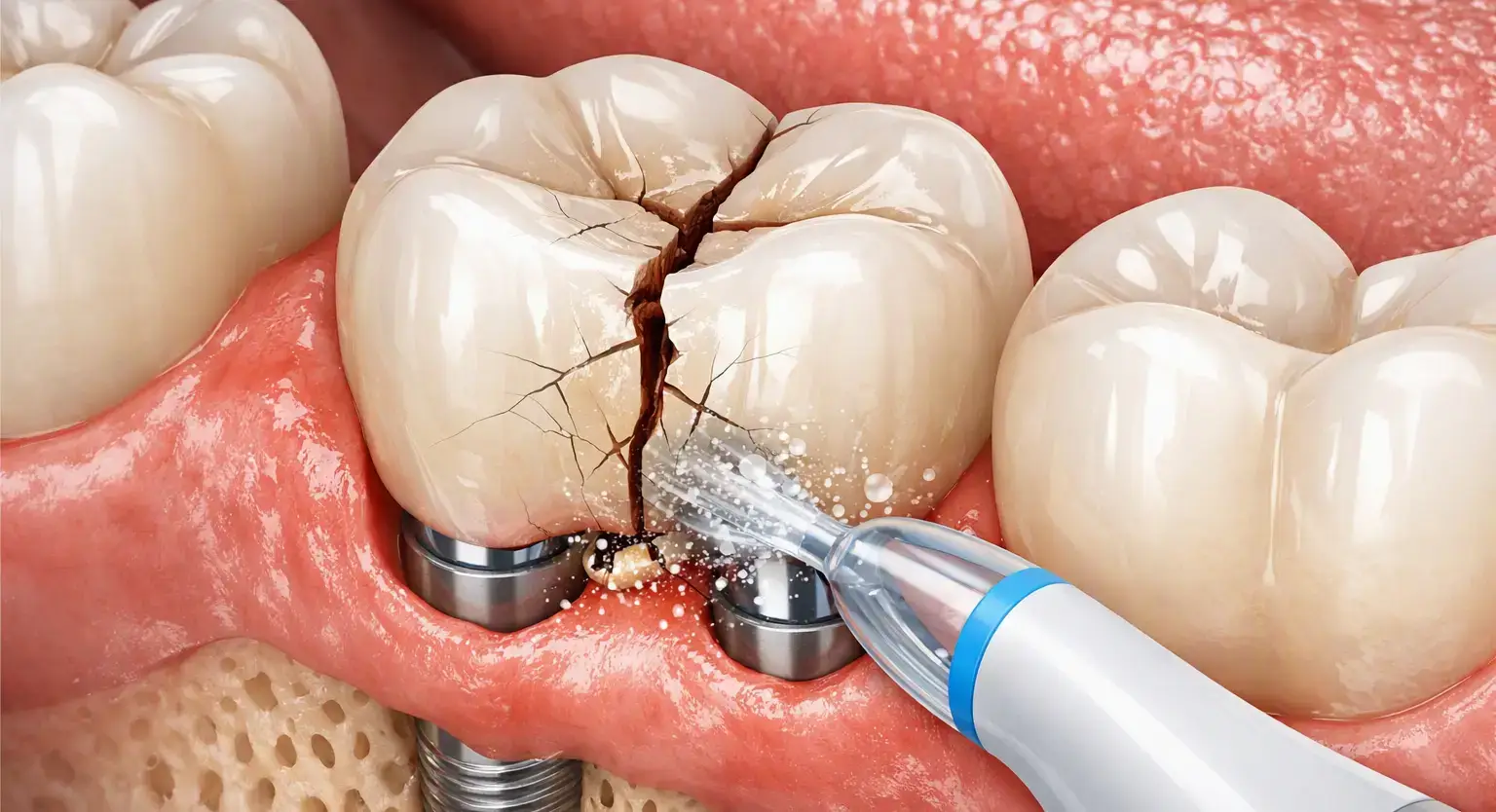
A cracked molar is one of the hardest things I diagnose and one of the most rewarding to catch early. Found while the crack is still up in the crown, most of these teeth keep working for years under a crown. Found late, the same tooth splits and comes out. I'm Dr. Bao Nguyen, and this is how I tell the two apart in my Murrieta office and what each kind of crack needs.
If You Only Read One Section
What a Cracked Tooth Usually Feels Like
Patients describe it the same way so often that I can usually guess before I look. You bite into something firm, maybe a nut or the crust on a sandwich, and nothing happens. Then you open and get a sharp, electric jab from one spot. It's gone in a second. Cold water might do the same thing. Then the tooth leaves you alone for a week and you start to wonder if you imagined it.
That on-again, off-again pattern is the crack. The rest of the time the tooth feels normal, which is why people wait months to mention it. By the time most cracked teeth reach my chair, the patient has been chewing on the other side for a while without realizing they started.
- The classic sign
- A sharp jab on one tooth when you release a bite, gone within a second
- Which teeth
- Mostly first and second molars, upper and lower, and premolars with big old fillings
- Who gets them
- Most of the people I treat for cracks are in their 40s and 50s, and many grind or clench
- Will it heal?
- No. Enamel and dentin don't knit back together the way bone does
- First visit
- A $20 exam with digital X-rays, a bite test, and a light test
- Usual fix
- A same-day crown, $1,200 cash, milled in this office
- Root canal?
- Only when the nerve is already inflamed past the point of recovery
This page sits under my root canal treatment page, because endodontists treat a cracked tooth first as a question about the nerve and the root. Most of the cracks I find never need a root canal, though. The sections below follow the order I actually work in: what the crack is, how I find it, and what it takes to keep the tooth.
The Mechanics
Why a Crack Hurts on Release, Not on the Bite
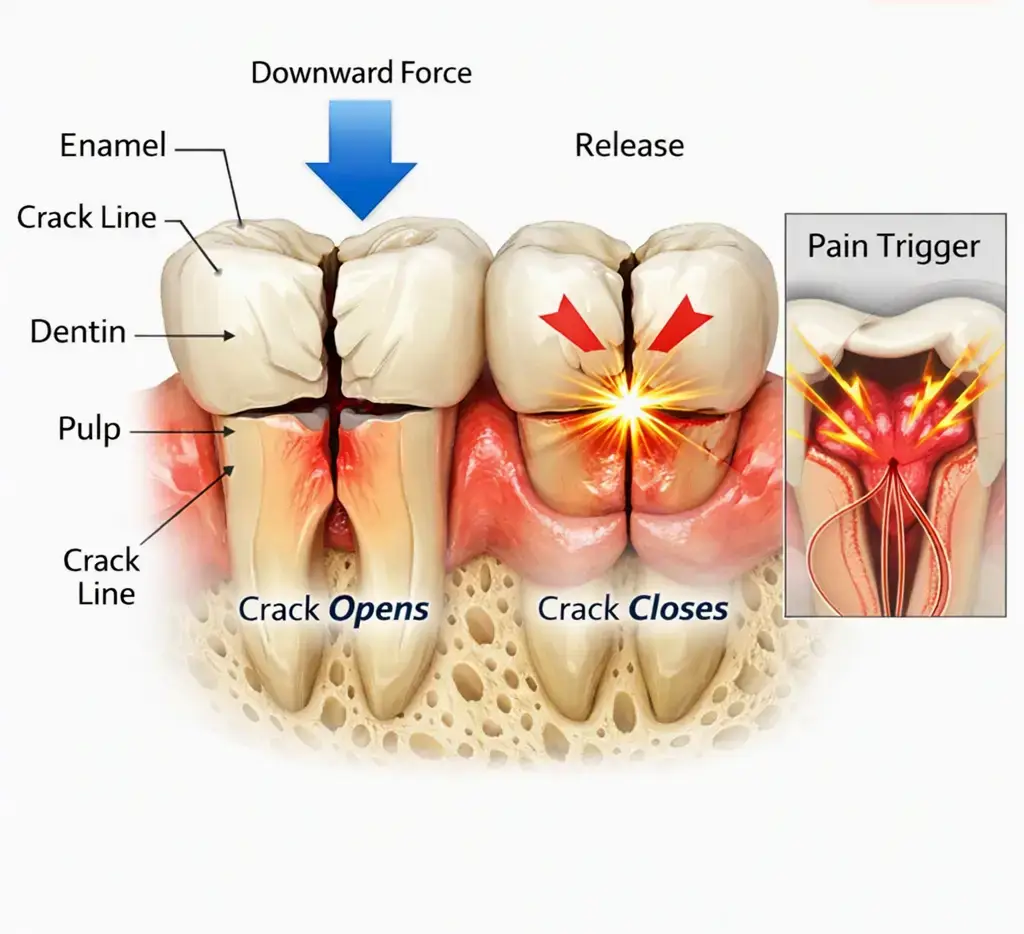
A tooth with a crack in it isn't one solid piece anymore. It's two parts of the same tooth still joined at the bottom. Bite down and the two parts get pushed a hair apart along the crack. Let go and they snap back together. That movement shoves fluid through the tiny tubes that run through dentin, and the nerve reads the sudden fluid shift as a sharp pain. A literature review of cracked tooth syndrome describes exactly this: the fragments move independently and fire the fast nerve fibers that produce brief, sharp pain.
Cold works the same way. It shrinks the tooth slightly and pulls fluid through the crack, so the cold sensitivity from a crack is a quick zing that ends when the cold does. An ache that hangs on for minutes after hot coffee is a different message, one I come back to further down.
Why your X-ray probably looked fine
Most cracks in back teeth run front to back across the chewing surface. A dental X-ray looks through the tooth from the cheek side, straight across the crack instead of along it, so the image shows solid tooth. A review of cone-beam imaging for cracked teeth makes the same point and adds that even a 3D scan usually can't resolve a fine crack in the crown.
When a patient tells me two other dentists looked and found nothing, I believe them. Nobody was careless. Cracks hide, and finding one takes testing, not just pictures.
Not All Cracks Are the Same
The Five Kinds of Crack, From Harmless to Unsavable
The American Association of Endodontists sorts cracks into five types, and I use the same system. Each type has a different outcome, and you deserve to know which one you have before you hear a price.
| Type | What it is | How it usually feels | What I do |
|---|---|---|---|
| Craze lines | Hairline lines in the outer enamel only. Almost every adult has a few. | Nothing at all | Nothing. They're cosmetic. I note them and move on. |
| Fractured cusp | One corner of the chewing surface cracks or breaks off, usually beside a large filling. | Sharp on biting, often easing once the loose piece is gone | Remove the piece and cover the tooth. The nerve is rarely involved. |
| Cracked tooth | A crack running from the chewing surface down toward the root, still in one piece. | The classic release pain and a quick cold zing that come and go | A crown soon, to hold it together. A root canal only if the nerve is past recovery. |
| Split tooth | A cracked tooth that has gone all the way through and separated into pieces. | Pain every time you chew; a piece may move | It can't be saved whole. Usually extraction, occasionally part of the tooth is kept. |
| Vertical root fracture | A crack that starts in the root, most often in a tooth that already had a root canal. | Mild and vague, often noticed as a gum infection beside the tooth | Usually extraction and replacement. |
Rows two and three are where acting early pays off. A cracked tooth left alone tends to keep going until it's a split tooth, and the AAE is blunt that a split tooth can't be saved intact. That's the whole case for not waiting on it.
Front teeth are a different story. A chip or a crack on an incisor usually comes from a fall or a bite on something hard rather than years of chewing pressure, and I cover those on my chipped front tooth page.
The $20 Exam
How I Find a Crack That Doesn't Show on an X-Ray
Every cracked-tooth visit starts with a $20 exam with digital X-rays. The X-ray rarely shows the crack itself, but it rules out the other things that cause the same pain: decay under an old filling, an abscess at the root tip, bone loss from gum disease. Then I go looking for the crack directly.
1Your story
Which side, what food, how long it's been going on, and whether the pain stops the moment you stop chewing. The history usually narrows it to one or two teeth before I pick up an instrument.
2Bite test
You bite on a small plastic tool one cusp at a time. When I land on the cracked cusp and you let go, you'll know. So will I.
3Light and magnification
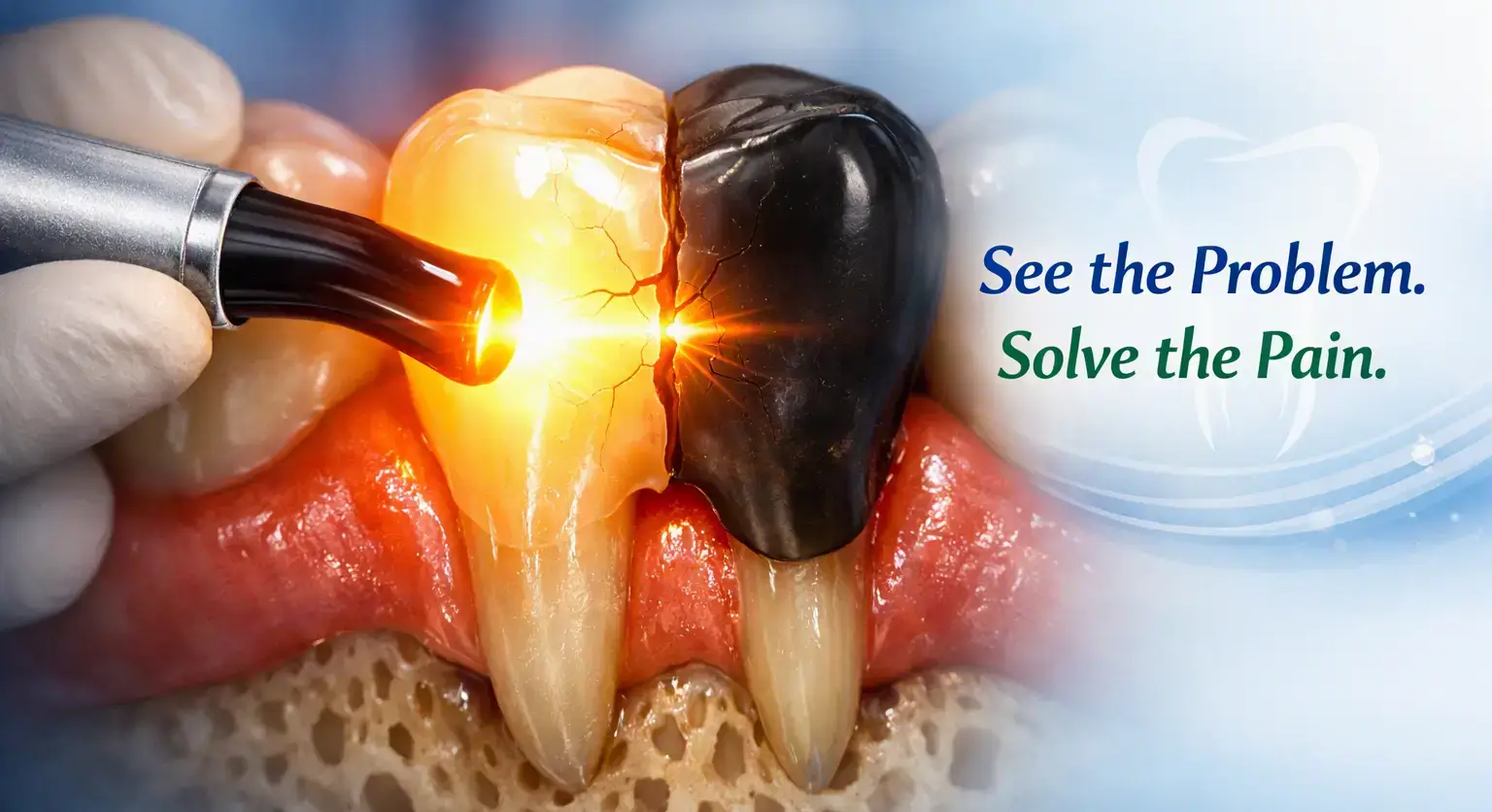
A bright light held against the tooth stops at a crack, so one side glows and the other goes dark. I show you what I'm seeing on the intraoral camera screen.
4Nerve testing
Cold and an electric pulp tester tell me whether the nerve is irritated but healthy or already failing. That one answer decides whether you need a root canal.
5Gum probing
A deep, narrow pocket right beside one tooth warns me the crack may have reached the root. It changes the odds a lot, as you'll see below.
6Under the old filling
Some cracks only show once an old filling comes out. If I suspect one under a big silver filling, I'll say so before I start, so the news isn't a surprise.
When a root fracture is on the list, especially in a tooth that already had a root canal, I take a cone-beam scan in the office. It won't always show the crack line, but it shows the pattern of bone loss a root fracture leaves behind, and that pattern is often the answer.
Treatment, by Depth
What I Do About a Cracked Tooth
The crack decides the treatment, not the other way around. Here is the ladder I work from, starting with the least.
Leave it alone
Craze lines and tiny cracks that cause no symptoms don't need anything. I take a photo with the intraoral camera so we have a baseline and look again at your next cleaning. I'm not going to crown a tooth because it has a line in it. Plenty of teeth carry a harmless line for decades.
A tooth-colored filling
When a small corner of a premolar breaks off cleanly, the nerve is calm, and the rest of the tooth is sound, a bonded tooth-colored filling can rebuild it in one short visit.
An onlay, once in a while
You'll read that an onlay is the conservative fix for a cracked cusp, and on paper it saves a little more tooth. In my experience onlays haven't held up as well as crowns, so I rarely place them. When one does make sense, a ceramic onlay is $850 cash. I explain that judgment on my onlay vs. crown page.
A crown, most of the time
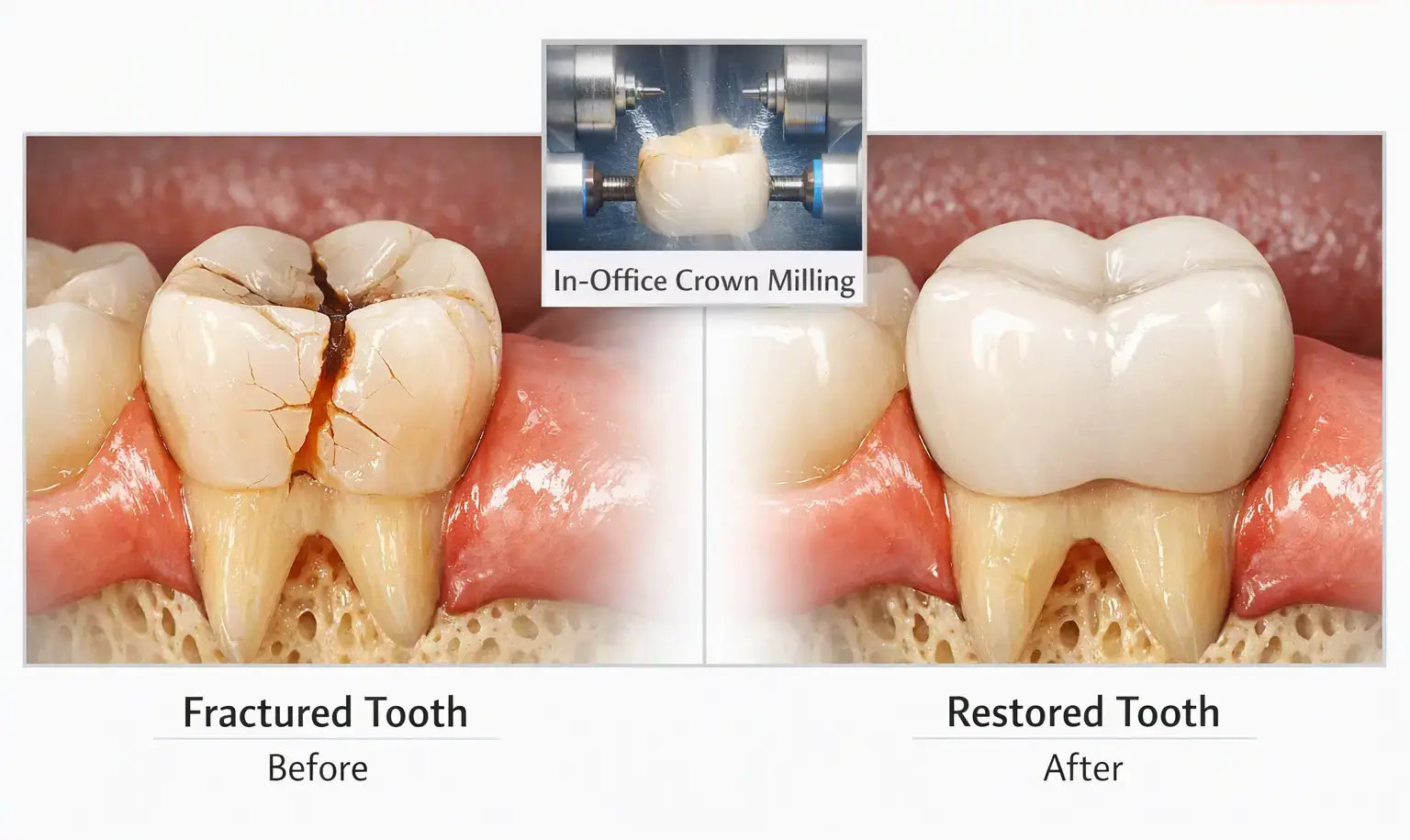
For a true cracked tooth, a full crown is what I recommend. It covers every cusp, so biting pressure pushes the pieces together instead of prying them apart. I scan, design, and mill same-day crowns here, so the tooth is protected before you leave. That matters more with a crack than with almost anything else, because two weeks in a temporary crown is two more weeks of chewing on a crack that's still moving. The price is $1,200 cash, in writing before I start.
A root canal, then a crown
If the crack has let bacteria reach the nerve, the nerve comes out first and the crown goes on afterward. The next section covers how I decide.
Taking the tooth out
A split tooth, a crack that runs well below the gum, or a vertical root fracture usually means extraction. I'll say so plainly when that's the honest answer, and we'll talk through replacing the tooth with an implant or a bridge. I'd rather you put your money into something that lasts than into a crown on a root that's already split.
The Root Canal Question
Does a Cracked Tooth Need a Root Canal?
Usually not, and this is where I see the most overtreatment. If the nerve is irritated but healthy, meaning cold gives a quick zing that fades within a few seconds and the tooth never hurts on its own, a crown by itself is often enough. In a six-year study of cracked teeth by Krell and Rivera, teeth with that kind of reversible nerve irritation were crowned and watched, and about one in five needed a root canal within roughly six months. The other four in five didn't. If your cracked tooth has a new crown and is still sore weeks later, my page on tooth pain after a crown explains which symptoms mean the nerve is settling and which mean it isn't.
That's why I don't do a root canal just in case before crowning a cracked tooth with a healthy nerve. If yours turns out to be the one in five, I treat the nerve through the crown, the crown stays on, and you've lost nothing by waiting.
A root canal comes first when the nerve is already past recovery: an ache that lingers for minutes after hot or cold, pain that wakes you at night, a tooth turning darker than its neighbors, or a pimple on the gum beside it. Those mean bacteria have followed the crack into the pulp. Then the order is a root canal and then the crown, and my root canal recovery page walks through the week after.
One number I watch closely is the gum probing next to the crack. In a study of cracked teeth treated with root canals, teeth with probing deeper than 6 mm survived two years about 74 percent of the time, against about 97 percent when the probing was shallower. A deep pocket tells me the crack has likely reached the root. When I see one, we'll talk honestly about whether saving the tooth is worth the money or whether replacing it is the better long-term spend.
What It Costs
What Fixing a Cracked Tooth Costs in Murrieta
$20
Exam and X-rays
Includes the bite test and light test
$1,200
Same-day crown
Cash price, milled in this office
$850
Ceramic onlay
Only when I think it will last
$505
Custom night guard
Hybrid hard and soft acrylic
Root canals are quoted per tooth, because a molar with four canals is a different job from a premolar with one. You'll have that number in writing before I start, along with everything else on your plan.
With insurance, I can't give you your out-of-pocket figure until we know your plan's coverage percentage and copay. Most plans treat crowns and root canals as major work. We're in network with Delta Dental PPO, Cigna, MetLife, Guardian, Aetna, and United Concordia, and CareCredit financing is available if you'd rather spread the cost out.
The cheapest cracked tooth is the one fixed while it's still a crack. A crown today costs far less than an extraction, a bone graft, and an implant later on.
Keeping the Next One Intact
Why Teeth Crack, and What Actually Prevents It
The Cleveland Clinic lists grinding, injuries, and simply getting older among the common causes, and that matches my chair. Almost every cracked tooth I treat has one or more of these behind it:
Where a night guard fits in
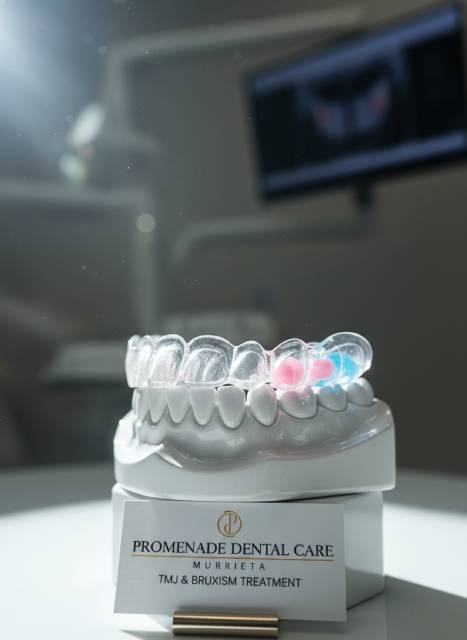
If I find a crack along with worn, flattened biting surfaces, I'll recommend a custom night guard. Mine are a hybrid: hard acrylic on the outside so it lasts, softer on the inside so you'll actually wear it. It's $505, flat.
A guard won't close a crack that's already there. What it does is protect the crown we just placed and the teeth beside it from the next few years of clenching. If your jaw is sore in the mornings too, the TMJ evaluation is the place to start.
Who Wrote This
Reviewed by Dr. Bao Nguyen, DDS
I graduated from the UCLA School of Dentistry and spent ten years as a dentist in the U.S. Navy, including an Advanced Education in General Dentistry residency at Naval Hospital Camp Pendleton. That adds up to 26 years of practice, the last sixteen of them on Date Street in Murrieta. I take around 40 hours of continuing education every year and belong to the American Dental Association, the California Dental Association, and the Tri-County Dental Society.
Cracks test a dentist's patience. It's tempting to start drilling until something turns up. I'd rather spend another ten minutes with the bite tool and the light, and if I can't find the crack, I'll tell you that and ask you to come back the next time it flares. When I do find one, I'll show it to you on the screen, tell you which of the five types it is, and give you the price before anything starts.
I do most root canals here myself. A crack that has run far down a root, or a case that needs a microscope and an endodontist's hands, goes to a specialist I trust, and I handle that handoff for you.

In Our Patients' Words
What Murrieta Patients Say
I became a patient in July of last year and needed some emergency dental work. I was able to get in the same day and have a crown and root canal done with zero pain! I recently had another toothache and was again provided a prompt same day appointment. Hands down the best dental experience I’ve had — zero pain, zero wait time. Pricing is always up front and affordable.
— Alicia Alvarado · Google Review
Skilled, friendly, and includes you every step of the way. Love that I could do a full cap replacement in one visit. Thank you Dr. Bao, you’re my new go-to man for dental work. Yessica at the front desk is a big help too.
— Philip C. · Google Review
I saw doctor Bao Nguyen at Promenade Dental Care on three occasions. In these visits, Dr Nguyen took time to carefully examine my dental concerns and explained very clearly to me what my conditions are, and what treatment options available. He advised me against immediate treatments for conditions that can be improved or maintained with good oral hygiene. He was very gentle with treatments, especially with the local anaesthetic injections. Greatly appreciate his professional care.
— C. Nguyen · Google Review
I’ve been to a lot of different dentists through the years and have had several fillings/crowns done. I often times experience pain and pressure during procedures even after the anesthetic. This time, zero pain, zero pressure, no nonsense. I’ll be coming back for regular cleanings and any needed procedures. They have my business indefinitely!
— Dominic S. · Google Review
Good to Know
Cracked Tooth FAQs
Can a cracked tooth heal on its own?
No. Enamel and dentin have no way to grow back across a crack, so a crack stays a crack. It can stay quiet for a long time, but it doesn't close up. What treatment does is hold the tooth together so the crack stops spreading.
Why does my tooth only hurt when I stop biting?
Because that's the moment the crack snaps shut. Biting pushes the two sides of the crack slightly apart, and releasing lets them spring back, which jolts the fluid inside the tooth and sets off the nerve. Pain on release from one specific tooth is the most reliable clue to a crack that I know of.
Why didn't the crack show up on my X-ray?
Most cracks in back teeth run front to back, and the X-ray looks through the tooth from the side, straight across the crack. The image shows solid tooth on both sides. I find cracks with a bite test, a bright light, magnification, and nerve testing, then use the X-ray to rule out other causes.
Is a cracked tooth an emergency?
A crack that only twinges when you chew isn't an emergency, but it should be seen within a week or two, because cracks spread. Facial swelling, a tooth that throbs on its own, a fever, or a piece that has broken away needs to be seen the same day. Call (951) 412-0127 and we'll make room.
Can a cracked molar be fixed with a filling or bonding?
Sometimes. If a small corner broke off cleanly and the nerve is calm, a bonded tooth-colored filling can rebuild it. A crack that runs down through the middle of the tooth needs a crown, because a filling sits inside the tooth and can actually wedge the two halves apart when you bite.
How long can I wait before getting a cracked tooth fixed?
There's no safe number of weeks, because it depends on how you chew and what you chew. Some cracks sit still for months and some split on the next almond. Until I see it, chew on the other side and avoid anything hard or sticky. If the pain changes from a quick jab to a lingering ache, come in sooner.
How much does it cost to fix a cracked tooth in Murrieta?
At my office the exam with X-rays is $20, a same-day ceramic crown is $1,200 cash, and an onlay, when I recommend one, is $850. If the nerve also needs treatment, the root canal is quoted per tooth in writing before I start. With insurance, your share depends on your plan's coverage percentage and copay.
Can a crack start under an old silver filling?
Yes, and it's one of the most common places I find them. Large silver fillings expand and contract with hot and cold differently than the tooth around them, and over twenty or thirty years that flexing can split the walls of the tooth. I often see the crack line clearly only after the old filling comes out.
Can a tooth that already had a root canal crack?
Yes. A root-canal-treated tooth has lost its internal moisture and blood supply and turns more brittle over time, which is why I crown back teeth after a root canal. Treated teeth are also where vertical root fractures usually happen, and those cracks are much harder to save.
What should I eat until my cracked tooth is fixed?
Chew on the other side and keep to softer foods. Skip ice, nuts, popcorn, hard bread crusts, jerky, and sticky candy, which can pull on the crack. Very hot or very cold drinks may sting. If you clench during the day, try to notice it and let your jaw rest.
Will a night guard stop my teeth from cracking?
It won't repair a crack, but for people who clench or grind at night it's the most effective protection I know of for the rest of their teeth and for any crown we place. My custom guards are a hybrid of hard and soft acrylic and cost $505. I recommend one when I see grinding wear alongside a crack, not to everyone with a cracked tooth.
Can a tooth be saved if the crack goes below the gum?
Sometimes, but the odds drop. A crack that ends just under the gum line may still be held with a crown, sometimes after a small gum procedure to reach it. A crack that runs well down the root, especially with a deep pocket beside it, usually can't be saved, and I'll tell you that before you spend money trying.
Do cracked teeth always need a crown?
No. Craze lines need nothing, and a small broken corner can often be rebuilt with a filling. A crown is for a crack that runs through the tooth and is causing symptoms or is likely to spread. Part of the exam is sorting out which of those you have, and I won't recommend a crown for a line that isn't going anywhere.
Bring the Tooth That Twinges to a $20 Exam
I'll find the crack if there is one, tell you which kind it is, and put the price in writing before anything is done.
(951) 412-0127 Request an AppointmentPromenade Dental Care · Dr. Bao Nguyen, DDS
26957 Date St., Suite B4, Murrieta, CA 92563
Mon, Tue, Thu 9:00 AM–5:00 PM · Wed, Fri 9:00 AM–3:00 PM · Sat by appointment & emergencies · Sun closed