
Murrieta · French Valley · Winchester · Menifee · Temecula
Onlay vs. Crown in Murrieta: Why I Usually Recommend the Crown
A dentist's plain answer to "can I get an onlay instead of a crown?" — what each one is, why onlays fail in real mouths, and what each costs at my office.
A back tooth has a large old filling, a corner has broken off, and you have been told it needs a crown. Then you read online that an onlay is the "conservative" choice that saves more tooth. I am Dr. Bao Nguyen, and I have been restoring teeth on Date Street in Murrieta since 2010. I can mill an onlay in the same appointment as a crown, and it costs less. I still rarely place them, and this page explains why, so you can weigh the trade for your own tooth.
UCLA School of Dentistry10 years, U.S. Navy Dental CorpsMurrieta since 2010
The Short Version
Onlay or Crown? What I Tell Patients at the Chair
An onlay covers the broken part of a tooth and leaves the rest alone. A crown covers the whole tooth. On paper the onlay wins: less drilling, more of your own enamel kept, a lower fee. In my own patients, over fifteen years of looking at my own work when it comes back, the onlay has not held up as well as the crown. Margins stain and open, ceramic edges chip where they thin out over a cusp, and a restoration that was supposed to save tooth ends up being replaced by the crown it was meant to avoid.
So my default on a tooth that has lost a cusp or carries a filling bigger than half its width is a same-day ceramic crown. I will place an onlay when the tooth is a good candidate and you understand the trade, and I charge less for it. What I will not do is sell you the cheaper option because it is easier to say yes to.
- Onlay, cash price
- $850, milled in-office, one visit
- Crown, cash price
- $1,200 starting fee, milled in-office, one visit
- With PPO insurance
- Fee depends on your coverage percentage and copay. I cannot quote it until we verify your plan.
- My usual recommendation
- Crown, once a cusp is gone or the tooth is cracked
- First step
- $20 exam with digital X-rays and a written quote for whichever option you choose
Four Rungs on One Ladder
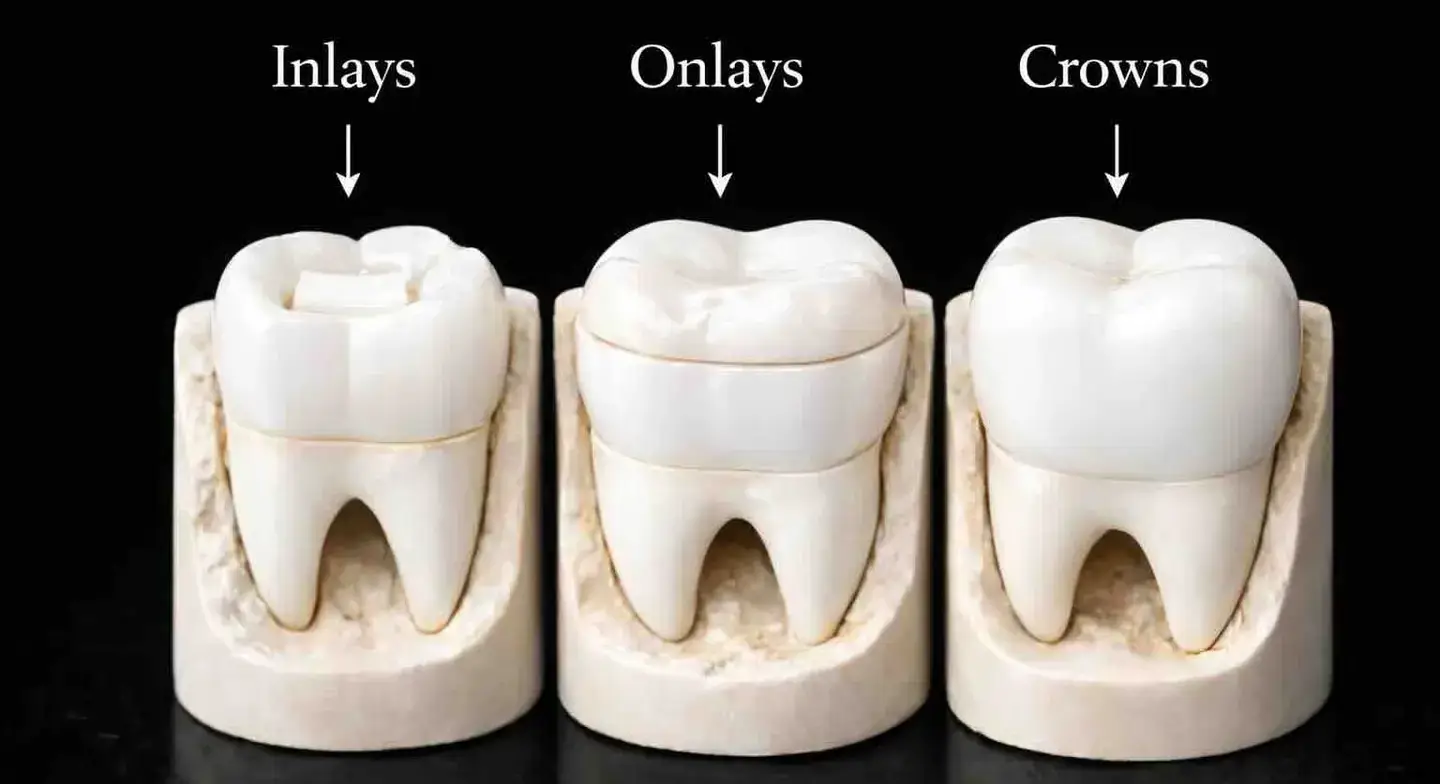
Filling, Inlay, Onlay, Crown: What Each One Actually Covers
Patients hear these four words as four different treatments. They are better understood as four points on a single scale of how much tooth is missing. The more structure that is gone, the further up the ladder the repair has to go.
| Restoration | What it covers | How it is made | Right for |
|---|---|---|---|
| Filling | A cavity inside the tooth, walls intact | Composite placed and shaped in the mouth | Small to moderate decay with strong enamel around it. See cavity fillings. |
| Inlay | The chewing surface between the cusps, no cusp coverage | Milled from a ceramic block, bonded in | A defect too wide for a filling but with every cusp still standing. Rare in my practice. |
| Onlay | The chewing surface plus one or more cusps | Milled from a ceramic block, bonded in | One broken cusp on a healthy, living tooth in a mouth that does not grind. Sometimes called a partial crown. |
| Crown | The entire tooth above the gumline | Milled from a ceramic block, bonded in | Cracked teeth, root-canal-treated back teeth, fillings past half the tooth, grinders. See same-day crowns. |
Notice that the inlay, the onlay, and the crown are made the same way in this office. All three come out of the same CEREC mill, from the same lithium disilicate or zirconia-reinforced blocks, in the same two-hour appointment. The difference is not the technology or the material. It is how much of the tooth the ceramic wraps around, and that turns out to matter more than most people expect.
The Part the Brochures Leave Out
Why Onlays Fail in Real Mouths
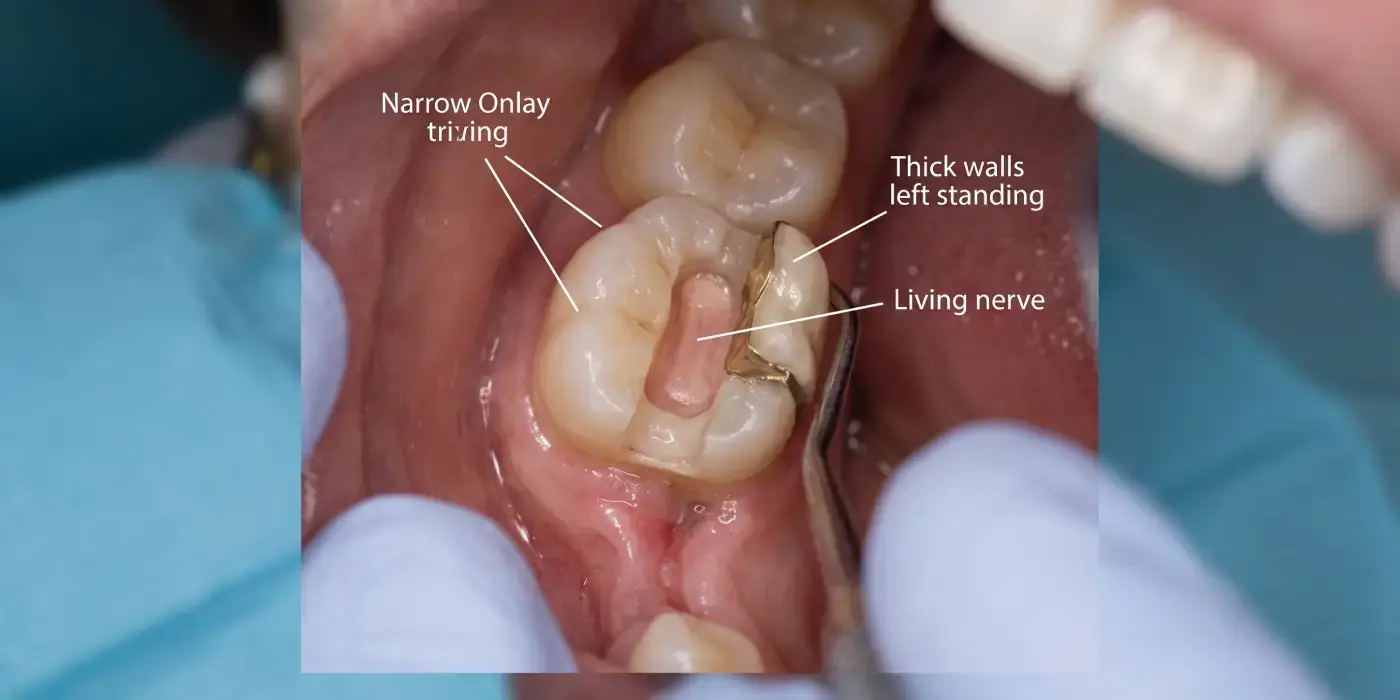
An onlay has no mechanical grip on the tooth. A crown wraps the whole circumference, so even if the cement weakened it would still be held on by geometry. An onlay sits on top of the tooth and stays there only because the bond holds. Bonding is an excellent technology when the field is dry, the enamel is fresh, and the edges of the ceramic are thick. In a molar at the back of a real mouth, with saliva, a tongue, and an old filling underneath, those conditions are met less often than the textbooks assume.
Then there is the edge itself. Where a crown's margin sits near the gumline in a protected zone, an onlay's margin usually runs across the chewing surface, straight through the area that takes the load every time you close. Ceramic feathered thin over a cusp is the weak point. It is exactly where I see the chip years later, and exactly where a stained, opening seam starts letting bacteria back under the restoration.
The research does not contradict this so much as explain it. A 2022 meta-analysis found onlays and crowns survive equally well over the first one to three years, which is why the internet sounds so confident. Look longer and the picture changes. A systematic review of ceramic onlays put survival past five years anywhere from 71 to 98.5 percent, with fracture the leading cause of failure and loss of margin integrity the most common form of deterioration. The same review flagged two situations where onlays fail more: teeth that have had a root canal, and patients who grind. A randomized trial on root-canal-treated molars reported every crown surviving at two years against roughly five in six onlays, with one in five onlays already showing marginal discoloration. That two-year gap in a study is the fifteen-year gap I see in my own charts.
A full crown can come loose too, but for different reasons: usually decay creeping under its edge, or a short tooth with too little height to grip. If that's happened to you, crown fell off covers what to do and when the same crown can go back on.
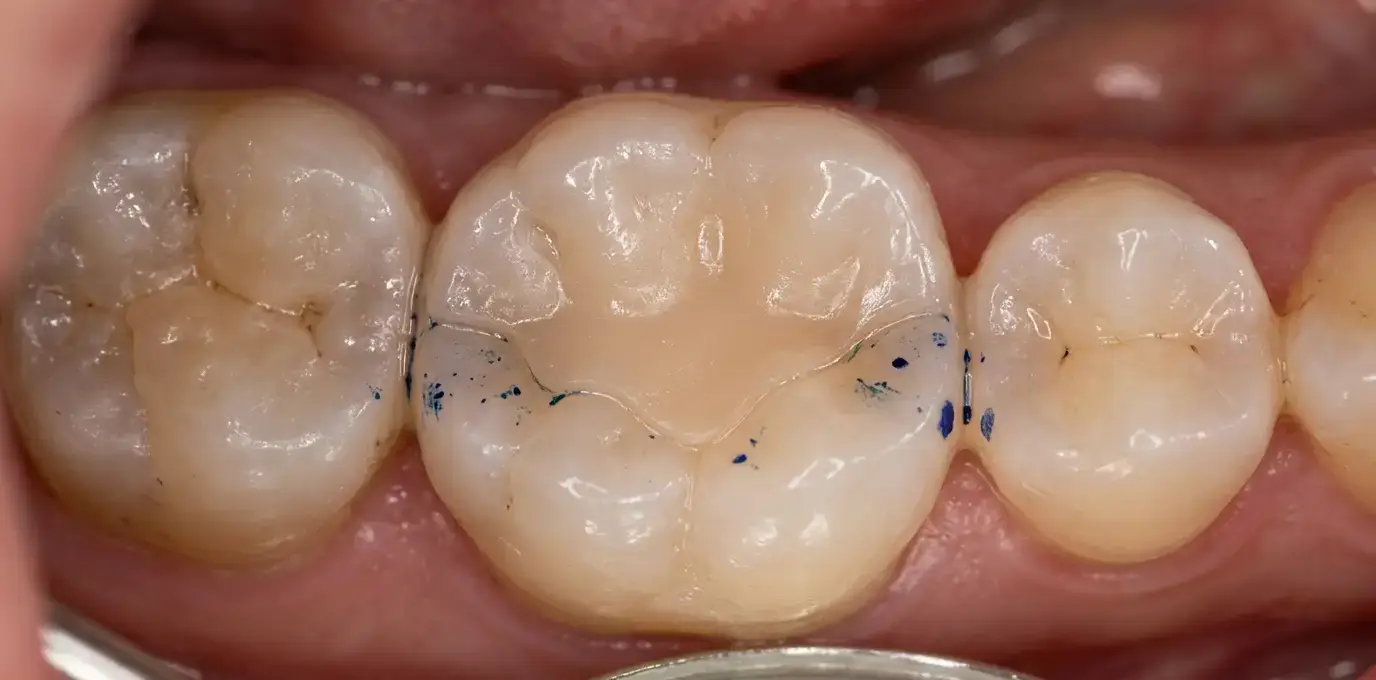
A word about "conservative." Saving tooth structure is a real value and I take it seriously. But a restoration that has to be redone is not conservative. The second procedure removes more tooth than the crown would have in the first place, and you pay for the tooth twice. Conservative means the repair that lasts, not the repair that drills least on the day.
The Honest Exceptions
When I Will Still Place an Onlay
None of the above means onlays are bad dentistry. It means they are a narrow tool, and I only reach for it when the tooth in front of me fits the narrow case. These are the conditions I look for before I will agree to one.
When a tooth checks every box, an onlay is a fair choice and I will make it in the same visit as a crown: numb, prepare, scan, design, mill, bond, done in about two hours. If it checks four out of six, we talk about why the crown is the better bet. If you have been diagnosed elsewhere and want a second opinion on whether your tooth is an onlay case, the $20 exam with digital X-rays is built for that conversation.
Both Numbers, In Writing
What an Onlay Costs in Murrieta Compared to a Crown
$850
Ceramic onlay, milled in-office
Cash fee. Excludes any additional work such as a core build-up or root canal.
$1,200
CEREC same-day ceramic crown
Starting cash fee. Excludes any additional work such as a core build-up or root canal.
Those are cash prices, and you see the one that applies to you on paper before I pick up a handpiece. The difference between the two is about $200. I want that number in front of you because it is the whole financial case for the onlay, and it is worth weighing against the cost of replacing a failed onlay with the crown later, which means paying for the same tooth a second time.
If you have dental insurance, I cannot tell you either number in advance. What you pay depends on your plan's coverage percentage for major restorative work, your copay, your deductible status, and how much of your annual maximum is left. We accept most PPO plans, including Delta Dental PPO, Cigna, MetLife, Guardian, Aetna, and United Concordia, and we verify benefits before treatment so the estimate you sign reflects your actual plan rather than a guess. Patients without insurance can use CareCredit financing for either option.
Same day, either way. Onlays and crowns are both designed, milled, and bonded in one appointment at the Date Street office. No temporary, no lab wait, no second numbing. Choosing the onlay does not save you a visit; it only saves the fee difference and some enamel.
The Dentist Making the Call
Why I Recommend the Crown When I Could Sell the Onlay
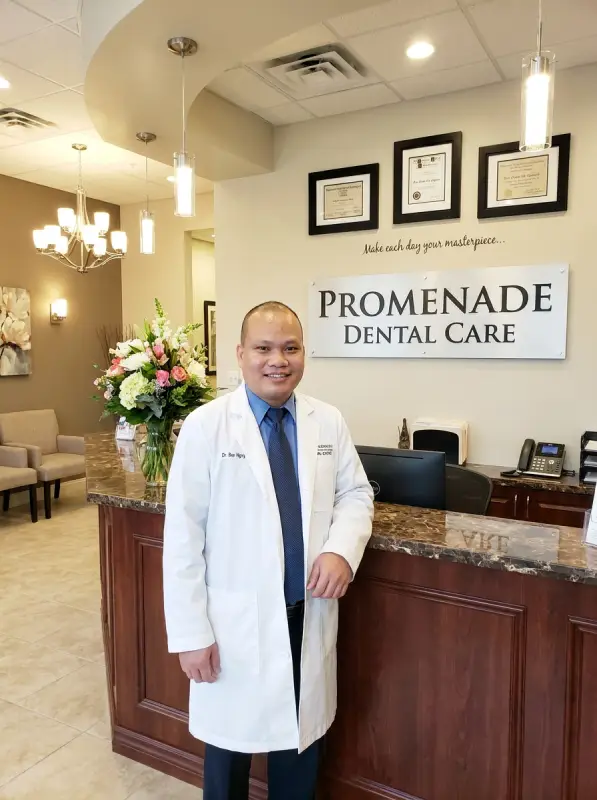
I trained at the UCLA School of Dentistry and spent ten years in the U.S. Navy Dental Corps, including a residency at Camp Pendleton. Military dentistry teaches you to plan restorations that will survive a deployment without you nearby to fix them, and that instinct has stayed with me. I would rather place one crown that is still in the mouth in twenty years than an onlay I have to apologize for in seven.
I have been treating families from Murrieta, French Valley, Winchester, Menifee, and Temecula at the same Date Street office since 2010, which means I see my own work come back for cleanings year after year. That feedback loop, not a lecture or a manufacturer's brochure, is where my opinion on onlays comes from. It is also why I keep the option available for the right tooth. The goal is the restoration that fits your tooth, not the one that fits a policy.
Related Care
Where the Onlay Question Usually Leads
Same-Day Crowns
Scanned, milled, and bonded in one two-hour visit. My default once a cusp is gone.
Cavity Fillings
When enough healthy tooth remains, a filling is still the right, and cheapest, answer.
Root Canal Treatment
A back tooth that has had a root canal gets a crown, not an onlay, to keep it from splitting.
Tooth Pain After a Crown
What's normal for the first two weeks after a crown, and the pain that means something else.
Grinding and Night Guards
If you clench or grind, that decides the onlay question before I do.
Broken Tooth Today?
Painful or bleeding fractures are seen the same day through the emergency line.
For the full picture from fillings to implants, see restorative dentistry.
From Patients Who Got a Straight Answer
What Murrieta Patients Say
“I saw doctor Bao Nguyen at Promenade Dental Care on three occasions. In these visits, Dr Nguyen took time to carefully examine my dental concerns and explained very clearly to me what my conditions are, and what treatment options available. He advised me against immediate treatments for conditions that can be improved or maintained with good oral hygiene. He was very gentle with treatments, especially with the local anaesthetic injections. Greatly appreciate his professional care.”
C. Nguyen · Google review
“This is a great place to go take care of your teeth. The team was very professional examining and providing with solutions by priority. I felt that I was in good hands. Very gentle and kind to me. They explained very well what was going on. The best dental care I have ever experienced! Will be coming back for all my future dental needs!”
Nancy R. · Google review
“Very knowledgable and good prices. Does only what is necessary — does not just look for stuff to charge for. Got an appointment quickly when I thought it was an emergency. My favorite dentist ever!!”
Sheila O’Connor · Google review
“Dr. Nguyen does a great job. He is always on time and very honest. Never has you do unnecessary treatments just to make extra money. I love that he is a solo practitioner and runs his own shop — he knows you personally as a patient. Best dentist I’ve ever had.”
Tom Haynes · Google review
Straight Answers
Onlay vs. Crown: Common Questions From Murrieta Patients
What is the difference between an onlay and a crown?
An onlay covers the chewing surface and one or more cusps of a back tooth and leaves the remaining walls untouched. A crown covers the entire tooth above the gumline. Both are milled from ceramic and bonded in place; the onlay depends entirely on that bond to stay put, while the crown is also held by the way it wraps around the tooth.
Do onlays last as long as crowns?
Not in my experience, and the longer-term research points the same way. Studies show onlays and crowns survive about equally for the first few years, but past five years onlay survival ranges from roughly 71 to 98.5 percent, with fracture and margin breakdown the usual causes. Teeth that have had root canals and patients who grind lose onlays fastest. In my own patients the crown has been the more dependable restoration, which is why it is my default.
How much does an onlay cost in Murrieta?
At Promenade Dental Care a ceramic onlay milled in-office is $850 cash, compared with a $1,200 starting fee for a same-day crown. Both exclude any additional work such as a core build-up or root canal, and both are quoted in writing before treatment. If you have PPO insurance, the fee depends on your coverage percentage and copay, so we verify your benefits first rather than guess.
Can I get an onlay instead of a crown to save money?
You can ask, and if your tooth is a good candidate I will do it. The saving is about $200. Weigh that against the risk that the onlay fails and the tooth needs the crown anyway, at which point you have paid for the same tooth twice and lost more structure than a crown would have cost in the first place. For a broken cusp on a living, non-grinding tooth the onlay is a fair option; for a cracked or root-canal-treated tooth it is a false economy.
Is an onlay the same as a partial crown or a three-quarter crown?
Essentially, yes. "Partial crown," "three-quarter crown," and "overlay" are older or regional names for a restoration that covers some but not all of the tooth. Whatever it is called, it shares the onlay's strengths and its weaknesses: less drilling, more retained enamel, and a bond-dependent margin that runs across the chewing surface.
Can an onlay be made in one visit?
Yes. In this office an onlay is scanned, designed, milled from a ceramic block, and bonded in the same two-hour appointment as a same-day crown. There is no temporary and no lab wait for either one. Choosing the onlay does not save a visit; it saves the fee difference and some tooth structure.
Do I need a crown after a root canal, or is an onlay enough?
On a back tooth, a crown. Root-canal-treated molars and premolars are drier and more brittle than living teeth, and the research on onlays shows they fail faster on those teeth. A crown holds the walls together under chewing load; an onlay does not. This is the one situation where I will not place an onlay regardless of the tooth's shape.
What if I grind my teeth?
Grinding settles the question in favor of the crown. Parafunction is one of the two biggest predictors of onlay failure, because a bonded ceramic edge across the chewing surface takes the full force of every clench. A crown distributes that load over the whole tooth. If you grind, I will also talk with you about a night guard to protect the crown and the teeth around it.
What is an inlay, and do you place them?
An inlay is a ceramic piece made to fit inside the cusps of a back tooth, like a filling made outside the mouth. It doesn't cover any cusp, so it only works when the walls of the tooth are healthy. In those teeth, a bonded tooth-colored filling usually does the same job in one step for less, so I rarely place inlays.
Does dental insurance cover an onlay?
Most PPO plans treat a ceramic onlay as a major service, much like a crown, and pay around half after the deductible. Some plans apply an alternate-benefit rule and pay only what they would for a large filling, leaving you the difference. The front desk can check your plan before treatment, and the cash fee here is $850.
Can a failing onlay be replaced with a crown?
Usually, yes. When an onlay chips, leaks at the edge, or comes loose, I remove it, clean out any decay underneath, and in most cases make a same-day crown in the same visit. The tooth has to have enough healthy structure left, which I check on the X-ray and under magnification before we start.
Is an onlay a good fix for a cracked tooth?
Rarely. A crack needs the whole tooth held together so biting pushes the pieces toward each other, and only a full crown does that. An onlay leaves walls uncovered, so the crack can keep spreading underneath it. For a true cracked tooth, I recommend a crown, and I explain why on my cracked tooth page.
Bring the Tooth. Get Both Numbers and an Honest Recommendation.
A $20 exam with digital X-rays tells you whether your tooth is an onlay case, a crown case, or neither. Serving Murrieta, French Valley, Winchester, Menifee, and Temecula from 26957 Date St, Suite B4, off Murrieta Hot Springs Road.
(951) 412-0127 Call to Book Your Exam