
Patient Guide · Murrieta, CA
Dental Bone Grafting and Socket Preservation in Murrieta
Keeping the jaw ready for an implant, or rebuilding one that has already shrunk, done in the same chair by the dentist who places the implant.
Two kinds of patients ask me about bone grafting. The first is sitting in the chair the day a tooth has to come out, deciding whether to add "socket preservation" to the extraction. The second lost a tooth years ago, finally wants an implant, and has just heard that the bone is no longer there to hold one. This page covers both: what happens to the jaw after a tooth is gone, when a graft is worth doing and when it is not, what the procedure involves, and what it costs on Date Street.
Start Here
Do You Actually Need a Bone Graft?
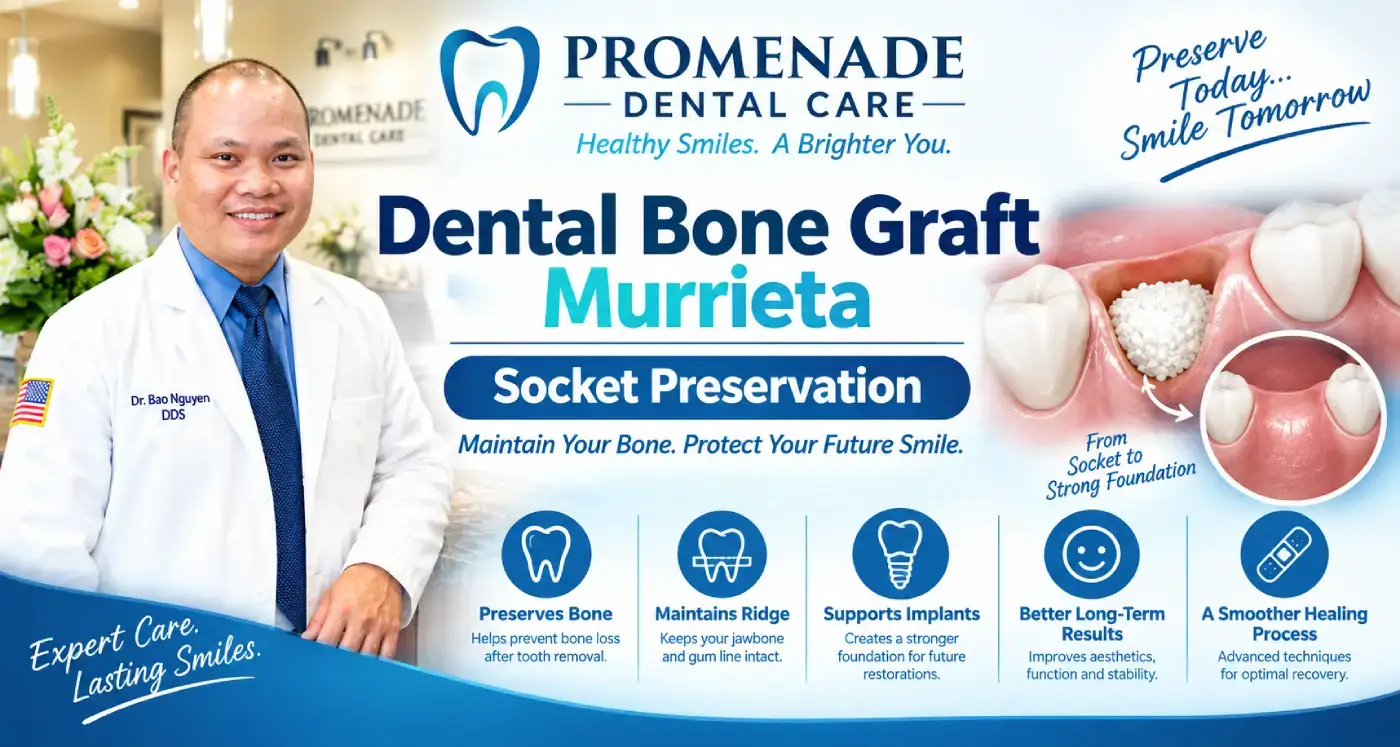
Not every extraction needs a graft, and I say that as the person who would be paid to do it. A graft is a means to an end, and the end is almost always a dental implant, occasionally a denture that needs a ridge to sit on. If neither is in your plans, filling the socket buys you very little, and I will say so before you spend $500 on it.
If you want an implant in that spot within the next year or so, socket preservation at the time of the extraction is usually worth it: it keeps the ridge close to its original width and spares you a bigger rebuild later. If the tooth is a wisdom tooth, a back molar you plan to leave empty, or is coming out ahead of a full denture, the socket can heal on its own. And if the tooth has been gone for years and the ridge has already collapsed, the question is no longer whether to preserve it but whether to rebuild it, covered further down.
- Best time to graft
- The same visit as the extraction, when the socket walls are still intact. It adds about 15 minutes to the appointment.
- Skip it when
- No implant or denture is planned for that site, or the site has plenty of bone and imaging shows an implant can go in as-is.
- Who does it
- Dr. Bao Nguyen, DDS, in-house on Date Street. The same dentist plans the graft, places it, and later places the implant.
- Healing before an implant
- Roughly three to six months of integration, confirmed on imaging rather than by the calendar.
- What settles it
- The $20 exam with digital X-rays, plus a cone-beam CT scan when the ridge needs measuring in three dimensions.
The Biology
What Happens to the Jaw After a Tooth Comes Out
Bone stays where it is used. The bone around a tooth root, called the alveolar ridge, is there because chewing loads the root and the root loads the bone. Remove the tooth and that signal stops, so the body begins reclaiming the ridge. The loss is fastest in the first three months and mostly finished within a year. The published numbers surprise patients: a review in The Open Dentistry Journal puts the width loss at four to six millimeters, up to half the original ridge, with roughly two-thirds of that shrinkage happening in the first 90 days.
Width is the dimension that matters for an implant: a ridge narrowed to the thickness of a pencil cannot hold a post safely no matter how much height is left. That is why the socket-preservation decision belongs on extraction day. Once the outer wall of the socket has resorbed, the only way to get the width back is a larger, staged augmentation.
Two other things accelerate bone loss and change my recommendation: an infection at the root tip, which has usually eaten away part of the socket wall before I ever see it, and untreated gum disease, which is the most common reason the ridge is already thin on the day of the extraction. Both make a graft more likely to be worthwhile, and both need to be cleared up before an implant goes in.
One Name, Three Procedures
Socket Preservation, Ridge Augmentation, or Sinus Lift
"Bone graft" is a category, not a single procedure. Which one you need depends on where the site is and how much bone has already gone. Most patients on this page will be in the first column.
| Socket preservation | Ridge augmentation | Sinus lift | |
|---|---|---|---|
| Same visit as the extraction | Months or years after tooth loss | Before an upper back implant | |
| Keep the ridge from shrinking | Rebuild width or height already lost | Add height under the sinus floor | |
| Smallest; adds about 15 minutes | Larger; a separate 60 to 90 minute surgery | Separate surgery, or done with the implant | |
| 3 to 4 months, sometimes 6 | 4 to 6 months, sometimes longer | 4 to 9 months for a lateral lift | |
| This page | This page | Sinus lift guide |
Ridge augmentation is the one I most want patients to avoid needing, because it is the one socket preservation prevents. A tooth pulled in 2018 with a ridge that has narrowed since can still be rebuilt with particulate graft under a membrane, but it is a bigger appointment, a longer wait, and a higher cost than the 15-minute version would have been on the original extraction day. The sinus lift has its own page because the upper back jaw loses bone in a different direction, upward into the sinus.
What Goes in the Socket
What Bone Graft Material Actually Is
The graft is not a solid piece of bone. It is a sterile, sand-like mineral that I pack into the socket to hold the space open while your own bone grows through it. Over the following months your body replaces most of it with new, living bone; the graft is a scaffold, not a permanent implant. The Cleveland Clinic patient guide groups the options into four kinds:
Over the graft goes a thin collagen membrane that keeps gum tissue, which grows faster than bone, from growing down into the space the bone is supposed to fill. The membranes I use dissolve on their own. If you have a religious or personal objection to donor or animal-derived material, tell me at the consultation; the synthetic option works well for socket preservation and I would rather plan around your preference than find out afterward.
What to Expect
The Bone Graft Procedure, Step by Step
This walk-through describes socket preservation, the version most patients get. A standalone ridge augmentation follows the same sequence but begins with a small incision over the healed ridge and takes longer.
Exam, X-rays, and a written quote
The $20 exam with digital X-rays shows the tooth, the socket walls, and any infection. You hear whether a graft is worth doing for your plans and get the price in writing before anything is booked.
Numbing, with sedation if you want it
Local anesthesia on every case. Nitrous oxide is available for anxious patients, and I recommend it when the extraction itself is surgical.
The extraction, done gently
The point is to keep the thin outer socket wall intact, so the tooth comes out with as little force on that wall as possible. A wall broken during the extraction is a wall the graft has to rebuild.
Cleaning the socket
Any infected tissue at the root tip is scraped out. Grafting over infection is how grafts fail, so this step is not skipped even when it adds a few minutes.
Placing the graft and membrane
The mineral is packed into the socket to the level of the surrounding bone, the collagen membrane is laid over it, and the gum is closed with a few dissolving stitches.
Healing, then imaging
Three to six months later, an X-ray or cone-beam scan confirms the site has turned into solid bone. That image, not the calendar, decides the implant date.
Healing
Bone Graft Recovery
The first week feels like an extraction, because it is one: soreness for two to four days, swelling that peaks around day two, a little oozing the first evening. Most patients manage with over-the-counter medication; I prescribe something stronger when the case warrants it. One thing specific to grafts: for the first few days you may notice gritty grains of graft material in your mouth. That is normal. The membrane holds the bulk in place, and losing a few surface particles does not affect the result.
The aftercare rules are the same ones that prevent dry socket after any extraction, and they matter more here because the graft depends on an undisturbed clot: no straws, no smoking, no vigorous rinsing, and no probing the site with your tongue. The full list is on the extraction aftercare section, and I send you home with a written version specific to your procedure.
Soft tissue closes in two to three weeks. The bone underneath takes three to six months to mature, invisibly and painlessly. Rushing an implant into a graft that has not finished integrating is the most common reason a grafted implant fails, so I confirm the site on imaging before booking the placement. The implant timeline page lays out how the graft phase fits into the full sequence.
Plain Talk
Bone Graft Risks and Failure Rates
Socket grafts fail rarely, and almost always for one of three reasons: infection present before the graft went in, an exposed membrane letting the graft wash out, or smoking. Smokers have measurably worse graft outcomes; if you smoke I will tell you the graft may not take and let you decide. A failed graft is cleaned out, allowed to heal, and can usually be regrafted.
The other caution is about expectations. The research on socket preservation is solid on one point and hedged on another. It reliably reduces how much ridge is lost, by a bit over a millimeter of width and height on average in a 2014 meta-analysis in the Journal of Dental Research. What it does not do is stop resorption entirely, and some authors, including a 2022 review in the British Dental Journal, argue the clinical benefit is smaller than dentists tend to claim. I agree that a graft should not be sold as a routine add-on to every extraction. I recommend it where the ridge is thin, the site is in the smile zone, or an implant is definitely planned, and skip it where it will not change the outcome.
Because socket preservation works inside a socket that already exists, the nerve and sinus considerations of larger jaw surgery are minimal. They do apply to bigger augmentations in the lower back jaw, which I plan on a cone-beam scan for that reason.
Pricing
What a Bone Graft Costs in Murrieta
A bone graft for socket preservation at Promenade is a flat $500 per site including membrane, and it goes in writing after the exam and X-rays, not as a range you have to decode. That fee covers the graft material, the membrane, and my time placing it at the extraction visit. A standalone ridge augmentation on a site that collapsed years ago is a larger surgery and is quoted separately once I have measured the ridge. The graft, the extraction, and the implant are listed as separate lines on the same written plan so you see the whole cost before committing to any of it.
Written quote before any procedure. In-network with Delta Dental PPO, Cigna, MetLife, Guardian, Aetna, and United Concordia. CareCredit financing available.
Most PPO plans treat bone grafting as major oral surgery and pay 50 to 80 percent after the deductible, though some only cover it when tied to a covered implant; I verify your benefit before the appointment. If you are comparing implant quotes around Murrieta and Temecula, ask each office whether grafting is inside or outside the number. Graft and implant under one roof means one facility, one set of images, and no second specialist consultation.
Who Wrote This
Reviewed by Dr. Bao Nguyen, DDS
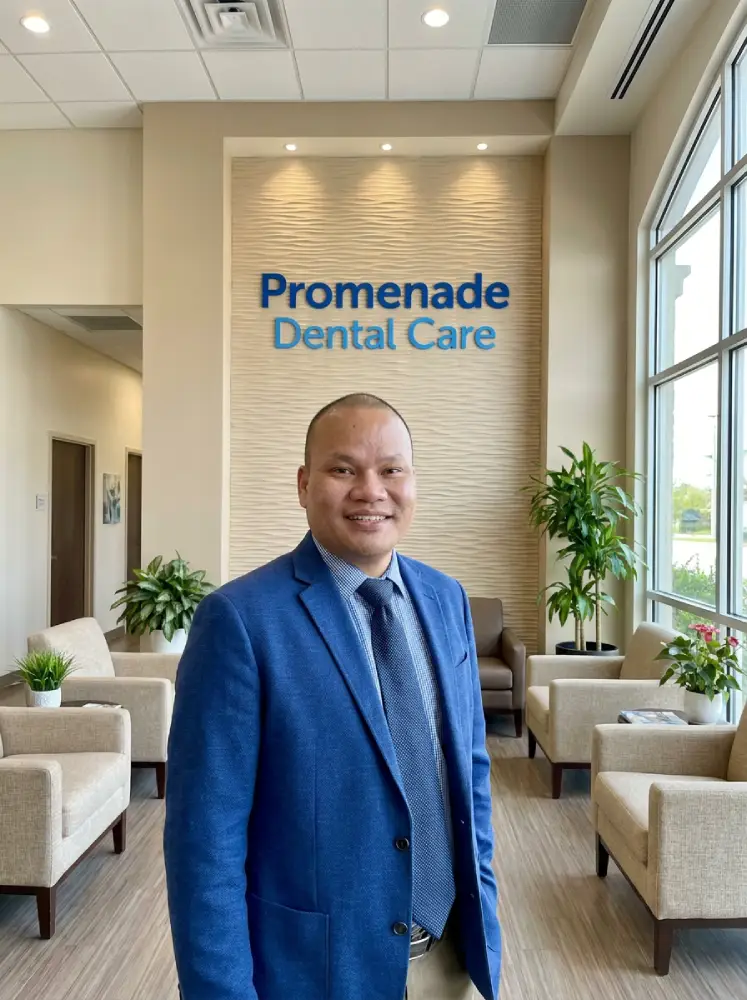
I trained at the UCLA School of Dentistry and then spent ten years in the U.S. Navy Dental Corps, including an Advanced Education in General Dentistry residency at Naval Hospital Camp Pendleton. Grafting bone for Marines back from trauma was routine that year, which is why I have never treated it as something to refer across town. Since 2010 I have done extractions, socket grafts, ridge rebuilds, and the implants that follow them in my own practice, usually all for the same patient.
The part of this job I care most about is the recommendation, not the procedure. I would rather tell you a graft is not worth your money in a given site than bill for one that will not change your outcome. When one is worth doing, I do it myself, and I place the implant into it myself when it is ready.
Related Care
Before and After the Graft
Tooth Extraction
Simple vs. surgical removal, aftercare, and when a socket graft is offered at the same visit.
Dental Implants
Candidacy, the full process, why bone and gum health decide the outcome, and cost.
Sinus Lift
The upper-back-jaw graft that adds height under the sinus floor before an implant.
Oral Surgery
Extractions, erupted and slightly impacted wisdom teeth, grafting, soft-tissue work, and biopsies in-office; deep impactions and jaw surgery are referred.
Guided Implant Surgery
How the cone-beam scan that measures your ridge also plans the implant placement.
From Our Google Reviews
What Surgical and Implant Patients Say
★★★★★Rated 5 out of 5 stars
“Dr. Nguyen does a great job. He is always on time and very honest. Never has you do unnecessary treatments, just to make extra money. I love that he is a solo practitioner and runs his own shop. That keeps his overhead costs low and he knows you more personally as a patient. All my family comes to see him. Best dentist I've ever had.”
Tom Haynes · Google review
★★★★★Rated 5 out of 5 stars
“Dr Nguyen is very quick but very gentle, he has more practical experience than most others, so my wife and I recommend his fine dentistry.”
Blue Sheppard · Google review
★★★★★Rated 5 out of 5 stars
“I saw doctor Bao Nguyen at Promenade Dental Care on three occasions. In these visits, Dr Nguyen took time to carefully examine my dental concerns and explained very clearly to me what my conditions are, and what treatment options available. He advised me against immediate treatments for conditions that can be improved or maintained with good oral hygiene. He was very gentle with treatments, especially with the local anaesthetic injections. Greatly appreciate his professional care. (P.S. Although we have the same surname, we are not related. I am newly relocated to the area and was looking for new dentist, happened to read other great reviews about Dr Nguyen)”
C Nguyen · Google review
Bone Grafting FAQs
Common Questions About Dental Bone Grafts
Do I need a bone graft after a tooth extraction?
Only if something will be built on that site later. If a dental implant is planned, socket preservation at the time of the extraction usually saves you a larger rebuild. If the site will stay empty, is a wisdom tooth, or is coming out ahead of a full denture, the socket can generally heal on its own. Dr. Nguyen tells you which applies before the extraction, and a graft is never added without your agreement.
Can I get a bone graft years after losing a tooth?
Yes. A ridge that has narrowed since an old extraction can be rebuilt with a ridge augmentation, which places graft material under a membrane over the healed ridge. It is larger than socket preservation and needs four to six months or more to integrate, but it makes an implant possible where the site would otherwise not hold one.
What is dental bone graft material made of?
Most socket grafts use processed human donor bone (allograft) or mineral from bovine bone (xenograft), both sterilized and supplied by licensed tissue banks. Synthetic mineral (alloplast) is available for patients who prefer it, and your own bone (autograft) is used for large rebuilds. In every case the material is a scaffold your body gradually replaces with its own bone.
Does a dental bone graft hurt?
Not during the procedure, which is done under local anesthesia with sedation available. Afterward it feels like a tooth extraction: soreness for two to four days and some swelling that peaks around the second day. The months of bone maturation that follow are painless.
Can the graft and the implant be done on the same day?
Sometimes. When the socket walls are intact and there is enough bone to hold the implant firmly, Dr. Nguyen can place the implant at the time of the extraction and pack graft material around it. When the walls are thin or an infection has damaged the socket, the graft goes in first and the implant waits three to six months. Imaging at the exam decides which path is safe.
Why did I find gritty particles in my mouth after the graft?
A few grains of graft material working out through the gum in the first several days is normal and does not mean the graft has failed; the membrane holds the bulk in the socket. If a large amount comes out, the stitches open, or the site gets more painful after day three, call the office.
What does a bone graft cost at Promenade Dental Care?
A bone graft for socket preservation is a flat $500 per site including membrane, confirmed in writing after the $20 exam with digital X-rays. That covers the graft material and membrane placed at the time of the extraction. A standalone ridge augmentation for a site that has already collapsed is a larger procedure and is quoted separately. The extraction and the implant are priced on their own lines of the same written plan.
Will my PPO plan pay for a bone graft?
Many PPO plans cover bone grafting as major oral surgery at 50 to 80 percent after the deductible, though some only pay when the graft is tied to a covered implant. Promenade Dental Care is in-network with Delta Dental PPO, Cigna, MetLife, Guardian, Aetna, and United Concordia, verifies your benefit before the appointment, and offers CareCredit for the remainder.
What happens if a bone graft fails?
Failure is uncommon and usually traces to pre-existing infection, an exposed membrane, or smoking. The site is cleaned out, allowed to heal, and can generally be grafted again once it is healthy. A failed graft delays the implant by a few months; it does not rule it out.
Facing an Extraction, or Ready for an Implant?
A $20 exam with digital X-rays tells you whether a graft is worth doing in your case, and you get the answer in writing.
(951) 412-0127 Call Promenade Dental Care