
Interesting Facts About Dentists and Teeth That Will Surprise You
From Sumerian tooth worms to same-day ceramic crowns — the real history of dentistry is stranger than the myths.
Organized dental care is more than 4,500 years old, and the road from tooth-worm remedies to digital scanners is full of odd cures, unlikely firsts, and facts that get repeated wrong more often than they get repeated right. Below are the ones worth knowing — including who really invented the foot-powered drill, how many dentists practice in the US today, why your teeth are as unique as your fingerprints, and what current research actually says about why people fear the dentist.

From Ancient Egypt to Modern Murrieta: 4,500 Years of Dental Care
If you think dentistry is a modern profession, the record says otherwise. The earliest named dentist we know of was an Egyptian official called Hesi-Re, who practiced around 2600 B.C. The inscription in his tomb describes him as the greatest of those who deal with teeth — a job title that predates the Great Pyramid.
The concern is older still. A Sumerian text from roughly 5000 B.C. blamed tooth decay on “tooth worms,” creatures thought to burrow into enamel and cause pain from the inside. The idea was durable: versions of it survived in European folk medicine into the 1700s. We now know the actual mechanism is acid produced by oral bacteria feeding on fermentable carbohydrates — but the underlying worry, that something is quietly destroying your teeth, was correct.
Landmark firsts in dental history
- c. 5000 B.C.
- Sumerian text records the “tooth worm” theory of decay.
- c. 2600 B.C.
- Hesi-Re, the first dentist known by name, practices in Egypt.
- c. 600 A.D.
- Maya artisans set carved shell into the jaw to replace missing teeth — the earliest known implants.
- 1498
- The bristle toothbrush appears in China: boar hair set into bamboo or bone handles.
- 1530
- The first book devoted entirely to dentistry is published in Germany.
- 1728
- Pierre Fauchard publishes Le Chirurgien Dentiste, describing fillings and prosthetics in detail.
- 1790
- John Greenwood builds the first foot-powered dental drill.
- 1844
- Dentist Horace Wells pioneers nitrous oxide for painless extraction.
- 1866
- Lucy Beaman Hobbs becomes the first woman to earn a DDS.
- 1945
- Grand Rapids, Michigan fluoridates its water — a first anywhere in the world.
Barbers, blacksmiths, and the birth of the profession
For much of the Middle Ages, the person who cut your hair also pulled your teeth. Barber-surgeons handled extractions, bloodletting, and minor surgery, and the red-and-white barber pole is a leftover from that arrangement. On the nineteenth-century American frontier the job frequently fell to the blacksmith, who at least owned tongs and a steady hand.
Dentistry became a distinct profession with formal training only in the 1840s, when the world's first dental college opened in Baltimore. Today's dentists — including Dr. Bao Nguyen at Promenade Dental Care, who trained at UCLA and completed an Advanced Education in General Dentistry residency with the U.S. Navy — work at the far end of that transformation.
Who actually built the first dental drill
This one is routinely told wrong. The first foot-powered dental drill was built in 1790 by John Greenwood — George Washington's dentist — who adapted his mother's foot-treadle spinning wheel to spin a drill bit, freeing both hands for the work. Greenwood used it mainly to shape dentures rather than to cut into living teeth. Washington himself did not build it; he was the patient.
Greenwood was ahead of his time in other ways too. He was among the first American dentists to push patients to brush daily, at a point when almost nobody did.
The evolution of toothpaste
Ancient Greek tooth powders combined crushed coral, pumice, and iron rust. Romans used urine as a mouth rinse — the ammonia in it genuinely does whiten, which is why Portuguese urine reportedly commanded a premium. Egyptian recipes preserved on papyrus called for rock salt, mint, pepper, and dried iris flower, and were arguably the most effective formulas anywhere for the next thousand years. Toothpaste in a tube, roughly as we would recognize it, is only about 150 years old.
Dental Myths vs. What the Evidence Shows
A lot of dental trivia circulates in a slightly wrong form. Here are the claims we hear most often in the operatory, and what the record actually supports.
| The claim | Verdict | What the record shows |
|---|---|---|
| George Washington had wooden teeth | Myth | His dentures were ivory, gold, lead, and human and animal teeth. Never wood. |
| Enamel is the hardest substance in the human body | True | About 5 on the Mohs scale — but brittle, and it cannot regenerate. |
| Dental implants are a modern invention | Myth | Maya jawbones from around 600 A.D. show shell implants with real bone fusion. |
| A dentist helped invent cotton candy | True | Dentist William Morrison and confectioner John C. Wharton patented the machine in 1897. |
| About a quarter of adults fear the dentist | Outdated | A 2025 JADA national survey put it at 72.6%, with 26.8% reporting severe fear. |
| Nothing could numb you before Novocain | Myth | Dentist Horace Wells demonstrated nitrous oxide in 1844, sixty years earlier. |
Strange and Surprising Facts About Teeth
Most of these never come up during a routine dental exam, which is a shame, because several of them explain why the exam matters.
Teeth across the animal kingdom
An adult human has 32 teeth. Dogs have 42, cats 30, and the armadillo 104 — the most of any common land mammal. All of them are outclassed by the garden snail, which carries upward of 25,000 microscopic teeth on a ribbon-like tongue called a radula and uses them to rasp through a vegetable garden overnight. Dolphins can carry up to 250 teeth and never chew with any of them; the teeth are purely for gripping.
Enamel is remarkable, and it does not grow back
Tooth enamel is the hardest tissue the human body produces — roughly 5 on the Mohs scale, which puts it above ordinary steel on that particular measure. The catch is that hardness and toughness are different properties. Enamel resists gradual wear beautifully and cracks under sudden force, which is why a molar can survive decades of chewing and then split on a popcorn kernel.
More importantly, enamel is the only tissue in the body with no capacity to regenerate. The cells that build it, called ameloblasts, are active only while a tooth is forming and die off once it erupts — so the enamel you have at about age 13 is all the enamel you will ever have. Bone remodels, skin closes, liver regrows. Enamel does none of that. Once it is gone, replacing it is a restorative job — which is the entire reason composite fillings and crowns exist.
Dental implants are about 1,400 years old
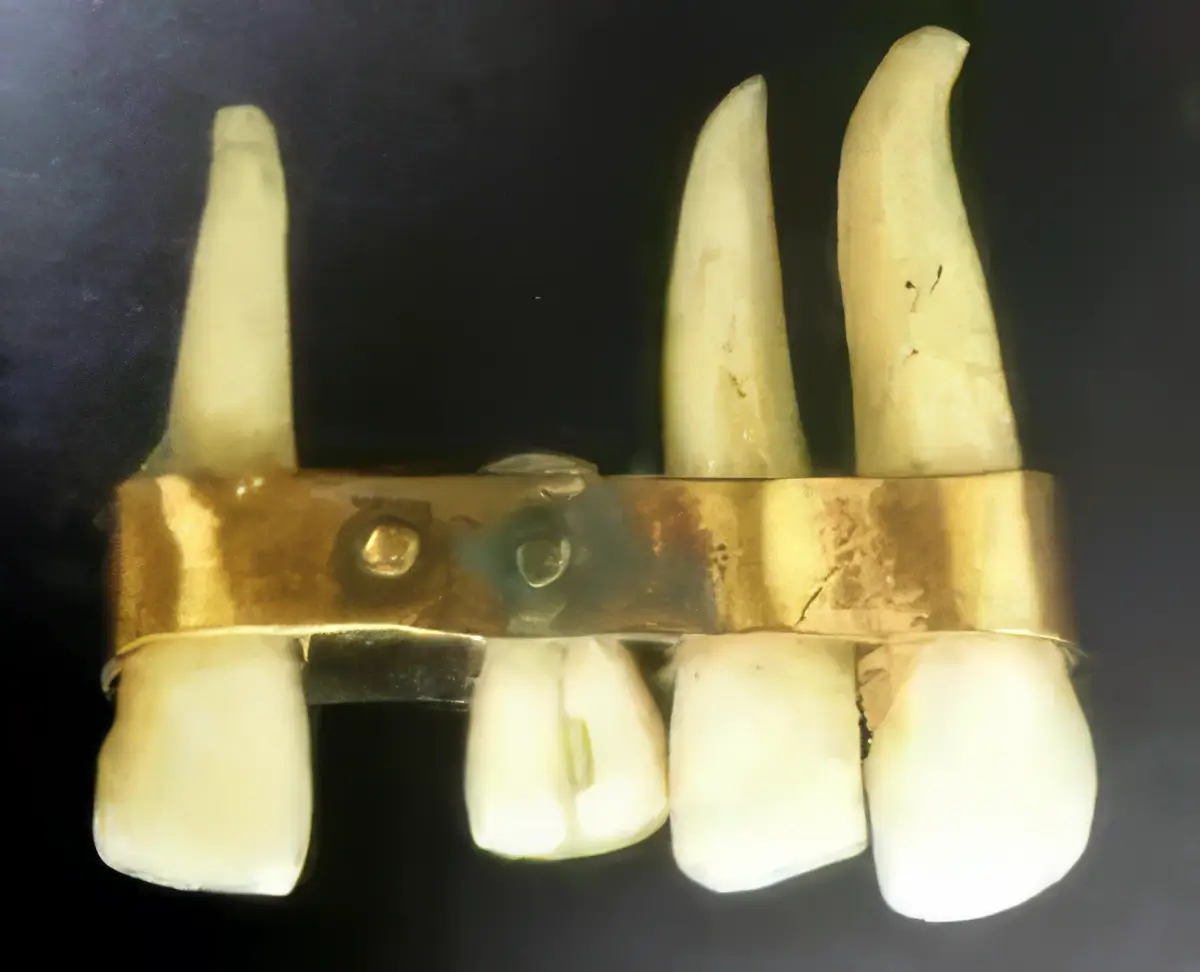
Around 600 A.D., Maya artisans set carved pieces of shell into the jaws of living patients to replace missing front teeth. When archaeologists examined the specimens, they found that bone had grown tightly against the shell — the same osseointegration that makes a modern titanium dental implant work. The materials changed. The principle did not.
A few more worth knowing
Isaac Newton's tooth was once the most valuable in the world. In 1816 a tooth said to be his sold in London for £730 — on the order of tens of thousands of dollars today. The buyer had it set into a ring.
Cotton candy was co-invented by a dentist. In 1897 the Nashville dentist William Morrison and the confectioner John C. Wharton patented a machine that spun melted sugar into fine threads. They called it “fairy floss” and sold 68,655 boxes of it at the 1904 World's Fair in St. Louis.
The oldest known filling is beeswax. A 6,500-year-old jawbone found in Slovenia has a cracked canine sealed with beeswax — the earliest direct evidence of therapeutic dental work anywhere.
Brushing math is unforgiving. The ADA recommends two minutes, twice a day. Do that for eighty years and you spend roughly 80 days of your life brushing. Studies that time people put the average adult at only about 45 to 47 seconds — barely enough to cover half the mouth — and roughly one in four adults brushes with a hard horizontal scrub that wears enamel and gums. Two minutes, soft bristles, gentle circles at a 45-degree angle to the gumline: it is the single easiest thing on this page to fix.
You will make about 25,000 quarts of saliva in a lifetime — enough to fill two swimming pools. It is doing more than you think: it rinses food away, neutralizes the acids that cause cavities, and carries calcium and phosphate back into enamel between brushings, which is why a dry mouth reliably leads to decay.
Your teeth are as unique as your fingerprints. No two people have the same set — not even identical twins — and neither do they have the same tongue print. Tooth size, shape, spacing, wear, and every filling and crown add up to a signature that forensic dentists can match with high confidence, which is why dental records are a standard identification tool.
Why People Fear the Dentist — And What Has Actually Changed
Until recently the working estimate was that roughly a quarter of American adults were anxious about dental visits. In September 2025 the Journal of the American Dental Association published the first nationally representative survey on the question, run by researchers at NYU College of Dentistry across 1,003 census-matched adults. The finding was much larger than expected: 72.6% reported some degree of dental fear — 45.8% moderate, 26.8% severe.
That reframes the problem. Dental fear is not a minority experience confined to a few patients; it is closer to the default. Fear of pain is consistently the leading trigger, followed by the sound and feel of the drill, and a sense of having no control while lying back in the chair. Most of it traces to a specific bad experience, usually in childhood or adolescence. The encouraging part of the same study: among people who reported fear, about 71% said they would be interested in treatment to address it.
How much modern dentistry has changed the experience
Two centuries ago a patient gripped the armrests while a treadle-driven drill turned at a few dozen revolutions a minute. There was no local anesthetic until Horace Wells demonstrated nitrous oxide in 1844, and no injectable local until Alfred Einhorn synthesized procaine — Novocain — in 1905. Given that history, it would be strange if dental fear weren't culturally embedded. What it should not do is keep you out of the chair now.
How Many Dentists Are in the US — And Where the Gaps Are
According to the American Dental Association's Health Policy Institute, there were 202,485 professionally active dentists in the United States as of 2024 — about 59.5 per 100,000 people. Roughly four in five are general dentists like Dr. Nguyen; the remaining fifth work in recognized specialties such as orthodontics, endodontics, oral surgery, and pediatric dentistry.
The composition of the profession has shifted sharply. Women made up about 16% of practicing dentists in 2001 and 39.6% as of 2024, and they are now the majority of dental school graduates. Dentist-to-population ratios vary enormously by state, from roughly 40 per 100,000 in Arkansas to more than 100 in the District of Columbia.
Those totals conceal a serious distribution problem. As of December 31, 2025, the Health Resources and Services Administration counted 7,443 designated Dental Health Professional Shortage Areas covering about 63.7 million people. In those areas, only about a third of the need for dental care is being met, and HRSA estimates it would take roughly 10,744 additional practitioners to lift the designations. Rural communities carry most of that burden.
Which is the practical argument for community practices. Promenade Dental Care has served Murrieta, Temecula, Menifee, French Valley, Winchester, and the surrounding Riverside County communities since 2010, covering the full scope of general, restorative, cosmetic, and emergency care at published prices — including same-day CEREC crowns, root canals, and ultrasonic teeth cleaning.
Dental Care at Promenade — Murrieta, CA
If any of this prompted you to finally book the appointment you have been putting off, here is where to start.
Dental Exam & X-Rays
A full exam with digital X-rays for $20. Early detection is the cheapest dentistry there is.
Sedation Dentistry
Nitrous oxide and a deliberately slow pace for patients with real dental anxiety.
Same-Day CEREC Crowns
No impression putty, no temporary crown, no second appointment. A milled ceramic crown in about two hours.
Dental Implants
Titanium posts that fuse with the jaw — the modern version of a 1,400-year-old idea.
Emergency Dentist
Same-day appointments for toothaches, broken and knocked-out teeth, and abscesses.
Kids Dentist
Gentle first visits, because most adult dental fear starts with a bad childhood appointment.
What Our Patients Say About Promenade Dental Care
Good Day, My name is Debby and I have been a patient of Dr. Nyugens now for over a decade at Promenade Dental. Doctor and staff, which includes Edith are incredibly wonderful, so kind, caring and compassionate, yet professional. They go above and beyond to care for their patients which includes painless treatments in a calming atmosphere. Dr. Nyugen met me at his office for an emergency visit during the height of covid and I will forever be thankful for it! I refer family and friends who have a pleasant experience also. Most Sincerely!
— Debra Davidowitz · Google review
Great service rates as well. As a retired Navy Chief Warrant Officer it's great to have found a former Navy Dentist.
— Phillip Rice · Google review
Promenade Dental Care is fantastic! The staff are warm, professional, and genuinely care about your comfort. The office is spotless and modern, and appointments always run on time. Dr Nguyen explains everything clearly and make sure you feel at ease. You leave with a bright smile and real confidence in your care.
— Sabrina Clemens · Google review
Ready to Book the Appointment You Have Been Putting Off?
Routine checkup or a problem you have been ignoring for years — you will get transparent pricing, an explanation before anything happens, and no judgment about the gap since your last visit.
(951) 412-0127 Book Your $20 Exam26957 Date St, Suite B4, Murrieta, CA 92563
Mon, Tue, Thu 9:00 AM – 5:00 PM • Wed, Fri 9:00 AM – 3:00 PM
Not open on weekends, except about one pre-booked Saturday a month for routine visits
FAQs About Dentists, Teeth, and Dental History
Who was the first dentist in recorded history?
The earliest dentist known by name was an Egyptian official called Hesi-Re, who practiced around 2600 B.C. His tomb inscription describes him as the greatest of those who deal with teeth. Egyptian practitioners also developed herbal preparations for tooth pain and gum inflammation, which makes them the earliest organized dental care we can document.
Is tooth enamel really harder than steel?
On the Mohs scale, yes. Enamel scores about 5, which places it above ordinary steel on that particular measure. Hardness is not the same as toughness, though: enamel resists gradual wear extremely well but is brittle and can crack or chip under sudden force. It is also the only tissue in the human body that cannot regenerate: the cells that produce enamel, called ameloblasts, are active only while a tooth is developing and die off once the tooth erupts, so chipped or acid-worn enamel is permanent. That is why protecting it with regular care and fluoride matters so much.
Are teeth really as unique as fingerprints?
Yes. No two people share an identical set of teeth, not even identical twins, and your tongue print is unique as well. Tooth size, shape, spacing, wear patterns, and any fillings, crowns, or root canals combine into a signature that forensic dentists can match with high accuracy. Because enamel is durable enough to survive conditions that destroy other identifying features, dental records are a standard tool for identifying people.
Did George Washington really have wooden teeth?
No, that is a myth. Washington's dentures were made from ivory, gold, lead, and a combination of human and animal teeth, including hippopotamus ivory. They were uncomfortable and needed frequent adjustment, and they changed the shape of his mouth enough to be visible in his later portraits. He lost his first adult tooth at 24 and had only one natural tooth left by the time he was inaugurated.
Who actually invented the first dental drill?
John Greenwood, one of George Washington's dentists, built the first known foot-powered dental drill in 1790 by adapting his mother's foot-treadle spinning wheel to rotate a drill bit. He used it primarily to shape dentures rather than to cut living teeth. The story is often garbled into Washington himself building it, which is not what happened.
Who was the first female dentist in the United States?
Lucy Beaman Hobbs became the first woman to earn a Doctor of Dental Surgery degree, graduating from the Ohio College of Dental Surgery in 1866 after years of being refused admission. Emeline Roberts Jones preceded her in practice, working alongside her husband from the 1850s and continuing on her own after his death, making her the first woman known to have practiced dentistry in the United States without a formal degree.
What is the oldest dental filling ever discovered?
A 6,500-year-old human jawbone found in Slovenia has a cracked canine sealed with beeswax, and it is the earliest direct evidence of therapeutic dental work found so far. Before modern composite and amalgam materials existed, cavities were also packed with stone chips, plant gum, and resin.
When was fluoride first added to public water supplies?
Grand Rapids, Michigan became the first city in the world to fluoridate its public water supply, beginning in January 1945, after researchers noticed that communities with naturally fluoridated water had dramatically less tooth decay. Within about ten years, cavity rates among Grand Rapids children had fallen by more than 60%. As of 2022, about 72.3% of the U.S. population served by community water systems received fluoridated water, and the CDC lists water fluoridation among the ten great public health achievements of the 20th century.
Is it true that a dentist helped invent cotton candy?
Yes. In 1897 the Nashville dentist William Morrison and the confectioner John C. Wharton patented the first machine that could spin melted sugar into fine threads. They called the result fairy floss and sold 68,655 boxes of it at the 1904 World's Fair in St. Louis. It was renamed cotton candy in the United States some years later.
Which animal has the most teeth?
Among familiar land animals the armadillo leads with 104 teeth. The overall winner is the garden snail, which carries more than 25,000 microscopic teeth on a ribbon-like tongue called a radula. Dolphins can have up to 250 teeth but use them only to grip prey rather than to chew. Adult humans have 32.