
Teeth Cleaning · Checkups & Cleanings · Murrieta
Teeth Cleaning in Murrieta: What Happens at a $95 Ultrasonic Cleaning
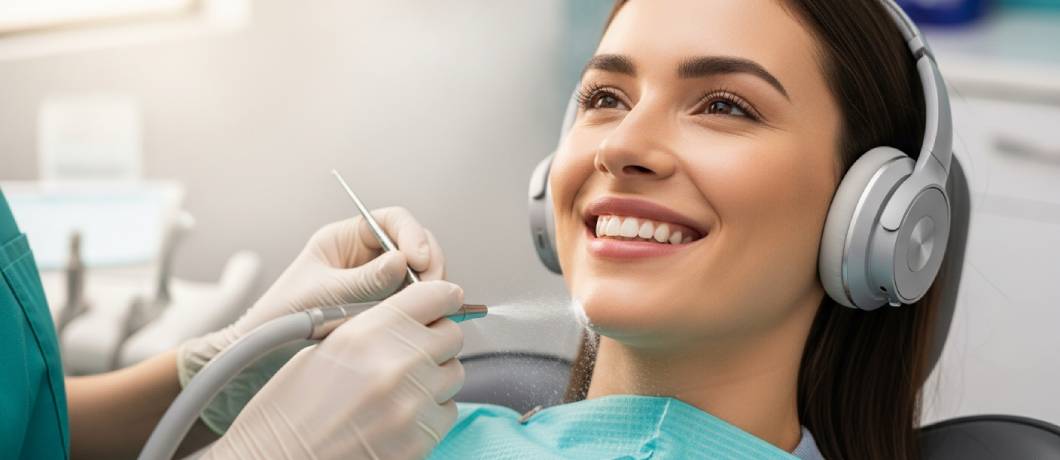
A routine cleaning removes the hardened tartar and surface stain your toothbrush can't, on the teeth and just under the gumline. Here it's done mostly with an ultrasonic scaler, a vibrating tip with a cooling water spray, then hand instruments only where something's left, and a polish. It's $95 without insurance for gums that measure healthy. If your gums measure deeper than that, a routine cleaning is the wrong appointment, and I'll tell you so.
Why it matters
Why do you need a professional cleaning if you brush and floss?
Because brushing and flossing remove soft plaque, and they can't remove tartar. Plaque that's missed for a few days starts to harden into calculus, and once it's hard, it's bonded to the tooth. No brush, water flosser, or toothpaste takes it off. Tartar is rough, so new plaque sticks to it faster, and when it sits at the gumline it keeps the gum inflamed. That inflammation is gingivitis, the stage of gum disease that still reverses.
Where I see it most on Murrieta patients is behind the lower front teeth and on the cheek side of the upper molars. Those are the spots right next to where the salivary glands empty, and saliva carries the minerals that harden plaque. Even careful brushers build some there.
- Procedure
- Routine cleaning (dental prophylaxis) with an ultrasonic scaler, hand finishing, and a polish
- Price
- $95 without insurance, for gums that measure healthy
- Chair time
- About 45 minutes; longer if it's been years
- Numbing
- Not usually needed; available for a sensitive area if you ask
- Usual interval
- Every 6 months for most adults; every 3 to 4 months after gum disease treatment
Who it's for
Who is a routine cleaning right for?
A routine cleaning is right when your gums measure healthy or close to it: pockets of 1 to 3 millimeters with little or no bleeding. That covers most adults who've kept up with visits. It's the right appointment if any of these sound like you:
Bleeding with shallow pockets usually means gingivitis, and a cleaning plus better daily cleaning at those spots reverses it. The gingivitis page covers what that looks like at home.
Decision boundaries
When is a routine cleaning the wrong appointment?
When the tartar is below where a routine cleaning reaches, or when something else needs attention first. I'd rather tell you that than bill a cleaning that doesn't fix the problem.
| What the exam shows | The right appointment | Why |
|---|---|---|
| Pockets of 4 mm or more with bleeding, or bone loss on X-rays | Full mouth deep cleaning, $320 without insurance | Tartar on the root below the gum needs scaling and root planing, usually with numbing |
| A toothache, a swollen gum, or a broken tooth | An emergency visit first | Pain and infection come before routine care |
| Pockets that stayed deep after a deep cleaning | Laser gum therapy | Another routine cleaning won't change a pocket that's already been treated |
| Healthy gums, very little tartar, low risk | A cleaning when it's needed, not automatically | For low-risk adults the evidence for a fixed schedule is weak, as below |
That last row deserves a straight explanation. A 2018 Cochrane review found that for adults without serious gum disease who see a dentist regularly, cleanings on a fixed six- or twelve-month schedule made little difference to gum inflammation over two to three years, compared with cleaning when the dentist judged it necessary. Tartar still builds, and I still remove it when it's there. But if your mouth is clean and healthy at a checkup, I won't sell you a cleaning just because the calendar says so.
Step by step
What happens during an ultrasonic cleaning?
Measuring comes first, because the numbers decide what kind of cleaning you get. Then the cleaning runs in this order.
1Measure the gums
Every pocket gets measured and any bleeding gets noted. New patients have this as part of the $20 exam with digital X-rays.
2Ultrasonic scaling
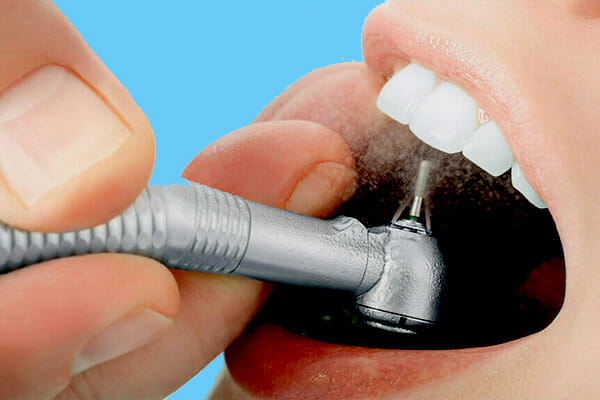
The tip vibrates thousands of times a second against a fine water spray. The vibration breaks tartar off the tooth and the water rinses it away, with much less pressure on the tooth than a hand scraper.
3Hand finishing
Fine hand instruments go only where a deposit is left, usually in tight spaces between teeth. Most of the work is done by then.
4Polish
A polish lifts surface stain and smooths the enamel so plaque has a harder time sticking. On stained teeth, implants, or veneers, air polishing uses a fine powder spray instead of gritty paste.
5Floss and the trouble spots
You'll hear which spots collected the most tartar and which gums bled, so you know where to spend an extra ten seconds each night.
6Your next date
Your interval is set from what we measured: six months for most people, three or four after gum disease treatment.
How I decide
How do I decide which cleaning you need?
From your gum measurements and your X-rays, not from a menu. Some offices nearby recommend a deep cleaning to nearly every new patient. I'd rather show you your own numbers on the screen and let them make the case. The American Academy of Periodontology describes the same dividing line: when pockets deepen and bone is lost, the root itself has to be cleaned.
| Your measurements | What it means | The cleaning |
|---|---|---|
| 1 to 3 mm, no bleeding | Healthy gums | Routine cleaning, $95 |
| 1 to 3 mm, bleeding in spots | Gingivitis | Routine cleaning, $95, plus home care at those spots |
| 4 mm or more, bleeding, bone loss on X-ray | Periodontitis | Full mouth deep cleaning, $320 |
| Already treated for gum disease | Keeping it stable | Maintenance cleanings every 3 to 4 months, priced at the exam |
Cost
What does a teeth cleaning cost without insurance?
A routine ultrasonic cleaning is $95 without insurance. New patients add the $20 exam with digital X-rays, because I need the measurements before I know which cleaning is right. These are my published prices:
Ultrasonic teeth cleaning
$95
Healthy gums, polish included, without insurance
New-patient exam with digital X-rays
$20
Gum measurements and oral cancer screening included
Full mouth deep cleaning
$320
All four quadrants, only when the measurements call for it
If you need something other than a routine cleaning, you get that price in writing before we start. A $95 cleaning twice a year costs a small fraction of the crown, root canal, or deep cleaning that skipped years tend to lead to.
Insurance and payment
Does insurance pay for teeth cleanings?
Most PPO plans cover routine cleanings as preventive care, usually twice a year and at a high percentage. A deep cleaning is billed under different codes and is usually covered at a lower rate. I accept PPO plans and I'm in network with Delta Dental PPO, Cigna, MetLife, Guardian, Aetna, and United Concordia, and my team checks your benefits before the visit.
Insured fees aren't listed here because they depend on your plan's coverage, deductible, and copay. Without insurance, the $95 is what you pay. I take cash, Visa, Mastercard, American Express, Discover, and CareCredit.
Limits
What can't a cleaning do?
Honest limits: a routine cleaning doesn't reach tartar deep under the gum, and it doesn't grow back bone that gum disease has already taken. It removes surface stain, but it won't change the natural shade of your teeth. It won't stop gingivitis from coming back if the plaque at those spots isn't cleaned every day. And if bad breath is coming from your tonsils, sinuses, or stomach, a cleaning won't touch it.
The usual side effects are small: gums that are a little tender or bleed for a day, and teeth that feel sensitive to cold for a day or two once tartar comes off root surfaces it was covering. If gums are badly inflamed, they can bleed more than you expect during the cleaning. That settles as the inflammation goes down, usually within a week or two, which is what the Mayo Clinic describes for treated gingivitis too.
Alternatives
What are the other ways to clean teeth, and when does each make sense?
| Option | Makes sense when | What's different |
|---|---|---|
| Ultrasonic cleaning | Healthy or nearly healthy gums, any amount of tartar | Vibration and water spray do most of the work; less scraping |
| Hand scaling only | Very light tartar, or a patient who can't tolerate the water spray | Slower, more pressure on the tooth, but it works |
| Air polishing | Heavy surface stain, or implants, veneers, and bonding | A powder spray replaces the gritty polishing paste; it's a finishing step, not a substitute for removing tartar |
| Deep cleaning | Pockets of 4 mm or more with bleeding or bone loss | Cleans and smooths the root below the gum, usually with numbing |
Afterward
How will your teeth feel afterward?
Smooth, mostly. Run your tongue behind your lower front teeth and the rough edge is gone. You can eat and drink normally right away. If your gums were inflamed, they may be tender or pink in the brush for a day, and teeth may be a little sensitive to cold where tartar came off. A sensitivity toothpaste helps if it lingers. If a tooth is still sensitive after a week, call, because that's worth a look.
The cleaning only lasts as long as the daily cleaning keeps up. The National Institute of Dental and Craniofacial Research puts it simply: brushing twice a day, cleaning between the teeth, and regular dental visits are what keep gum disease from starting.
Booking
How do you book a cleaning, and can it be on a Saturday?
Call (951) 412-0127. The office isn't open on weekends, but about one Saturday a month I come in for checkups, cleanings, and routine treatment when three or four patients have asked for a Saturday. If weekdays are hard for you, tell the front desk you'd like a Saturday and they'll book you ahead. If it's been years since your last cleaning, mention that too, so we block enough time. Spanish and Vietnamese are spoken in the office.
| Monday | 9:00 AM – 5:00 PM |
| Tuesday | 9:00 AM – 5:00 PM |
| Wednesday | 9:00 AM – 3:00 PM |
| Thursday | 9:00 AM – 5:00 PM |
| Friday | 9:00 AM – 3:00 PM |
| Saturday | Closed, except about one pre-booked Saturday a month for routine visits |
| Sunday | Closed |
The office is at 26957 Date St, Suite B4, in Murrieta, an easy drive from Temecula, Menifee, French Valley, Winchester, Wildomar, and Lake Elsinore.
Dental exam
What the checkup covers and how often you need one.
Air polishing
A gentler polish for stain, implants, and veneers.
Full mouth deep cleaning
When the measurements show gum disease, $320.
Gingivitis
Bleeding gums that still reverse, and how.
Your dentist
Who sets your cleaning plan?
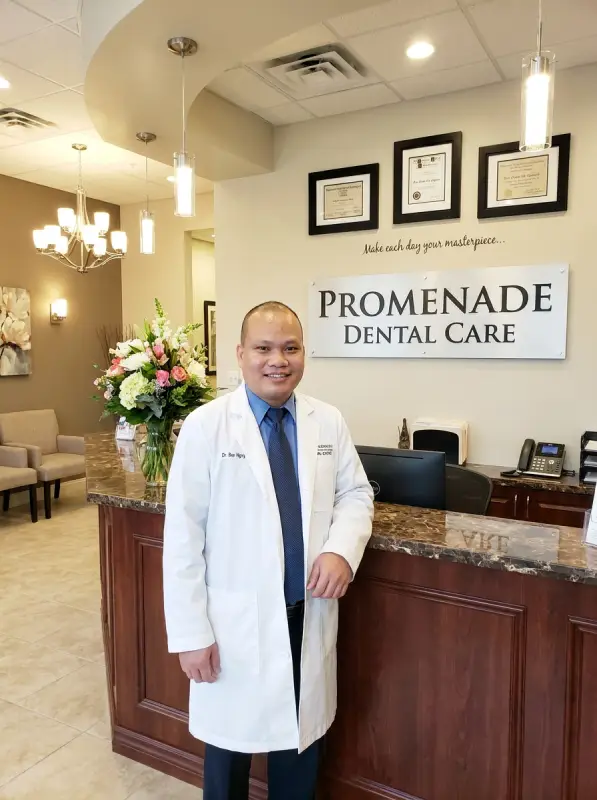
I do. I'm Dr. Bao Nguyen, and Promenade Dental Care is my one-dentist office on Date Street in Murrieta, where I've practiced since 2010. I earned my DDS at the UCLA School of Dentistry and served ten years as a U.S. Navy dentist, including an Advanced Education in General Dentistry residency at Naval Hospital Camp Pendleton. I take about 40 hours of continuing education a year and belong to the ADA, the California Dental Association, and the Tri-County Dental Society.
The way I run cleanings comes from the Navy: measure first, recommend only what the numbers support, and tell people plainly when they don't need something.
Patient reviews
What do cleaning patients say?
Love this dentist so much. So timely and my teeth feel amazing after every cleaning
— Anachristina Padilla · Google review
I had a wonderful experience as usual. This time it was a teeth cleaning and consultation for an implant. Everything was fast and painless.
— Alex Ronan · Google review
From check in to completed crown and cleaning, fast easy and extremely pleased with my visit at Promenade Dental. Will be happy to refer to my friends and neighbors!
— Barbara Crosdale · Google review
FAQ
What else do people ask about teeth cleanings?
How much is a teeth cleaning in Murrieta if I don't have insurance?
A routine ultrasonic cleaning at Promenade Dental Care is $95 without insurance. New patients also have the $20 exam with digital X-rays first, because the gum measurements decide which cleaning is right. If your gum measurements show you need a deep cleaning instead, that's $320 for the full mouth, and you'll know before we start.
Is an ultrasonic cleaning painful on sensitive teeth?
Most people find it easier than the scraping they remember, because the tip vibrates against a water spray instead of being dragged across the tooth. You'll feel vibration and water, and maybe a zing on a sensitive root. Tell us if a spot is touchy. We can slow down, use warm water, or numb that one area.
Is ultrasonic scaling better than scraping with hand tools?
For most tartar, it's faster and gentler on the tooth, and the water spray flushes debris out as it works. Hand instruments are still better in a few tight spots, so a good cleaning uses both: the ultrasonic tip for the bulk of it, hand instruments to finish.
Can a cleaning get rid of bad breath or bleeding gums?
Often, yes, when both come from plaque and tartar at the gumline. Removing them takes away the source, and the gums usually stop bleeding within a week or two if you keep those spots clean. If the bleeding doesn't stop, or the breath comes from somewhere else, the next step is finding out why. The bad breath page covers the other causes.
Is it safe to get my teeth cleaned while I'm pregnant?
Yes, and it's a good idea. Pregnancy hormones make gums swell and bleed more easily, and a cleaning helps keep that from turning into something bigger. The second trimester is usually the most comfortable time. Tell us you're pregnant when you book.
Is it normal for teeth to feel sensitive for a day afterward?
Yes. When tartar comes off a root surface it was covering, that surface can react to cold for a day or two. Gums that were inflamed can also be tender. Both settle quickly. A sensitivity toothpaste helps. If one tooth is still sensitive after a week, call, because that's worth checking.
Will a regular cleaning take off coffee and tea stain?
Most of it. Coffee, tea, and red wine stain sits on the surface, and the polish at the end of the cleaning lifts it. Heavy stain comes off better with air polishing. Stain inside the enamel and the natural shade of your teeth don't change with a cleaning.
Do I really need a cleaning every six months?
Every six months suits most adults. If you've been treated for gum disease, build tartar quickly, have diabetes, or have dry mouth from a medication, every three or four months usually works better. If your gums are healthy and you build very little tartar, I may tell you a cleaning isn't needed every visit.
What if it's been years since my last cleaning?
Then we start with the exam and measurements, not a lecture. A lot of heavy tartar with healthy pockets underneath can still be a routine cleaning, just a longer one, and sometimes it's split into two visits. If the pockets are deep, you'll need a deep cleaning, and I'll show you the numbers that say so.
Ready to book a cleaning?
Call to book. New patients start with the $20 exam and gum measurements, and most go straight into a $95 cleaning the same visit.
What the exam coversPromenade Dental Care · Dr. Bao Nguyen, DDS
26957 Date St, Suite B4, Murrieta, CA 92563
Mon, Tue, Thu 9 AM–5 PM · Wed, Fri 9 AM–3 PM · not open on weekends