
Gum Recession · Promenade Dental Care, Murrieta
Gum Recession Treatment in Murrieta
Receding gums don't grow back, but they can almost always be stopped where they are. Mild recession often needs nothing more than a softer brush and a measurement every visit; deeper recession that exposes a root may need a deep cleaning or a gum graft.
I'm Dr. Bao Nguyen. At a $20 exam I'll measure every tooth, find out why the gum is pulling back, and tell you honestly whether yours needs treatment or just watching.

Understanding gum recession
What is gum recession, and how do you know you have it?
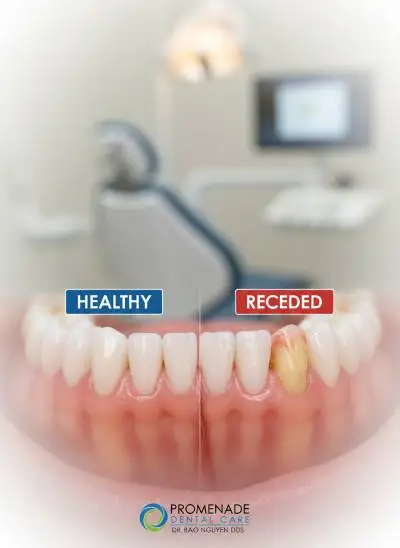
Gum recession is the gum line creeping down the tooth, so part of the root shows. Most people notice it one of two ways: a tooth that looks longer than its neighbor, or a sharp twinge in one spot when something cold hits it. It's one of the most common things I see at my Date Street office, and it isn't only a problem for people over sixty. The Cleveland Clinic's overview of gum recession puts it at about 88% of people over 65 on at least one tooth, but I find it in plenty of thirty-year-olds too.
It's progressive. Left alone, receding gums expose more of the root, a surface with no enamel on it. That root is softer, more sensitive, and decays faster than the crown above it. If your gums also bleed when you brush, read my page on gingivitis treatment as well. That stage of gum disease is still fully reversible, and recession is often what comes after it.
- Condition
- Gum recession (gingival recession): loss of gum tissue that exposes the root surface of a tooth.
- What I do here
- Measuring and monitoring, fixing the cause, full-mouth deep cleaning when gum disease is driving it, and small gum grafts on one or two teeth.
- What I refer out
- Grafting across a long span of teeth, and rebuilding bone around a natural tooth; both go to a periodontist.
- First visit
- $20 exam with digital X-rays, without insurance, including measurements of recession and pocket depth around every tooth.
- Where
- 26957 Date St, Suite B4, Murrieta, CA 92563, serving Murrieta, Temecula, Menifee, Wildomar, French Valley, and Winchester.
- Insurance and payment
- Accepts PPO plans; in network with Delta Dental PPO, Cigna, MetLife, Guardian, Aetna, and United Concordia. CareCredit financing available.
- Office hours
- Mon, Tue, Thu 9 AM–5 PM · Wed, Fri 9 AM–3 PM · no regular weekend hours; weekend emergencies by arrangement.
Causes
Why are my gums receding?
Recession almost never comes from one thing. In most of the mouths I examine, two or three causes are stacked on top of each other, and sorting out which ones apply to you comes first, because the right fix depends entirely on why the tissue is pulling away.
Gum disease (periodontitis)
Bacteria below the gumline destroy the connective tissue and bone that anchor a tooth, and the gum follows the bone down. It's the biggest driver nationally: the CDC's national survey found periodontitis in an estimated 42% of U.S. adults 30 and older. My gum disease treatment page covers staging and treatment.
Brushing too hard
A stiff brush and a heavy hand grind away thin tissue, usually on the outside of the canines and premolars. I see it constantly, almost always in people who assumed harder scrubbing meant cleaner teeth. It's the one cause that's free to fix.
Thin gum tissue
Some people are simply built with thin gums. When the band of firm tissue around a tooth is naturally narrow, a little inflammation or friction is enough to start recession that thicker tissue would shrug off.
Grinding and clenching
Clenching loads a tooth sideways and flexes it at the gumline. Most of the grinders I see had no idea they were doing it until I showed them the wear on their teeth. A custom night guard takes that load off at night.
Past orthodontic movement
Braces or aligners can push a root toward the thin outer edge of its bone. If the bone there is thin, the gum doesn't follow the tooth, and recession shows up during or years after treatment.
Tobacco
Smoking and chewing tobacco cut blood supply to the gums, slow healing, and speed up attachment loss. In the same CDC survey, severe periodontitis was most common among smokers, older adults, and a few other groups.
What I tell patients: switch to a soft-bristled brush and use short, gentle strokes angled toward the gumline instead of sawing side to side. Ask me to show you at your next visit. It takes about thirty seconds to learn, and it's the one change that stops brush-related recession by itself.
Root exposure
Is an exposed tooth root dangerous?
Yes, and the risk climbs the longer the root stays uncovered. Enamel only covers the crown of a tooth. Below the gumline the root is wrapped in cementum, which is much softer and wears away quickly once acid and bacteria reach it. Root decay behaves differently from an ordinary cavity: it spreads sideways along the root and gets under crowns and fillings that were fine before.
Then there's the sensitivity. An exposed root can make hot, cold, and sweet foods unpleasant enough that you start chewing on one side without deciding to. Root surfaces are also harder to keep clean, so plaque builds up faster and the recession creeps further. In advanced cases the bone breaks down and the tooth loosens; my loose teeth page covers what happens then. That's why I take an exposed root seriously the first time I see one.
Decision boundaries
When don't receding gums need treatment?
A lot of recession needs watching, not fixing. If the gum has been at the same level for years, the root isn't decaying, and the tooth isn't sensitive, the honest answer is often "let's measure it and leave it alone." Here's how I sort it out.
| What I find | What I usually recommend | Why |
|---|---|---|
| A millimeter or two of recession, stable at every visit, no sensitivity | Measure and chart it each visit; no treatment | Stable recession with healthy tissue around it isn't a problem to fix |
| Brush-related recession with firm, healthy gum | A soft brush and a better technique | Removing the cause is usually enough to stop it |
| Sensitivity is the only complaint | Desensitizing toothpaste, or a fluoride varnish in the office | Treats the symptom without surgery; give toothpaste a few weeks to work |
| A notch at the gumline that catches a fingernail, no decay | Sometimes tooth-colored bonding over the notch | Covers the notch and calms sensitivity; it doesn't put gum back |
| Recession that's worse at each visit, or root decay starting | Treatment: deep cleaning if disease is driving it, a graft if the root needs covering | Recession that's moving doesn't stop on its own |
The Cleveland Clinic's gum recession guide lists desensitizing toothpastes with potassium nitrate, stannous fluoride, arginine, or strontium chloride. Any of those is a reasonable start for a sensitive root, and none of them needs a prescription.
How I measure it
How do I decide what your recession needs?
I decide from four measurements, not from how the gum looks in a mirror. That evaluation happens at a $20 exam with digital X-rays. The price is low on purpose: I'd rather nobody in Murrieta put off finding out where they stand because of what the appointment costs.
| What I check | How | What it tells me |
|---|---|---|
| How far the gum has moved | A periodontal probe, in millimeters, on every tooth | Whether recession is mild, moderate, or severe, and a baseline to compare next time |
| Pocket depth | The same probe, around each tooth | Whether gum disease is active; healthy pockets run about 1 to 3 mm |
| Firm tissue left | Looking at and feeling the band of gum around the tooth | Whether the gum is likely to keep receding without a graft |
| Bone level | Digital X-rays | Whether bone has gone too, which changes who should treat it |
Then I look for the cause: brushing pattern, wear from grinding, signs of gum disease, old orthodontic movement, tobacco. You leave knowing which group you're in, what I'd do about it, and what it costs, before anything is scheduled.
Treatment options
What treats gum recession?
Treatment matches the cause and the amount of damage. It goes from doing nothing but watching, up to surgery, and most people land near the bottom of that ladder.
Monitoring early recession
When recession is a millimeter or two, with no sensitivity, no root decay, and healthy tissue around it, the right move is often careful monitoring plus habit changes. We chart it, deal with whatever caused it, and measure again at each visit. I won't recommend a procedure the measurements don't support.
Deep cleaning when gum disease is behind it
If gum disease is driving the recession, the infection has to come under control first. A full-mouth deep cleaning (scaling and root planing) removes hardened deposits from below the gumline and smooths the roots so the tissue can heal against them. It's $320 for the whole mouth here, without insurance, and nitrous oxide is available if you want it. For a lot of people with disease-driven recession, a deep cleaning plus regular maintenance is enough to stop the loss right there.
Gum grafting
A graft is the only treatment that puts tissue back over an exposed root. The Cleveland Clinic calls gum graft surgery the most predictable and longest-lasting option for recession. There are two common kinds:
Connective tissue graft
A thin layer of tissue is taken from under the surface of the palate, placed over the exposed root, and tucked under the surrounding gum. Over several weeks it knits in and leaves a natural-looking band of firm gum. This is the standard graft for covering a root.
Free gingival graft
A thin layer is taken from the surface of the palate and placed where thicker, firmer tissue is needed. It's mainly for thickening thin gum to prevent more recession rather than covering a root that's already exposed, and the color match is less perfect, so it's used more on lower back teeth.
Small grafts on one or two teeth I can do here. Grafting across a long span of teeth goes to a periodontist, and I'll tell you at the exam which one your case is.
When bone has been lost too
Advanced recession usually comes with bone loss around the tooth. Rebuilding bone around a natural tooth is periodontal surgery, and I refer it to a periodontist rather than stretch past what this office should do. If a tooth is past saving, we talk about an extraction and what replaces it.
Maintenance afterward
Every recession plan I write ends with a maintenance schedule, because the most expensive procedure in dentistry is the one you have to do twice. Regular periodontal maintenance visits let me watch the healing, keep bacteria down, and catch new recession while it's still small.
Worth asking about: how thick your gum tissue is. Thick or thin tissue predicts recession risk better than almost anything else, and it decides which prevention will actually work for you.
Warning signs
Do I need a gum graft?
Not everyone with recession does. But a few signs mean it's moved past the point where watching is a reasonable plan. If you recognize one or more of these, get your gums measured; the earlier recession is assessed, the more options stay open.
Try this at home: run a fingernail gently down the front of each lower front tooth, from the gum toward the biting edge. If you feel a distinct step where the texture changes, that's very likely where enamel ends and exposed root begins. Point it out to me at your next visit and I'll measure it.
If a tooth has started to feel loose, or the gum around it is swollen and sore, don't wait for a routine visit. Call (951) 412-0127; my emergency dentist page covers what happens when something can't wait.
Treat or wait
What happens if recession is treated versus left alone?
People put off treatment for two reasons: it doesn't hurt yet, and they aren't sure it's worth the money. Both are fair. Here's what tends to happen either way over the following years, once recession has reached the point where it's progressing.
| Factor | With treatment | Left untreated |
|---|---|---|
| Root protection | A graft covers the exposed root with firm tissue | The root stays bare and open to decay |
| Sensitivity | Usually fades once the root is covered or sealed | Tends to worsen as more root shows |
| Progression | Stopped when the cause is fixed | Continues; progressing recession doesn't stop on its own |
| Bone support | Protected by controlling gum disease | Gradual bone loss can loosen the tooth |
| Long-term cost | One treatment plus maintenance | Risk of fillings, root canals, or losing the tooth later |
After a graft
What is gum graft recovery like, week by week?
Most people feel back to normal in about two weeks, and the graft keeps maturing for a few months after that. Everybody heals a little differently, but this is the usual course.
Week 1: swelling and tenderness
Mild to moderate swelling at the graft site and the palate is normal. Most people manage on over-the-counter pain relievers and stay on soft food. Don't brush or floss the graft itself. Desk work is usually fine by day two or three; heavy work and the gym should wait.
Weeks 2 to 4: the graft takes hold
Swelling drops off and the graft picks up its own blood supply. The palate usually heals faster than the graft site. You can go back to gentle brushing with a soft brush, leaving the graft alone until I clear it. Uneven color is expected at this stage.
Months 1 to 3: final healing
The new tissue blends into the gum around it, and sensitivity at the treated tooth usually fades. I measure the result to confirm the root is covered the way we planned.
The one thing that matters most: leave the graft alone. Pulling your lip up to check on it, prodding it with your tongue, or eating something crunchy too early can move the tissue before it has attached. Follow the written instructions you leave with to the letter.
Cost and insurance
What does gum recession treatment cost in Murrieta?
It depends on what your recession needs, so the honest answer starts with the $20 exam. Monitoring costs nothing beyond your regular visits. A deep cleaning has a published price. A graft gets a written quote after I've measured the site, because one tooth and a long span are different procedures.
Exam with digital X-rays
$20
Without insurance; includes recession and pocket measurements
Full-mouth deep cleaning
$320
Without insurance; all four quadrants, when gum disease is driving the recession
Gum graft
Quote
Written quote after the exam, before anything is scheduled
My office accepts PPO plans and is in network with Delta Dental PPO, Cigna, MetLife, Guardian, Aetna, and United Concordia. Many plans pay part of a graft when it's medically necessary, meaning the recession threatens the tooth rather than only its looks. I don't quote insured fees on this page because they depend on your plan's coverage and copay; my team checks your benefits and hands you a written estimate first. Without insurance, you pay the written quote, and CareCredit financing is available if paying monthly works better.
My rule on this: I'd rather give you an honest answer that costs me the procedure than recommend something your mouth doesn't need. If watching is the right call, that's what I'll tell you.
Your dentist
Who will be measuring your gums?
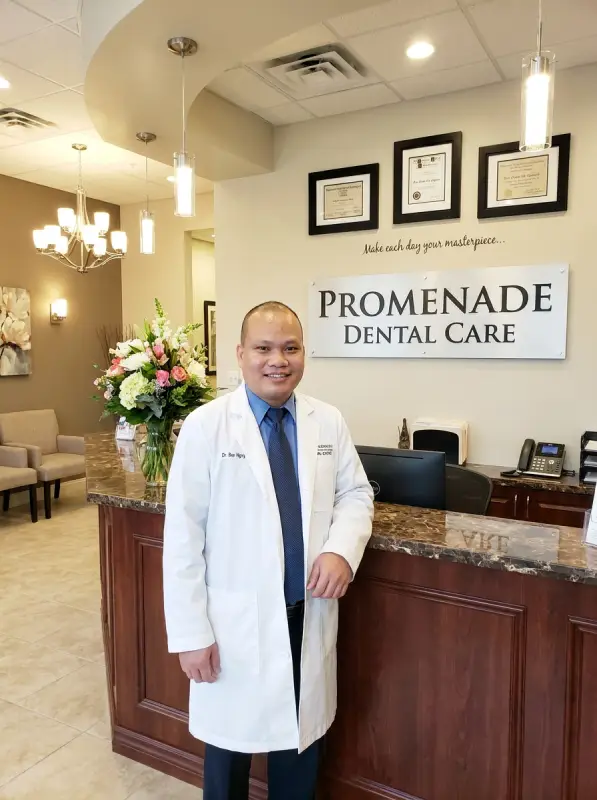
I will. I'm Dr. Bao Nguyen, and Promenade Dental Care is my one-dentist office on Date Street in Murrieta. I earned my DDS at the UCLA School of Dentistry, then served ten years as a U.S. Navy dentist, including an Advanced Education in General Dentistry residency at Naval Hospital Camp Pendleton and deployments to Kuwait and Iraq. I have 26 years of clinical experience, I take about 40 hours of continuing education a year, and I'm a member of the American Dental Association, the California Dental Association, and the Tri-County Dental Society.
What patients mention in their reviews isn't the résumé. It's that I slow down. I show you the X-rays, explain what I'm seeing and why it matters, and walk you through the reasoning before you decide anything. If your case belongs with a periodontist, I'll say so at the first visit rather than after I've started.
If dental anxiety is part of your picture, and gum surgery makes plenty of level-headed people nervous, I take the numbing slowly, explain each step before it happens, and offer nitrous oxide. You can read more about my background and the practice.
What decides whether a graft holds
A graft isn't just covering a root. Four things separate one that lasts from one that fails:
Location
Where is the office, and who comes here?
Promenade Dental Care is at 26957 Date St, Suite B4, Murrieta, CA 92563, on Date Street between Murrieta Hot Springs Road and Clinton Keith Road, a few minutes off the I-15 and I-215. Patients come from central Murrieta, up from Temecula, and over from Menifee, Wildomar, French Valley, and Winchester.
If you were searching for a periodontist or a gum specialist in Murrieta, starting here costs $20 and tells you whether you actually need one. Most recession doesn't; when yours does, you'll leave with the referral and the reason for it.
First visit: an exam with digital X-rays is $20 without insurance, and it includes the measurements that decide everything on this page. Call (951) 412-0127 or read what the $20 exam covers.
Patient reviews
What do patients say about the advice they got?
I woke up with aching tooth pain while visiting family in Temecula on a Saturday morning. I called Promenade Dental Care at 7:30am. Dr. Nguyen answered the phone and was able to get me in his office 30 minutes later. He promptly collected my insurance information and took an X-ray of the area that was bothering me. He reviewed the X-ray findings honestly and accurately. Luckily, I didn’t have an infection or cavity, but he treated the tooth with sealant to decrease the sensitivity. I have gum recession on this specific tooth from braces which has resulted in some painful sensitivity. He explained what I could do moving forward to help treat the gum recession and suggested different hygiene techniques to keep the sensitivity at bay. The reviews are accurate. This is a dentist you can trust and rely on.
— mischa Denton · Google review
I had a really great experience at Promenade Dental Care. The doctor took the time to explain everything clearly, showed me exactly what was going on, and made sure I understood the treatment plan without making me feel rushed or pressured. I need quite a bit of dental work, so I was honestly expecting the cost to be overwhelming, but the pricing was beyond affordable compared to other quotes I’ve received. That alone was such a huge relief. I felt comfortable, informed, and confident in the plan, and I will absolutely be completing my treatment here. I’m very happy I found this office and would definitely recommend them to anyone looking for a dentist who is thorough, honest, and reasonably priced
— Courtney Sussman · Google review
The office treats you with respect and dignity. The dentist / Owner is informative and concerned with the patient and their needs. He tells the truth. No sells pitch just the right procedure advised with the patient as his prime concern. A rarity today, honesty and concern. Highly recommend. Larry Hilliard
— Larry Hilliard · Google review
Dr. Nguyen does a great job. He is always on time and very honest. Never has you do unnecessary treatments, just to make extra money. I love that he is a solo practitioner and runs his own shop. That keeps his overhead costs low and he knows you more personally as a patient. All my family comes to see him. Best dentist I've ever had.
— Tom Haynes · Google review
Frequently asked questions
Gum recession: questions patients ask
Is a gum graft painful?
Not during the procedure. The area is fully numb with local anesthetic, and nitrous oxide is there if you want it. Afterward most people describe it as sore rather than painful and manage on ibuprofen. When the graft tissue comes from the roof of the mouth, that spot usually bothers people more than the graft site, and it peaks around day two or three before it settles.
How long does a gum graft last?
A graft that heals well and is looked after is meant to be permanent. What decides it is less the surgery than what happens afterward: if the original cause is still active, whether that's untreated gum disease, heavy brushing, or grinding at night, the same forces go to work on the new tissue too.
Can gum recession be stopped without surgery?
Yes, if you catch it early. When the recession is a millimeter or two and the bone underneath is intact, fixing the cause is usually enough: a soft brush and gentler technique, a night guard for grinding, and a deep cleaning if bacteria are driving it. What no non-surgical treatment can do is put lost gum back. Once a root is exposed and the recession keeps moving, the choice is between holding the line and grafting.
Is my recession from brushing too hard or from gum disease?
Brush-related recession shows up on the cheek side of the teeth, usually the canines and premolars, and the gum around it looks pink and firm, just lower than it should be. Disease-related recession comes with redness, puffiness, bleeding, and deeper pockets when I measure. A probe and digital X-rays usually settle it at the exam, and plenty of people have both going on at once.
Will you do my gum graft here, or send me to a periodontist?
It depends on the size of the job. Small grafts on one or two teeth I can do here. Grafting across a long span of teeth, or any case where bone has to be rebuilt around the tooth, goes to a periodontist, a specialist with extra years of training in gums and bone. I'll tell you which one yours is at the first visit, not halfway through.
Does dental insurance cover gum grafting?
Many PPO plans cover part of a graft when it's medically necessary, meaning the recession threatens the tooth itself rather than only the way it looks. Coverage for purely cosmetic grafting is rare. My office accepts PPO plans and is in network with Delta Dental PPO, Cigna, MetLife, Guardian, Aetna, and United Concordia. We check your benefits and hand you a written estimate before you agree to anything.
What can I eat after gum graft surgery?
Soft, cool, and bland for the first one to two weeks: yogurt, eggs, mashed potatoes, smoothies eaten with a spoon rather than a straw, pasta, and soup that has cooled down. Nothing crunchy, spicy, acidic, or hot, and chew on the other side from the graft. Most people are back to a normal diet by week three or four. You leave with written instructions for your procedure.
I'm afraid of the dentist. Can I still get my receding gums treated?
Yes, and you wouldn't be the first. Fear is one of the most common reasons I see recession that could have been handled a couple of years earlier. Nitrous oxide is available, I explain what I'm about to do before I do it, and you can stop me at any point by raising a hand.
Ready to find out what your gums need?
Book a $20 exam. I'll measure the recession, tell you honestly whether it needs treatment or watching, and give you a clear price before anything happens.
What the $20 exam coversPromenade Dental Care · Dr. Bao Nguyen, DDS
26957 Date St, Suite B4, Murrieta, CA 92563
Mon, Tue, Thu 9 AM–5 PM · Wed, Fri 9 AM–3 PM · no regular weekend hours