
Pediatric & Family Dentistry • Murrieta, CA
Pediatric Dentist in Murrieta, CA
Exams, cleanings, fluoride, sealants, space maintainers, nitrous oxide, and same-day care for kids' emergencies — from the first tooth on
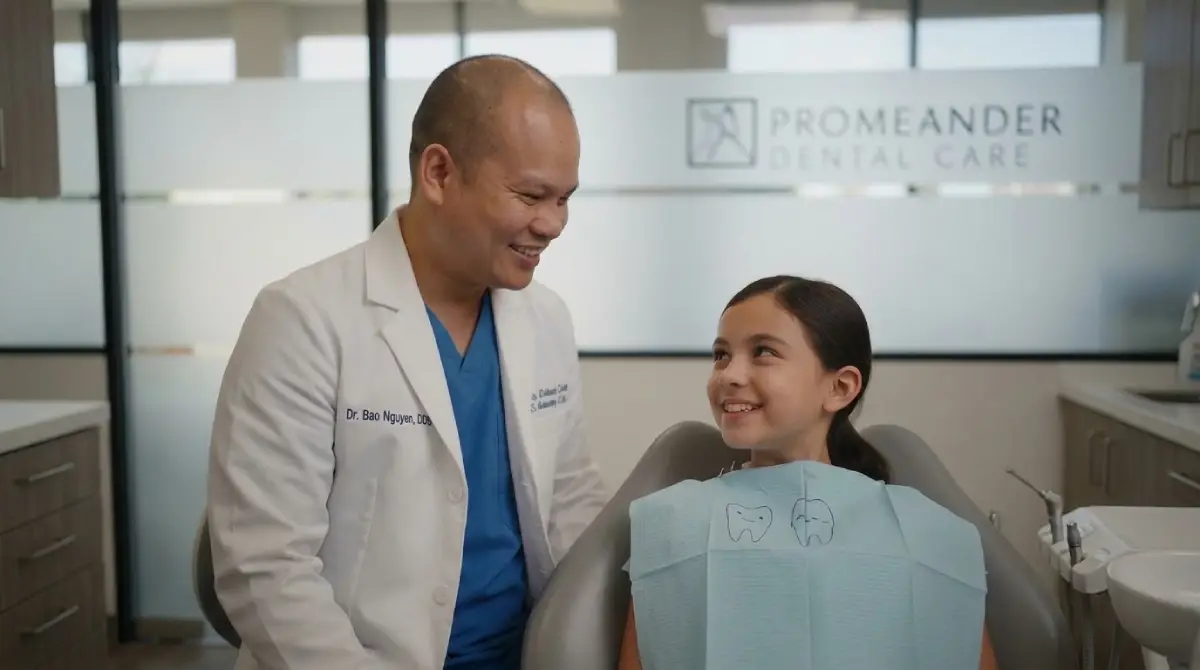
Children are not small adults, and I do not treat them like it. I have been seeing kids in this Date Street office since 2010 — toddlers who sit in a parent's lap, six-year-olds getting their first sealants, teenagers I have known since they were three. Same $20 exam as any adult. Nitrous oxide when a child needs it. And if your child is not ready today, we stop and try again another day.
Start Here
Your Child's First Dental Visit
By the first birthday, or within six months of the first tooth — whichever comes first. That is the recommendation from the American Academy of Pediatric Dentistry, the American Academy of Pediatrics, and the ADA, and it is earlier than most parents guess. The first visit is short, your toddler stays in your lap, and nothing happens that hurts. I wrote a separate guide that walks through exactly what happens at a child's first dental appointment, how to prepare a toddler for it, and the milestones from the first tooth to the last baby tooth. If your child has not been to a dentist yet, start there. This page covers everything that comes after.
Routine Care
Kids' Dental Exams and Cleanings in Murrieta
A children's comprehensive dental exam at Promenade costs the same $20 as an adult exam and covers everything on the adult checklist plus the growth questions that only apply to a child. Most kids come in every six months. A child with a history of cavities, deep grooves in the molars, or a diet heavy in juice and snacks may need to come in more often for a while, and I will tell you if that is the case rather than putting everyone on the same schedule.
What a children's cleaning involves
A kids' cleaning is shorter and gentler than an adult cleaning. For toddlers it is a toothbrush prophy — a soft rotating brush and a mild polish, mostly so the child learns that the noise and the taste are nothing to fear. As kids get older and permanent teeth come in, the cleaning starts to look like an adult ultrasonic cleaning, with plaque and early tartar removed from around the gumline and between the teeth. Fluoride varnish usually goes on at the end.
The part of the visit parents underrate is the conversation. What is your child drinking, and how often? Who brushes at night? Any thumb sucking past age four? Any grinding you can hear from the hallway? The answers change the prevention plan more often than anything I find inside the mouth.

Why I do not X-ray every child every year
X-ray frequency should follow cavity risk, not the calendar. A six-year-old with no history of decay and good home care may go a long stretch without needing radiographs. A ten-year-old who has already had two cavities between the molars needs them more often, because that is the one place I cannot see with a mirror. Digital sensors use a fraction of the radiation of the film X-rays most parents remember, and I explain which category your child is in, and why, at the appointment.
★★★★★Rated 5 out of 5 stars
“Our 2 kids had a Phenomenal experience for one of their first dental visits!! 10/10!!”
Andrew Franco · Google review
Prevention
Fluoride Treatment for Children
Fluoride varnish is a sticky, concentrated coating painted onto the teeth with a small brush at the end of a checkup. It takes about a minute, it does not hurt, and it hardens on contact with saliva so your child can eat and drink soon after. The fluoride sits against the enamel for several hours, where it strengthens the outer layer of the tooth and helps early soft spots re-harden before they turn into cavities.
The AAPD's fluoride therapy guidance and the American Academy of Pediatrics both support varnish every three to six months starting when the first tooth comes in, with the interval set by each child's cavity risk. A child with no decay, a good diet, and supervised brushing may get it twice a year at routine visits. A child who already has white-spot lesions or a cavity history is the one who benefits from the shorter interval.
Fluoride at home: how much toothpaste
The question I get more than any other about fluoride is toothpaste. The answer is the same from the AAP, the AAPD, and the ADA: fluoride toothpaste from the first tooth, in the right amount. For a child under three, a smear the size of a grain of rice. From age three on, a pea-sized amount. A parent should be putting the toothpaste on the brush and helping until the child can tie their own shoes — that is roughly the fine-motor skill brushing well requires.
Fluoride mouthrinse is not recommended under age six, because young children swallow it. Prescription-strength toothpaste is something I bring up only for children at high cavity risk, and I explain why before writing for it.
If you have questions about fluoride
Some parents come in unsure about fluoride, and I would rather you ask than stay quiet. At the concentrations used in a dental office and in over-the-counter toothpaste, fluoride is supported by the National Institute of Dental and Craniofacial Research and the ADA as safe and effective for preventing decay in children. Varnish is a small, controlled dose applied to the teeth, not swallowed. I will give you the evidence, answer whatever you want to ask, and respect your decision either way. There is no lecture and no pressure.
Prevention
Dental Sealants for Kids
The chewing surfaces of a child's molars are full of narrow grooves, and in many kids those grooves are deeper than a toothbrush bristle is wide. Food and plaque pack into them, and that is where most childhood cavities start. A sealant is a thin coating flowed into those grooves and hardened with a light, so the groove is sealed off from food and bacteria. The CDC reports that sealants prevent about 80 percent of cavities in the back teeth for two years after placement, continue to prevent about half of them for up to four years, and that children ages 6 to 11 without sealants have nearly three times as many first-molar cavities as children with them.
Clean and dry the tooth
The molar is cleaned, isolated with cotton rolls or a small shield, and dried. Sealants need a dry surface to bond, so keeping a wiggly six-year-old's tongue away from the tooth is most of the skill involved.
Condition the grooves
A mild gel is brushed onto the chewing surface for a few seconds and rinsed off. It roughens the enamel microscopically so the sealant grips. It tastes sour, and that is the worst part.
Flow in the sealant
The liquid sealant is painted into the grooves, then hardened with a blue curing light for about twenty seconds. No drilling, no anesthetic, no numb lip afterward. Your child can eat right away.
Check it at every visit
Sealants wear over years and occasionally chip. I check each one at every checkup and touch up any that have worn, which takes a minute and is usually free of charge for my own patients.
When sealants go on
The timing matters more than most parents realize. Sealants work best when they go on shortly after a permanent molar comes through the gum — around age six for the first molars and around age twelve for the second molars — before the grooves have had a chance to start decaying. Between those two ages, I watch the premolars and the baby molars too. If a baby molar has unusually deep grooves and your child has a cavity history, I will sometimes seal that tooth as well, even though it will eventually fall out, because a cavity in a baby molar at age five is a filling, a possible crown, and a scared child. A sealant is two minutes.
The arithmetic I give every parent: the most expensive dental work your child will ever need is the work that a sealant would have prevented. Sealing a tooth takes about two minutes, needs no drilling and no anesthetic, and costs a fraction of the filling it replaces. Most PPO plans cover sealants on permanent molars for children at 80 to 100 percent.
When a Baby Tooth Is Lost Early
Space Maintainers for Children
Baby teeth have one job that nobody talks about: they hold a parking spot. Each primary molar saves the space that the permanent premolar underneath will need when it erupts, sometimes six or seven years later. When a baby molar is lost early — to decay too deep to fill, to an infection, or to an injury — the teeth on either side start drifting into the gap within weeks. By the time the permanent tooth is ready to come in, there is no room for it, and it erupts crooked, sideways, or not at all. What began as one lost baby tooth turns into crowding that costs far more to fix at fourteen than it would have cost to prevent at six.
A space maintainer is a small, passive appliance that holds that space open. The AAPD's guidance on the developing dentition describes them as appliances that prevent the loss of arch length by keeping the remaining teeth where they are. The most common type for a single lost molar is a band-and-loop: a thin stainless steel band cemented around the tooth behind the gap, with a wire loop that rests against the tooth in front of it. It does not move anything and it does not hurt. Your child forgets it is there within a day or two.
| Situation | Does the space need holding? | Why |
|---|---|---|
| Baby molar lost before the permanent tooth is close | Usually yes | Neighbors drift within weeks; the premolar underneath may still be years from erupting |
| Baby molar lost and the permanent tooth is already visible on the X-ray, close to the surface | Often no | The permanent tooth will erupt into the space before the neighbors can close it |
| Front baby tooth lost early | Rarely | Front teeth seldom lose space once the baby canines are in; appearance is the main concern, not spacing |
| Baby tooth lost at the normal time | No | The permanent tooth is what pushed it out; nothing to hold |
What living with one looks like
Placing a band-and-loop takes two short visits: one to fit the band and take an impression, one to cement the finished appliance. Sticky and hard candy, gum, and ice can bend the loop or pull the band loose, so those go on the list for a while. Your child brushes around it normally, and I check it at every visit to make sure it is still seated and is not catching the gum. When the permanent tooth begins to erupt into the space, the maintainer comes off in a minute or two. Most children wear one for a year or two, occasionally longer.
The honest caveat: space maintainers are a second-best outcome. The best outcome is not losing the baby tooth early in the first place, which is why the sections above on fluoride and sealants come first on this page, and why I would rather fill a small cavity in a baby molar than wait and see.
Care by Age
What Kids Need at Each Stage
The same child needs very different things at eighteen months and at fifteen years. Here is roughly how I work through it.
Ages 0–3: Infants and Toddlers
First exam in your lap, cavity-risk assessment, fluoride varnish, and a straight conversation about bottles, sippy cups, and night feeding. I check eruption order and look for a tongue-tie or lip-tie that is interfering with feeding or speech. At this age the only real objective is that the dental office becomes a predictable, safe place.
Ages 3–6: Preschool and Kindergarten
Cleanings, fluoride, and sealants on the baby molars when the grooves are deep enough to trap food. This is when the first permanent molars usually appear behind the last baby teeth, and when an early-lost baby molar may need a space maintainer. Thumb and pacifier habits get discussed here, gently.
Ages 6–12: Mixed Dentition
Sealants on the permanent first molars as soon as they erupt. Tooth-colored fillings when decay has already started. Bite and jaw development checks as the front teeth change over, with a referral if early intervention would head off a bigger problem. Sports mouthguards. I talk brushing technique directly to the child at this stage, not to the parent standing behind them.
Ages 12–18: Teenagers
Sealants on the second molars, wisdom tooth monitoring, bonding for chipped front teeth, and gum health, which is worse in teenagers than most parents expect. Mostly I am handing ownership of their mouth over to them before they leave for college.
Nitrous Oxide and Nervous Children
What Happens When Your Child Is Scared
Nothing happens. That is the point.
I do not force a frightened child through a procedure. I do not hold a child down. I am not going to tell you they will be fine and push ahead while your child is in real distress. If your child is not ready, the appointment turns into a practice run — ride the chair up and down, hold the mirror, count my fingers, go home. The clinical work waits until your child has decided on their own that the chair is not a threat. That decision usually comes faster than parents expect, and it holds.
Nitrous oxide for children
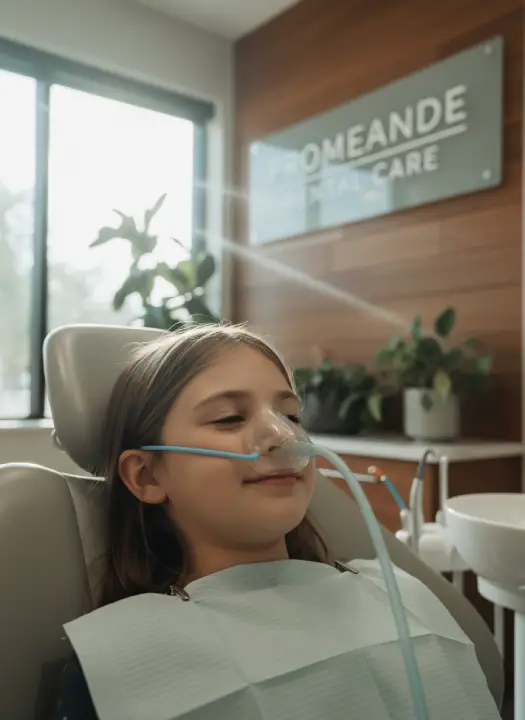
When patience alone is not enough, nitrous oxide is the one thing I add, and I'll be honest that it doesn't work for every child. I don't give oral sedation to anyone under 18. The AAPD recognizes nitrous oxide and oxygen inhalation as a safe and effective way to reduce anxiety and produce mild pain relief in children. Your child breathes it through a small soft nose mask that smells faintly sweet. It takes effect in three to five minutes, and it clears within minutes of switching to plain oxygen at the end, so your child can go back to school the same afternoon with nothing lingering.
Your child stays awake and can talk to me the whole time. I set the concentration to their size and their response, and I adjust it during the appointment rather than picking a number at the start. Most kids describe it as feeling floaty or tingly, and many ask for it again. For children who need more than nitrous, or who have significant special needs, I refer to a pediatric specialist rather than stretch past what this office should be doing.
The safe-haven approach this practice is known for started with children. Treating military families at Camp Pendleton taught me something no textbook covers: the kids who had been forced through an appointment somewhere else were the hardest to reach afterward, sometimes for years. The ones who had been given time were easy. I built this office around the second group. Sixteen years on, a good number of the adults who walk in here without fear are people I saw as children.
★★★★★Rated 5 out of 5 stars
“I usually don’t like to review in general but for this dental practice I will! :) we set up an appt for my son to get his teeth checked for school last minute cause most pediatric dentists were booked and receptionist (Edith, I think) she was super friendly, efficient and genuine, gave my son a cute toy after visit (usually stickers)! Our dentist Bao Nguyen was chill and everything was just felt like a smooth breeze, our appt was at 11, and we literally got out 11:20 without a child crying! Definitely our whole fam coming back that’s for sure, super super ecstatic that we choose this place!”
MG F · Google review
Same-Day Care
Kids' Dental Emergencies
Children fall off bikes, take a soccer ball to the face, and wake up at 2 a.m. with a toothache that was "fine" at dinner. I hold time in the schedule every day for exactly this, and the phone line at (951) 412-0127 is monitored outside office hours. When you call, tell us your child's age and what happened, and we will tell you what to do while you drive over. The full guide to what counts as an emergency and how we handle it lives on the emergency dentist page. What follows is the part that is different for kids.
Knocked-out baby tooth
Do not put it back in. Forcing a baby tooth into the socket can damage the permanent tooth developing right above it. Press a clean cloth on the gum to stop the bleeding, bring the tooth with you if you have it, and call. I will check the neighboring teeth, the gum, and the permanent tooth underneath on an X-ray.
Knocked-out permanent tooth
This is the sixty-minute emergency. Pick the tooth up by the crown, not the root. If it is dirty, rinse it gently for a few seconds — no scrubbing. Put it in a cup of milk, or in the child's cheek if they are old enough not to swallow it, and call on the way. Re-implanted within the first thirty to sixty minutes, most of these teeth can be saved.
Chipped front tooth
Save the piece if you can find it. If the tooth is not painful and the nerve is not exposed, this is a same-day-if-possible visit rather than a drop-everything one. Most chips in kids are smoothed or repaired with bonding. A chip with bleeding from the tooth itself, or a tooth that has been pushed out of position, is urgent.
Toothache or swelling
A toothache that wakes a child at night, or any swelling of the face or gum, means an infection until proven otherwise, and a dental infection in a small child can spread quickly. Call the same day. Children's ibuprofen at the dose on the box helps while you wait. Do not put aspirin on the gum, and do not wait for it to "settle down."
Cut lip, tongue, or cheek
Mouths bleed dramatically and heal fast. Firm pressure with a clean cloth for ten minutes stops most of it. A cut that keeps bleeding after that, goes all the way through the lip, or has a tooth fragment in it needs to be seen — by us if a tooth is involved, or by urgent care if it is purely a skin laceration.
Lost filling, crown, or space maintainer
Not an emergency in the middle of the night, but call the next morning. A lost filling exposes the tooth to sensitivity and decay, and a space maintainer that comes off needs to be re-cemented within a few days before the teeth start to drift.
Head injury first. If the fall that knocked out the tooth also involved a blow to the head, and your child was knocked out, is vomiting, confused, or unusually drowsy, that is an emergency-room visit, not a dental visit. The tooth can wait an hour. A concussion cannot.
What Parents Ask Me About
Common Pediatric Dental Problems
Almost everything on this list is either preventable or easy to handle when it is caught at a routine exam. It gets expensive and unpleasant when it is not.
Cavities in baby teeth
Baby teeth are not disposable. They hold space for the permanent teeth and guide jaw growth, and the last ones do not fall out until around age twelve. Untreated decay causes pain, infection, and early loss, and early loss is how a child ends up needing a space maintainer. Small cavities in baby teeth get tooth-colored fillings, the same day when I can.
White spots on the front teeth
Chalky white patches near the gumline are the first visible stage of decay, and at that stage they are still reversible. This is the single most common thing I find in toddlers who go to bed with a bottle or sippy cup. Fluoride varnish, a change in the bedtime routine, and a recheck in three months usually turns them around without a filling.
Thumb sucking and pacifiers
Normal and harmless before age three. Past age four it can start to change the bite and the shape of the palate. I check for it at each exam and tell you where your child sits. Most children stop on their own once they are developmentally ready, and pressure from a parent usually backfires.
Tongue-tie and lip-tie
A tight band of tissue under the tongue or upper lip is common, and most of them need nothing. A few interfere with nursing in infants or with speech and cleaning in older children. I explain when release is warranted and when it is not on the frenectomy page.
Grinding at night
Very common while permanent teeth are coming in, and usually self-limiting once the bite settles. I look at wear patterns each visit. I only recommend a nightguard when the grinding is actively taking structure off the teeth, which in children is uncommon.
Crowding and bite development
By around age seven, when the first permanent molars and front teeth are in, the bite becomes readable. I check crossbites, crowding, and jaw relationship at every exam from that point on. Many children turn out to need nothing at all. When early intervention would prevent a harder problem later, I refer and explain why.
Ready to Get Your Child In?
A $20 exam with digital X-rays is the whole commitment. You will leave knowing exactly where your child stands.
Cost and Insurance
What Children's Dental Care Costs in Murrieta
Twenty dollars is the same figure I charge an adult. A nervous six-year-old takes me longer than a compliant forty-year-old, and I have never seen a good reason to bill you for that. Cleanings, fluoride varnish, sealants, and space maintainers are quoted before they happen. Anything beyond the exam comes to you as a written estimate first, so there is no invoice at the front desk that you have not already seen.
Most PPO plans cover children's preventive care — exams, cleanings, fluoride, and sealants on permanent molars — at 80 to 100 percent, and many plans pay enhanced benefits for patients under 18. Space maintainers are usually covered as a basic service. Promenade accepts all PPO dental plans and is in-network with Delta Dental PPO, Cigna, MetLife, Guardian, Aetna, and United Concordia. We verify your child's specific benefits before treatment starts. If you do not have dental coverage, you get the cash price upfront, and CareCredit financing is available.
- Exam
- $20, including digital X-rays when clinically indicated — same price as an adult exam
- Cleaning, fluoride, sealants
- Quoted in writing before they are done; most PPO plans cover them for children at 80–100%
- Space maintainers
- Quoted in writing after the exam; commonly covered as a basic service
- Nitrous oxide
- Quoted separately; ask when you book if you think your child will need it
- Insurance
- All PPO plans accepted; in-network with Delta Dental PPO, Cigna, MetLife, Guardian, Aetna, United Concordia
- No insurance
- Cash price upfront; CareCredit financing available
About Your Child's Dentist
Dr. Bao Nguyen, DDS
I earned my Doctor of Dental Surgery degree at the UCLA School of Dentistry and then spent ten years as a United States Navy dentist, including an Advanced Education in General Dentistry residency at Naval Hospital Camp Pendleton and deployments to Kuwait and Iraq.
A large share of my patients at Camp Pendleton were military dependents: children and teenagers whose families moved every two or three years, showing up at a new office with missing records, fresh anxiety, and sometimes years of care nobody had gotten around to. That taught me two things dental school does not. How to earn a child's trust in the first five minutes. And how to talk to a parent who is worn out from being told their kid just needs to cooperate.
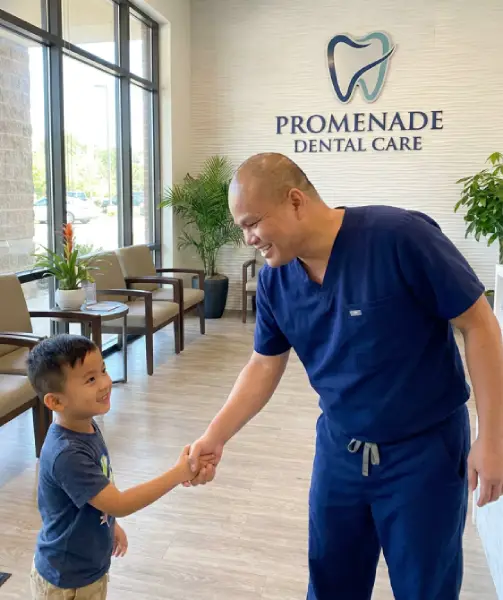
I opened Promenade Dental Care in 2010 as a real family practice. Not a pediatric-only office, and not an adult office that tolerates children. The idea was always the whole family under one roof: your toddler's first exam, your own crown, your mother's denture adjustment. That continuity is worth more than it sounds. A child who sees the same dentist from age one to age eighteen never has to explain their gag reflex, their anxiety, or their history to a stranger. I already know.
I am a general dentist, not a board-certified pediatric specialist, and I would rather you hear that from me. My residency included treating the children of active-duty families, and I see kids from the first tooth up. What I do not do is stretch past my scope: a child who needs deep sedation or general anesthesia for dental work, or who has significant special health care needs, gets a referral to a pediatric specialist rather than an appointment here. I speak English, Spanish, and Vietnamese, which matters in a practice serving Murrieta, Temecula, French Valley, and Winchester. There are more than 230 five-star Google reviews from families across this valley, and they are a fairer summary of how this works in practice than anything I could write here.
★★★★★Rated 5 out of 5 stars
“Absolutely love this dental office. me and my family all come for our 6months cleanings and check ups. Dr. Nguyen is super friendly to my children they even have cute stickers for the kids and little toys.”
Valeria morales · Google review
★★★★★Rated 5 out of 5 stars
“Fit my daughter in for an emergency visit!! Kind, knowledgeable, and quick! Plan on continuing care for my whole family🤍”
Nancy Carranza · Google review
★★★★★Rated 5 out of 5 stars
“Took my son in to get a root canal and crown. Staff was very polite and kept me updated on the process. My son was very comfortable with the process”
Javier Gonzales · Google review
★★★★★Rated 5 out of 5 stars
“Fast and easy. Have now switched all four of my kids to Promenade Dental Care”
Autumn Montgomery · Google review
Related Pages
More on Children's and Family Dentistry
Your Child's First Dental Visit
When to come, what happens in the chair, how to prepare a toddler, and the milestones from the first tooth to the last baby tooth.
Tooth-Colored Fillings
How a cavity is filled, what it costs, and a section written specifically about gentle fillings for kids.
Frenectomy for Tongue-Tie and Lip-Tie
Which ties need release, which do not, and why I am cautious with infants.
Emergency Dentist in Murrieta
Same-day care for toothaches, knocked-out teeth, and injuries — for every age, with a section on children.
Sedation Dentistry
Nitrous oxide and oral sedation: how each works and what to expect afterward. Oral sedation is only for patients 18 and older.
$20 Exam and Digital X-Rays
What the comprehensive exam covers for adults and children, and why it costs twenty dollars.
Visit the Office
A Kids Dentist for the Temecula Valley
The office is on the Date Street corridor near Clinton Keith Road, a few minutes off I-215 and about fifteen minutes from most of Temecula and Menifee. Families bring children in from Murrieta, Temecula, Menifee, French Valley, Winchester, Wildomar, Lake Elsinore, Canyon Lake, Fallbrook, and Hemet. Many book back-to-back appointments so parents and kids are seen in one trip.
- Practice
- Promenade Dental Care — Dr. Bao Nguyen, DDS
- Address
- 26957 Date St, Suite B4, Murrieta, CA 92563
- Phone
- (951) 412-0127
- Ages seen
- First tooth through adulthood — no age floor or ceiling
- Children's services
- Exams and cleanings, fluoride varnish, sealants, space maintainers, tooth-colored fillings, nitrous oxide, same-day emergency care
- Payment
- All PPO plans accepted • CareCredit financing • Cash, Visa, Mastercard, Amex, Discover
- Languages
- English, Español, Tiếng Việt
Office hours
| Monday | 9:00 AM – 5:00 PM |
| Tuesday | 9:00 AM – 5:00 PM |
| Wednesday | 9:00 AM – 3:00 PM |
| Thursday | 9:00 AM – 5:00 PM |
| Friday | 9:00 AM – 3:00 PM |
| Saturday | By appointment & emergencies |
| Sunday | Closed — emergency line monitored |
Questions Parents Actually Ask
Murrieta Pediatric Dentist FAQs
At what age should my child first see a dentist?
By the first birthday, or within six months of the first tooth erupting, whichever comes first. The American Academy of Pediatric Dentistry, the American Academy of Pediatrics, and the American Dental Association all give the same recommendation. At Promenade Dental Care in Murrieta a children's exam is $20, the same price as an adult exam. A full guide to the first visit, including how to prepare a toddler, is on the children's first dental appointment page.
Is Dr. Bao a pediatric dentist or a general dentist?
Dr. Bao Nguyen is a general dentist whose training includes pediatric care. His Advanced Education in General Dentistry residency at Naval Hospital Camp Pendleton involved treating the children of active-duty military families, and he sees patients from the first tooth through adulthood, so a child never has to switch dentists at twelve or eighteen. For children who need deeper sedation than nitrous oxide, or who have significant special health care needs, he refers to a board-certified pediatric specialist rather than treating outside his scope.
How often should a child have a dental cleaning?
Every six months for most children, starting once there are enough teeth to clean. A child with a history of cavities, deep molar grooves, or a diet heavy in juice and frequent snacks may be scheduled more often for a stretch, and a child with no decay and good home care may not need more than the two routine visits a year. Dr. Bao sets the interval by each child's cavity risk rather than putting every patient on the same calendar.
How much does a children's dental exam cost in Murrieta?
A children's dental exam at Promenade Dental Care costs $20, the same as an adult exam, and includes digital X-rays when they are clinically indicated. There is no separate pediatric pricing tier and no upcharge for the extra time a nervous child takes. Cleanings, fluoride, sealants, and space maintainers are quoted as a written estimate before treatment begins. All PPO dental plans are accepted and CareCredit financing is available.
Does dental insurance cover my child's cleanings and sealants?
Yes, in most cases. Most PPO dental plans cover children's preventive care — exams, cleanings, fluoride, and sealants on permanent molars — at 80 to 100 percent, and many plans pay enhanced benefits for patients under 18. Space maintainers are usually covered as a basic service. Promenade Dental Care accepts all PPO plans and is in-network with Delta Dental PPO, Cigna, MetLife, Guardian, Aetna, and United Concordia. The office verifies your child's specific benefits before treatment starts, so you know the out-of-pocket figure in advance.
Is fluoride varnish safe for my child?
Yes. Fluoride varnish is a small, controlled dose painted directly onto the teeth, where it hardens on contact with saliva rather than being swallowed. The American Academy of Pediatric Dentistry, the American Academy of Pediatrics, and the National Institute of Dental and Craniofacial Research all support it as a safe and effective way to prevent decay in children, applied every three to six months starting with the first tooth. Dr. Bao discusses fluoride individually with every parent, gives you the evidence, and respects your decision either way without pressure.
How much toothpaste should my child use?
Fluoride toothpaste from the first tooth: a smear the size of a grain of rice for children under three, and a pea-sized amount from age three on. A parent should put the toothpaste on the brush and help with brushing until the child has the fine-motor skill to do it well, which is usually around the time they can tie their own shoes. Fluoride mouthrinse is not recommended for children under six because they tend to swallow it.
Are dental sealants worth it for my child?
Yes, for most children they are the single best return on prevention available. The CDC reports that dental sealants prevent about 80 percent of cavities in the back teeth for two years after placement, continue to prevent about half of them for up to four years, and that children ages 6 to 11 without sealants have nearly three times as many first-molar cavities as children with them. Application takes about two minutes per tooth with no drilling and no anesthetic, and most PPO plans cover sealants on permanent molars for children at a high percentage.
When should my child get sealants?
Shortly after each permanent molar comes through the gum — around age six for the first molars and around age twelve for the second molars — before the grooves have had a chance to start decaying. Dr. Bao will occasionally seal a baby molar with unusually deep grooves in a child with a cavity history, even though it will eventually fall out, because a sealant is far simpler than a filling in a five-year-old. Sealants are checked at every checkup and touched up if they wear.
What is a space maintainer and does my child really need one?
A space maintainer is a small, passive appliance — most often a stainless steel band cemented to one tooth with a wire loop resting against the next — that holds the gap open after a baby molar is lost early. Without it, the neighboring teeth drift into the space within weeks and the permanent tooth underneath erupts crooked or gets trapped. It is usually needed when a baby molar is lost well before the permanent tooth is ready, and usually not needed when the permanent tooth is already close to erupting or when a front baby tooth is lost. Dr. Bao decides from the X-ray and explains the reasoning either way.
What happens if my child is too scared to open their mouth?
Nothing happens, and that is deliberate. Dr. Bao does not force a frightened child through a procedure and does not restrain children. If your child is not ready, the appointment becomes a practice visit — riding the chair, holding the mirror, meeting the instruments — and the clinical work waits for another day. Most children come around within one or two visits, and the trust holds afterward. Promenade's safe-haven approach to dental anxiety was originally built around children.
Do you use nitrous oxide on children?
Yes, though it doesn't work for every child. Nitrous oxide (laughing gas) is the only comfort option used for patients under 18 at Promenade Dental Care, and no one under 18 is given oral sedation here. The American Academy of Pediatric Dentistry recognizes nitrous oxide and oxygen inhalation as a safe and effective way to reduce anxiety in pediatric patients. It takes effect in about three to five minutes and clears within minutes after the mask is removed, so most children return to school the same day. Your child stays awake and able to talk, and Dr. Bao adjusts the concentration to each child's size and response during the appointment.
Do cavities in baby teeth really need to be filled?
Yes. Baby teeth hold space for the permanent teeth, guide jaw development, and affect speech, and the last primary molars do not fall out until around age twelve. Untreated decay in a baby tooth causes pain and infection and can lead to early tooth loss, which allows neighboring teeth to drift and crowd out the permanent tooth underneath — the situation a space maintainer exists to rescue. Treating a cavity in a primary tooth is a clinical decision, not a cosmetic one.
My child knocked out a tooth — what should I do right now?
If it is a permanent tooth, pick it up by the crown rather than the root, rinse it gently if it is dirty, place it in milk, and call (951) 412-0127 immediately. Re-implantation has the best outcome within the first 30 to 60 minutes. If it is a baby tooth, do not attempt to put it back in, because that can damage the permanent tooth developing above it — press a clean cloth on the gum to stop the bleeding, then call and bring your child in to be checked. Chipped teeth, toothaches, and dental injuries in children are seen the same day.
Can my whole family see Dr. Bao at the same office?
Yes. Promenade Dental Care is a general family practice, so children, teenagers, parents, and grandparents are all treated by Dr. Bao Nguyen at the same Murrieta office. Families frequently book back-to-back appointments to make one trip to Date Street instead of three. There is no age floor and no age ceiling, and children never have to transfer to a different dentist when they outgrow a pediatric practice.
Book Your Child's $20 Exam
Call Promenade Dental Care and bring your questions. You will get a straight answer about your child's teeth, in writing, before anything is scheduled.
(951) 412-0127