
Sedation Dentistry · Promenade Dental Care, Murrieta
Sedation Dentistry in Murrieta: Laughing Gas, Oral Sedation, and Who Actually Needs Them
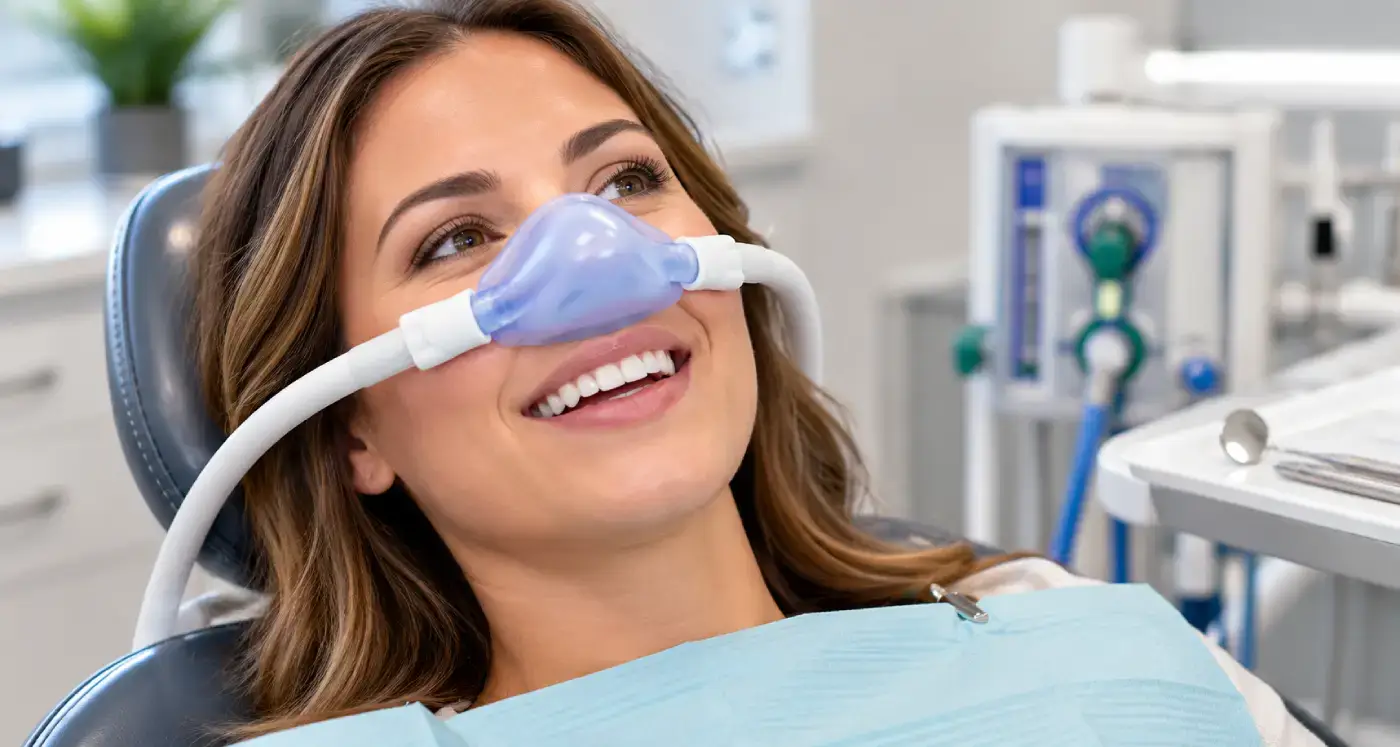
Sedation in my office means one of two things: nitrous oxide, the laughing gas you breathe through a small nose mask, or oral conscious sedation, a prescription pill for adults 18 and older. You stay awake and breathe on your own with either one, and local anesthetic still does the numbing. I don't offer IV sedation or general anesthesia, and plenty of nervous people turn out not to need sedation at all. I'll tell you which group you're in at a $20 exam.
The basics
What is sedation dentistry, and what does it actually feel like?
Sedation takes the fear out of the appointment. It doesn't take the pain out; local anesthetic does that, the same as it would without sedation. That split matters, because a lot of people come in picturing being "put under," and that isn't what happens here. With nitrous oxide you feel calm, warm, and a little floaty within a few minutes, and you can talk to me the whole time. With oral sedation you feel heavy and drowsy, time seems to move fast, and many people remember very little of the visit afterward. In both cases you're breathing on your own and you respond when I talk to you.
The American Dental Association's patient guide to anesthesia and sedation lays out the whole range, from local anesthetic through gas, pills, IV medication, and general anesthesia. My office works at the light end of that range on purpose. Deeper sedation belongs with an oral surgeon or a dental anesthesiologist who does it every day, and I'd rather refer you than stretch a general practice past what it should do.
- What I offer
- Nitrous oxide (laughing gas) and oral conscious sedation
- What I don't offer
- IV sedation and general anesthesia; I refer those cases out
- Are you asleep?
- No. You stay awake, breathe on your own, and can answer questions
- Pain control
- Local anesthetic, the same as any visit; sedation handles the anxiety
- Oral sedation
- Adults 18 and older only, and you need a driver
- Children
- Nitrous oxide is the only option I use, and it doesn't work for every child
- My credential
- Dental Board of California certificate for oral conscious sedation of adult patients
- First step
- A $20 new-patient exam with digital X-rays, without insurance
Who it's for
Who is sedation right for?
Sedation is right for people whose fear, gag reflex, or treatment plan is the thing standing between them and getting their teeth fixed. If any of these describe you, it's worth asking about at your exam:
The last two are common in Murrieta and Temecula patients who come to me after years away. The fear usually traces back to one appointment, often a long time ago, where somebody started before the tooth was numb or kept going after the patient said stop. That's learned fear, and the Cleveland Clinic's overview of dentophobia lists exactly those experiences among its causes. Sedation can get you through the first few visits while calm, uneventful appointments do the slower work of unlearning it.
Decision boundaries
When don't you need sedation?
You don't need sedation when the fear is about one specific thing I can fix another way, or when the visit is short enough that the drive here takes longer. I'd rather tell you that than add a fee you don't need.
| Your situation | What I'd do instead | Why |
|---|---|---|
| Mild nerves before an exam or cleaning | No sedation: a slower pace, headphones, and a stop signal | The visit is short and nothing sharp is involved |
| The shot is the only thing you dread | Numbing gel given real time to work, then a slow injection; nitrous only if that isn't enough | Most injection pain comes from rushing, not the needle; see how I keep the shot from hurting |
| You hate the noise | Your own earbuds and playlist; an ultrasonic cleaning instead of long hand scraping | Sound drives a lot of dental fear, and it's easy to block |
| You want to be completely asleep | A referral to an oral surgeon or dental anesthesiologist for IV sedation or general anesthesia | I don't put patients to sleep in this office |
| You're pregnant and the visit is elective | Postpone sedation until after delivery; urgent care goes ahead with local anesthetic | Elective sedation can wait; an infection can't |
| A child who can't sit through treatment | Nitrous oxide may help; if it doesn't, a referral to a pediatric dentist | Oral sedation here is for adults only |
A good number of people who ask for sedation at the exam never end up using it. Knowing it was available, and that they could stop me at any point, was enough to get them through. If that turns out to be you, great. If it doesn't, the option is still there for the next visit.
Your two options
Nitrous oxide or oral sedation: which one fits you?
Nitrous oxide fits mild to moderate fear and short or medium visits. Oral sedation fits severe fear, long-term avoidance, and long appointments where several things get done at once. Here's how they compare side by side.
| What you'll want to know | Nitrous oxide | Oral conscious sedation |
|---|---|---|
| How you take it | Breathe through a small mask over your nose | A prescription pill taken before the visit |
| How fast it works | A few minutes | Roughly an hour |
| How you feel | Relaxed, light, fully able to talk | Drowsy and heavy, but you still respond |
| Memory of the visit | Usually clear | Often hazy or patchy |
| Adjustable during the visit | Yes, up or down as we go | No; the dose is set beforehand |
| Wears off | Within minutes of switching to plain oxygen | Drowsiness lasts the rest of the day |
| Driving home | Usually fine once it has cleared | No; an adult drives you both ways |
| Age | Adults and children | 18 and older only |
| Fee | The lower of the two | Higher, because of the longer monitoring |
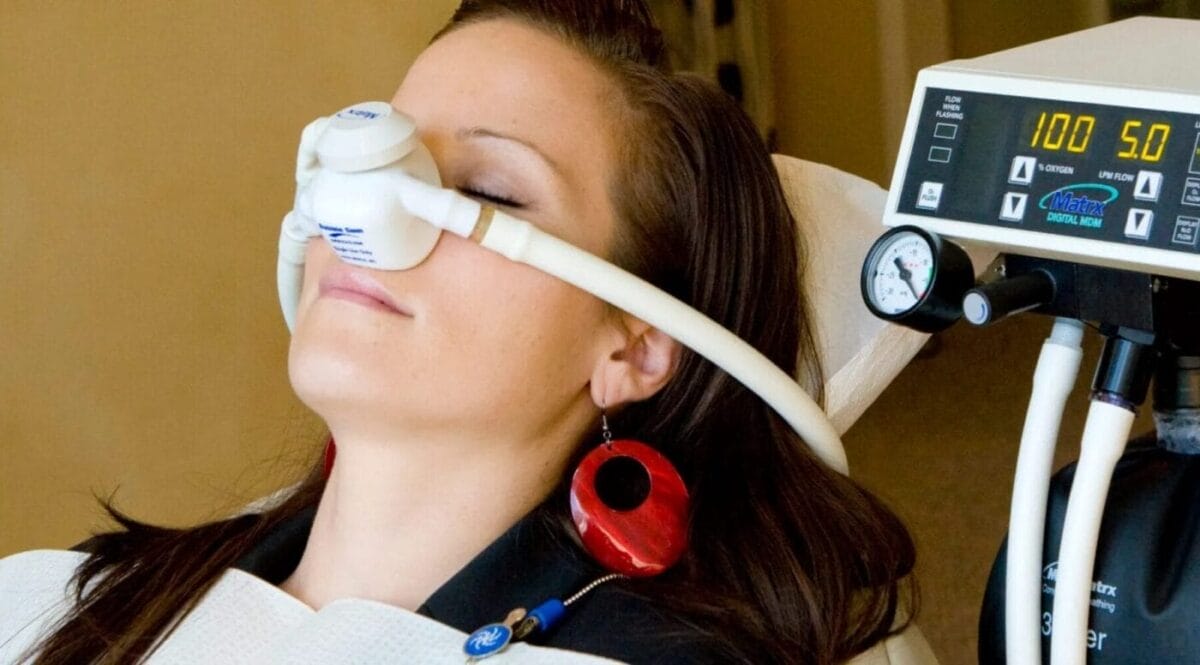
If nitrous will do the job, that's what you get. There's no reason to take the heavier option when the lighter one works, and nitrous has the big advantage of being easy to turn down or stop the moment you want it gone. The Cleveland Clinic's nitrous oxide page makes the same point I make in the chair: laughing gas dulls pain without removing it, which is why it's always paired with local anesthetic.
Step by step
What happens on a sedation visit?
A sedation visit runs in the same order every time, and the first step happens on a different day from the treatment.
1We talk at the exam
At your $20 new-patient exam I ask what scares you, what happened last time, and what medications you take. Nothing is done to you that day unless you want it.
2You get a plan and a price
You leave with which method I'd use, what work it covers, and the written price for both the treatment and the sedation.
3Before the day
For oral sedation you get the prescription and written instructions, including when to stop eating, and you line up an adult to drive you both ways.
4Settling in
A pulse oximeter goes on your finger. With nitrous, the mask goes on and I raise the level until you feel calm. With oral sedation, we wait until the pill has taken hold.
5Numbing, then treatment
Topical gel, then local anesthetic, then I test that the area is numb before I start. You keep your stop signal the whole time.
6Going home
With nitrous you breathe plain oxygen for a few minutes and usually drive yourself. With oral sedation your driver takes you home to rest.
How I decide
How do I decide whether you need sedation, and which kind?
I decide from three things: what exactly you're afraid of, what's in your health history, and how much work we're doing. A general fear of "the dentist" and a specific fear of needles call for different plans, and a forty-minute filling and a three-hour visit call for different ones again. I spent ten years as a Navy dentist treating sailors and Marines, plenty of whom had never sat in a dental chair, and the habit that stuck with me is to start with the lightest thing that works and add only what's needed.
| What I find | What I usually recommend |
|---|---|
| Nervous, healthy, short visit | No sedation; a slow pace and a stop signal, with nitrous on standby |
| Fear centered on the shot or the gag reflex | Nitrous oxide, adjusted during the visit |
| Years of avoidance and several teeth to fix | Oral sedation, with as much work as is sensible combined into one visit |
| Untreated sleep apnea, serious lung disease, or medications that slow breathing | No oral sedation until I've talked with your physician; sometimes nitrous, sometimes a referral |
| Wants to be fully asleep, or the case is surgically complex | A referral for IV sedation or general anesthesia |
The health history isn't paperwork. Sleep aids, anxiety medication, opioid pain relievers, alcohol use, and some antibiotics and antifungals all change how a sedative behaves, and so does sleep apnea. Tell me about supplements and over-the-counter drugs too. If something in your history makes me uneasy, I'll ask your physician before I sedate you, not after.
Risks and limits
What are the risks, and when would I send you somewhere else?
Both methods are safe when the patient is screened properly and watched the whole time, but neither is risk-free, and you should hear the downsides from me before you agree to anything.
Honest limits: nitrous oxide can cause brief light-headedness, nausea, or a headache, usually when the level is higher than you need or you ate a heavy meal right before. Oral sedation stays in your system for hours, so drowsiness, unsteady walking, and dry mouth are expected, and rarely a person gets restless instead of calm. Sedation is a continuum, so a dose can run deeper than intended, which is why your oxygen and pulse are watched for the whole visit. Neither method numbs you; the local anesthetic still has to work. And oral sedation can't be adjusted once you've taken it.
I refer out when a case calls for more than a general practice should do. That means IV sedation or general anesthesia with an oral surgeon or a dental anesthesiologist, impacted wisdom teeth and other complicated extractions with an oral surgeon, and a child who still can't sit for treatment after nitrous with a pediatric dentist. I'd rather hand you to the right person than push past what this office should be doing.
Cost
What does sedation cost?
Sedation is a separate fee on top of the treatment it's used for, and it isn't on my published price list, so you get it in writing after the exam, before anything is scheduled. Nitrous oxide is the lower fee; oral sedation costs more because the monitoring runs longer. The quote you sign covers the treatment and the sedation together.
New-patient exam with digital X-rays
$20
Without insurance; this is where the sedation plan gets made
Nitrous oxide
Quote
Written price after the exam, added to the treatment fee
Oral conscious sedation
Quote
Written price after the exam; adults 18 and older
The money argument for sedation is simple. A person who stays away for five years because of fear usually comes back needing a root canal or an extraction where a filling would have done. The sedation fee costs less than what the avoidance costs.
Insurance and payment
Does dental insurance cover sedation?
Usually not. Most plans treat sedation as elective, though some PPO plans pay for it when it's documented as medically necessary, for example a gag reflex that blocks treatment. I accept PPO plans and I'm in network with Delta Dental PPO, Cigna, MetLife, Guardian, Aetna, and United Concordia. My team checks your benefits before the visit and tells you what your plan will and won't pay.
I don't quote insured fees on this page because they depend on your plan's coverage, deductible, and copay. Without insurance, you pay the written quote. I take cash, Visa, Mastercard, American Express, Discover, and CareCredit.
Alternatives
What else helps if you'd rather not be sedated?
Several things help without any medication, and I use them with every nervous patient whether or not they're sedated.
| Option | Best for | Its limits |
|---|---|---|
| Topical gel and a slow injection | Fear of the shot | Doesn't touch general dread of the visit |
| A stop signal and breaks | Feeling trapped in the chair | You have to trust it, which takes a visit or two |
| Short visits, easiest work first | Long-term avoiders rebuilding trust | More trips to the office |
| Earbuds and your own playlist | Noise | Nothing for needle fear |
| Therapy for dental phobia | Panic that keeps you from booking at all | Takes weeks; works best alongside calm visits |
| IV sedation or general anesthesia elsewhere | Severe phobia or complex surgery | Higher cost, a separate office, longer recovery |
Specific phobias respond well to treatment, and the Mayo Clinic's page on specific phobias notes that without it they tend to last. If your fear is at the panic end, sedation and a therapist together usually work better than either alone. The dental phobia article goes further into that.
Afterward
How long does sedation take to wear off, and what's the rest of the day like?
Nitrous oxide clears within minutes; oral sedation takes the rest of the day. Plan around the one you're having.
- After nitrous oxide
- A few minutes of plain oxygen, then most people feel normal and drive themselves back to work
- After oral sedation
- Expect to nap. No driving, no work, no important decisions or signatures for the rest of the day, and an adult nearby for the first few hours
- The numbness
- Local anesthetic usually wears off in a few hours, separately from the sedation; what normal soreness feels like is covered here
- Eating
- Something soft once the numbness is gone, and no alcohol that day
- When to call
- Nausea that won't settle, dizziness still there the next morning, or pain that's climbing instead of fading
Call (951) 412-0127 if anything after a sedated visit doesn't feel right. I'd rather hear about it early.
For nervous patients
Where should a nervous patient start reading?
Sedation is one tool among several. These pages cover the rest, from what a phobia is to what each procedure actually feels like.
Dentist for dental anxiety
How a first visit runs here when you're scared, step by step.
Dental phobia
What dentophobia is, where it comes from, and how it gets treated.
Is it going to hurt?
What the shot, a filling, a root canal, and an extraction feel like.
Pain-free dentistry
The techniques that keep the shot and the visit from hurting.
Emergency dentist
When a toothache won't wait, nervous or not.
$20 dental exam
Where every sedation plan starts.
Your dentist
Who sedates you?
I do. I'm Dr. Bao Nguyen, and Promenade Dental Care is my one-dentist office on Date Street in Murrieta, near Murrieta Hot Springs Road and Winchester Road. I've practiced here since 2010. I earned my DDS at the UCLA School of Dentistry, then served ten years as a U.S. Navy dentist, including an Advanced Education in General Dentistry residency at Naval Hospital Camp Pendleton and deployments to Kuwait and Iraq.
I hold the Dental Board of California's oral conscious sedation certificate for adult patients, which the Board renews every two years only with continuing education in oral sedation. That's on top of the roughly 40 hours of continuing education I take each year. Patients come in from Murrieta, Temecula, Menifee, French Valley, Winchester, Wildomar, Lake Elsinore, and Canyon Lake, and the office speaks English, Spanish, and Vietnamese.

Patient reviews
What do nervous patients say afterward?
I am completely terrified of the dentist. I neglected getting anything done for years and years because of bad experiences and just general fear and anxiety. Well I got sick of having an aching jaw everyday so I came in and got a x-ray and consultation and they told me what work needed to be done. The price was pretty much half of what comparable dentists wanted and they were really really nice to me. So I saved up the money and went back in for the procedure. The doctor gave me some anxiety meds which completely relaxed me and they were just great about everything and I can honestly say I have way less fear and anxiety about going back to the dentist. The best part was they did all my procedures at once so I wouldn't have to make return visits. I got a tooth extraction, a crown, a handful of cavities, a deep cleaning and some other stuff all done at the exact same time. It's been 3 days now and everything is healing beautifully I'm no longer in any pain and I'm just grateful. So if you have any anxiety about going to the dentist, this is the place for you. Oh and tell the doctor I said get rid of that creepy tooth picture in the waiting room haha!
— Jay · Google review
Dr. Nguyen and his staff are so kind and professional. I hated going to the dentist, until I started my dental treatments with @PromenadenralCare. They understand how frightening past experiences can make a person feel very anxious. The dentist was very patient & compassionate.
— Cindy D · Google review
Dr Nguyen is great! Very professional. Going to the dentist can be scary, but Dr Nguyen is amazing and makes the process as least painful as he can. Edith is also amazing, she is very communicative and understanding to situations that arise with scheduling appointments. Found my new permanent dentist.
— Cody Brown · Google review
Great experience! The staff was super friendly, and Dr. Bao Nguyen was gentle, patient, and explained everything clearly. I felt very comfortable the whole time. Highly recommend!
— Nhi Huynh · Google review
FAQ
What else do people ask about sedation?
Will I be unconscious with oral sedation?
No. Oral conscious sedation leaves you drowsy and relaxed, but you breathe on your own and respond when I talk to you. Many people remember little of the appointment afterward, which is often the point for someone who has avoided the dentist for years. If you want to be fully unconscious, that's general anesthesia, and I refer it to an oral surgeon or a dental anesthesiologist.
Can children have oral sedation at your office?
No. Oral sedation in my office is for patients 18 and older only. The one option I use with a nervous child is nitrous oxide, and it doesn't work for every child. A child who still can't sit through treatment with it gets a referral to a pediatric dentist.
Does laughing gas make the numbing shot hurt less?
It helps. Nitrous oxide takes the edge off the anticipation, which is most of what people feel, and it dulls sensation somewhat. The bigger difference comes from technique: numbing gel left long enough to work, then the anesthetic delivered slowly. With both, most people barely notice the injection.
Can several procedures be done in one sedated visit?
Often, yes, and that's one of the best reasons to use oral sedation. Fillings, a crown, and a cleaning can frequently be combined into one longer appointment instead of four short ones, which means one day of dread instead of four. I plan the combination at the exam so the visit length stays reasonable.
Can I be sedated if I'm pregnant?
I postpone elective sedation until after the baby is born. Urgent problems, like an infected tooth, shouldn't wait, and most of that care can be done with local anesthetic alone. Tell the front desk you're pregnant when you call, and I'll coordinate with your OB before treating you.
What should I tell you about my health before sedation?
Everything you take, including sleep aids, anxiety medication, pain medication, supplements, and over-the-counter drugs, plus any lung or heart condition, sleep apnea, and how much you drink. These change how a sedative behaves. If anything raises a question, I'll talk to your physician before your appointment.
How do I ask for sedation when I call?
Just say it: "I'm nervous, and I'd like to talk about sedation." The front desk books you for the exam with enough time to talk, and nothing is done that day unless you want it. You can decide on sedation after we've talked and you've seen the written price.
Is it safe to have nitrous oxide more than once?
Yes. Used in the dental chair under supervision, nitrous oxide doesn't build up or cause lasting effects, and plenty of patients use it at every visit. Some people find they need it less over time as calm appointments pile up, and some never stop using it. Either is fine.
What if the sedation doesn't relax me enough?
With nitrous I can raise the level during the visit. With oral sedation the dose is set beforehand, so if it isn't enough we stop, regroup, and plan differently rather than push through. For some people that next plan is a referral for IV sedation, and that's a reasonable outcome, not a failure.
Ready to talk about it?
Call and say you're nervous. You'll start with a $20 exam and a conversation, and you'll know which option fits you, and what it costs, before anything is scheduled.
What the $20 exam coversPromenade Dental Care · Dr. Bao Nguyen, DDS
26957 Date St, Suite B4, Murrieta, CA 92563
Mon, Tue, Thu 9 AM–5 PM · Wed, Fri 9 AM–3 PM · no regular weekend hours