Murrieta Dentist • Drink & Enamel Guide
Is Alcohol Bad for Your Teeth? A Dentist’s Drink-by-Drink Guide
Wine, beer, cocktails and hard seltzer ranked by acid, sugar and what they actually do to enamel
Alcohol itself does not drill holes in your teeth. What does the damage is the combination it creates — acid on the enamel, sugar for the bacteria, and far less saliva to wash either one away. Here is how each type of drink compares, and how to keep drinking without paying for it in fillings.
The Short Answer
Is Alcohol Bad for Your Teeth?
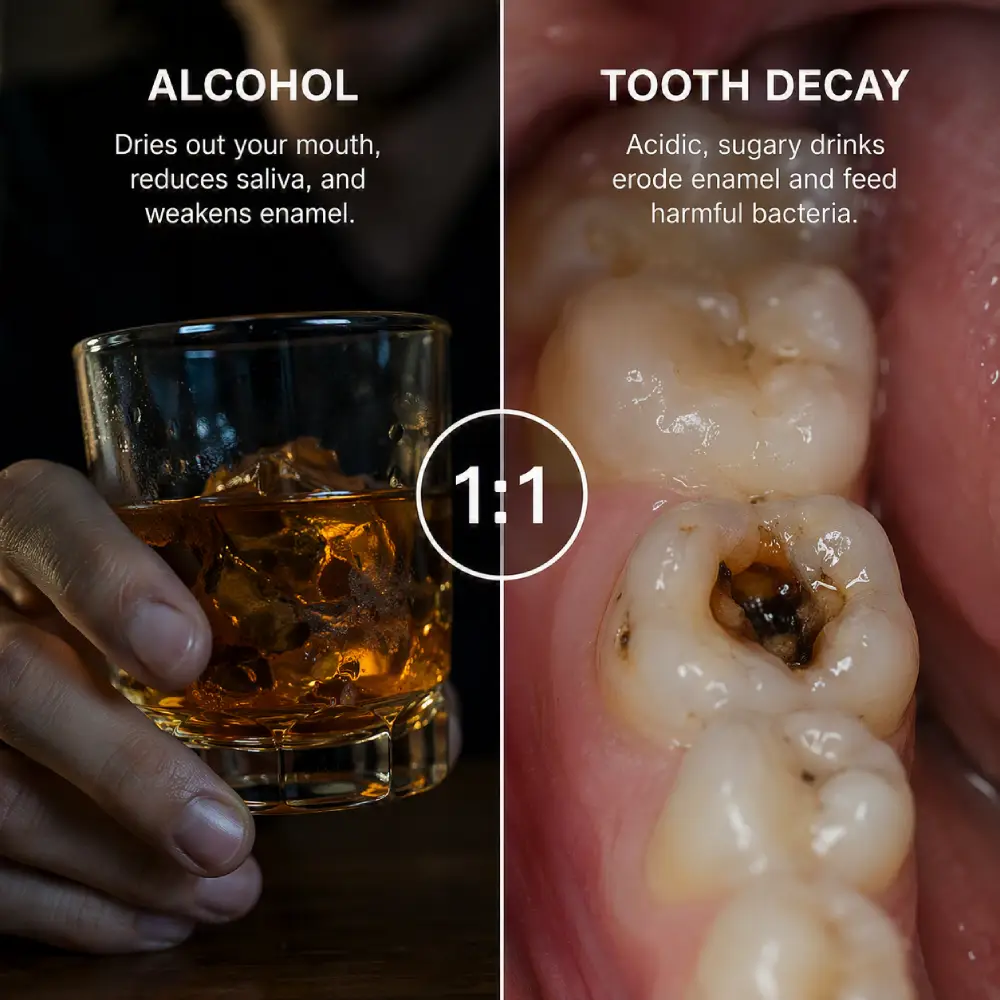
Yes — but indirectly. Ethanol does not attack enamel on its own. The harm comes from three things that travel with it: most alcoholic drinks are acidic enough to soften enamel, many carry sugar that feeds cavity bacteria, and alcohol reduces the saliva that would normally neutralize both. Remove the saliva and an otherwise ordinary drink becomes a much longer acid exposure.
That is why the answer changes depending on what is in your glass. A dry vodka soda and a whiskey sour are not the same risk. Below is how the common categories actually compare.
- Main mechanism
- Acid erosion, amplified by reduced saliva flow
- Secondary risks
- Sugar-driven decay, gum inflammation, staining
- Serious risk
- Alcohol is an established cause of mouth and throat cancer
- Worst combination
- Citrus-based sugary cocktails, sipped slowly over hours
- Easiest fix
- A glass of water between drinks; no brushing for 30 minutes after
Drink by Drink
Which Alcoholic Drinks Are Worst for Your Teeth?
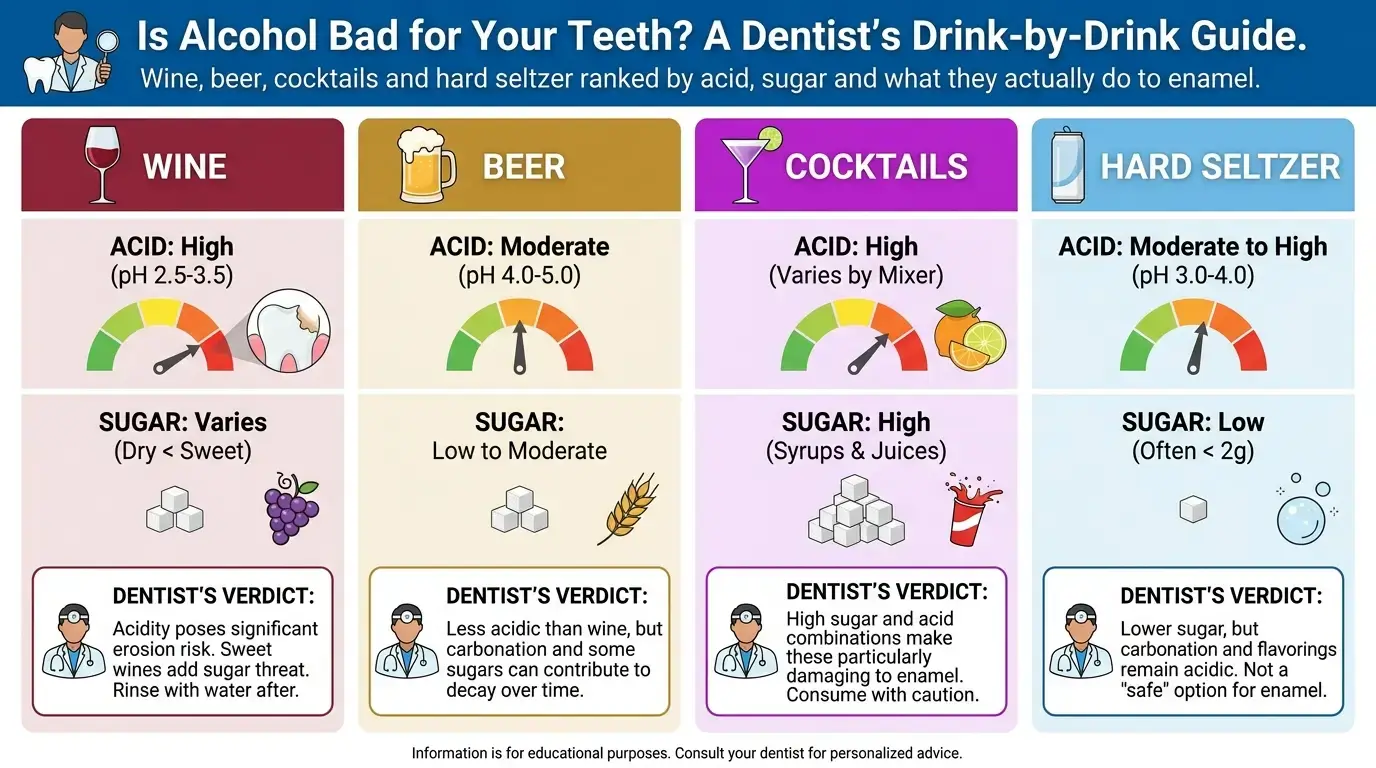
Enamel starts to demineralize at about pH 5.5. In laboratory testing, white wine, red wine and beer averaged roughly pH 3.0, 3.5 and 4.0 respectively — every one of them below the threshold. Sugar is the second variable, and it is the one you have the most control over.
| Drink | Acidity | Sugar | Main risk to your teeth |
|---|---|---|---|
| White wine & sparkling | Highest — around pH 3.0 | Low if dry, high if sweet | The most erosive common drink. Sipped over an hour, it keeps enamel softened the entire time. |
| Red wine | High — around pH 3.5 | Low if dry | Erosion plus tannin and pigment staining that settles into softened enamel. |
| Beer | Moderate — roughly pH 4.0–4.4 | Low to moderate | Gentler per sip, but usually consumed in larger volume over longer sessions. |
| Hard seltzer | Acidic and carbonated | Usually near zero | Less erosive than cola in lab testing — but that testing also showed the protection disappears without saliva. |
| Cocktails & mixers | Often the lowest pH of all with citrus | High | Acid and sugar together, which is the combination that actually produces cavities. |
| Spirits neat or on the rocks | Closest to neutral | None | Least erosive choice. Dry mouth is the remaining concern. |
The hard seltzer catch. Seltzers get a reputation as the “safe” option because they have no sugar, and lab work using atomic force microscopy did find them far less damaging to an enamel-mimic surface than cola. The same work found that adding saliva eliminated measurable damage altogether. That is the problem: alcohol is what suppresses saliva. The drink that depends on saliva for its safety margin is also removing it.
If you want the broader picture beyond alcohol, we cover it in the 10 worst foods and drinks for your teeth.
The Multiplier
Alcohol, Dry Mouth and Why It Makes Everything Worse
Alcohol is a diuretic and it suppresses saliva flow. That matters more than it sounds, because saliva is not just moisture — it is an active repair system. It buffers acid back toward neutral within minutes, rinses away sugar, and redeposits calcium and phosphate into enamel that has just been softened.
When saliva drops, all three of those stop at once. Acid that would have been neutralized in ten minutes lingers for an hour. Sugar sits on the tooth surface instead of being cleared. Enamel that was softened never gets remineralized before the next sip arrives. This is the single reason a drink with an unremarkable pH can still do real damage.
Dry mouth also explains the morning-after breath, and it is worth knowing that most chronic bad breath traces back to the same bacterial overgrowth that low saliva encourages.
Do this instead of nothing: alternate every alcoholic drink with a full glass of water. It is the highest-return habit on this page — it restores saliva flow, dilutes acid, and clears sugar without asking you to change what you drink.
Enamel Under Attack
Does Alcohol Cause Cavities and Enamel Erosion?
Erosion and decay are two different processes and alcohol drives both. Erosion is chemical: acid dissolves mineral straight off the enamel surface, no bacteria required. Decay is biological: bacteria metabolize sugar, produce their own acid, and burrow in. Sweet mixed drinks deliver both at the same time.
Early erosion shows up as sensitivity to cold and a slightly glassy, translucent look at the biting edges of the front teeth. That stage is reversible with fluoride and better habits. Once it progresses to a cavity, it needs a tooth-colored filling, and if decay reaches the pulp, a root canal.
If cold drinks have started to bother you, read our guide to why teeth become sensitive and what actually reverses it.
The 30-minute rule most people get backwards
Brushing right after a drink feels responsible and is the wrong move. Enamel is temporarily softened by acid, and a brush at that moment scrubs away mineral you could have kept. Rinse with water instead, then wait about half an hour before brushing. Fluoride toothpaste at that point helps rebuild enamel strength rather than working against it.
Professional ultrasonic cleanings handle the tartar and staining that build up faster when saliva is chronically low.
Gums & the Oral Microbiome
Does Alcohol Cause Gum Disease?
Your mouth hosts more than 700 bacterial species, and in a healthy mouth most of them are either harmless or actively protective. Research from the Perlmutter Cancer Center followed 1,044 adults aged 55 to 87 and found regular drinkers carried fewer beneficial bacteria such as Lactobacillales and more of the harmful kinds — Bacteroides, Actinomyces and Neisseria.
That shift has consequences past bad breath. An unbalanced oral microbiome tracks with gum disease and tooth decay, and heavy drinkers show more severe periodontal disease than moderate or non-drinkers. Bleeding gums are an open wound that lets oral bacteria into the bloodstream, which is part of why gum disease keeps turning up alongside heart disease in the research.
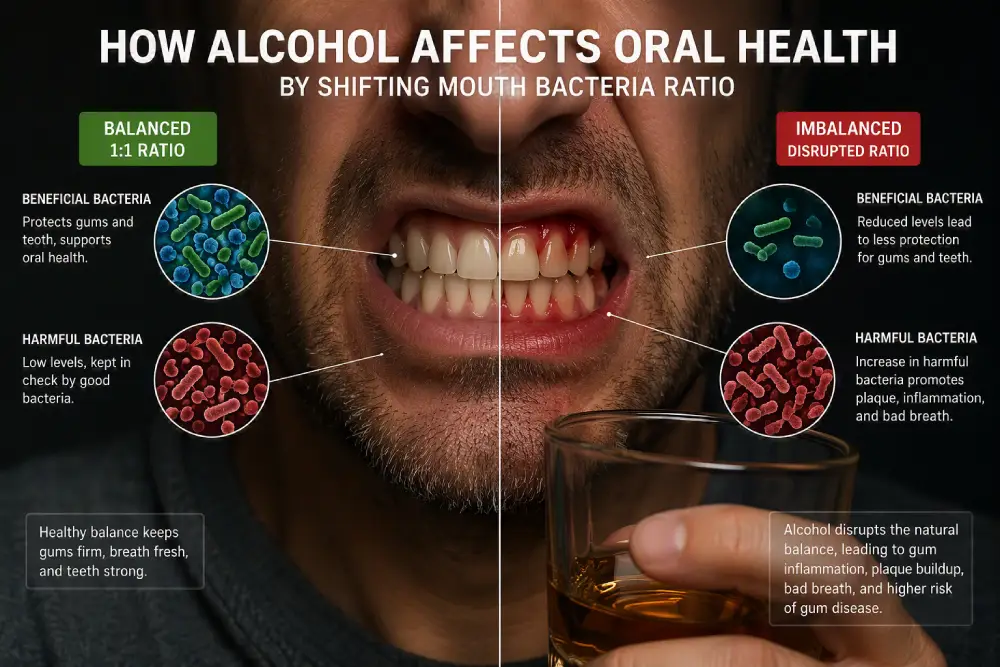
Why the balance tips
Two likely mechanisms. The acidity of most drinks is hostile to the beneficial species your mouth depends on. And as your body processes alcohol it produces acetaldehyde, which disrupts the microbiome and damages cells directly. Researchers are still working out whether alcohol mainly kills the good bacteria, feeds the bad ones, or both.
Bleeding when you brush is not normal and it is not something to wait out. Caught at the gingivitis stage it reverses; past that it needs periodontal treatment.
The Serious Risk
Does Alcohol Increase Oral Cancer Risk?
This one is settled. The American Cancer Society and the CDC both recognize alcohol as a cause of cancers of the mouth and throat. Risk rises with how much you drink, and it rises sharply — far beyond simple addition — when alcohol is combined with tobacco.
Acetaldehyde is again the mechanism. As your body breaks alcohol down it produces the compound directly in contact with the cells lining your mouth and throat, where it can damage DNA. That is why routine screening matters more for people who drink regularly, not less.
Detected early, mouth cancer is far more treatable, according to the National Institute of Dental and Craniofacial Research.
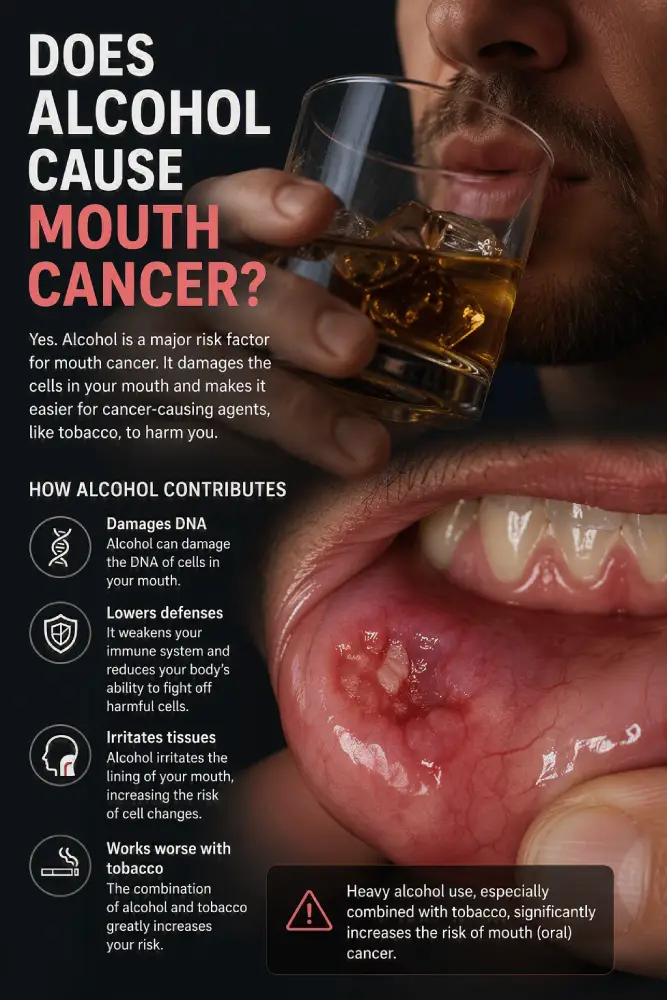
Every exam here includes a screening. When Dr. Bao performs a routine exam at Promenade Dental Care, he checks for the early signs of mouth cancer — a sore that will not heal, a red or white patch, an unexplained lump. It takes about two minutes. If you have persistent mouth pain, a sore lasting more than two weeks, or difficulty swallowing, do not wait: call (951) 412-0127. Here is what an oral cancer screening involves.
Take Action
How to Drink Without Wrecking Your Teeth
None of this requires giving up alcohol. It requires changing the conditions in your mouth while you drink.
1 Water between drinks
Restores saliva flow, dilutes acid and clears sugar. The single highest-value habit here.
2 Pick drier, skip citrus mixers
Dry over sweet, and a spirit with soda over a sour. Sugar plus acid is the cavity combination.
3 Do not nurse the glass
Exposure time matters as much as pH. One drink over two hours is worse than one drink over twenty minutes.
4 Rinse now, brush in 30 minutes
Water immediately. Fluoride toothpaste once enamel has rehardened, not while it is soft.
5 Never pair with tobacco
Together the two multiply oral cancer risk rather than simply adding to it.
6 Keep your six-month visits
Cleanings remove what dry mouth leaves behind, and every exam includes a cancer screening.
$20 Dental Exam & X-Rays
A full check-up including an oral cancer screening and a look for early erosion and decay.
Ultrasonic Teeth Cleaning
Removes the plaque, tartar and wine staining that dry mouth and acidic drinks leave behind.
Gum & Periodontal Care
Treatment for bleeding gums and early gum disease, before it starts costing you bone.
What Murrieta Patients Say
Trusted by Families Across the Valley
Phenomenal experience here! They reached out about a special exam for only $20 and so I went in. I was greeted immediately by name. They took me back immediately, no waiting at all! The dentist himself did the x-rays and explained what he was seen every step along the way I had a little cavity that I needed to have filled, he walked me personally from the x-ray room to the chair. Took care of the cavity, which was very reasonably priced. And I was in and out within 20 minutes! I loved their attention to detail, how reasonably priced they were, how there is only one dentist for one patient, and how attentive they were to everything. I will come here again and again.
— Ericka Howard · Google review
Great experience. Easy to get ahold of and easy to schedule an appointment. Never felt like I was being pushed to get more than what I actually needed. Highly recommend!
— Vinny O · Google review
Common Questions
Alcohol and Teeth: FAQ
Does alcohol itself damage enamel, or is it something else in the drink?
Mostly something else in the drink. Alcohol itself does not attack enamel. The damage comes from three things that accompany it: most alcoholic drinks are acidic enough to soften enamel, many contain sugar that feeds cavity-causing bacteria, and alcohol reduces saliva flow so both linger far longer than they otherwise would. The risk depends heavily on which drink you choose and how slowly you drink it.
Are sweet cocktails worse for teeth than wine or spirits?
Sweet citrus-based cocktails are the worst, because they combine the lowest pH with the highest sugar load. Among plain drinks, white wine and sparkling wine are the most erosive, averaging around pH 3.0 in laboratory testing. Spirits taken neat or on the rocks are the least erosive choice, since they are closest to neutral and contain no sugar.
Is white wine harder on enamel than red wine?
Yes, slightly. Both are acidic enough to soften enamel. In laboratory testing white wine averaged about pH 3.0 and red wine about pH 3.5, both well below the pH 5.5 threshold at which enamel begins to dissolve. Red wine adds tannins and pigments that stain softened enamel more readily. Sipping wine slowly over an hour extends the acid exposure, which matters more than the total amount you drink.
Does beer cause cavities?
Beer is less acidic than wine, measuring roughly pH 4.0 to 4.4, but that is still below the level at which enamel demineralizes. Beer also contains fermentable carbohydrates and is typically consumed in larger volumes over longer periods, so the total acid exposure can end up higher than a single glass of wine. Combined with alcohol-related dry mouth, it does contribute to decay over time.
Is hard seltzer better for your teeth?
Somewhat, but less than its reputation suggests. Hard seltzers contain little or no sugar, and laboratory work using atomic force microscopy found them considerably less damaging to an enamel-mimic surface than cola. That same research found the damage disappeared entirely when saliva was present. Since alcohol is what suppresses saliva, the safety margin depends on the very thing the drink is reducing. Drinking water alongside it restores that protection.
Why do regular drinkers get more gum disease?
Alcohol contributes to it. Regular drinkers show fewer protective oral bacteria and more harmful species, and heavy drinkers tend to have more severe periodontal disease than moderate or non-drinkers. Reduced saliva allows plaque to accumulate and harden into tartar, which drives gum inflammation. Bleeding gums are the early warning sign and should be evaluated rather than waited out.
Should I brush my teeth right after drinking?
No. Acid temporarily softens enamel, and brushing at that moment scrubs away mineral you could otherwise keep. Rinse with water immediately, then wait about 30 minutes before brushing with fluoride toothpaste, once saliva has had time to reharden the surface.
Does drinking really raise the risk of mouth cancer?
Yes. The American Cancer Society and the CDC both recognize alcohol as a cause of cancers of the mouth and throat. As your body breaks alcohol down it produces acetaldehyde, which can damage the DNA in the cells lining your mouth. Risk increases with the amount consumed and rises sharply when alcohol is combined with tobacco. A screening takes about two minutes and is included in every routine exam.
Not Sure Whether Your Enamel Has Already Taken a Hit?
A $20 exam with digital X-rays includes an oral cancer screening and an honest look at early erosion, decay and gum health. Same-week appointments are usually available in Murrieta.
Book Your $20 Exam26957 Date St, Suite B4, Murrieta, CA 92563