
Dental Implants in Murrieta, CA
Murrieta Dental Implants
Guided surgery, one dentist start to finish, and a written price before anything begins.
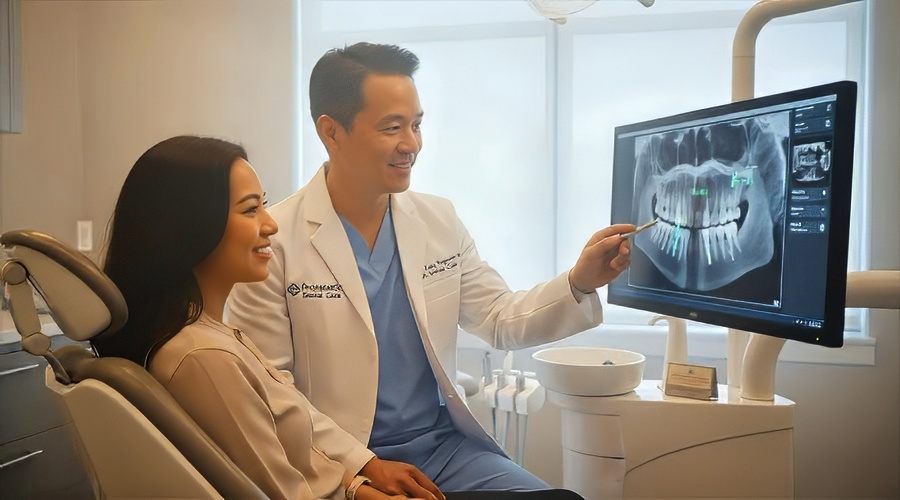
I have been placing implants on Date Street since 2010. Everything happens in this one office: I read your cone-beam scan, plan the position in software, place the post through a printed surgical guide, and make the crown that goes on top of it. Nobody hands you off to a surgeon across town and mails you a bill afterward that nobody warned you about. And if an implant is not the right answer for your mouth, I will tell you that instead.
Replacing a Missing Tooth
What a Dental Implant Actually Is
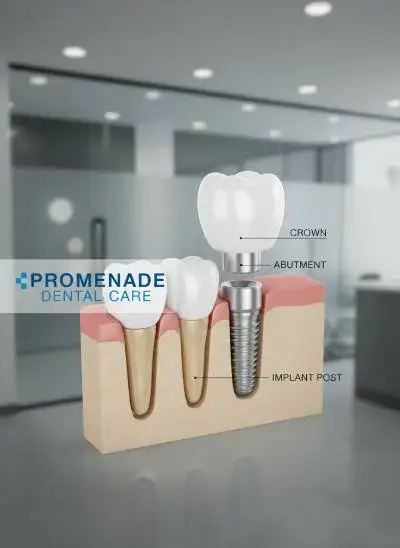
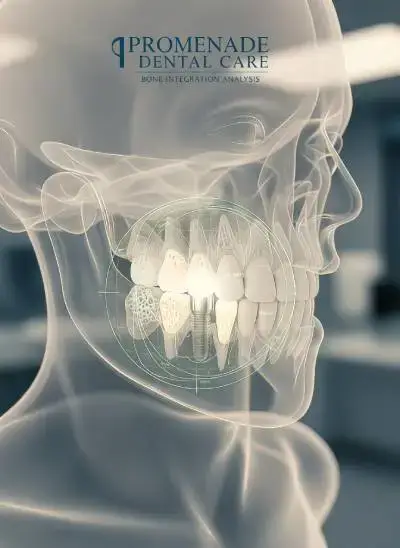
An implant is a titanium post roughly the size of a tooth root. I place it into the jawbone where your own root used to sit, and over the next three to six months the bone grows directly onto its surface. That process has a name, osseointegration, and it is the entire reason implants work. When it finishes, the post is not sitting in your jaw. It is part of it.
Bridges and dentures replace the part of a tooth you can see. An implant replaces the part you cannot. That distinction matters more than most patients expect, because the root is what keeps jawbone dense. Pull the root out and the bone underneath quietly shrinks, year after year, until the shape of the lower face starts to change with it. A denture resting on top of that gum does nothing to slow it down. The American Dental Association patient guide draws the anatomy out if you want to see it.
None of this is new technology. What has changed is the precision. A decade ago most posts went in freehand, guided by a flat X-ray and the surgeon's experience. I plan mine in three dimensions and place them through a printed guide, which is also what puts same-day implants on the table for the patients who qualify.
Candidacy
Who Can Get an Implant, and Who Has to Wait
Most adults missing one or more teeth in Murrieta are candidates. What decides it is bone volume, gum health, and whether something in your medical history slows healing. Age is not on that list.
The two things I look at hardest are the two nobody asks about. Is there enough bone left to hold a post, and are the gums free of active infection. If a tooth has been gone for a year or five years, the bone that used to support it has been shrinking the whole time, and a graft may need to rebuild the site before anything else happens. If there is untreated gum disease, that gets handled first, because placing an implant into infected tissue is one of the reliable ways to lose it. The Cleveland Clinic overview of implants covers the general candidacy picture; a scan of your actual jaw settles it.
- Bone
- Enough height and width to anchor the post. When there is not, a bone graft rebuilds the site and the implant follows after it heals.
- Gums
- No active periodontal infection. Gum disease is treated before placement, never after.
- Medical history
- Uncontrolled diabetes, heavy smoking, jaw radiation, and some immune-suppressing medications all slow healing. They change the plan. They rarely end it.
- Age
- Not a deciding factor. I have placed implants for patients in their eighties with better bone than patients half that age.
- Timeline
- Straightforward case, three to six months from placement to final crown. Add three to four months when grafting comes first.
- What settles it
- A $20 exam with digital X-rays, plus a cone-beam CT scan when the case calls for one.
From Our Google Reviews
What Murrieta Patients Say
“Skilled, friendly, and includes you every step of the way. Love that I could do a full cap replacement in one visit. Thank you Dr. Bao, you’re my new go-to man for dental work. Yessica at the front desk is a big help too.”
Philip Canaday · Google Review
“I am completely terrified of the dentist. I neglected getting anything done for years because of bad experiences and anxiety. The price was pretty much half of what comparable dentists wanted and they were really really nice to me. I can honestly say I have way less fear now.”
Jay D · Google Review
“Bao was a military doctor and was sent to all the best post-graduate dental clinics available in the USA. Dr. Nguyen did an amazing job — not just fixed my forever-problem front teeth but also gave me a new smile.”
Google Review · Front-tooth restoration patient
Precision Placement
Guided Implant Surgery: Taking the Guesswork Out

It starts with a cone-beam CT scan, which builds a three-dimensional map of your jaw. Bone density, the nerve canal, the sinus floor, and the roots of the teeth on either side all show up at once. A flat X-ray shows me none of that with any confidence.
I load that scan into planning software and set the implant exactly where it needs to go. Angle, depth, and clearance from every structure I want to stay away from are locked in before you ever sit down. Then a surgical guide gets printed from that plan. During the procedure it seats over your teeth and physically holds the drill on the path I programmed.
What you get out of that is a smaller opening, less disturbed tissue, faster healing, and a result that behaves the way the plan said it would. Research indexed in the National Library of Medicine consistently finds guided placement more accurate than freehand technique. Here it is the standard protocol on every case, not an upgrade you get quoted separately.
Choosing a Path
Three Implant Options, and When a Bridge Beats All of Them
Which one is right depends on how many teeth are gone, what the bone looks like, and what you care about most: long-term stability, a faster finish, or the lowest number today. These are the three configurations I place.
Single Dental Implant
One post, one abutment, one crown. The teeth on either side are never touched, the bone keeps getting stimulated, and it cleans like a natural tooth because it essentially is one. This is what I recommend for a single gap when the bone supports it.
Best for: one missing tooth.
Implant-Supported Bridge
Two implants carry a multi-tooth span, replacing three or more teeth in a row without grinding down a single natural tooth beside them. The bite load is shared the way roots are meant to share it, and cost per tooth drops as the span gets longer.
Best for: several missing teeth in a row.
Implant-Supported Dentures
Four to six implants anchor a whole arch, either a snap-on overdenture you take out to clean or a fixed hybrid that stays put. Chewing strength comes back close to natural, the jawbone is preserved, and adhesive leaves your bathroom counter for good.
Best for: a full upper or lower arch.
Conventional options still have a place, and I will say so when they fit. A fixed bridge skips surgery entirely but means reshaping the two healthy teeth on either side of the gap. A conventional denture is the smallest number today, but it rests on gum instead of bone, so the ridge underneath keeps shrinking and relines and remakes turn into a recurring expense. When surgery is off the table medically, or when the neighboring teeth already need crowns anyway, one of those is the better answer. Here is how all three compare across the things that matter over twenty years.
| What you are comparing | Single implant | Fixed bridge | Removable denture |
|---|---|---|---|
| Neighboring teeth | Left completely alone | Ground down and crowned | Often clasped for support |
| Jawbone underneath | Stimulated and preserved | Continues to shrink | Continues to shrink |
| Typical service life | Post can last for life; crown 15 to 25 years | Roughly 10 to 15 years | 5 to 8 years between relines and remakes |
| Surgery | Yes, under local anesthetic | None | None |
| Cost today | Highest | Middle | Lowest |
| Cost over 20 years | Usually the lowest | One or two replacements | Relines, remakes, adhesive |
| Cleaning | Brush and floss normally | Threader or floss under the span | Removed and soaked daily |
| Chewing strength | Close to a natural tooth | Good | Noticeably reduced |
What to Expect
The Implant Process, Step by Step
From the first phone call to biting into something without thinking about it, this is what the timeline actually looks like.
1. Consultation and imaging
A $20 exam with digital X-rays, and a cone-beam CT scan when the case needs one. I evaluate bone, gums, bite, and medical history. You leave with a written plan and a quote covering every option that fits your mouth.
2. Groundwork, if needed
Gum disease treatment, bone grafting, a sinus lift, or removing a failing tooth. Not everyone needs this. Skipping it when you do need it is one of the main reasons implants fail inside two years.
3. Placing the post
Thirty to sixty minutes per implant, through a small guided opening, fully numb. Sedation is available if you want it. When the bone grips well enough, a temporary crown goes on the same day.
4. Healing
Three to six months while bone fuses to the implant surface. You do not feel this happening. You eat, work, and smile normally, usually with a temporary restoration in place so there is never a visible gap.
5. Abutment and final crown
Once I confirm integration, the abutment goes on and your final crown, bridge, or denture is color-matched, bite-adjusted, and seated for good.
6. Yearly follow-up
I check the post, the crown, the bone level, and the gum collar once a year. Implants do not get cavities, but they do get gum infections, and catching that early is the difference between a cleaning and a replacement.
The Part Most Offices Rush
Why Gum and Bone Health Decide the Outcome
An implant is a titanium post in bone, sealed by gum tissue. If the bone is thin or the gums are infected, no amount of placement precision saves it. This is the part of implant dentistry I am most particular about, and it is the part that gets skipped when a practice is running on volume.
Bone is the anchor bed
I need a minimum width and height of dense bone at the site. When a tooth has been gone a while, that bone has been resorbing the whole time, and the CDC oral health data shows how common tooth loss is among American adults. I measure density and volume off the cone-beam scan. When it comes up short, I graft, and the implant waits until the graft has taken. Placing into marginal bone to save an appointment is why implants loosen in year two.
Gums are the seal
Healthy tissue forms a tight collar around the post and keeps bacteria out of the seam between implant and bone. Active gum disease breaks that seal from day one. The American Academy of Periodontology recommends clearing infection before placement, and I follow that without exception. Treatment usually takes a few weeks. Those weeks buy a decade of stable function.
Why I handle both myself
My Navy residency at Camp Pendleton was heavy on periodontics and oral surgery, not just restorative work. So I am not only placing the implant, I am reading and treating the tissue it has to live in. Grafting, gum treatment, placement, and the crown all happen here, planned by one person looking at the whole mouth. When the surgeon and the restoring dentist work from separate charts in separate buildings, that continuity is the thing that gets lost.
The Risks, Plainly
Why Dental Implants Fail, and How I Prevent It
Published survival rates run above 95 percent, which means roughly one implant in twenty does fail. I would rather you understand why than be surprised by it. The Mayo Clinic summary of implant surgery covers the general risk factors. Here is what they look like in the chair.
Peri-implantitis
Bacterial infection in the gum and bone around the post. It is gum disease, aimed at an implant. Driven by hygiene gaps or periodontal disease that was never cleared beforehand. Largely preventable with yearly monitoring and daily cleaning.
Failed integration
The bone never fuses to the post. Usually because bone volume was marginal to begin with, a graft did not take, or the implant carried a bite load too early. Proper staging and honest imaging cut this sharply.
Overload and grinding
Bruxism or a high bite puts more mechanical stress on the post than the surrounding bone can distribute. A night guard and careful bite adjustment at the crown appointment handle this well.
Systemic factors
Uncontrolled diabetes, heavy smoking, immune-suppressing medication, and prior radiation to the jaw all impair healing. None are automatic disqualifiers. All of them demand a modified protocol and a frank conversation.
Poor planning
Freehand placement near a nerve canal, or into bone that looked adequate on a flat film and was not. Cone-beam imaging and a printed guide all but eliminate this one, which is why both are standard on every case here.
Skipped maintenance
An implant that fails in year seven is almost always one nobody looked at between year one and year seven. Bone loss around a post is painless until it is advanced. A yearly check catches it while it is still reversible.
Money, Plainly
What Drives Dental Implant Cost in Murrieta
Implant pricing varies around the valley because the procedure is modular, and offices bundle the modules differently. Once you know which pieces exist, you can compare two quotes properly instead of comparing one number to another number.
The three parts of a single implant
The titanium post is one fee. The abutment that connects to it is a second. The crown that sits on top is a third. Most people hear the word implant and picture one item. When an office advertises a low figure, ask which of the three it covers, and whether imaging and grafting are inside or outside that number.
Bone grafting
Not everyone needs it. When bone is too thin or too short to hold a post, grafting adds both cost and a healing phase before placement. I do grafting here, which means no specialist referral, no second facility fee, and no paying twice for imaging somebody else already took.
Multiple teeth and full arches
More posts and more prosthetic work cost more in total, but the cost per tooth drops as the span grows. A full-arch restoration is the largest single investment I quote. Measured across the life of the prosthesis it usually lands below the running cost of conventional dentures, adhesives, relines, and eventual remakes.
Insurance and financing
PPO coverage for implants has improved. Some plans pay toward the post, some only toward the crown, and many apply a bridge-equivalent allowance. Promenade Dental Care accepts all PPO plans and is in-network with Delta Dental PPO, Cigna, MetLife, Guardian, Aetna, and United Concordia. A large share of my implant patients have no dental insurance at all, and they get flat written cash pricing plus CareCredit with up to six months at zero interest. The National Institute of Dental and Craniofacial Research lists cost as a leading reason adults delay dental treatment. My job is to take that obstacle down, not add to it.
Your Implant Dentist in Murrieta
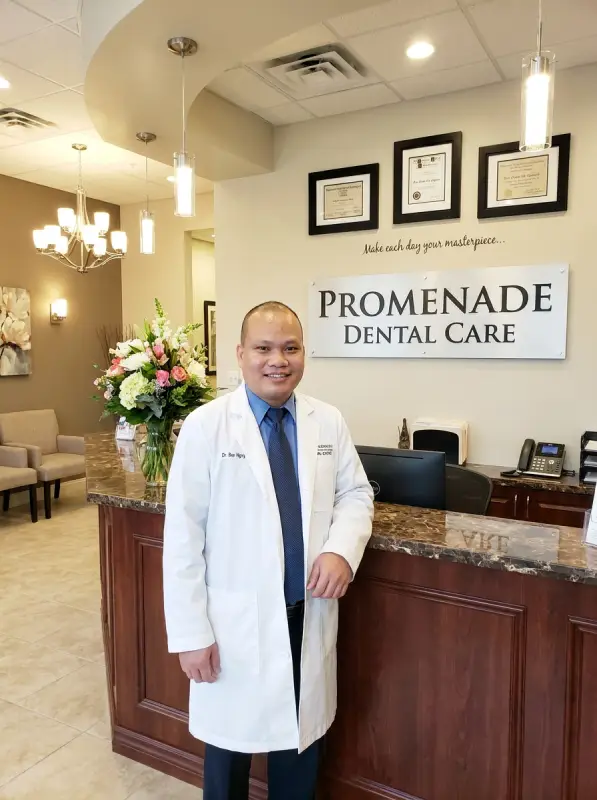
Dr. Bao Nguyen, DDS
I trained at the UCLA School of Dentistry and then spent ten years as a dentist in the U.S. Navy, including an Advanced Education in General Dentistry residency at Naval Hospital Camp Pendleton and deployments to Kuwait and Iraq. Military clinics run a volume and a range of cases that a suburban private practice rarely sees. Complex extractions, full-mouth rehabilitation, trauma, and prosthetics all landed on the same schedule in the same week.
That range is what I brought to Date Street in 2010, and it is why the whole implant process stays under this roof. Cone-beam imaging, guided planning, bone grafting, placement, the crown, and the periodontal maintenance afterward are all mine. One dentist, one chart, one plan. For patients that means fewer appointments, a lower total number, and somebody who has seen the case from the first scan rather than picking it up halfway through.
My office speaks English, Spanish, and Vietnamese. If dental anxiety is what has kept you out of a chair for years, that is common here and there is a whole approach built around it. Ask for Edith or Yessica at the front desk when you call. They have been getting nervous patients through the door longer than most practices have been open.
More From Google
Clear Plans, Honest Pricing, Comfortable Visits
“Finding an excellent dentist is difficult! Dr. Bao offers the most affordable dental care in Murrieta. He is friendly and professional. I don’t have insurance and the pricing was explained up front — no surprises and no pressure to do more than I needed.”
Google Review · Cash-pay patient, no insurance
“My name is Debby and I have been a patient of Dr. Nguyen’s now for over a decade at Promenade Dental. Doctor and staff, which includes Edith, are incredibly wonderful — so kind, caring and compassionate, yet professional. They go above and beyond.”
Debra Davidowitz · Google Review · Patient 10+ years
“Dr. Nguyen does a great job. He is always on time and very honest. Never has you do unnecessary treatments just to make extra money. I love that he is a solo practitioner and runs his own shop. All my family comes to see him.”
Tom Haynes · Google Review
Where to Find Us
Serving Murrieta, French Valley, and the Temecula Valley
Promenade Dental Care is at 26957 Date St, Suite B4, Murrieta, CA 92563, in the Aldi shopping center at Winchester Road and Murrieta Hot Springs Road, about two minutes off the 215. If you live in French Valley, we are probably the closest full-service implant office to your door. From most of Temecula the drive is ten to fifteen minutes on Winchester or Clinton Keith. Every step of the procedure happens in this building, so there is no second address to find on surgery day. Get directions.
Office hours
| Monday | 9:00 AM – 5:00 PM |
| Tuesday | 9:00 AM – 5:00 PM |
| Wednesday | 9:00 AM – 3:00 PM |
| Thursday | 9:00 AM – 5:00 PM |
| Friday | 9:00 AM – 3:00 PM |
| Saturday | By appointment & emergencies |
| Sunday | Closed |
Messages at (951) 412-0127 are received around the clock, and urgent problems get called back.
Patients travel here from
Questions I Hear Every Week
Dental Implant FAQs
How much do dental implants cost in Murrieta?
A dental implant is billed as three separate parts: the titanium post, the abutment that connects to it, and the crown on top. Bone grafting and 3D imaging are billed separately again when your case needs them. That is why quotes around Murrieta vary so widely, and why a low advertised number often covers only one of the three parts. I price all of it in writing after a $20 exam, before you commit to anything. Promenade Dental Care accepts all PPO plans, offers CareCredit with up to six months at zero interest, and publishes flat cash rates for patients without insurance.
Are affordable dental implants as good as expensive ones?
The price difference usually comes from overhead, not from the implant. I use the same titanium implant systems, the same cone-beam CT imaging, and the same computer-guided surgical protocol that specialty offices use. What I do not have is a corporate management fee, a regional sales target, or a referral markup added on top of the surgeon's bill. Promenade Dental Care is one dentist in one building in Murrieta, and that is where the savings come from. Ask any office you are comparing whether their quote includes the post, the abutment, the crown, imaging, and grafting. That single question explains most price gaps.
Does getting a dental implant hurt?
Placing the implant does not hurt. The site is fully numb with local anesthetic, and because I place implants through a guided surgical template, the opening is small and I disturb very little tissue. Most of my patients describe day one and day two as pressure and mild soreness, handled with ibuprofen, and are done with it by about day three. Sedation is available if dental anxiety is the real obstacle for you. A fair number of people tell me the implant appointment was easier than the extraction that came before it.
How long do dental implants last?
The titanium post itself can last the rest of your life. It is fused into living bone, and bone does not wear out the way a filling does. The crown on top is the part with a service life, usually 15 to 25 years before normal chewing wear calls for a replacement. What actually shortens an implant is gum disease around the post, not the post failing on its own. That is why I evaluate periodontal health before I place anything, and why I want to see implant patients once a year afterward.
Am I still a candidate if I have been missing a tooth for years?
Usually yes. When a tooth has been gone for a long time, the bone that used to hold its root shrinks, which is the main thing I am checking for. If there is not enough height or width left to anchor a post, a bone graft rebuilds the site first and the implant goes in after it heals. Upper back teeth sitting close to the sinus sometimes need a sinus lift for the same reason. Neither one disqualifies you. Age does not disqualify you either. I have placed implants for patients in their eighties whose bone was in better shape than patients half that age.
Dental implant or dental bridge: which one should I get?
A bridge replaces the visible tooth by grinding down the two healthy teeth beside the gap and capping them. An implant replaces the root, so the neighboring teeth are never touched and the bone underneath keeps getting the pressure it needs to stay dense. The implant is the better long-term answer in most single-gap cases. The bridge is faster, avoids surgery, and is genuinely the smarter choice when the teeth on either side already need crowns anyway, or when a medical condition makes surgery a poor idea. I will tell you when the bridge is the right call, even though it is the smaller case for me.
Can I get a dental implant in one day?
Sometimes, and it depends entirely on bone density. If the bone grips the post tightly enough at placement to resist movement, I can seat a temporary crown the same visit so you never walk around with a gap. That is called immediate loading. If the bone is soft, or there is an active infection at the site, loading it early is how implants fail, so I stage it instead. Guided surgery is what makes the same-day option realistic more often, because the position and depth are planned to a fraction of a millimeter before I start. Your cone-beam scan gives the answer in one appointment.
What happens if a dental implant fails?
Roughly 5 percent of implants fail, and there are three common reasons: infection in the gum around the post, bone that never fully integrated with the surface, and too much bite force too early. Caught early, a failing implant can often be saved by treating the infection and adjusting the bite. When it cannot be saved, I remove the post, let the site heal, graft bone back into it if needed, and place a new implant. A failed implant is a setback of a few months. It is not the end of the road, and it does not mean you are stuck with a denture.
Does dental insurance cover implants?
More PPO plans cover implants now than they did five years ago, but the structure varies plan by plan. Some pay toward the post, some only toward the crown, and many apply what is called a bridge-equivalent allowance, meaning they pay what a bridge would have cost and you cover the difference. Promenade Dental Care accepts all PPO plans and is in-network with Delta Dental PPO, Cigna, MetLife, Guardian, Aetna, and United Concordia. My front desk verifies your specific benefit before treatment starts and puts the out-of-pocket number in writing, so the estimate you sign is the bill you get.
How long does it take to recover from implant surgery?
Most people go back to work the next day. Swelling and soreness peak around day two and are gone by day five. Soft food for about a week, no smoking, and no vigorous rinsing while the site closes. The longer phase is osseointegration, which is the bone growing into the implant surface, and that takes three to six months. You do not feel it happening and you are not without a tooth during it, because a temporary restoration goes in while you heal.
Where can I get dental implants near me in Murrieta?
Promenade Dental Care is at 26957 Date St, Suite B4, Murrieta, CA 92563, in the Aldi plaza at Winchester Road and Murrieta Hot Springs Road, about two minutes off the 215. If you are in French Valley, we are probably the closest full-service implant office to you. From most of Temecula the drive is ten to fifteen minutes on Winchester or Clinton Keith. Everything happens in this one building: the scan, the planning, the grafting, the surgery, and the crown. There is no second address to drive to on surgery day. Call (951) 412-0127 to book the $20 exam.
Should I go to a dental chain or an independent implant dentist?
At a chain, the implant is typically split across people: a treatment coordinator sells it, a traveling surgeon places it, and a restorative dentist you have not met makes the crown. Each one works from a different piece of the chart. I do all of it myself, in one office, and I am the person you call if something feels wrong at month four. I also own the practice, which means nobody sends me a monthly production target. If a $400 filling solves your problem, I am not paid more for talking you into a $4,000 implant instead.
Find Out If an Implant Is Right for You
Start with a $20 exam and digital X-rays. You will leave knowing whether a single implant, an implant-supported bridge, or a full-arch restoration fits your mouth, with a written quote and no pressure to decide on the spot.
(951) 412-0127Promenade Dental Care · Dr. Bao Nguyen, DDS
26957 Date St, Suite B4, Murrieta, CA 92563
Mon, Tue, Thu 9:00 AM – 5:00 PM · Wed, Fri 9:00 AM – 3:00 PM
Saturday by appointment & emergencies · Sunday closed