
Dental Implants · Murrieta, CA
How Long Do Dental Implants Last?
The post can last a lifetime. The crown lasts 10–15 years.
What actually wears out, what shortens implant life, and what you can control — explained by Dr. Bao Nguyen, DDS.
★★★★★ UCLA School of Dentistry 10 years, U.S. Navy Dental Corps Own practice since 2010
"How long do dental implants last?" is one of the first questions Dr. Nguyen hears when a Murrieta patient is weighing an implant against a bridge or a partial denture. It is the right question, because an implant is the most expensive tooth replacement up front and often the cheapest one over twenty years, provided it is placed well and cared for. This page is about lifespan. For the fee, what’s included, and how insurance treats it, see my breakdown of dental implant cost in Murrieta.
95%+
Implant success rate at 10 years
25+ yrs
Expected life of the titanium post
10–15 yrs
Typical crown replacement window
An implant is two parts, with two different lifespans
People talk about "the implant" as one object. Clinically it is three pieces, and they do not wear at the same rate.
- Titanium post
- Placed into the jawbone, where it fuses to bone through osseointegration. 25+ years to lifetime.
- Abutment
- The connector between post and crown. Rarely replaced, but it can be if a screw loosens.
- Crown
- The visible tooth. 10–15 years — the same range as a crown on a natural tooth.
That distinction matters for budgeting. Replacing a worn crown in 2040 costs a fraction of the original implant, because the post underneath stays put.
The American Academy of Implant Dentistry and this medically reviewed Healthline overview both put long-term implant survival above 95% at ten years.
Risk factors
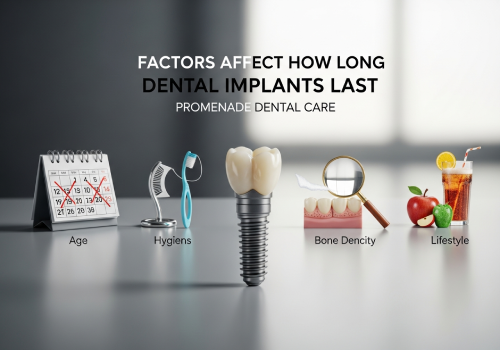
What actually shortens implant life
Implants do not fail from age. They fail for reasons — and most of those reasons show up in the first year, or later in the gum tissue around the post.
Gum disease around the implant
Peri-implantitis is the leading cause of late implant failure. Bacteria inflame the gum, bone recedes from the post, and the post loses its anchorage. An implant cannot get a cavity — but the bone holding it absolutely can be lost. This is why cleanings do not stop being necessary once you have an implant.
If your gums bleed when you brush, start with gum disease treatment.
Smoking
Smoking constricts blood flow to healing tissue and measurably raises failure rates. Dr. Nguyen will ask you to stop before surgery and stay off it through healing. This is the single largest controllable risk factor.
Bone quality and quantity
A post needs bone to fuse to. If the tooth has been missing for years, the ridge may have resorbed and a graft is needed first. Skipping that step to save time is how implants end up loose.
Grinding and clenching
An implant has no periodontal ligament, so it does not cushion force the way a natural tooth does. Bruxism sends that load straight into the bone and the crown. A night guard is inexpensive insurance.
General health
Uncontrolled diabetes and osteoporosis both slow healing. Neither disqualifies you — controlled diabetes is not a barrier — but they change the timeline and the monitoring.
Who places it
Angulation, depth, and torque at placement determine how force distributes for the next thirty years. Experience is not a marketing line here; it is the variable with the longest tail.
Warning signs an implant is in trouble
Early peri-implantitis is treatable. Advanced bone loss often is not. Call the office if you notice any of these.
Pain or discomfort that does not resolve
Any movement in the implant or crown
Swollen, red, or bleeding gums around the implant
Gum receding away from the crown
Pain or difficulty chewing on that side
A metallic edge becoming visible at the gumline
Implant types and how long each lasts
Endosteal (traditional)
A titanium post seated in the jawbone. This is what Dr. Nguyen places — the type with the longest track record and the lifetime expectation.
Mini implants
Narrower posts used where bone width is limited, often to stabilize a denture. Less surface area for fusion means a shorter expected service life.
All-on-4
Four implants supporting a full arch. The posts last decades; the prosthetic arch on top is what gets refurbished, generally past 10–15 years.
Subperiosteal
A framework resting on the bone rather than in it. Largely historical — grafting made it unnecessary, and it never matched endosteal longevity.
Daily care
How to make yours last
The ADA's guidance on caring for dental implants lines up with what we tell patients:
- Brush twice daily, including around the gumline of the implant
- Floss or use interdental brushes daily — plaque around the post is the whole ballgame
- Keep your cleaning schedule; implants need monitoring, not just teeth
- Do not smoke
- Wear a night guard if you grind
- Do not chew ice, pens, or popcorn kernels on the implant side
Implants versus the alternatives
| Option | Typical lifespan | Preserves jawbone |
|---|---|---|
| Dental implant | Post: lifetime · Crown: 10–15 yrs | Yes |
| Dental bridge | 10–15 years | No |
| Dentures | 5–10 years | No |
The bone column is the one people overlook. A bridge or denture sits on top of the ridge; the bone under a missing tooth keeps shrinking. An implant loads the bone and slows that loss, which is why the face holds its shape.
★★★★★
I had a wonderful experience as usual. This time it was a teeth cleaning and consultation for an implant. Everything was fast and painless.
— Alex Ronan · Google review
Frequently asked questions
How long do dental implants last?
The titanium post placed in the jawbone can last a lifetime, and success rates exceed 95% at ten years. The crown attached to it typically needs replacement every 10 to 15 years due to normal chewing wear.
Can a dental implant fail years after it was placed?
Yes. The most common cause of late failure is peri-implantitis, a gum infection that destroys the bone supporting the post. It is preventable with daily cleaning and regular dental visits, and treatable if caught early.
Do dental implants get cavities?
No. Titanium and porcelain cannot decay. The gum and bone around the implant can still become diseased, so brushing and flossing remain essential.
Does smoking affect how long an implant lasts?
Yes. Smoking reduces blood flow to healing tissue and significantly raises the risk of implant failure. Patients are asked to stop before surgery and remain off tobacco throughout healing.
Will I need a bone graft before an implant?
Only if the jawbone lacks the width or height to hold the post securely. Dr. Nguyen determines this from a digital X-ray at your exam and will tell you before treatment begins.
Is an implant worth it over 20 years?
Over 20 years an implant usually outlasts a bridge or denture that would need redoing in that time, and it is the only option that keeps the jawbone under the missing tooth from shrinking. The fee itself is on the implant page.
Wondering whether an implant is right for your missing tooth?
A $20 exam with digital X-rays is all it takes to get an honest answer — no upselling, prices published before we start.
(951) 412-0127 See Implant Options & Pricing26957 Date St, Suite B4, Murrieta, CA 92563
Mon, Tue, Thu 9–5 · Wed, Fri 9–3 · Sat by appointment & emergencies