
Two Good Options, One Decision
Dental Bridge vs Implant: Which Is Better for a Missing Tooth?
Neither one wins every case. The right answer depends on the teeth beside the gap, the bone underneath it, and how long you plan to keep the result. Here is how I work through it with patients in Murrieta.
If you have been handed two treatment plans with two very different price tags, you are not being upsold or misled. A dental bridge and a dental implant solve the same problem in genuinely different ways, and the better choice changes from mouth to mouth. This page lays out the trade-offs the way I lay them out in the chair.
Start Here
The Short Answer, Before the Detail
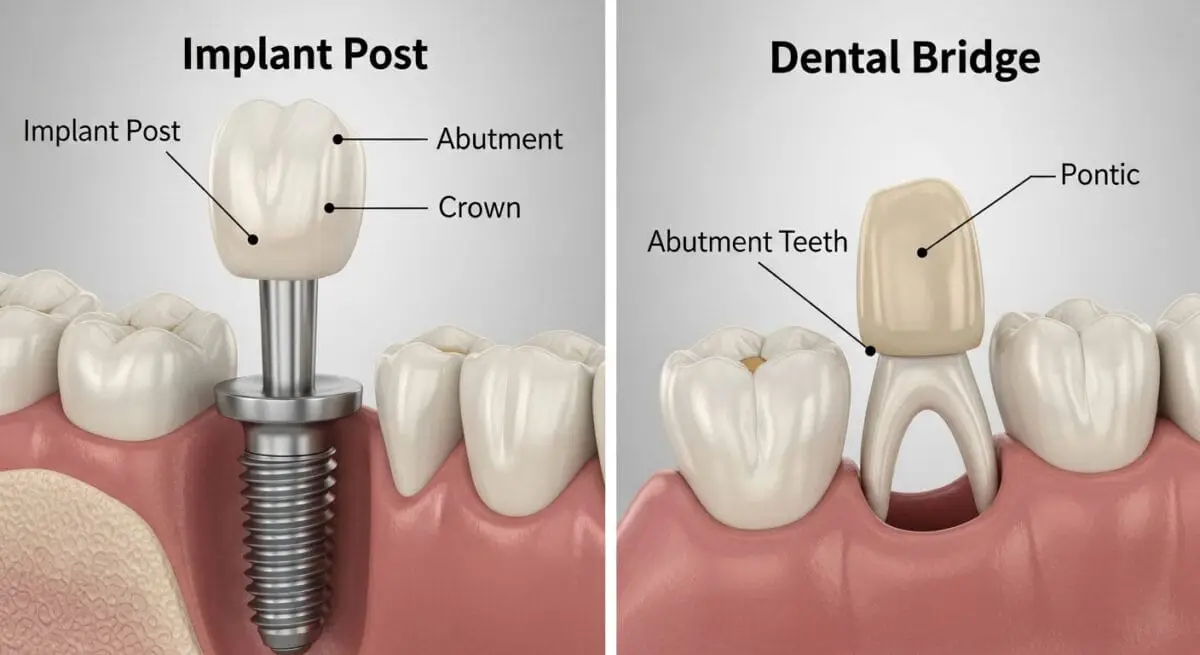
A dental bridge replaces the visible part of a missing tooth by borrowing support from the teeth on either side of the gap. Those two teeth are reshaped, crowned, and joined to a false tooth in the middle. Nothing goes into the bone.
A dental implant replaces the root. A titanium post is placed into the jawbone, left to fuse over several months, and then topped with a crown. The neighboring teeth are never touched.
The rule I use in the chair: if the teeth on both sides of the gap already need crowns, a bridge often does two jobs at once and is the sensible choice. If those teeth are healthy and untouched, I lean toward the implant, because a bridge means grinding down sound enamel that will never grow back.
That is the whole decision in two sentences. Everything below explains why, and what changes the answer.
The Comparison
Dental Bridge vs Implant, Line by Line
| Factor | Dental Bridge | Dental Implant |
|---|---|---|
| What it replaces | The crown only. The root space stays empty. | The root and the crown, from the bone up. |
| Effect on neighboring teeth | Both are permanently reshaped and crowned. | Left completely untouched. |
| Jawbone underneath | Not stimulated. Gradual bone loss continues. | Stimulated by the post, which slows resorption. |
| Surgery | None. | Minor oral surgery, sometimes a bone graft first. |
| Time to finish | Usually two to three visits over a few weeks. | Several months, most of it healing time. |
| Typical lifespan | Commonly 10 to 15 years. | Often 20 years or more. |
| Cleaning | Needs a floss threader or water flosser to clean underneath. | Brushed and flossed like a natural tooth. |
| Main failure risk | Decay or fracture in one of the support teeth. | Gum inflammation around the post (peri-implantitis). |
| Cost shape | Lower up front, replaced sooner. | Higher up front, replaced later or not at all. |
Read that table twice and you will notice the pattern. The bridge trades long-term tooth structure for speed and a lower entry price. The implant trades months of healing and a bigger cheque for a result that leaves the rest of your mouth alone.
The Part Nobody Mentions
What Happens to the Bone Under the Gap
Bone Needs a Job to Keep Its Shape
Jawbone is maintained by the force of chewing travelling down through a tooth root. Take the root away and that signal stops. The bone in that spot narrows and shortens over the following months and years, which is why a gap that has been empty for a decade looks sunken compared with the ridge beside it.
A bridge sits above this process without changing it. The porcelain looks correct on day one, but the ridge underneath keeps shrinking, and a gap can eventually open between the false tooth and the gum.
An implant post takes over the root's job. That is the single biggest clinical argument in its favour, and it matters most for younger patients and for front teeth, where a receding ridge shows.
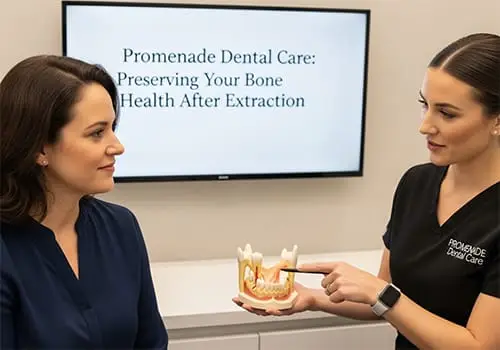
This cuts both ways. If you have already lost significant bone height, an implant may need a graft before it can be placed, which adds months. In that situation a bridge is sometimes the more practical answer, not the lesser one.
The Deciding Factor
Look at the Teeth Beside the Gap First
More decisions turn on this than on anything else. Before I discuss materials or timelines, I examine the two teeth that would carry a bridge.
That last point is not a formality. A bridge is only as strong as the teeth holding it, and cementing porcelain onto a foundation with active gum disease is how a five-year restoration becomes a two-year one. If your gums need attention, we handle that before anything else gets planned. That is what gum disease treatment is for.
What to Expect
How Long Each One Actually Takes
1Bridge, visit one
The two support teeth are numbed and reshaped, impressions or a digital scan are taken, and a temporary bridge goes on the same day. You leave with the gap closed.
2Bridge, visit two
The lab bridge is tried in, adjusted for bite and contact, and cemented. Most patients are finished within two to three weeks of starting.
3Implant, placement
The post is placed into the bone under local anaesthetic, with sedation available if you want it. The appointment is shorter than most people expect.
4Implant, healing and crown
The post fuses with the bone over several months. Once it is stable, the crown is attached. A temporary tooth can cover the gap in the meantime.
If you need the gap closed before an event in three weeks, that is a real constraint and the bridge answers it. If the timing is open, the healing months are rarely the deciding factor.
Money
Comparing Cost Without Comparing Sticker Prices
A bridge costs less on the day. An implant costs more on the day. Both statements are true and neither one settles the question, because the two restorations are not replaced on the same schedule.
The useful comparison is cost divided by expected years of service, with one detail added: when a bridge is eventually replaced, the two support teeth are usually re-prepared as well, and each cycle takes a little more tooth structure. When an implant crown is replaced, the post normally stays where it is.
At Promenade Dental Care you get both plans written out, side by side, with what your insurance is expected to cover on each. No estimate is given verbally and no one is asked to decide in the chair. We take all PPO plans, are in network with several, and offer CareCredit financing.
Coverage differs sharply between the two. Many dental plans treat a bridge as a standard restorative benefit and an implant as a major or excluded one, which can shift the real out-of-pocket gap in either direction. That is worth checking before you settle on an answer.
Meet Your Dentist
How I Work Through This With Patients
Dr. Bao Nguyen, DDS
I trained at the UCLA School of Dentistry and spent ten years as a dentist in the U.S. Navy Dental Corps, including an Advanced Education in General Dentistry residency at Camp Pendleton and deployments to Kuwait and Iraq. I have practised in Murrieta since 2010.
Military dentistry teaches you to plan around what a patient's mouth can actually support rather than what looks impressive on a treatment plan. That is the habit I brought to Date Street. I place implants and I make bridges, and I have no financial reason to steer you toward either one.
What I will do is show you the X-ray, point at the two teeth beside the gap, and tell you plainly which way the evidence in your own mouth points. More about my background.

A $20 exam with digital X-rays is enough to answer the question properly. See what the exam includes.
Related Reading
Go Deeper on Either Option
Dental Bridges in Murrieta
Types of bridge, how the support teeth are prepared, what the appointments involve, and pricing.
Dental Implants in Murrieta
Placement, healing, bone grafting, and what makes someone a good implant candidate.
If Neither Fits
For several missing teeth in a row, a partial denture is sometimes the better starting point.
After the Decision
What living with each one is actually like, from the first week with a bridge to how many years an implant really lasts.
Questions We Hear Every Week
Dental Bridge vs Implant: FAQs
Is a dental implant always better than a dental bridge?
No. An implant is the stronger option in most cases because it replaces the root, preserves bone, and leaves the neighbouring teeth alone. But it is the wrong call when the teeth beside the gap already need crowns, when there is not enough bone to hold a post without grafting, or when a health condition makes minor surgery unwise. In those situations a bridge is the better dentistry, not the compromise.
How long does a dental bridge last compared with an implant?
A well-made bridge commonly lasts 10 to 15 years, and with healthy gums many go longer. An implant post often lasts 20 years or more, and the crown on top may be replaced once during that time. In both cases the porcelain is rarely what fails first. What determines the lifespan is the health of the supporting tissue underneath, which is why cleanings matter more than the material you choose.
Does a dental bridge cause bone loss?
A bridge does not cause bone loss, but it does not stop it either. Bone in the gap shrinks because the root that used to stimulate it is gone. A bridge spans over that space without loading the bone underneath, so the ridge continues to resorb and a small gap can appear under the false tooth over time. An implant post transmits chewing force into the bone, which is why it slows the process.
Do I have to grind down healthy teeth for a bridge?
Yes, for a traditional bridge. Both teeth beside the gap are reshaped to take crowns, and that enamel does not grow back. This is the main reason I hesitate to recommend a bridge when those two teeth are untouched and healthy. A Maryland bridge removes far less tooth structure but is only suitable in limited situations, usually a front tooth with a light bite.
Which option is cheaper, a bridge or an implant?
A bridge costs less up front. An implant usually costs more at the start but is replaced less often, so the gap narrows when you compare cost against years of service. Insurance also treats them differently, with many plans covering a bridge as standard restorative work and an implant as a major or excluded benefit. We give you both plans in writing with your expected coverage on each before you decide anything.
Can I switch from a bridge to an implant later?
Often yes, but it gets harder with time. Once a bridge is removed the support teeth already have crown preparations and cannot be returned to their original state, and the ridge under the gap will have lost more height than it had at the start. If an implant is likely to be what you want eventually, it is usually cheaper and simpler to do it first.
How do I find out which one is right for me?
An exam with digital X-rays answers it. I need to see the bone height under the gap and the condition of the two teeth beside it, and neither is visible from the outside. At Promenade Dental Care that exam is $20 with X-rays included, and you leave with both options priced in writing and no pressure to choose on the day. Call (951) 412-0127 to book.
Get Both Options Priced, Then Decide at Home
Start with a $20 exam and digital X-rays. You will leave knowing whether a bridge or an implant fits your bone, your neighbouring teeth, and your budget, with both plans written down and nothing to sign on the spot.
(951) 412-0127 Request an Appointment Online26957 Date St, Suite B4, Murrieta, CA 92563
Mon, Tue, Thu 9:00 AM – 5:00 PM · Wed, Fri 9:00 AM – 3:00 PM · Sat by appointment & emergencies