
Gum Health & Research · Murrieta, CA
Gum Disease and Your Health: What the Research Shows, and What It Doesn't
Diabetes, heart disease, and pregnancy: an honest read of the evidence from a dentist who doesn't use it as a sales pitch.
You've probably heard that gum disease causes heart attacks, or that a cleaning will protect your heart. Some of that is true, some is overstated, and some hasn't been shown at all. I'm Dr. Bao Nguyen. Here's how I explain the research to patients in my Murrieta office, with links to the studies so you can read them yourself.

The Short Answer
Your Gums Are Connected to the Rest of You. How Much Depends on the Condition.
Gum disease is a chronic infection sitting against a lot of blood vessels. Inflamed pockets around the teeth can add up to a wound area bigger than most people imagine, and bacteria and inflammatory signals from that wound do get into the bloodstream. So it makes sense that researchers have spent decades looking for links between gum disease and the rest of the body.
Some links have held up well. Others have turned out to be weaker than the headlines suggested. Here's where things stand for the three conditions patients ask me about most.
The rest of this page goes condition by condition. If you came here because you're worried about your own gums, the gum disease treatment page explains the stages and treatment.
Diabetes
Diabetes and Gum Disease: The Strongest Link We Have
This is the one I bring up with every diabetic patient, because the evidence runs both ways. High blood sugar weakens the body's response to infection and slows healing, so people with poorly controlled diabetes get gum disease more often and more severely. The CDC lists diabetes alongside smoking and poor oral hygiene as the main things associated with serious gum disease.
The other direction is the interesting part. Gum infection keeps the body in a state of low-grade inflammation, and inflammation makes it harder to control blood sugar. The 2022 Cochrane review pulled together 35 randomized trials with more than 3,200 people who had both periodontitis and diabetes, mostly type 2. Its authors concluded, with moderate certainty, that treating the gum disease with scaling and root planing improved blood sugar control by a clinically meaningful amount compared with no treatment. The drop in HbA1c at three to four months was roughly four-tenths of a percentage point.
That's not a cure, and it's not a reason to change your diabetes medication. But it's a real, measurable benefit from a $320 deep cleaning, and your doctor will usually be glad to hear you've had it.
Heart Disease
Heart Disease: A Real Association, Not a Proven Cause
You'll find dental offices saying gum disease doubles your risk of a heart attack. Here's the more careful version.
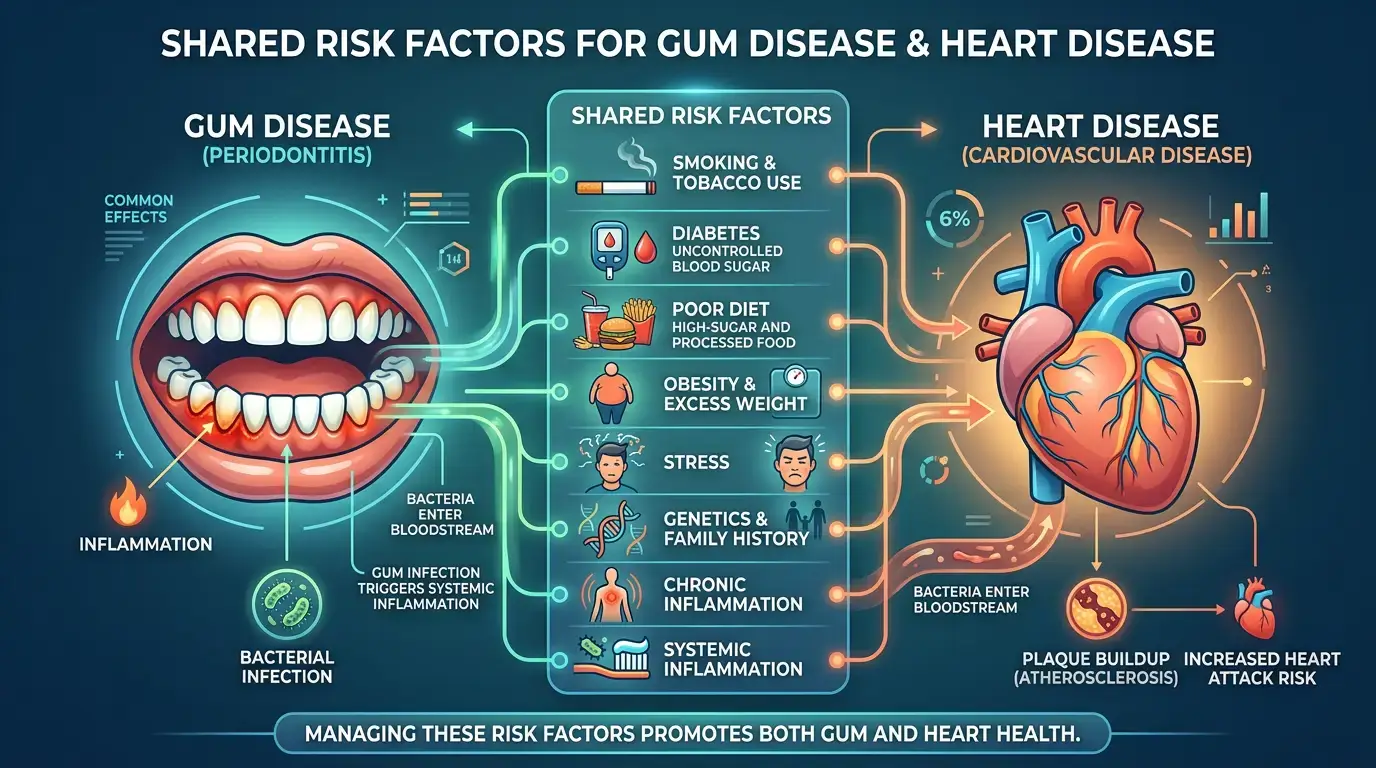
People with gum disease do have more heart and blood vessel disease than people without it, even after researchers account for smoking, age, and diabetes. But in 2012, the American Heart Association reviewed the evidence in a statement endorsed by the ADA and concluded that it supports an association, not a cause. Gum treatment lowered inflammation markers in short-term studies, but there was no evidence it prevented heart disease or changed its outcome. The AHA specifically called claims that treating gums prevents heart attacks or strokes unwarranted.
Part of the reason is that both diseases share the same big risk factors. Smoking, diabetes, and age drive both, which makes it very hard to tell whether the gums add anything on their own.
So I don't tell patients a deep cleaning will protect their heart. I tell them the gums are worth treating for their own sake, that it lowers the inflammation their body is dealing with, and that their cardiologist's advice on blood pressure, cholesterol, and smoking matters far more for their heart than anything I do.
Pregnancy
Pregnancy: Treat Your Gums for You, and Know It's Safe
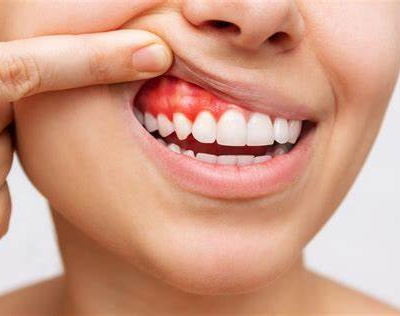
Pregnancy hormones make gums react much more strongly to plaque. Gums that were a little puffy before can become red, swollen, and bleed easily, usually building through the pregnancy. The Cleveland Clinic calls this pregnancy gingivitis, and I see it in a lot of expecting moms from Murrieta and Temecula.
For years, studies tied gum disease to premature birth and low birth weight, and some offices still market treatment that way. The American College of Obstetricians and Gynecologists looked at the research and noted that treating gum disease during pregnancy hasn't been shown to improve birth outcomes.
The same ACOG guidance is clear on the part that matters most: dental care during pregnancy is safe and shouldn't be put off. Cleanings, X-rays with shielding, local anesthetic, and gum treatment can all be done while you're pregnant. I like to do non-urgent treatment in the second trimester when you're most comfortable in the chair, and I keep appointments short and let you sit up whenever you need to.

Other Conditions
Other Links You May Have Read About
Researchers have also found associations between gum disease and rheumatoid arthritis, chronic kidney disease, lung infections in frail older adults, and dementia. Some of this work is interesting, and the mouth-to-bloodstream pathway is real. But for most of these, the evidence is still observational: people with one condition are more likely to have the other, without proof that one causes the other or that treating the gums changes the outcome.
I'd rather not oversell it. If a study comes out that changes how I'd treat you, I'll tell you. Until then, here's what the evidence does support: gum disease is very common, it's the leading reason adults lose teeth, it's treatable, and for people with diabetes, treating it helps.
A few habits hurt both your gums and your general health at the same time. Smoking is the biggest, and heavy drinking is another; I wrote about how alcohol affects your gums separately.
At a Glance
What the Evidence Supports
| Claim | What the evidence shows | What I tell patients |
|---|---|---|
| Diabetes makes gum disease worse | Well established | Better sugar control helps your gums heal |
| Treating gums improves blood sugar | Moderate-certainty evidence of a modest benefit | A real reason to treat if you're diabetic |
| Gum disease is linked to heart disease | Association, independent of smoking and diabetes | Worth knowing, not a reason to panic |
| Treating gums prevents heart attacks | Not shown | I don't make that claim |
| Dental care during pregnancy is safe | Supported by ACOG guidance | Don't put it off |
| Treating gums prevents preterm birth | Not shown | Treat your gums for your own comfort and health |
In My Office
What This Means When You're in My Chair
The research changes how I take care of you in a few concrete ways.
If your gums are healthy, you'll get a regular $95 cleaning. If they bleed but the bone is intact, it's gingivitis and it's reversible. If you have periodontitis, the first step is usually a full mouth deep cleaning. And if a tooth has started to move, my loose teeth guide covers what that means.
Who Wrote This
Reviewed by Dr. Bao Nguyen, DDS

I trained at the UCLA School of Dentistry and served ten years in the U.S. Navy Dental Corps, including an Advanced Education in General Dentistry residency at Naval Hospital Camp Pendleton. Hospital dentistry meant treating patients with diabetes, heart conditions, and pregnancies alongside their physicians, and coordinating care with medical teams is still a normal part of my week.
I opened Promenade Dental Care in Murrieta in 2010 and still see every patient myself. I take 40 hours of continuing education every year, and I read the research before I repeat it to patients. If the evidence for something is weak, I'd rather tell you that than use it to sell a treatment.
Patient Reviews
Patients on Clear, Honest Explanations
These are real Google reviews from our patients about the practice in general. What they describe is how I try to handle every health question: explain it plainly and let you decide.
I love coming to Promenade Dental Care. Dr. Nguyen and Edith are the best. They’re friendly and I love that I’m taken care of right away. Dr. Nguyen is thorough and efficient. He answers any questions I have and explains things clearly. I actually look forward to my biannual dentist visits now because they’re the best. Can’t recommend a dentist more!
Rated 5 out of 5 stars. — Kamilah C. | Google Review
I was greeted immediately by name. They took me back immediately, no waiting at all! The dentist himself did the x-rays and explained what he was seen every step along the way I had a little cavity that I needed to have filled, he walked me personally from the x-ray room to the chair. Took care of the cavity, which was very reasonably priced. And I was in and out within 20 minutes! I loved their attention to detail, how reasonably priced they were, how there is only one dentist for one patient, and how attentive they were to everything. I will come here again and again.
Rated 5 out of 5 stars. — Ericka H. | Google Review
Dr. Nguyen does a great job. He is always on time and very honest. Never has you do unnecessary treatments, just to make extra money. I love that he is a solo practitioner and runs his own shop. That keeps his overhead costs low and he knows you more personally as a patient. All my family comes to see him. Best dentist I’ve ever had.
Rated 5 out of 5 stars. — Tom H. | Google Review
Very comfortable office. Dr. Bao N. is AMAZING! He is gentle, straight to the point and HONEST.
Rated 5 out of 5 stars. — Sharma Kliche LLP | Google Review
Gum Health FAQs
Gum Disease and Overall Health: Questions Patients Ask Me
Does gum disease cause heart disease?
It hasn't been proven to. People with gum disease have more heart disease, but both share risk factors like smoking, diabetes, and age. The American Heart Association reviewed the research and concluded it supports an association, not a cause-and-effect relationship.
Will treating my gums lower my risk of a heart attack?
That hasn't been shown. Gum treatment lowers some inflammation markers in the short term, but no study has shown it prevents heart attacks or strokes. I recommend treating gum disease because it saves teeth and helps diabetes control, not as heart protection.
Can gum disease make diabetes harder to control?
Yes. Gum infection adds inflammation that makes blood sugar harder to manage. A 2022 Cochrane review of 35 trials found that treating periodontitis with scaling and root planing modestly lowered HbA1c in people with diabetes compared with no treatment.
Does diabetes make gum disease worse?
Yes, especially when blood sugar is poorly controlled. High glucose weakens the response to infection and slows healing, so gum disease tends to be more common, more severe, and slower to respond to treatment. Better control usually means better results from gum treatment.
Should I tell my dentist my A1c?
Please do. Your A1c tells me how well your gums are likely to heal and how closely I should follow up after treatment. It also helps to know about recent changes in your diabetes medications, especially insulin, so we can time appointments around meals.
Can I have a deep cleaning while I'm pregnant?
Yes. The American College of Obstetricians and Gynecologists says dental treatment, including local anesthetic and X-rays, is safe during pregnancy. I prefer to schedule non-urgent gum treatment in the second trimester, but if you have pain, swelling, or infection, I'll treat it whenever you need it.
Does gum disease cause premature birth?
Studies have found an association, but treating gum disease during pregnancy hasn't been shown to lower the rate of premature birth or low birth weight. Gum care during pregnancy is still worthwhile for your own comfort and oral health, and it's safe.
Is gum disease linked to dementia or Alzheimer's?
Some studies have found associations, and researchers are actively looking at how oral bacteria might be involved. But it hasn't been shown that gum disease causes dementia or that treating it lowers the risk. I'd treat it as an open research question for now.
Can bacteria from my gums get into my bloodstream?
Yes. Inflamed gums bleed easily, and bacteria can enter the bloodstream briefly during chewing, brushing, and dental treatment. In healthy people the body clears them quickly. That's one reason I'd rather your gums be healthy and not bleeding every day.
Do I need antibiotics before dental work if I have a heart condition?
Most people don't. Current American Heart Association guidance limits antibiotics before dental work to a small group of patients, such as those with artificial heart valves, a past case of infective endocarditis, or certain congenital heart conditions. If you're in one of those groups, I'll coordinate with your cardiologist.
What medical history should I tell you about before gum treatment?
Tell me about diabetes and your last A1c, pregnancy, blood thinners, osteoporosis medications, heart conditions, recent surgeries or joint replacements, and whether you smoke or vape. Each of these can change how I plan treatment or how your gums will heal.
Can treating gum disease improve my overall health?
For people with diabetes, it modestly improves blood sugar control. For everyone, it removes a chronic infection, stops bleeding gums and bad breath, and protects the teeth you'd otherwise lose. Beyond that, I won't promise more than the research supports.
Bring Your Health History. I'll Read It.
A $20 exam with X-rays and gum measurements shows whether you have gum disease and what it would take to treat. If you have diabetes, a heart condition, or you're pregnant, we'll plan around it.
(951) 412-0127 Request an Appointment OnlinePromenade Dental Care · Dr. Bao Nguyen, DDS
26957 Date St., Suite B4, Murrieta, CA 92563
Serving Murrieta, Temecula, French Valley, Menifee, Wildomar & Winchester