
Gum & Bone Problems · Murrieta, CA
Loose Adult Tooth? What It Means and How I Try to Save It
A grown-up tooth should never wiggle. Here's what usually causes it, what I check, and when it can still be saved.
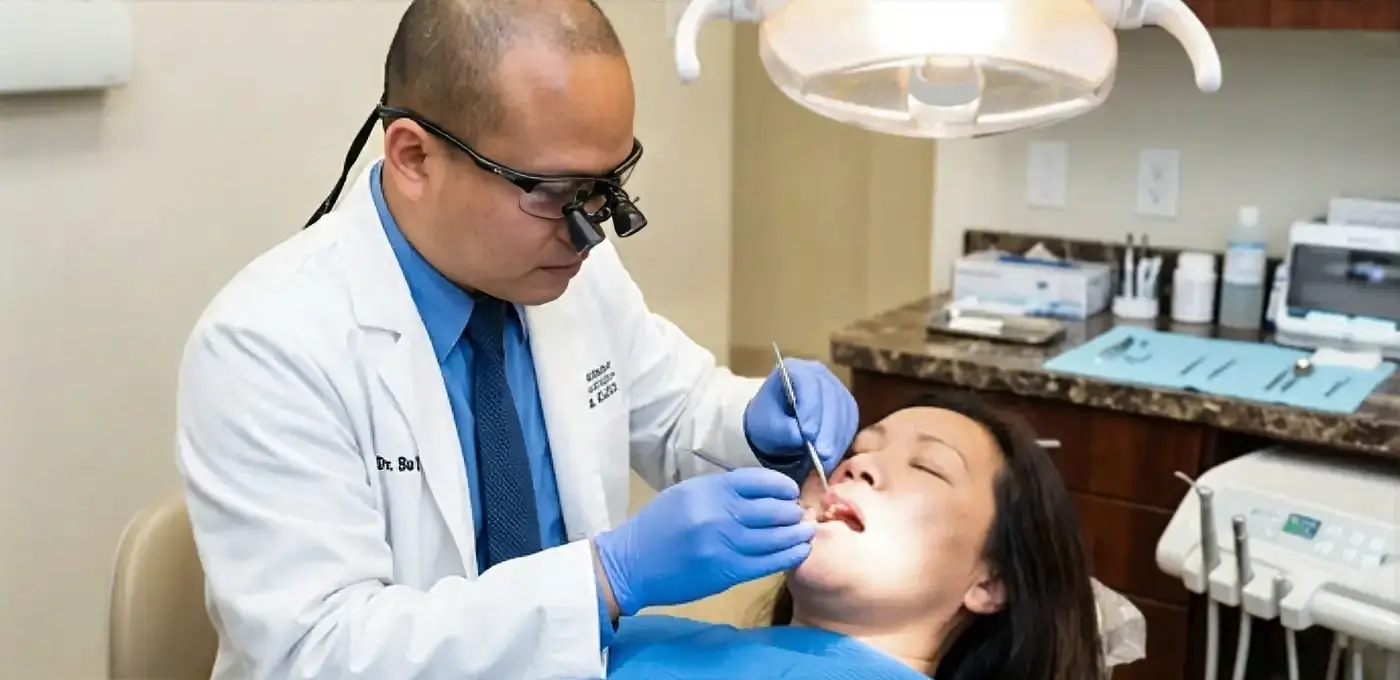
Maybe you noticed it with your tongue, or a tooth moves when you bite into an apple, or a front tooth has drifted and left a gap. I'm Dr. Bao Nguyen. Loose teeth are one of the most common reasons adults finally come see me, and the answer to "can it be saved?" depends almost entirely on why it's loose.
Start Here
First Question: Did Something Hit It?
If nothing hit it and it's been getting looser slowly, it's not an emergency, but it's not something to wait months on either. A tooth that loosened over time is telling you the bone or the ligament holding it has been under attack, and the sooner I find out why, the more options you have.
Dentists grade looseness on a simple scale. You can't grade your own tooth accurately, but it helps to know what I'm looking for:
| Grade | What it means | How it usually feels |
|---|---|---|
| Grade 1 | Moves slightly more than normal, under a millimeter side to side | You may not notice; it "feels off" when you bite |
| Grade 2 | Moves a millimeter or more side to side | You can feel it shift with your tongue or when chewing |
| Grade 3 | Moves side to side and can be pushed down into the socket | Clearly wobbly; chewing on it is uncomfortable |
Grade 1 teeth tighten up regularly once the cause is treated. Grade 3 teeth with heavy bone loss usually can't be saved. Grade 2 is where the honest answer is "it depends," and that's most of the people who call me.
Causes
Why Adult Teeth Get Loose
A tooth isn't cemented into the jaw. It hangs in its socket by a thin ligament attached to the bone around the root. Anything that destroys that bone, inflames that ligament, or overloads it can make the tooth move. These are the causes I see in Murrieta, roughly from most to least common.
Gum disease
Periodontitis is the most common reason adults get loose teeth. The Cleveland Clinic calls it the leading cause of loose teeth and tooth loss worldwide, and that matches my experience. The infection slowly dissolves the bone around the roots. You don't feel the bone going. You feel it when there's not enough left, often years in. Bleeding gums, bad breath, and gums pulling back usually came first. The full picture is on my gum disease treatment page.
Grinding and clenching
Night grinding puts forces on teeth many times stronger than chewing. Over time the ligament gets inflamed and the tooth loosens, sometimes with no bone loss at all. Clues are flattened or chipped edges, a sore jaw in the morning, and teeth that feel loose when you wake up but tighter by afternoon. When grinding meets gum disease, teeth loosen much faster than either one would cause alone.
Injury
A fall, a sports hit, or biting down hard on something can stretch or tear the ligament. That's called a luxation, and the Cleveland Clinic's overview explains the types. These teeth often firm up again if they're stabilized early, but the nerve inside can be damaged, so I keep an eye on them for months.
An infection at the root tip
An abscess at the end of the root can eat the bone around it and make a tooth feel loose and tall when you bite. Here the fix is often a root canal, not gum treatment, and the tooth commonly tightens up as the bone heals.
Less common causes
Pregnancy hormones can loosen the tissue around the teeth for a while; it usually settles after the baby comes. Some osteoporosis medications, cysts, and rarely tumors can affect the jawbone too. And teeth can feel a little looser for a few weeks right after a deep cleaning, which is normal and covered on the deep cleaning page.
The Exam
What I Check Before I Tell You Anything
I don't guess about loose teeth, because the treatment for gum disease, grinding, and an abscess are completely different, and the wrong one won't help. At your $20 exam I check five things.
1Mobility
I hold the tooth between two instruments and grade how far it moves, and compare it to its neighbors.
2Pockets
I measure the gum at six spots around the tooth. Deep pockets point to gum disease.
3X-rays
Digital X-rays show how much bone is left and whether there's an infection at the root tip.
4Your bite
Marking paper shows if that tooth takes too much force when you close or slide your jaw.
5Nerve test
A cold test tells me whether the nerve is alive, which separates an abscess from gum disease.
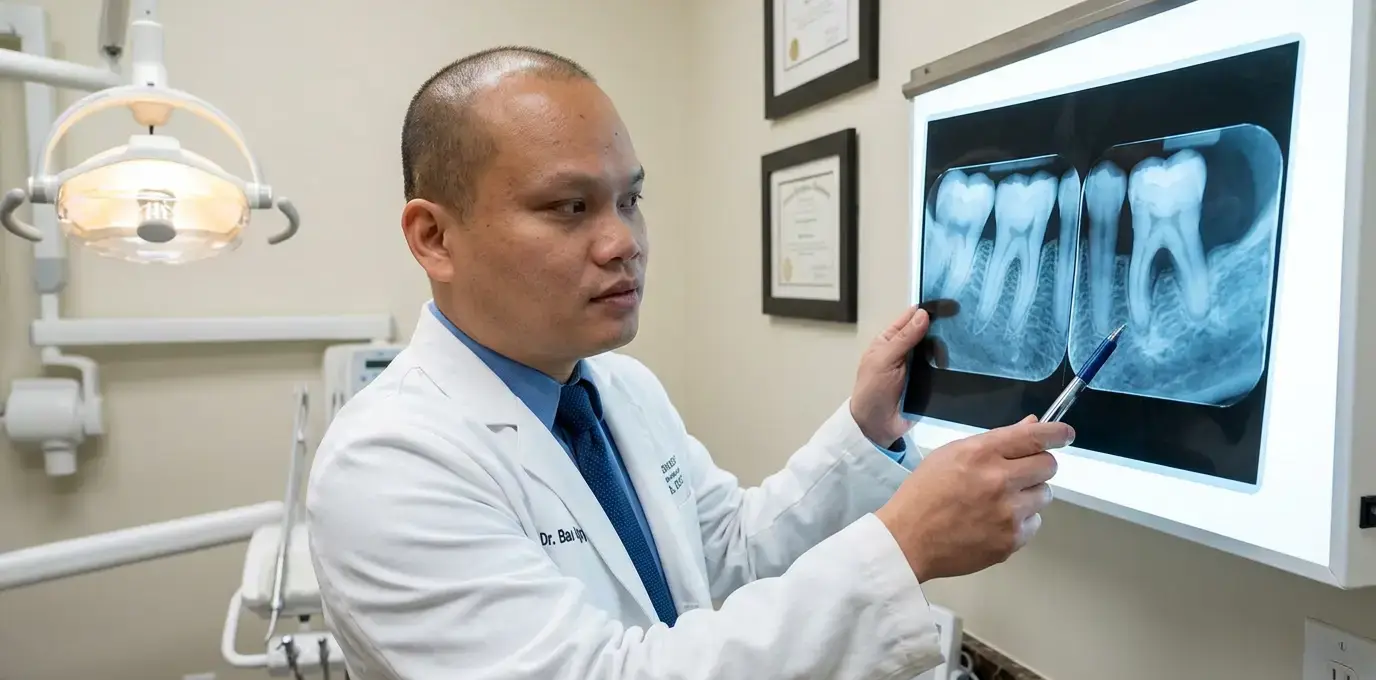
If the X-ray leaves questions about the bone, I can take a 3D cone-beam scan in the office. Then I'll show you what I found and tell you plainly which of three groups your tooth is in: likely to tighten up, worth trying to save, or not worth the money and discomfort of trying.
Saving the Tooth
How a Loose Tooth Gets Saved
Treatment goes after the cause first. Holding a tooth still doesn't help if the infection or the grinding that loosened it keeps going.
Treat the gum disease
A full mouth deep cleaning ($320 for all four quadrants) removes the tartar and bacteria under the gums. As the inflammation calms down over four to six weeks, many grade 1 and some grade 2 teeth firm up noticeably.
Take the pressure off
If one tooth is hitting first when you bite, I can smooth a small amount of enamel so the force spreads out. It takes a few minutes and doesn't need numbing.
Protect it at night
For grinders, a custom night guard ($505) spreads the force across all the teeth while you sleep. If jaw pain is part of it, the TMJ page covers that side.
Splint it
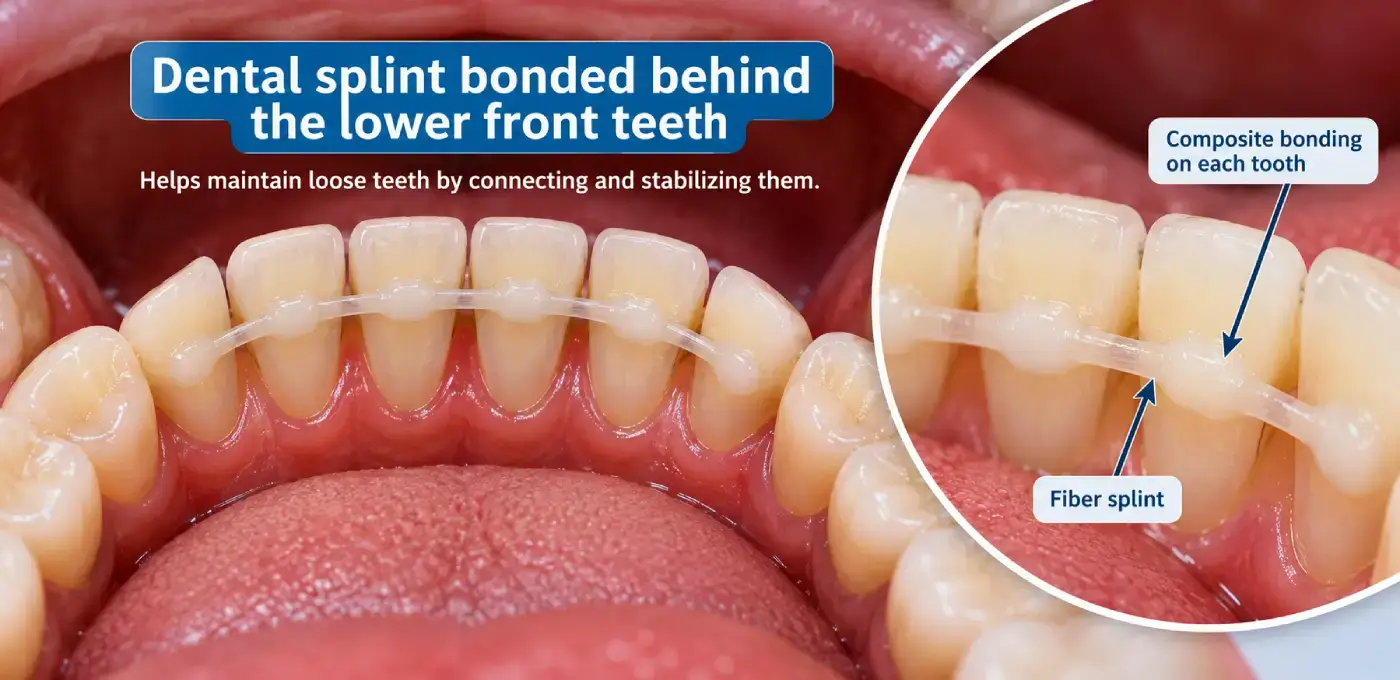
A thin wire or fiber bonded to the back of the loose tooth and its neighbors holds it still while it heals. I quote it in writing at your exam.
If a tooth has lost a lot of bone but the rest of your mouth is healthy, regenerative surgery can sometimes rebuild part of it. That's periodontist work, and I'll refer you if your case is a good candidate rather than talk you into something that won't hold.
Honest Answer
When I'll Tell You It Can't Be Saved
Some teeth aren't worth fighting for, and I'd rather say that than charge you for months of treatment on a tooth that's going to fail. Usually that's a grade 3 tooth with bone gone to near the root tip, a tooth with a crack down the root, or one that hurts every time you chew despite treatment.
Leaving that tooth in has a cost too. The infection around it keeps eating bone that we'll want later for a replacement. So when a tooth is hopeless, I recommend a gentle extraction, often with a bone graft in the socket to keep the ridge, and then we talk about replacing it with a dental implant or a bridge. My bridge vs. implant guide walks through that choice. Whatever we do, the gum disease that caused the problem has to be under control first, or it'll attack the replacement too.
Until Your Visit
What to Do (and Not Do) Until I See You
Call sooner than your appointment if the gum around the tooth swells, you see pus, you get a fever, or the tooth suddenly gets much looser. Those can mean an active infection.
Who Wrote This
Reviewed by Dr. Bao Nguyen, DDS
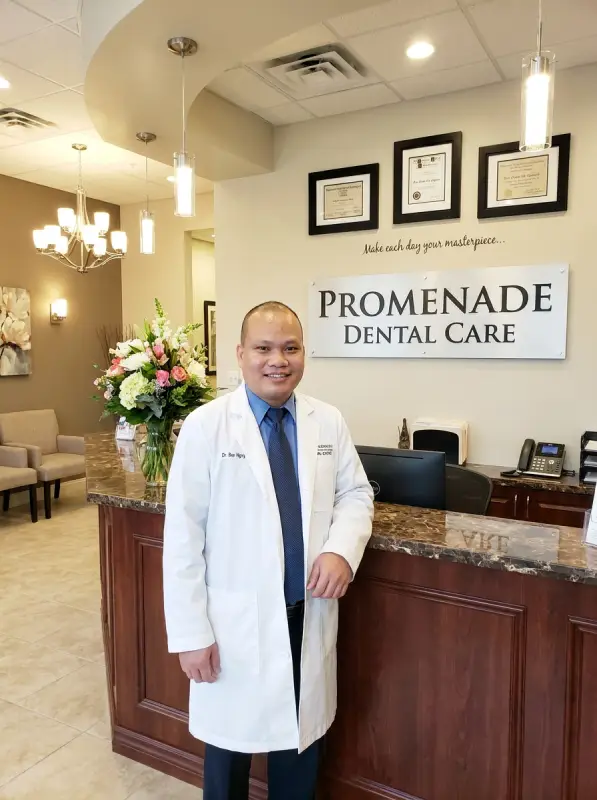
I trained at the UCLA School of Dentistry and served ten years in the U.S. Navy Dental Corps, including an Advanced Education in General Dentistry residency at Naval Hospital Camp Pendleton. In the Navy I saw a lot of young sailors and Marines with teeth loosened by injuries, and a lot of older service members with teeth loosened by gum disease. Telling the two apart quickly, and knowing which one could be saved, was a daily job.
I opened Promenade Dental Care in Murrieta in 2010, and I still see every patient myself. My approach to a loose tooth is conservative: find the cause, treat it, and keep the natural tooth when that's realistic. When it isn't, I say so.
Patient Reviews
Patients on Getting a Straight Answer
These are real Google reviews from our patients, about the practice in general. The theme is the one I care about most when a tooth is in question: honest advice and only the treatment you need.
Dr. Nguyen does a great job. He is always on time and very honest. Never has you do unnecessary treatments, just to make extra money. I love that he is a solo practitioner and runs his own shop. That keeps his overhead costs low and he knows you more personally as a patient. All my family comes to see him. Best dentist I’ve ever had.
Rated 5 out of 5 stars. — Tom H. | Google Review
Very knowledgable and good prices. Does only what is necessary. Does not just look for stuff to charge for. Got an appointment quickly when I thought it was an emergency. My favorite dentist ever!!
Rated 5 out of 5 stars. — Sheila O. | Google Review
I am completely terrified of the dentist. I neglected getting anything done for years and years because of bad experiences and just general fear and anxiety. Well I got sick of having an aching jaw everyday so I came in and got a x-ray and consultation and they told me what work needed to be done. The price was pretty much half of what comparable dentists wanted and they were really really nice to me. The doctor gave me some anxiety meds which completely relaxed me and I can honestly say I have way less fear and anxiety about going back to the dentist. So if you have any anxiety about going to the dentist, this is the place for you.
Rated 5 out of 5 stars. — Jay D. | Google Review
Very comfortable office. Dr. Bao N. is AMAZING! He is gentle, straight to the point and HONEST.
Rated 5 out of 5 stars. — Sharma Kliche LLP | Google Review
Loose Tooth FAQs
Loose Adult Teeth: Questions Patients Ask Me
Can a loose adult tooth tighten back up?
Yes, often. When the cause is gum inflammation, grinding, or a recent injury, the ligament around the tooth can heal and the tooth firms up over a few weeks to a few months. Teeth that lost a lot of bone to gum disease may stay slightly mobile even when they're stable and healthy.
How long can a loose tooth last before it falls out?
There's no set timeline. A slightly loose tooth from gum disease can hang on for years, while a badly loosened tooth with an active infection can go in weeks. The real risk of waiting is that the bone keeps disappearing, which limits your options for saving or replacing the tooth.
Should I pull a very loose adult tooth myself?
No. Adult teeth have long roots, and pulling one at home can break the root, tear the gum, or leave infection behind. Pulling it also removes the chance that it could have been saved. Call the office and we'll see you promptly.
Why do my teeth feel loose in the morning?
That's a classic sign of grinding or clenching at night. The pressure inflames the ligaments overnight, so the teeth feel loose and sore when you wake and settle as the day goes on. A custom night guard usually helps, but I'd also check your gums, because grinding speeds up bone loss from gum disease.
Can stress make my teeth loose?
Indirectly, yes. Stress makes many people clench or grind, often without knowing it, and that extra force can loosen teeth. Stress can also make it harder to keep up with home care, which lets gum disease progress.
Is a loose tooth a dental emergency?
If an injury loosened it, yes, call right away, because stabilizing it within about an hour gives the best chance of saving it. If it loosened gradually with no pain or swelling, it's not an emergency, but it should be checked within a week or two. Swelling, pus, or fever with a loose tooth means call the same day.
What is a dental splint and how long would I wear it?
A splint is a thin wire or fiber strip bonded to the back of the loose tooth and the teeth next to it, so they move as one unit. After an injury it's usually left on for a few weeks. For teeth loosened by gum disease, it may stay longer to keep them comfortable for chewing. It's not visible from the front.
Can a bone graft tighten a loose tooth?
Sometimes, in the right case. Rebuilding bone around a natural tooth is a periodontal surgery, and I refer those cases to a periodontist. The bone grafting I do in my office is for empty sockets after an extraction, to save the bone for a future implant.
Why is my front tooth loose when it doesn't hurt?
Gum disease and grinding usually loosen teeth without pain, which is why people put it off. Front teeth have shorter roots and less bone than molars, so they often show looseness first. Drifting, a new gap, or a tooth that looks longer are all signs to get it checked.
Will a night guard fix a loose tooth?
It helps when grinding is the cause or a big part of it, because it takes the overnight pressure off and gives the ligament a chance to heal. A night guard won't fix bone lost to gum disease, so if your pockets are deep, you'll need gum treatment as well.
What happens if I ignore a loose tooth?
The cause usually keeps going. With gum disease, bone keeps disappearing and neighboring teeth can start to loosen too. With an abscess, the infection can spread. And by the time the tooth is lost, there may not be enough bone left for an implant without grafting first.
How much does it cost to treat a loose tooth in Murrieta?
It depends on the cause. The exam with X-rays is $20. If gum disease is the cause, a full mouth deep cleaning is $320. A custom night guard is $505. A bite adjustment or splint is quoted in writing at your exam. Those are cash fees; with PPO insurance, your share depends on your plan.
Find Out Why Your Tooth Is Loose
A $20 exam with X-rays tells us whether it's your gums, your bite, an infection, or an old injury, and whether the tooth can be saved. You'll know the plan and the fee before we start.
(951) 412-0127 Request an Appointment OnlinePromenade Dental Care · Dr. Bao Nguyen, DDS
26957 Date St., Suite B4, Murrieta, CA 92563
Serving Murrieta, Temecula, French Valley, Menifee, Wildomar & Winchester