
Murrieta · Temecula · Menifee · Wildomar · French Valley · Winchester 92596
Dental Anxiety & Dentophobia: The Hardest Part Is the Front Door
A first visit here can be a conversation and nothing more.
If you have been avoiding the dentist because of fear, panic, embarrassment, or one bad appointment you never got over, you are not an unusual patient in this office. You are a regular one. I am Dr. Bao Nguyen, and I have been treating anxious patients in Murrieta since 2010. Nothing happens in my chair that you have not agreed to first.
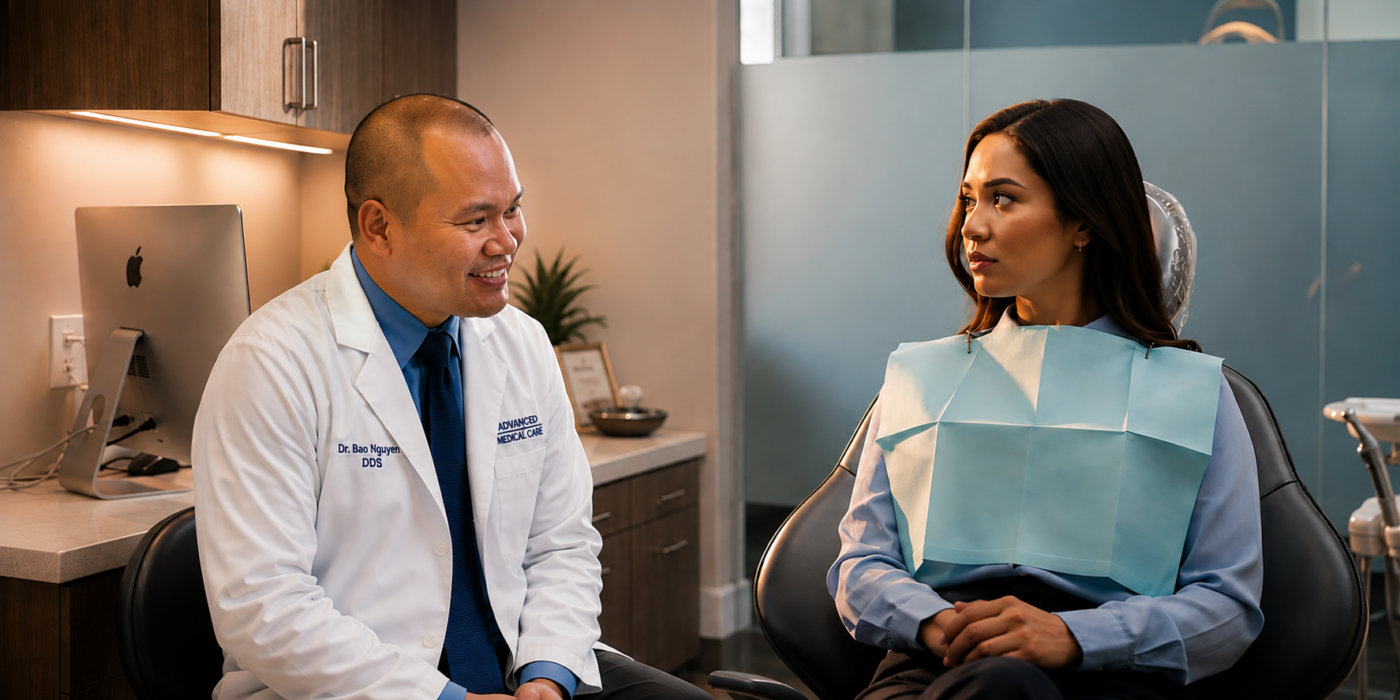
From the chair, not a textbook
What does dental anxiety actually look like?
Most people think dentophobia means feeling nervous before an appointment. It usually runs a lot deeper than that.
Here is what patients describe to me, almost word for word, year after year. They cancel at the last minute and then feel guilty about it. They lose sleep the night before. Their heart is already going in the parking lot. They wait until a tooth hurts badly enough that the fear of the pain finally beats the fear of me. And a lot of them are embarrassed about what the waiting did to their teeth, which is its own separate weight to carry in.
The body keeps score too: sweating in the waiting room, a hand gripping the armrest, sometimes a full panic attack before a mirror ever goes anywhere near the mouth. None of that is weakness. Dental phobia belongs to the same recognized family of specific phobias as fear of flying, and the Cleveland Clinic’s overview of dentophobia describes the same loop I watch in real time. Fear leads to avoidance, and avoidance produces exactly the outcomes the person was afraid of.
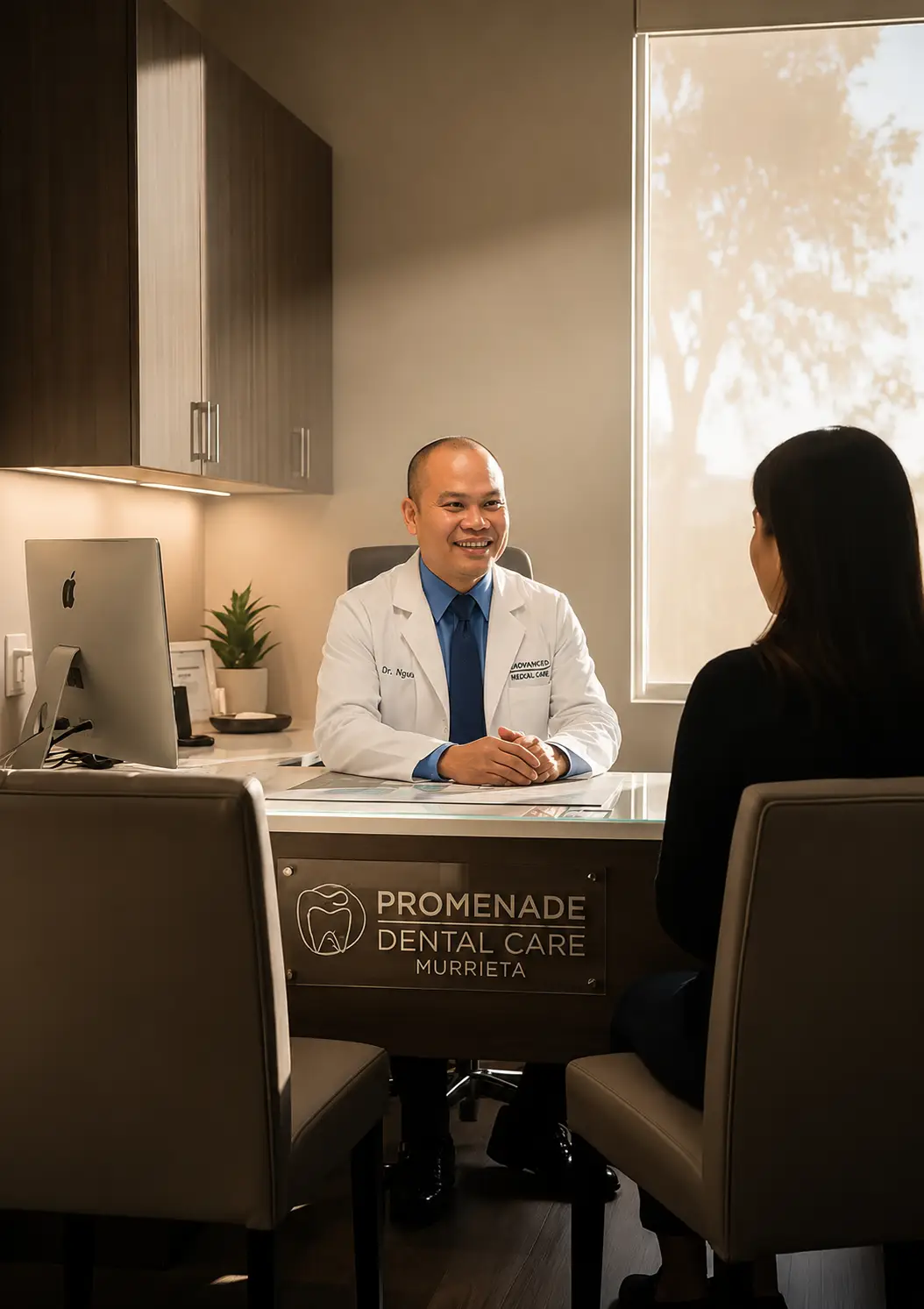
What Waiting Actually Costs
I am not trying to scare anyone here. But avoidance only moves in one direction, and the patients paying the highest price are almost always the ones who were most afraid of the small version of the problem.
A small cavity
Treated early, it is a filling. Left alone, the same tooth becomes a root canal and a crown. Ten times the cost and considerably more of exactly what an anxious patient dreads.
A loose filling
It becomes a cracked tooth, and the crack picks its own timing. Usually a popcorn kernel on a Friday night. A visit you could have scheduled turns into an emergency you cannot.
Early gum disease
It advances without hurting, which is why people miss it for years. By the time it announces itself, bone has been lost, and bone does not grow back.
The hardest part of treating dental fear is convincing someone that the fear is usually much worse than the treatment. I do not say that to minimize anything. I say it because I watch the comparison happen most weeks, and the sentence I hear afterward is almost always the same one.
“I should have done this years ago.” That is the sentence I hear most from patients who stayed away the longest, usually said in the same parking lot where they sat panicking two hours earlier.
The question our front desk hears every week
What is the first appointment really like?
People call and ask some version of the same thing: what happens if I get here and I am too nervous to do anything? The answer is that then we do not do anything. That is not a line to get you in the door. It is how the appointment is built.
1We talk first
Face to face, sitting up, chair upright, nothing on the tray. I want to hear what happened before and what you are actually afraid of.
2We name the specifics
The dentist who kept going after you said stop. The injection that hurt. The lecture. Each one gets a concrete accommodation, because “be less scared” is not a plan.
3X-rays, only if you want them
Quick, low dose digital images that show what is really going on. Not ready today? They wait. The $20 exam price holds either way.
4I explain what I see
On your own images, in plain English, with written cash prices you take home. No treatment coordinator, no close, no decision required while you are still in the chair.
5A plan at your pace
If work is needed, we sequence it easiest to hardest on your timeline, often starting with a gentle ultrasonic cleaning, with sedation available for the steps that warrant it.
What will not happen at that first visit
No drilling. No pressure. No surprise procedure. No commitment to treatment of any kind. For some patients, simply finding out what is going on in their mouth takes the edge off years of dread on its own. The point of the first appointment is not to get dentistry done. It is to make the second appointment feel possible.
Found Dr Bao years ago when I needed emergency care on a weekend. Started going to him while I still lived in the area. Moved a few years ago, but recently felt like I was being scammed by my new dentist (new insurance), drove over an hour to get a second opinion from Dr Bao. He is as straight forward, efficient, and affordable as ever. Work was still needed but not nearly to the extent and cost as was being told to me by the other dentist.
— P Hooper · Google review
Say it when you book
The single most useful thing a nervous patient can do is say so on the phone. “I am scared of the dentist and I have not been in a long time.” That one sentence gets you a longer appointment, a quieter time of day, and a visit planned around talking instead of production. Our front desk has heard it so many times it barely registers as unusual.
Named fears get fixed
Which four fears do I hear most, and what do I do about each one?
Fear of the dentist is rarely generic. After enough first visits, the same four specifics come up again and again, and each one has an actual answer rather than a reassuring adjective.
Fear of dental injections
For a large share of fearful patients, the procedure was never the issue. The needle was. It is one of the most common fears in all of medicine, and dentistry compounds it with a needle you cannot see going somewhere as personal as your mouth.
What I do: strong topical gel first, so the site is numb before anything sharp arrives. Slow, warmed delivery, which is what actually prevents the sting. The syringe stays out of your sightline, every time. And you can ask me to pause at any point. Most needle-fearful patients tell me afterward that the waiting was the whole ordeal.
Fear of root canals
No procedure carries more inherited dread or deserves less of it. The reputation comes from techniques two generations old. A modern root canal is done on a thoroughly numb tooth and, for most people, feels a lot like getting a large filling. The pain everyone associates with root canals is the abscess beforehand, not the treatment that ends it.
What I do: I verify the numbing before I start, and you confirm it. The stop signal applies throughout. Sedation is available if you would rather the appointment pass in a blur. And I walk you through what you will actually feel first, which for most patients is pressure, vibration, and boredom.
Fear of pain
The most rational fear on this list, especially for anyone whose last dentistry predates modern anesthetic, or who once had a dentist keep working after they said it hurt. That single experience, the “almost done” while somebody suffers, has manufactured more dental fear than any drill.
What I do: my rule does not bend. If it hurts, you signal, I stop, we numb again. No exceptions and no negotiating. Between modern anesthetics, gentle ultrasonic instruments, and testing before I proceed, pain is a rare exception here rather than the price of admission. You do not calm an anxious nervous system by asking it to relax. You calm it by never giving it evidence.
Embarrassment after years away
The quietest one, and maybe the most common. Patients ashamed of what a decade of avoidance did, bracing for a lecture, convinced they will be the worst thing I have seen. They never are. Ten and fifteen year gaps come through this door regularly.
What I do: no lectures, ever. Shaming a returning patient is how a dental office loses that person for another decade, and I know it. I assess where things stand today and map the gentlest workable path forward. The state of your teeth is information, not a verdict. And the money worry that usually rides along with the shame gets answered the same visit, in writing: $20 exam, $95 cleaning, flat cash prices, no insurance required.
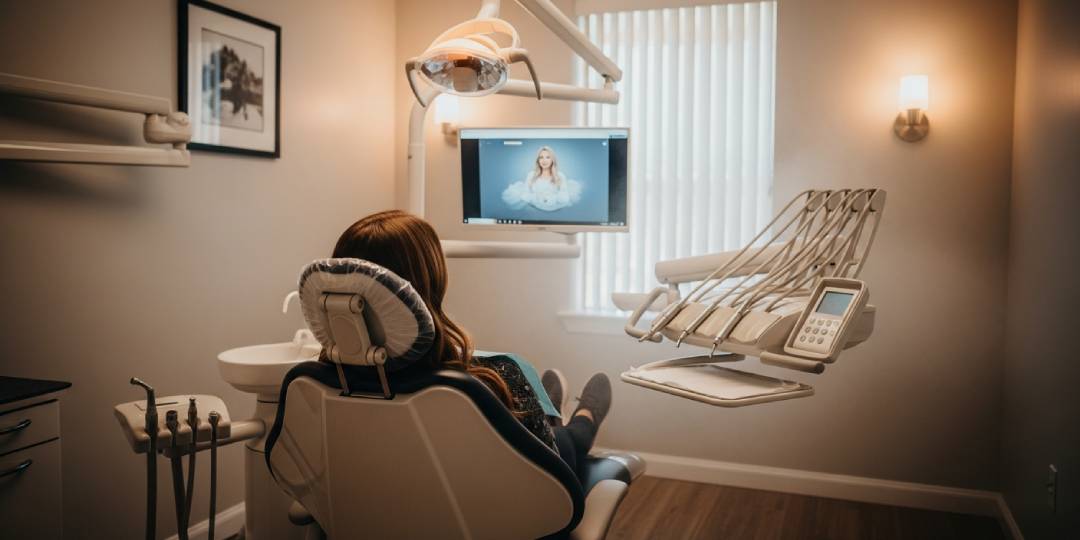
Worth the short drive, according to the people making it
Where do anxious patients drive in from?
Fearful patients do not pick the closest office. They pick the one where the fear gets taken seriously. We are at 26957 Date St., Suite B4, in the Aldi center off Murrieta Hot Springs Road, and people come in from every direction around us.
From Temecula
About fifteen minutes up the 215 or Winchester Road. Close enough that the drive does not give the dread time to build, far enough from your own neighborhood that nobody you know is sitting in the waiting room. More embarrassed patients tell me that second part matters than you would guess.
From Menifee
The 215 south to Murrieta Hot Springs or Clinton Keith, roughly fifteen minutes, and against the commute flow if you book a mid-morning slot. Several Menifee families found us through one anxious member who made the first trip alone.
From Wildomar
Clinton Keith east to the 215, then up Murrieta Hot Springs. About fifteen minutes. For patients whose anxiety spikes in big clinical settings, a small single dentist office with one familiar team and no rotating strangers is usually the reason they drive past larger practices to get here.
From French Valley and Winchester 92596
Six to eight minutes down Murrieta Hot Springs Road from the airport area, and closer still from parts of Winchester. For anxious parents working around the school run, the timing is friendly: drop the kids, take the quiet slot, be home with a written plan before the morning is gone.
The Practical Details
- Address
- 26957 Date St., Suite B4, Murrieta, CA 92563 · off Murrieta Hot Springs Road
- Phone
- (951) 412-0127 · tell us you are nervous when you book
- Office hours
- Mon, Tue, Thu 9:00 AM–5:00 PM · Wed, Fri 9:00 AM–3:00 PM · no regular weekend hours; weekend emergencies by arrangement
- First visit
- Can be conversation only. $20 exam with digital X-rays if and when you are ready.
- Cleaning
- $95 ultrasonic cleaning, without insurance
- Payment
- I accept PPO plans and I am in network with Delta Dental PPO, Cigna, MetLife, Guardian, Aetna, and United Concordia; CareCredit; written cash prices for patients without insurance
- Languages
- English, Spanish, Vietnamese
- Your dentist
- Dr. Bao Nguyen, DDS, the same dentist at every visit since 2010
And when avoidance has already ended the hard way, with a broken tooth or a swollen face or a night you could not sleep through, our Murrieta emergency dentist priority applies to fearful patients with no scolding attached. Pain first, plans later, judgment never.
Structure, not adjectives
Why don't I advertise myself as a “gentle dentist”?
Search for help with dental fear around here and every office in the valley calls itself gentle. The word costs nothing to print and commits nobody to anything. What an anxious patient needs is structure: specific, checkable changes to how the appointment runs.
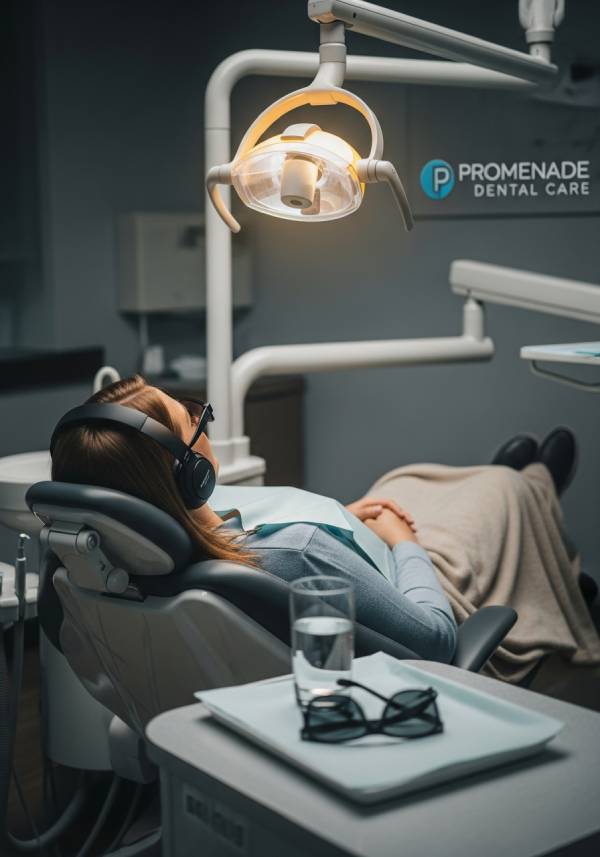
One dentist, every visit, since 2010. I trained at UCLA School of Dentistry and spent ten years as a U.S. Navy dentist, including an Advanced Education in General Dentistry residency at Camp Pendleton and deployments to Kuwait and Iraq. I treated sailors and Marines whose dental anxiety came with no opt-out clause. That decade taught me one specific skill: earning trust quickly from people with good reason to withhold it. Every exam in this office since 2010 has been mine. The person who learns your stop signal in June is the person holding the instruments in December.
The fear is a design requirement, not a complaint. Stop signal agreed before anything begins. Tell, show, then do, so nothing in your mouth is a surprise. Numbing verified before work starts. Longer slots at quieter times for anxious patients. A first visit that can be all conversation. These are not favors handed out to difficult people. They are how the office runs.
Sedation as a bridge, not a product. I review your full health history first and recommend the lightest option that gets you through comfortably. Plenty of patients use sedation for the early or larger appointments and then find routine visits manageable without it once enough calm experiences have stacked up. The goal is to make sedation progressively unnecessary.
Honesty is part of the treatment. Anxious patients are the favorite target of quota dentistry: frighten, stack the plan, close at the front desk. Severe dental anxiety gets measurably worse every time that happens. We run the opposite play, including the sentence corporate offices rarely say out loud, which is that a tooth just needs watching. And when the fear runs deeper than anything I can accommodate, tangled up with panic attacks or old trauma, pairing dental care with a psychologist is the standard of care and not an admission of failure. Both the American Psychological Association and NIMH point the same direction: specific phobias are among the most treatable conditions in mental health.
Nobody is born afraid of dentists. Somewhere along the line, somebody in my profession earned that fear. My job is to un-earn it, one boring, predictable, pain-free visit at a time.
Dr. Bao Nguyen, DDS
Good Day, My name is Debby and I have been a patient of Dr. Nyugens now for over a decade at Promenade Dental. Doctor and staff, which includes Edith are incredibly wonderful, so kind, caring and compassionate, yet professional. They go above and beyond to care for their patients which includes painless treatments in a calming atmosphere. Dr. Nyugen met me at his office for an emergency visit during the height of covid and I will forever be thankful for it! I refer family and friends who have a pleasant experience also. Most Sincerely!
— Debra Davidowitz · Google review
This is a great place to go take care of your teeth. The team was very professional examining and providing with solutions by priority. I felt that I was in good hands. Very gentle and kind to me. They explained very well what was going on. The best dental care I have ever experienced! Will be coming back for all my future dental needs!
— nancy ramirez · Google review
I like the Dentist, he was honest and seem to care about my well-being. The atmosphere was peaceful, also willing to work around my schedule.
— Dennis King · Google review
Practical, not preachy
What can you do before you come in?
These are the things our patients actually report using, not a generic relaxation list. Pick the two or three that sound like they would help you and ignore the rest.
If even the phone call is hard, use this script
“Hi, I would like to book a first visit. I am very nervous about the dentist and I have not been in years. Can we keep it to a conversation and maybe X-rays?” Read it word for word if you need to. Our front desk takes it from there, and the hardest part of your entire return will be behind you before you hang up.
Asked quietly, answered plainly
What else do people ask about dentophobia?
What is dentophobia?
Dentophobia is the severe end of dental anxiety: a fear of dentists or dental treatment strong enough that someone avoids care even while in pain. It sits in the recognized category of specific phobias, alongside fear of flying or heights. Most people assume it just means feeling nervous before an appointment. In my chair it usually looks like canceled visits, a sleepless night before, a racing heart in the parking lot, and years of putting it off. It is common, it is treatable, and nobody here treats it as a character flaw.
What is the difference between dental anxiety and dental phobia?
Dental anxiety is uneasiness that you push through, while dental phobia is fear strong enough that you avoid care entirely, sometimes for years. Roughly one adult in ten meets the description of severe dental fear, and dentophobia is recognized in the clinical literature as a specific phobia. The practical difference is behavior. An anxious patient reschedules twice and then shows up. A phobic patient stops booking at all and only appears when pain forces the issue. Both respond to the same treatment, which is gradual, controlled exposure in an office that does not rush.
How common is dental anxiety?
Roughly a third of adults report some level of dental anxiety, and about one in ten has fear severe enough to be called dentophobia. Our front desk hears “I’m scared of the dentist” most weeks. Patients drive to us from Murrieta, Temecula, Menifee, Wildomar, French Valley, and Winchester 92596 specifically because of it. If you have been avoiding dental care, you are not an unusual case in this office. You are one of the regular ones.
Can dentophobia be treated?
Yes, and it works best from two directions at once. On my side, treatment means rebuilding predictability: a first visit with no treatment in it, a stop signal I honor instantly, numbing that is verified before I start, the same dentist every time, and sedation used as a bridge when it is warranted. On the mental health side, specific phobias respond very well to gradual exposure and cognitive behavioral therapy. Mild cases often settle after a few calm visits. Severe cases do better when a therapist and a dentist are both involved.
What causes fear of the dentist?
The causes I hear most often in first visits are a painful or dismissive past appointment, fear of dental injections, fear of pain itself, dread of a specific procedure such as a root canal, embarrassment about the condition of the teeth after years away, fear picked up in childhood from an anxious parent, and the loss of control that comes with lying back in a chair with your mouth open. Each cause needs a different accommodation. That is why naming yours is the first thing we do.
How do dentists help anxious patients?
By changing how the appointment is built, not by telling you to relax. What that looks like here: longer appointments that are not rushed, a first visit that can be conversation only, a hand signal agreed before anything starts, narration so nothing in your mouth is a surprise, numbing tested before any work begins, sedation dentistry when it is warranted, the same dentist at every visit, and written cash prices so the bill is not its own ambush. I have run this office personally since 2010.
Do I have to get treatment at my first visit?
No. A first appointment can be a conversation and nothing else. If you want to stop there, we stop there. If you feel ready, we take digital X-rays so you can see what is actually happening, which is usually less than years of dread predicted. I explain the findings on your own images in plain language, hand you written prices, and you go home and think about it. No treatment coordinator, no closing pitch, no decision required in the chair.
Can I bring someone with me to my appointment?
Yes, and please do if it helps. A trusted person in the room is a legitimate accommodation, not a weakness. Mention it when you book so we plan the room for it. For deeper sedation appointments a companion is required anyway, because you will not be able to drive yourself home.
Does anxiety-friendly dental care cost more?
No. The longer appointment, the conversation-only first visit, the stop signal, and the narration are how this office runs, not add-on services with a fee attached. An exam with digital X-rays is $20 and an ultrasonic cleaning is $95, without insurance. Sedation is the one item that carries its own charge, and you get that price in writing before you agree to anything. I accept PPO plans, in network with Delta Dental PPO, Cigna, MetLife, Guardian, Aetna, and United Concordia, plus CareCredit, and cash patients get the same written prices as everyone else.
The Hardest Part Is the Front Door. I Will Handle the Rest.
One phone call, one visit that can be conversation only, and one dentist who stays the same. Serving anxious patients from Murrieta, Temecula, Menifee, Wildomar, French Valley, and Winchester 92596 at 26957 Date St., Suite B4.
(951) 412-0127