
Pediatric & Family Dentistry • Murrieta, CA
When Should Your Child First Visit the Dentist?
By the first birthday, or within six months of the first tooth, whichever comes first
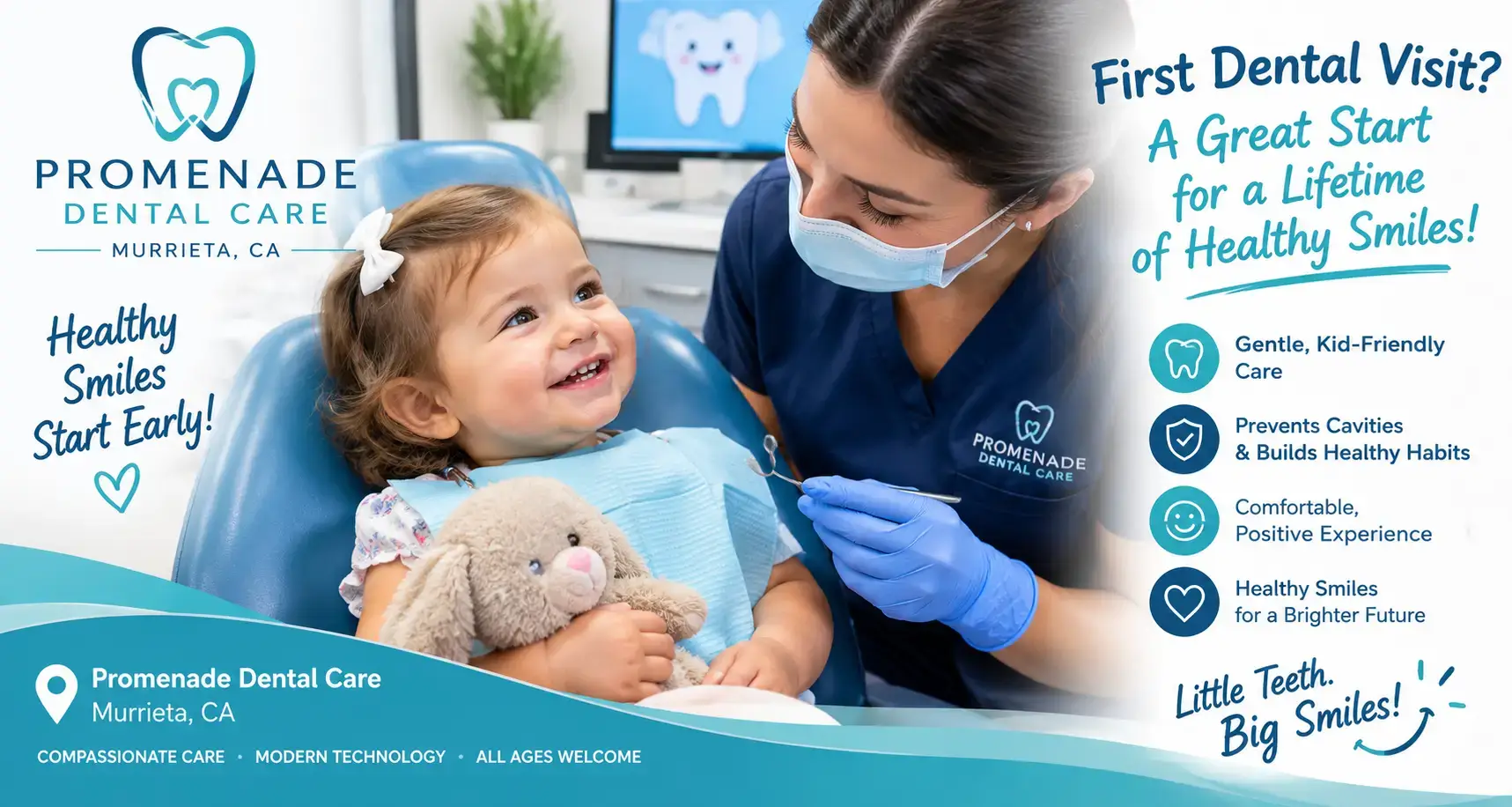
Most parents guess three or four. The American Academy of Pediatric Dentistry, the American Academy of Pediatrics, and the American Dental Association all say age one. This page covers why the answer is that early, exactly what happens at a first visit in my Date Street office, how to prepare a toddler for it, and the ages that matter after that. If you are already past one, the right time is simply the next available appointment.
The Answer
By Age 1 or the First Tooth, Whichever Comes First
This is not my house rule. The American Academy of Pediatric Dentistry recommends a first dental visit within six months of the first tooth erupting and no later than the first birthday. The American Dental Association and the American Academy of Pediatrics land in the same place. Three separate professional bodies looked at the same evidence and arrived at the same age.
The reason the window opens that early is simple: the first tooth usually shows up somewhere around six months, and a tooth can start to decay the day it appears. Waiting until preschool means two to three years of enamel sitting in a mouth nobody has looked at professionally.
Already past the first birthday? Plenty of first visits happen at four, six, or nine, and nobody in this office will make you feel late for it. The right time is the next appointment you can get. If your child had a rough experience somewhere else, tell us when you book and we will pace the visit to match.
Why So Early
Baby Teeth Fall Out. The Consequences of Losing Them Early Don't.
The most common objection I hear is that baby teeth are temporary, so why spend money on them. The answer is that all twenty of them have jobs to do for the next six to twelve years. They let a child chew a real diet. They shape speech. And each one holds a spot in the jaw for the permanent tooth coming in behind it. When a baby tooth is lost early to decay or infection, the neighbors drift into the gap, and the adult tooth that was supposed to fill that space comes in crowded or crooked. That is an orthodontic problem you are buying at age four.
Decay in young children is also more common than most parents assume, and it moves fast. The CDC's 2024 oral health surveillance report found that about one in ten children between two and five already has an untreated cavity in a baby tooth, and by six to eight it's closer to one in five. A small white spot on a front tooth at eighteen months can be a tooth that needs a crown or an extraction by three, because enamel on primary teeth is thinner than on adult teeth and the decay reaches the nerve faster.
The part parents cannot see: a toddler cannot tell you a tooth hurts. Fussiness at meals, refusing cold foods, waking at night, chewing on one side. Parents reasonably chalk all of it up to teething or a phase. By the time a child can point to the tooth, the problem is usually months old. An early visit puts a trained set of eyes on the mouth before the child has to be the one to report it.
There is a second, less clinical reason to start at one. A child whose first dental memory is sitting in a parent's lap while someone counts their teeth has a very different relationship with this office than a child whose first visit is a toothache. The first kind grows up thinking the dentist is boring. The second kind grows into the adult who avoids the dentist for a decade. I have treated both.
What to Expect
What Happens at a Child's First Dental Appointment
Less than parents imagine. There is no drill, no numbing, and usually no X-rays. The first visit is deliberately short and deliberately uneventful, and the goal is that your child leaves thinking it was fine. Not fun. Fine.
1Knee-to-knee exam
For infants and toddlers, you sit facing me, your child lies back across both our laps, and I get a clear look at everything without anyone being handed to a stranger. Nobody takes the baby.
2Count and look
I count the teeth out loud, check that they are arriving in the right order, look at the gums and the soft tissue, and see how the upper and lower jaws are meeting. A three-second look in a squirming mouth tells me most of what I need.
3Check for early trouble
White-spot lesions on the front teeth are the first visible stage of decay and are still reversible at this point. I also screen for tongue-tie or lip-tie that is interfering with feeding or speech.
4Fluoride varnish, if it makes sense
A quick brush-on coat that hardens on contact. It takes about thirty seconds and a child barely notices it. Recommended by the AAPD from the first tooth for children at cavity risk, which in Southern California is most of them.
5The parent conversation
This is the part that matters most. What is in the bottle or sippy cup, and when? Who is doing the brushing, and with what? Thumb or pacifier? Night feeding? The answers change the prevention plan more than anything I find in the mouth.
6X-rays only if I need them
Digital X-rays are not part of a routine first visit. I take them when I see something that needs a closer look, not on a schedule.
If your child is not ready, we stop
Some one-year-olds cry the moment the chair moves. Some three-year-olds clamp their mouth shut and will not open it for anyone. That is not a failed visit. We do what we can, you leave with a plan, and we try again in a few weeks. Crying at the first visit or two is expected and is not a reason to stay away. The children who come back on a regular schedule are the ones who stop crying, usually by the third visit.
Nitrous oxide is available for older children who need help with a longer appointment. For a child who needs more than that, I refer out rather than push through.

How to Prepare
How to Prepare a Toddler (and Yourself) for the First Visit
Children read a parent's face before they hear a word, so most of the preparation is about you. Keep it low-key and unremarkable. You are going somewhere to have your teeth counted; that is the entire pitch.
What to bring, and what it costs
Your insurance card if you have coverage. We take PPO plans, including Delta Dental PPO, Cigna, MetLife, Guardian, Aetna, and United Concordia, and the front desk can check your child's benefits before the visit. Most plans treat a child's exam as preventive care. Without insurance, the children's exam is $20.
A short medical history, too. Conditions that seem unrelated to teeth often are not. And a list of the questions you have been meaning to ask about teething, thumb-sucking, bottles, fluoride, or diet. The first visit is the best time to get personal answers, because there is nothing else on the schedule.
If I do find something that needs treatment, you get a written quote before anything is scheduled, and CareCredit financing is available. Nothing gets done on a first visit that you have not agreed to.

Specialist or Not
Pediatric Dentist vs. General Dentist: Does Your Child Need a Specialist?
A board-certified pediatric dentist completes two to three additional years of residency after dental school, with training in child development, behavior management, pediatric sedation, and treatment of children with special health care needs. That training is real, and for some children it is the right call.
I am a general dentist who has been seeing children since I opened this office in 2010, from first-tooth toddlers through the teenagers I have known since they were three. The honest way to frame the choice is by what your child needs, not by the sign on the door.
| Your situation | A general dentist who sees kids | A pediatric specialist |
|---|---|---|
| Routine first visits, checkups, fluoride, sealants, small fillings | Yes, this is the bulk of what I do for children | Yes |
| Mild anxiety, a child who needs extra time and patience | Yes, with nitrous oxide available when it helps | Yes |
| Extensive decay in a very young child needing many teeth treated at once | Referral for treatment under deeper sedation or general anesthesia | Best fit |
| Significant developmental or medical special needs | Depends on the child; I will tell you honestly at the first visit | Best fit |
| Whole family seen in one office, same dentist as your child grows up | Yes, no aging out at eighteen | Typically refers out at adulthood |
If your child falls into one of the rows where a specialist is the better fit, I will say so at the first visit and refer you. The first exam still tells us that, which is one more reason not to wait on it. More on how I work with children of every age is on the pediatric dentistry page.
Ages to Know
Key Dental Milestones From the First Tooth to the Last Baby Tooth
Dental visits that track a child's development catch problems at the age when they are still easy to fix. Here is the timeline I work from.
- 6–12 months
- First tooth erupts, usually a lower front tooth. Start brushing with a rice-grain smear of fluoride toothpaste. Schedule the first visit.
- Age 1
- First dental visit at the latest. Establish a dental home. Bottles and sippy cups should carry only milk, formula, or water; never at bedtime.
- Age 2
- Most of the twenty baby teeth are in. Routine six-month checkups begin. Check the transition off the bottle and pacifier.
- Age 3
- All baby teeth in. Toothpaste goes up to a pea-sized amount. Full exam of bite and development. Start working on thumb and pacifier habits.
- Age 4
- Last reasonable window to stop thumb- or finger-sucking before it begins to shape the bite.
- Age 6
- First permanent molars erupt behind the baby teeth, and the lower front baby teeth start to fall out. Sealants on those molars as soon as they are through the gum.
- Age 7
- First orthodontic screening, per the American Association of Orthodontists. Enough adult teeth are in to assess the bite.
- Ages 12–13
- Last baby molars fall out and the second permanent molars come in. Sealants on those too.
What happens after this first visit, from six-month cleanings and fluoride varnish to sealants, space maintainers, and what to do when a child knocks out a tooth, is covered on our main page for children's dentistry in Murrieta.
Who Will See Your Child
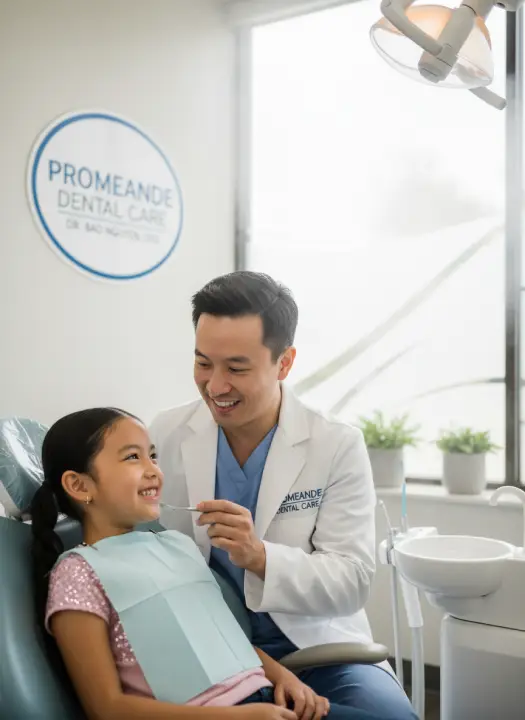
Dr. Bao Nguyen, DDS
I trained at the UCLA School of Dentistry and served ten years in the U.S. Navy Dental Corps, with my general dentistry residency at Naval Hospital Camp Pendleton. Navy families moved constantly, so I saw a lot of kids walking into yet another new dental office, usually a little scared and often with no records. You learn quickly that the first two minutes decide whether a child will open their mouth for you.
That is still how I run a first visit on Date Street. I do the exam myself, and I will be the same dentist at age four, age ten, and age sixteen. I speak English, Spanish, and Vietnamese, and most of the families I see come from Murrieta, Temecula, French Valley, Winchester, and Menifee.
What patients say
These are general practice reviews from our Google listing, not reviews about children's visits specifically. I would rather show you real words from adult patients than make up a parent's.
I have been a patient of Dr. Nguyen now for over a decade at Promenade Dental. Doctor and staff are incredibly wonderful, so kind, caring and compassionate, yet professional. They go above and beyond to care for their patients, which includes painless treatments in a calming atmosphere.
— Debby L. • Google Review
Since starting with Promenade Dental Care I have had cleanings, fillings, teeth replaced, root canal and crown replacement yesterday. I have never gone to a more gentle caring dentist. Love my dentist!
— Lucille L. • Google Review
I was greeted immediately by name. They took me back immediately, no waiting at all! The dentist himself did the x-rays and explained what he was seen every step along the way I had a little cavity that I needed to have filled, he walked me personally from the x-ray room to the chair. Took care of the cavity, which was very reasonably priced. And I was in and out within 20 minutes! I loved their attention to detail, how reasonably priced they were, how there is only one dentist for one patient, and how attentive they were to everything. I will come here again and again.
— Ericka H. • Google Review
Love this Dentist. Great office staff too. I had a minor chip on my bottom front tooth. It was a simple fix. I have HMO dental insurance, but I am using this office for my dental care. I will pay cash to see this Dentist. He is amazing.
— Valeria M. • Google Review
Related Pages
More on Kids' Dental Care in Murrieta
Children's Dentistry
Checkups, fluoride, sealants, space maintainers, nitrous for nervous kids, and children's emergencies, all in one place.
$20 Exam and Digital X-Rays
What the exam covers for adults and children, and why it costs twenty dollars.
Tongue-Tie and Lip-Tie
Which ties actually cause feeding or speech trouble, and which ones are better left alone.
Tooth-Colored Fillings
How small cavities are filled, what it costs, and how fillings are handled for kids.
Nitrous and Sedation
How laughing gas works for an anxious child, and when a referral makes more sense.
Emergency Dentist
Knocked-out or broken baby teeth, toothaches, and swelling. Same-day care for every age.
FAQs
Common Questions About a Child's First Dental Visit
What is the recommended age for a child's first dental visit?
By the first birthday, or within six months of the first tooth erupting, whichever comes first. The American Academy of Pediatric Dentistry, the American Dental Association, and the American Academy of Pediatrics all give the same recommendation. Most babies get a first tooth around six months, so the window opens earlier than many parents expect. The purpose of the visit is an exam, a parent conversation about home care, and a calm first experience, not treatment.
Is it too late if my child is already three or four and has never seen a dentist?
No. Plenty of first visits happen at four, six, or nine. The best time is the next available appointment, and nobody here lectures parents about it. If your child had a bad experience at another office, mention it when you book and we will pace the visit accordingly.
What actually happens at a first dental appointment for a toddler?
A knee-to-knee exam in your lap, counting the teeth, a look at the gums and bite, a check for early white-spot decay and tongue- or lip-tie, fluoride varnish if indicated, and a conversation with you about bottles, brushing, and habits. No drill, no numbing, and X-rays only if something needs a closer look. About twenty minutes.
Can I stay with my child during the exam?
Yes. For babies and toddlers you are part of the exam: your child sits in your lap and leans back into mine, so they can see your face the whole time. Older kids who want to sit in the chair on their own can, and you are still welcome in the room. I have never asked a parent to wait outside for a first visit.
How do I prepare my child for the first dentist visit?
Keep it low-key. Describe it as going to have your teeth counted. Avoid the words "hurt," "shot," and "drill," even to reassure. Play pretend dentist at home, read a picture book about the dentist, bring a comfort object, and book a morning slot when your child is rested. If you are the anxious parent, let the other parent take the first visit.
What should I bring to my child's first dental appointment?
Your dental insurance card if you have coverage, a short medical history including any medications, allergies, or developmental concerns, a list of your questions, and your child's comfort item. Ask for new-patient forms when you book so they are done before you arrive.
Will my child need X-rays at the first visit?
Usually not. Most one- and two-year-olds leave without a single X-ray. I take them when I see something I cannot judge by looking, like a dark spot between two back teeth or a tooth that took a fall. When I do need one, it is a digital X-ray, which uses far less radiation than the old film kind.
How do I clean my baby's mouth before the first tooth comes in?
Wipe the gums with a clean, damp washcloth or a piece of gauze after feedings. It takes ten seconds and gets your baby used to having a mouth cleaned. Once the first tooth shows up, switch to a soft infant toothbrush and a smear of fluoride toothpaste no bigger than a grain of rice, twice a day.
My baby is past one and still has no teeth. Should I worry?
Usually not. Some perfectly healthy babies do not get a first tooth until twelve or fifteen months, and late teeth often run in families. Bring your child in at one anyway, because I can feel and see a lot about what is coming through the gums. If there is still nothing by about eighteen months, that is when I want to look more closely.
Is a bottle or nursing at night bad for my baby's teeth?
A bottle in the crib is the classic cause of early decay on the upper front teeth, because milk or juice pools around the teeth all night. Nursing is different, and I do not tell mothers to stop. What matters once teeth are in is that they get wiped or brushed after the last feeding of the night, and that nothing but water goes into a bedtime bottle.
What does a white spot on my toddler's front tooth mean?
A chalky white line or patch near the gumline on the upper front teeth is usually the first stage of decay, where the enamel has lost minerals but has not broken down yet. At that stage it can often be stopped or reversed with fluoride varnish and a few changes at home. If it turns yellow or brown, or feels rough, the tooth has started to break down and needs treatment. Either way, do not wait for the next checkup. Call and have it looked at.
Are baby teeth really that important if they are going to fall out anyway?
Yes. Baby teeth are in place for six to twelve years. They are needed for chewing and speech, and each one holds space in the jaw for the permanent tooth that replaces it. When one is lost early to decay, the neighboring teeth drift into the gap and the adult tooth comes in crowded or crooked, an orthodontic problem created in preschool. Untreated decay in a baby tooth can also abscess and affect the developing permanent tooth beneath it.
When do children start losing their baby teeth?
Around age six, usually starting with the lower front teeth, and continuing to about twelve or thirteen when the last baby molars are replaced. Starting as early as four or as late as seven is usually still normal. If your child reaches seven without losing any teeth, or is losing them much earlier than expected, bring it up at a checkup.
Start Early. Keep It Boring.
A $20 exam is the whole commitment. Twenty minutes, your lap, and a plan you can actually follow at home.
Promenade Dental Care
26957 Date St, Suite B4, Murrieta, CA 92563