
Tooth Pain • Murrieta, CA
Why Do My Teeth Hurt? What Your Tooth Pain Is Telling You
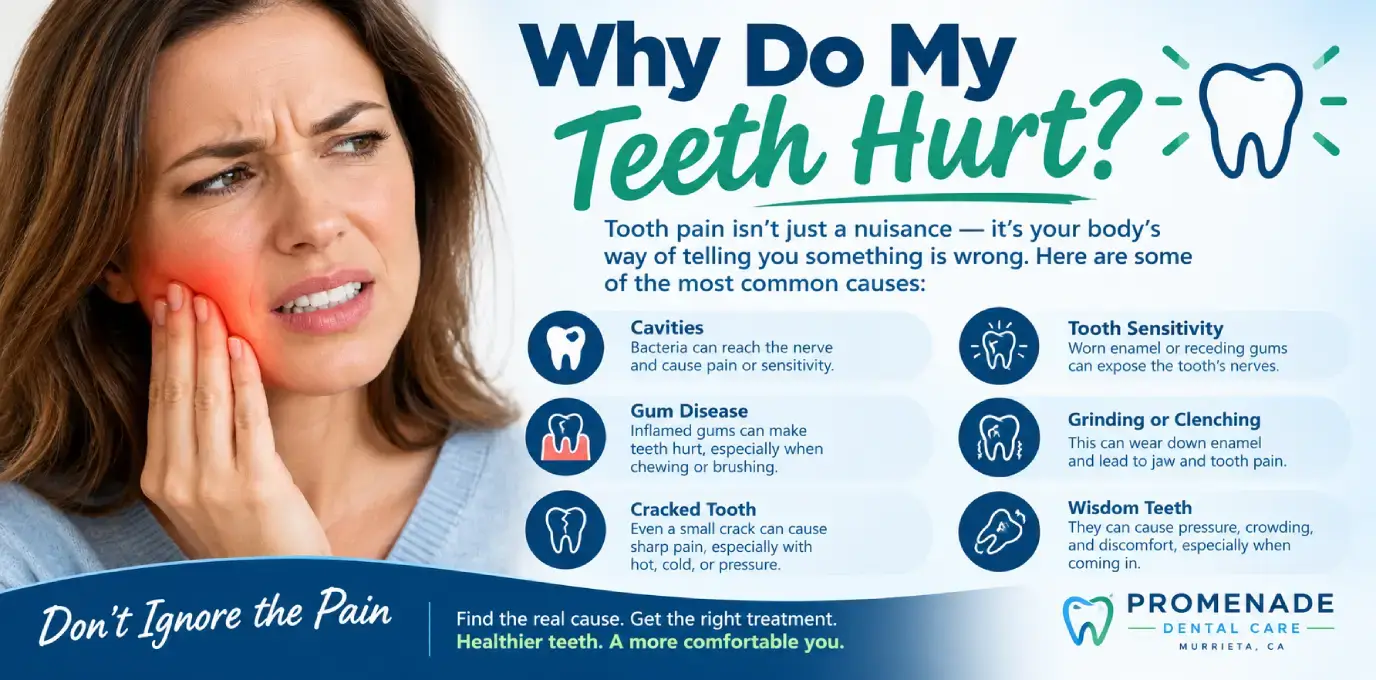
A quick zing, a throb that keeps you up, a sharp jolt when you bite. Each one points somewhere different.
When someone calls the office with a toothache, the first thing I ask isn't which tooth. It's what the pain feels like, what sets it off, and how long it lasts. Those three answers narrow things down more than most people expect. Here's how I read tooth pain, what you can safely do at home tonight, and when it can't wait.
Start Here
A Quick Guide to What Your Tooth Pain Means
Teeth only have a few ways to tell you something is wrong, and almost all of it comes through one nerve inside each tooth. The same nerve reacts to cold, pressure, and infection, which is why tooth pain is so easy to misread. The way it behaves is the clue. This table is the short version of what I'm thinking when you describe your pain over the phone.
| What you feel | Most likely cause | How soon to be seen |
|---|---|---|
| Quick zing from cold or sweets that fades in seconds | Exposed dentin, worn enamel, gum recession, or an early cavity | Within a few weeks |
| Pain from cold or heat that lingers 30 seconds or more | An inflamed nerve, often from deep decay or a crack | Within a few days |
| Throbbing that starts on its own or wakes you up | Nerve damage or infection | Same day or next day |
| Sharp jolt when biting or letting go of a bite | A cracked tooth or a high filling | Within a few days |
| Dull ache in several upper back teeth with a stuffy nose | Sinus pressure | Dental check if it lasts past the cold |
| Sore teeth and jaw on waking | Clenching or grinding at night | At your next convenient visit |
| Swelling in the face or gum, fever, or a bad taste | Abscess or spreading infection | Today |
A table can't examine you, and pain doesn't always follow the rules. But if your pain fits one of the bottom rows, don't wait for it to settle down. Call us, and if it's after hours, see the urgent signs further down this page.
Types of Tooth Pain
Reading the Pain: Seven Patterns I See Every Week
1. The quick zing
Cold water, ice cream, or a breath of cold air sends a sharp flash through the tooth that's gone in a second or two. That's usually dentin that has lost its covering, from worn enamel, a receding gumline, or brushing too hard. It's the least worrying pattern, but it's also how many early cavities first show up. I go through the nine common causes and how each is treated on my page about why teeth get sensitive.
2. Pain that lingers after hot or cold
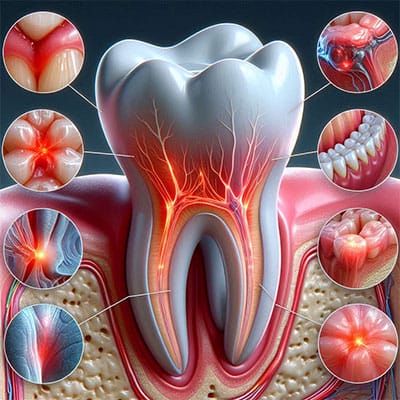
This is the one I pay closest attention to. If the ache keeps going for half a minute or more after the cold drink is gone, the nerve itself is inflamed. Sometimes that inflammation settles once we remove the cause, such as a deep cavity. Sometimes the nerve can't recover. The National Institute of Dental and Craniofacial Research notes that early decay usually causes no symptoms at all, and that pain and sensitivity to sweets, hot, or cold tend to arrive as decay advances. So by the time decay hurts like this, it's usually deep.
3. Throbbing that starts on its own
A tooth that aches with nothing touching it, pulses with your heartbeat, or wakes you at 2 a.m. has usually moved past inflammation into nerve damage or infection. Lying down tends to make it worse. This kind of pain rarely goes away for good. When it seems to, the nerve has often died, and the infection can keep going quietly. Most of these teeth can still be saved with a root canal, which I do in the office.
4. A sharp jolt when you bite
Pain on biting, especially a jolt when you release the bite, is the classic sign of a cracked tooth. The Cleveland Clinic lists biting hard foods like ice and popcorn kernels, grinding, large old fillings, and age as common reasons teeth crack, and notes that people over 50 are more likely to have them. Cracks often don't show on an X-ray, so I test each tooth with a bite stick. A crack caught early can usually be held together with a crown. I make same-day crowns in the office, so a cracked tooth is often protected in one visit.
5. A dull ache across the upper back teeth
If several upper molars ache at once, bending over makes it worse, and you've got a cold or allergies, your sinuses are a likely source. The roots of the upper back teeth sit right under the maxillary sinus. Mayo Clinic recommends seeing a dentist first to rule out a dental cause, then a physician if the teeth check out. That order matters, because an infected upper tooth can also cause a stubborn sinus infection.
6. Sore teeth and a tired jaw in the morning
Waking up with teeth that feel bruised, a tight jaw, or a headache at the temples points to clenching or grinding at night. Many people have no idea they do it. I look for flattened edges, tiny chips, and cracks. My TMJ evaluation page covers grinding and jaw pain, and a custom night guard protects the teeth while you sleep.
7. Gum pain that feels like tooth pain
Sore, puffy, or bleeding gums around a tooth can feel exactly like a toothache. A popcorn hull stuck under the gum is a common and simple cause. Deeper gum infections and periodontal pockets are another. If the gums bleed when you brush, my page on gum disease treatment explains how I stage it and what it costs.
Why It Hurts
What's Happening Inside the Tooth
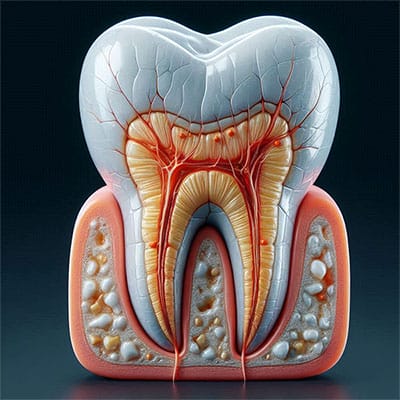
A tooth has three layers. Enamel on the outside has no nerves, so wearing it down doesn't hurt by itself. Under it is dentin, which is full of microscopic tubes filled with fluid. When dentin is exposed, cold and sweet things move that fluid, and the nerve reads the movement as a sharp zing.
At the center is the pulp: the nerve and blood supply. It lives inside a rigid box with no room to swell. When the pulp gets inflamed from deep decay, a crack, or a hit to the tooth, the pressure has nowhere to go. That's why nerve pain throbs, and why it gets worse when you lie down and more blood flows to your head.
Once bacteria reach the pulp and spread out through the tip of the root, the pain often shifts from temperature to pressure. The tooth feels tall, and it hurts to tap or chew on.
Widespread Pain
Why Do All My Teeth Hurt at Once?
A single tooth usually means a single problem in that tooth. When patients tell me everything hurts, I think about causes that touch many teeth at the same time:
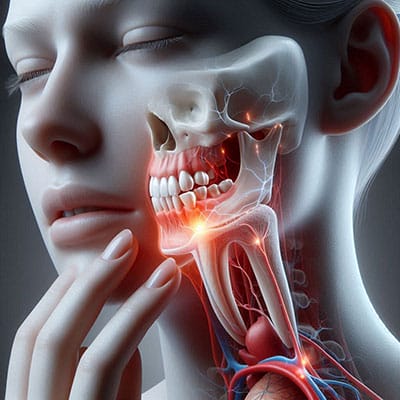
There's one more that's easy to miss. Sometimes a single bad tooth refers pain across the whole side of the jaw, so it feels like the upper and lower teeth all hurt. A cold test and an X-ray usually find the one that's actually responsible.
If you think diet is part of the picture, my list of the worst foods and drinks for your teeth covers the habits I see behind widespread wear.
Until You're Seen
What You Can Safely Do for Tooth Pain Tonight
None of this fixes the tooth. It just gets you through until we can look at it.
Over-the-counter pain relief
Ibuprofen or acetaminophen, taken exactly as the label says, if they're safe for you. Ask your pharmacist if you're unsure.
Cold on the outside
A cold pack on the cheek for 15 to 20 minutes at a time helps swelling and throbbing. Don't use heat on a swollen face.
Rinse and floss gently
Warm salt water and a gentle floss can clear food stuck against the gum, which is sometimes the whole problem.
Keep your head up
An extra pillow helps nerve pain that gets worse lying flat.
Don't Wait
When Tooth Pain Is Urgent
Most toothaches are miserable but not dangerous. A few signs change that. The Cleveland Clinic treats severe tooth pain with fever and chills as a dental emergency, because a tooth infection can spread beyond the mouth.
Call us the same day if you have facial or gum swelling, a pimple-like bump on the gum, a bad taste that won't rinse away, or pain that painkillers aren't touching. We hold time for same-day pain visits at our emergency dentist office in Murrieta.
Finding the Cause
What Happens When You Come In for Tooth Pain
New patients start with the $20 exam and digital X-rays. For a toothache, I add the tests that actually pin down the tooth: a cold test to see how the nerve responds and how long the pain lasts, a tap test, a bite test for cracks, and a check of the gums around it. Then I show you the X-ray and tell you what I think is going on in plain terms.
- Exam and X-rays
- $20 for new patients, including digital X-rays
- Treatment cost
- A written quote before anything is done, insured or not
- Insurance
- PPO plans accepted; in-network with Delta Dental PPO, Cigna, MetLife, Guardian, Aetna, and United Concordia
- Financing
- CareCredit
- Location
- 26957 Date St, Suite B4, Murrieta, serving Temecula, Menifee, Wildomar, and Lake Elsinore
Sometimes the answer is a small tooth-colored filling. Sometimes it's a root canal and a crown, or taking a wisdom tooth out. And sometimes it's nothing that needs a drill at all.
Who Wrote This
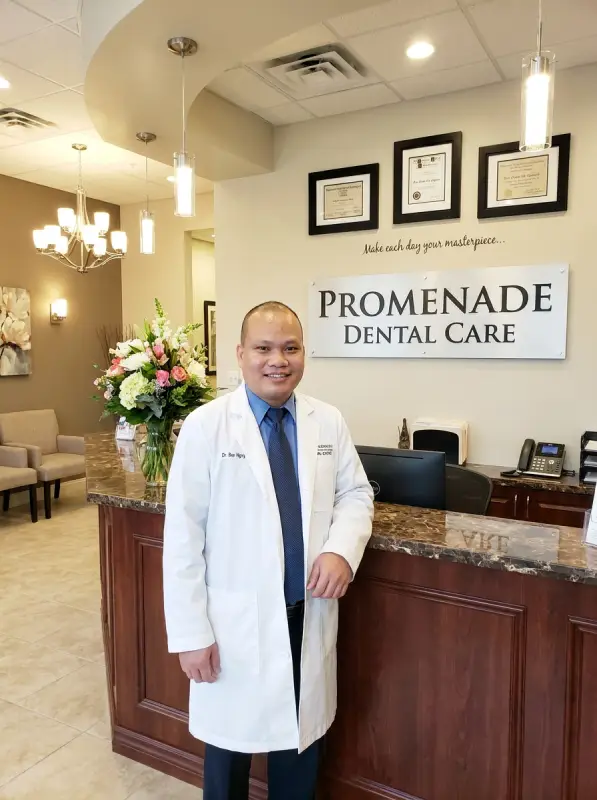
Dr. Bao Nguyen, DDS
I earned my dental degree at the UCLA School of Dentistry and spent ten years as a U.S. Navy dentist, including an Advanced Education in General Dentistry residency at Naval Hospital Camp Pendleton. Military dentistry is built around one question: can this person do their job tomorrow? That habit of finding the real source of pain fast, and treating only what needs treating, is how I still run toothache visits.
I've practiced on Date Street in Murrieta since 2010. I do fillings, root canals, same-day crowns, and extractions in the office, so most painful teeth can be diagnosed and treated here without a referral.
From Our Patients
What Murrieta Patients Say About Toothache Visits
These are real Google reviews from patients of the practice.
I was in significant pain and Dr. Bao Nguyen was able to see me right away. The service was excellent and thorough. I needed a couple fillings done and it was quick, painless, and thorough. He made sure everything was done well and confirmed with imaging to ensure that I wouldn’t have any troubles or pain with the filling. A truly exceptional dentist that I would highly recommend!
— Kim V. • Google Review
I became a patient in July of last year and needed some emergency dental work. I was able to get in the same day and have a crown and root canal done with zero pain! I recently had another toothache and was again provided a prompt same day appointment. Hands down the best dental experience I’ve had — zero pain, zero wait time. Pricing is always up front and affordable.
— Alicia Alvarado • Google Review
I’ve been to a lot of different dentists through the years and have had several fillings/crowns done. I often times experience pain and pressure during procedures even after the anesthetic. This time, zero pain, zero pressure, no nonsense. I’ll be coming back for regular cleanings and any needed procedures. They have my business indefinitely!
— Dominic S. • Google Review
I have been a patient of Dr. Nguyen’s for over a decade. Doctor and staff are incredibly wonderful — so kind, caring and compassionate, yet professional. Dr. Nguyen met me at his office for an emergency visit during the height of covid, and I will forever be thankful for it!
— Debra Davidowitz • Google Review
Related Pages
Where to Go Next
Emergency Dentist in Murrieta
Same-day care for severe toothaches, swelling, and broken teeth.
Why Are My Teeth Sensitive?
Quick zings from cold and sweets, the nine common causes, and the fixes.
Root Canal Treatment
Saving a tooth with an inflamed or infected nerve, done in the office.
Same-Day Crowns
Protecting a cracked tooth in one visit.
Wisdom Tooth Removal
When pressure at the back of the jaw is a wisdom tooth coming in.
TMJ and Grinding
Morning jaw soreness, clenching, and night guards.
Questions Patients Ask
Why Do My Teeth Hurt? Frequently Asked Questions
Why do all my teeth hurt at once?
Pain across many teeth usually comes from something that affects them all together: clenching or grinding, sinus congestion, widespread enamel wear, or receding gums. A single bad tooth can also refer pain across one whole side of the jaw, so an exam with a cold test and X-rays is the way to tell which it is.
Why does my tooth hurt when I bite down?
The most common causes are a cracked tooth, a filling that sits too high, or infection at the tip of the root. A sharp jolt when you release the bite points strongly to a crack. Dr. Nguyen uses a bite test to find the exact tooth, because cracks often do not show on X-rays.
Why does my toothache get worse at night?
Lying flat increases blood flow to the head, and an inflamed nerve inside a tooth has no room to swell, so the pressure and throbbing go up. There are also fewer distractions at night. Pain that wakes you from sleep usually means the nerve is badly inflamed or infected and should be seen within a day or two.
Can a sinus infection make my upper teeth hurt?
Yes. The roots of the upper back teeth sit just below the maxillary sinus, so sinus pressure often feels like a dull ache in several upper molars, worse when you bend over. Mayo Clinic advises seeing a dentist first to rule out a dental cause, since an infected upper tooth can also cause sinus problems.
Why does my tooth hurt after a new filling?
Some sensitivity to cold for a week or two after a filling is normal, especially with a deep one. Pain when you bite usually means the filling is a little high, which takes a few minutes to adjust. Pain that keeps getting worse, or throbbing that starts on its own, should be checked.
My toothache went away on its own. Am I in the clear?
Not necessarily. Pain from gum irritation or a bit of stuck food can clear up in a day or two. But when a tooth that throbbed suddenly goes quiet, the nerve has often died, and the infection can keep spreading without pain. If the pain was severe or lasted more than a couple of days, have it checked.
Can stress make my teeth hurt?
Indirectly, yes. Stress is a common trigger for clenching and grinding, often during sleep. That can leave teeth feeling sore or bruised in the morning, tire the jaw muscles, and over time chip or crack teeth. A night guard protects the teeth while the stress itself is dealt with.
Can wisdom teeth make the teeth in front of them hurt?
Yes. A wisdom tooth coming in at an angle can press on the second molar, trap food against it, and cause decay or gum infection there. The pain can feel like it is coming from the second molar or the whole back of the jaw. An X-ray shows which tooth is actually involved.
Can gum disease make my teeth hurt?
It can. Infected gum pockets make the gums and teeth ache, and receding gums expose root surfaces that are sensitive to cold. An abscess in the gum can throb just like a tooth infection. Bleeding when you brush or floss is the early warning sign.
Can jaw or tooth pain be a sign of a heart attack?
Rarely, but yes. Heart pain can spread to the jaw, most often the lower jaw. If jaw or tooth pain comes with chest pressure, shortness of breath, sweating, nausea, or pain down the arm, call 911 instead of a dentist.
Should I take antibiotics for a toothache?
Not on your own. Antibiotics can calm a spreading infection, but they do not fix the tooth, and the pain usually comes back once they are finished. The source of the infection has to be treated with a root canal, filling, or extraction. Never take leftover antibiotics without being examined.
What happens at a visit for tooth pain in Murrieta?
New patients get the $20 exam with digital X-rays, plus the tests that find the painful tooth: a cold test, a tap test, a bite test for cracks, and a gum check. Dr. Nguyen explains what he finds and gives you a written quote before any treatment. Same-day visits are available for severe pain.
Find Out Why Your Tooth Hurts
Call for a same-day pain visit or a $20 new patient exam with digital X-rays. You get a written quote before any treatment.
(951) 412-0127 Contact Us Online