
Patient Guide · Murrieta, CA
Frenectomy in Murrieta: When a Tongue-Tie or Lip-Tie Actually Needs to Be Released
A short procedure that deserves a careful decision, from the dentist who would rather watch a tie than cut one that does not need it.
Somewhere in the last few years, "tongue-tie" went from a phrase most parents had never heard to something a stranger in a Facebook group will diagnose from a photo of your baby yawning. This page slows that down. It covers what a frenulum is, why most of them should be left alone, when a release is the right call for an infant, a child, or an adult, and what the procedure and recovery involve. Frenectomy is part of the soft-tissue surgery done in this office, but the decision matters more than the procedure.
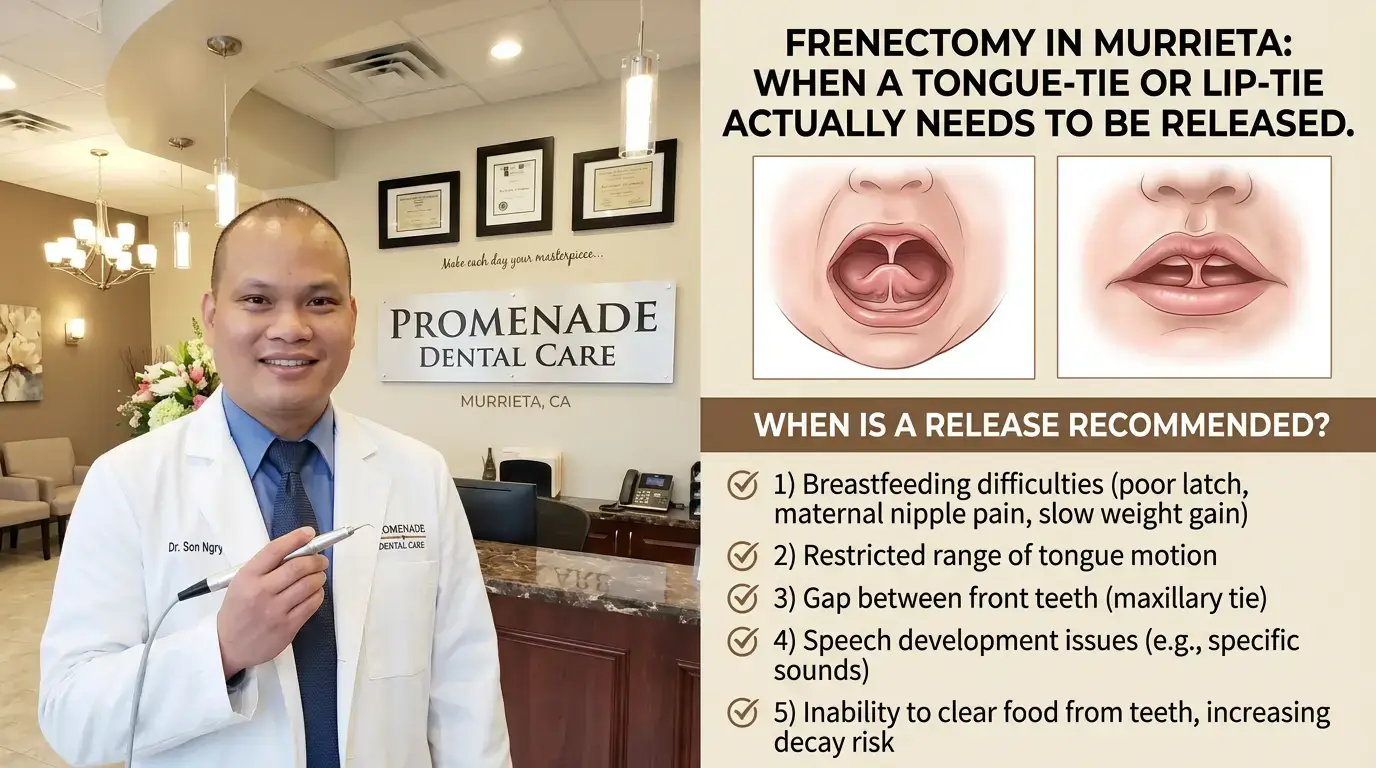
The Short Answer
What a Frenulum Is, and Why Everyone Has Them
A frenulum is a small fold of tissue that tethers one part of the mouth to another. You have one under your tongue, one behind your upper lip, one behind your lower lip, and a few smaller ones near the cheeks. They are supposed to be there. Their job is to give the tongue and lips a stable anchor while the rest of the mouth moves.
A "tie" is what we call a frenulum that is short, thick, or attached so far forward that it restricts movement. Under the tongue that is ankyloglossia, or tongue-tie. Behind the upper lip it is a lip-tie. The important word in both definitions is restricts. A frenulum that looks prominent but lets the tongue lift, sweep, and extend normally is an anatomical variation, not a problem. The Cleveland Clinic's tongue-tie overview says it plainly: a frenulum that is tighter than usual does not by itself mean a child has tongue-tie or needs treatment. Function is the diagnosis. Appearance is not.
- What it is
- Release of a frenulum under the tongue (tongue-tie) or behind the lip (lip-tie) that is restricting movement.
- Who it is for
- Infants with a documented feeding problem, children whose tongue physically cannot do what speech therapy asks, and adults with recession, denture, or lifelong mobility issues tied to the frenulum.
- Who it is not for
- A frenulum that looks tight but works fine. A gap between a young child's front teeth. A "just in case" release to prevent future problems.
- Who does it
- Dr. Bao Nguyen, DDS, in-office under local anesthetic, with sedation available.
- Chair time
- Usually under half an hour. Most sites look healed in two to three weeks.
Newborns and Nursing
Why I Am Cautious With Infants
The rate of tongue-tie diagnosis and release in this country has climbed sharply over the last two decades. The American Academy of Pediatrics' 2024 clinical report is candid that nobody knows how much of that increase is real, how much is better recognition, and how much is overtreatment. Its central advice is that a nursing infant with a suspected tie should have the whole feeding picture evaluated first, ideally with a lactation consultant, because latch problems, milk supply, positioning, and reflux can all produce the exact same complaints a tie does.
That is also my position. Ten years in the Navy Dental Corps taught me that a procedure done for the wrong reason is still a procedure, with all the same risks and none of the benefit. If you bring me a newborn who is struggling to feed, I will look, I will tell you what I see, and if the frenulum is clearly restrictive and the lactation team agrees it is contributing, releasing it is quick and reasonable. If the anatomy is borderline and feeding is improving with help, waiting is not neglect. It is the evidence-based choice.
Ages One Through the Teen Years
Toddlers and Older Children
By the time a child is walking and talking, the questions change. Parents ask me about speech, about a tongue that cannot reach the roof of the mouth, about a kid who gags on textured food or cannot lick an ice cream cone, and about that dark triangle of a gap between the two front teeth.
Speech
Speech is the one I get asked about most and the one that needs the most honesty. A restricted tongue can make certain sounds harder, particularly the ones that need the tip to touch behind the top teeth. But most articulation issues in young children have nothing to do with the frenulum, and the American Academy of Pediatric Dentistry is clear that releasing a tie to prevent future speech problems is not supported by the research. When a parent raises speech, I want a speech-language pathologist's opinion before I pick up an instrument. If the SLP says the tongue physically cannot do what therapy is asking of it, that is a tie worth releasing. If therapy is progressing, the frenulum is not the obstacle.
The gap between the front teeth
The upper lip is a different story, and it is where I most often talk families out of surgery. Nearly every young child has a low, thick upper lip frenulum and a space between the front baby teeth. That is normal development. As the permanent front teeth come in, and especially once the permanent canines erupt, that frenulum thins and migrates upward on its own and the gap usually closes. Cutting it at age six to fix a gap that biology was already going to fix is a procedure the child did not need.
| Situation | Watch and wait | Consider release |
|---|---|---|
| Age | Baby teeth or early mixed dentition | Permanent front teeth and canines are in |
| The gap | Present, but the adult teeth have not finished arriving | Has persisted after eruption and the tissue is clearly holding it open |
| The tissue | Prominent but not blanching or pulling the gum | Thick band inserting between the teeth, gum blanches when the lip is lifted |
| Timing | Re-check at routine visits | Coordinated with whoever is managing the alignment, so scar tissue does not re-form in the gap |
I screen for these attachments at every child's visit starting with the first appointment, so most families hear about a tie from me years before it would ever need attention. That is the point. We watch it, and most of the time watching is all it ever needs.
It Is Not Just a Pediatric Procedure
Adults: The Ties Nobody Told You About
Adults find their way to this page for three reasons, and none of them involve nursing.
What Actually Happens
What a Frenectomy Involves
1Confirming it is the frenulum
I check how the tongue or lip actually moves, not how the tissue looks at rest. For speech or feeding questions, that means an SLP or lactation consultant is in the loop before anything is scheduled.
2Numbing
A frenectomy for a child or adult takes place in a normal dental chair on Date Street under local anesthetic. Nitrous oxide or oral sedation is available for children who need help holding still or adults who want it.
3The release
I release the tight band of tissue. For a thick adult tongue-tie there is usually some muscle fiber involved, which is why the adult version takes a little longer than the pediatric one.
4Closing
Depending on the site and the thickness, the small wound is either left to heal on its own or closed with a few dissolving stitches. Total chair time is usually under half an hour.
5Stretches, shown before you leave
A released frenulum wants to reattach. I demonstrate the gentle movements that keep the site open, because the aftercare decides the result as much as the release does.
It is one of the shorter things I do among the surgical procedures in this office, which is exactly why the decision to do it deserves more of the attention than the procedure itself.
What to Expect Afterward
Healing After a Frenectomy
The site is sore for two or three days, managed with children's or adult over-the-counter pain medication and soft food. The wound turns white or yellow as it heals, which alarms parents every single time and is completely normal. It is not infection. It is new tissue.
The part people underestimate is the stretching. A released frenulum wants to reattach, and the way to prevent that is gentle movement of the tongue or lip several times a day for a couple of weeks. For older children and adults with a tongue release, a few sessions with a speech therapist or myofunctional therapist afterward teach the tongue to use the range it never had, which is often the difference between a good result and a great one.
Most sites look fully healed in two to three weeks. A frenulum that was released for a functional reason and stretched properly rarely needs a second procedure.
Money, Plainly
What a Frenectomy Costs
A frenectomy is a coded surgical procedure, and many dental plans cover it when it is done for a documented functional reason: a feeding problem, an SLP finding, recession, or a denture that cannot seal. A release done because a frenulum "looks tight" is usually not covered, which is one more reason I do not do them on appearance.
Promenade Dental Care accepts all PPO plans and is in-network with Delta Dental PPO, Cigna, MetLife, Guardian, Aetna, and United Concordia. My front desk checks your specific plan before the appointment and you get a written quote, not an estimate, before I do anything. Uninsured patients get flat written cash pricing, plus CareCredit financing for qualified applicants.
Who Wrote This
Reviewed by Dr. Bao Nguyen, DDS

My Navy residency at Camp Pendleton covered periodontics and oral surgery alongside restorative work, and soft-tissue procedures like frenectomy have been part of my own chair ever since. I have seen children and adults on both sides of this: the ones who needed a release and did well, and the ones who had one they did not need. The second group is the reason this page reads the way it does.
I would rather watch a frenulum at your child's routine visits for five years than release one at age three that was going to thin out on its own. When the release is warranted, I do it myself here in Murrieta, one dentist and one chart from the exam through the follow-up.
Related Care
Pages That Connect to This One
Oral Surgery
The full in-office surgical scope, including the other soft-tissue procedures.
Pediatric Dentistry
Age-by-age care, including the tie screening done at every visit.
A Child's First Appointment
What happens at the first visit and how to prepare.
Sealants for Kids
ow I decide which teeth need sealant, what the BPA worry is really about, how long they hold up, and what they cost here on Date Street.
Sedation Dentistry
Nitrous and oral sedation options for children and anxious adults.
From Our Google Reviews
What Families and Patients Say
"No upselling, easy to make an appointment, and he told me exactly what was going on without trying to scare me into unnecessary work. The pricing was fair and upfront. Best dentist I've had."
"Very knowledgeable and good prices. Does only what is necessary, does not just look for stuff to charge for. Got an appointment quickly when I thought it was an emergency. My favorite dentist ever."
"Dr. Nguyen is very quick but very gentle. He has more practical experience than most others, so my wife and I recommend his fine dentistry."
Frenectomy FAQs
Questions Parents and Patients Ask
My baby has a tie. Should I have it released now before it causes problems?
Not unless it is causing a problem now. A frenulum that is not interfering with feeding is not a reason for surgery, and there is no evidence that releasing it early prevents speech or dental issues later. We note it, we watch it, and we act if function is affected.
Will a lip-tie release close the gap between my child's front teeth?
Usually not on its own, and in a young child the gap usually closes by itself as the permanent teeth erupt. A frenectomy for a gap makes sense only once the adult teeth are in, the space has persisted, and it is timed with whatever is being done to close the space.
Does a frenectomy hurt?
The area is fully numb during the procedure. Afterward it feels like a canker sore for a few days. Children are typically eating normally within a day or two.
Can an adult have a tongue-tie released?
Yes. It is a slightly bigger procedure than in a child because the tissue is thicker, but it is done in-office under local anesthetic and adults are often the patients most relieved by it.
Do you use a laser for frenectomies?
The instrument matters far less than the diagnosis. There is no strong evidence that one method heals better or faster than another for this procedure. What matters is releasing the right tissue for the right reason and doing the stretches afterward.
Is a frenectomy covered by dental insurance?
Often, when it is done for a documented functional reason such as a feeding problem, a speech-language pathologist's finding, gum recession, or a denture that cannot seal. A release done only because the tissue looks tight is usually not covered. The office verifies your plan and gives you a written quote before anything is scheduled.
Wondering Whether a Tie Is the Problem?
Five minutes in the chair beats an evening of searching. Call and we'll take a look.
(951) 412-0127 Call Promenade Dental Care