
Children's Preventive Dentistry • Murrieta, CA
Dental Sealants for Kids in Murrieta, CA
No shots, no drilling, and your child can eat lunch right after
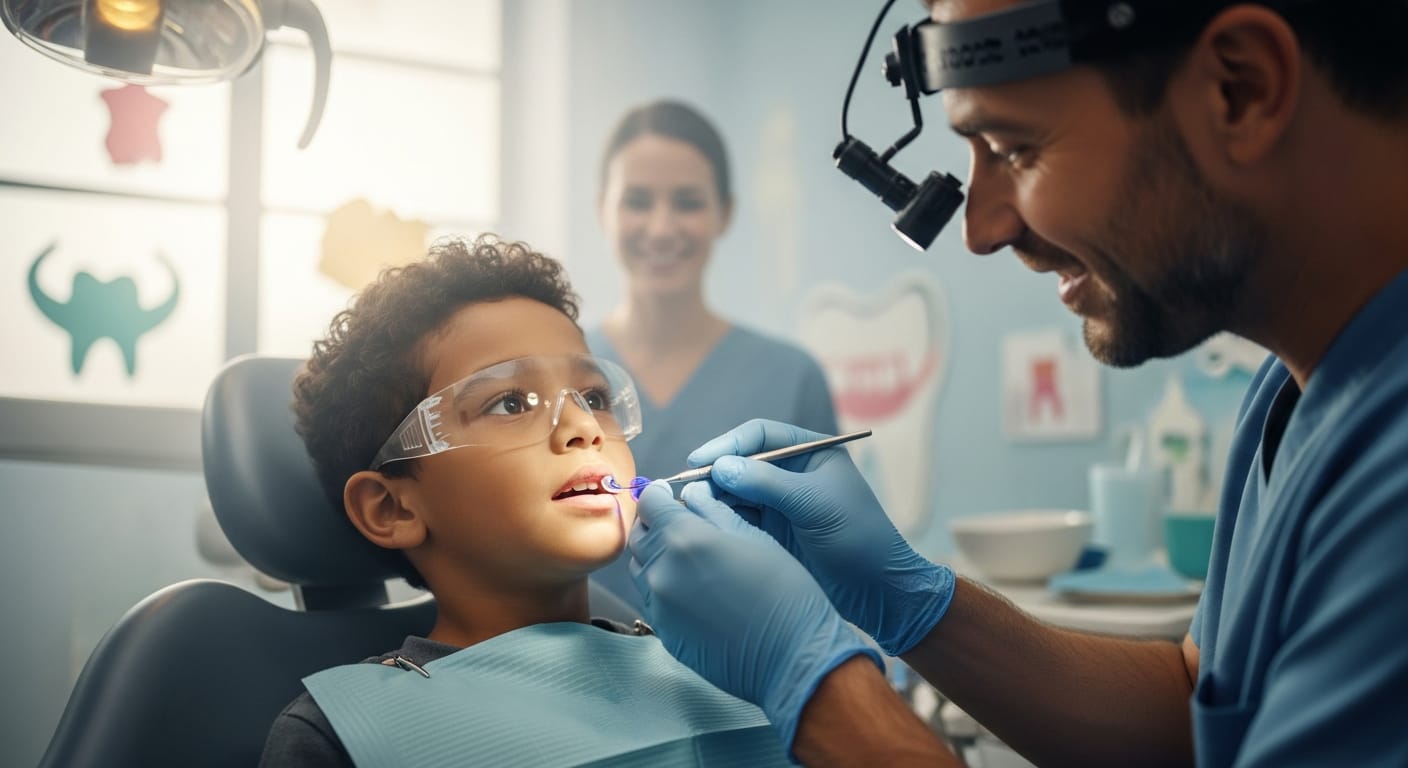
Most of the cavities I fill in kids start in the same place: the deep grooves on top of the back molars. A sealant closes those grooves off before decay gets a foothold. Below is how I decide which teeth need one, what the BPA worry is really about, how long they hold up, and what they cost here on Date Street.
The Problem Sealants Solve
Why Your Child's Back Molars Get Cavities First
Look at the top of a brand-new six-year molar under magnification and you'll see a little canyon system. The grooves, which dentists call pits and fissures, are often narrower than a single toothbrush bristle. Your child can brush perfectly and still never reach the bottom of them. Plaque sits down there, feeds on whatever sugar comes by, and the enamel softens from the inside of the groove outward.
That's why the chewing surface of a first molar is the single most common spot I find decay in kids between six and twelve. It isn't a brushing failure. It's anatomy. And new permanent molars are at their most vulnerable in the first couple of years after they come through, before the enamel has fully matured.
A sealant is a thin liquid coating flowed into those grooves and hardened in place. It turns a deep canyon into a smooth, shallow surface a toothbrush can actually clean. According to the Centers for Disease Control and Prevention, sealants placed soon after the permanent molars erupt prevent up to 80 percent of cavities for two years and keep protecting against about half of them for up to four years.
If you want the broader picture of children's care at this office, from the first visit through fluoride and space maintainers, that lives on my pediatric dentist page in Murrieta. This page goes deeper on sealants alone, because they generate more questions from parents than almost anything else I recommend for kids.
Safety
Are Dental Sealants Safe? The BPA Question, Answered Straight
The question I hear most often isn't whether sealants work. It's whether they're safe, and it almost always comes from something a parent read about BPA (bisphenol A). It's a fair thing to ask, so here's what the evidence actually says.
BPA isn't an ingredient in dental sealants. The American Dental Association reports that trace amounts can show up as a manufacturing contaminant or a breakdown by-product, and that resin materials may release exceedingly low levels for a few hours after placement. The ADA puts that exposure at less than what a person gets from breathing air or handling a store receipt, and there's no evidence of harm from BPA in dental sealants.
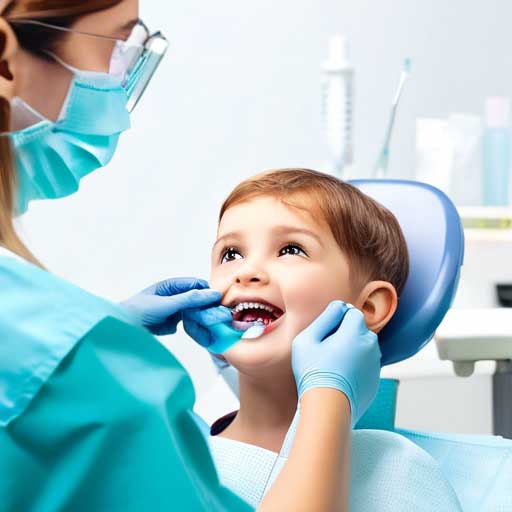
The ADA also lists a few steps that cut that brief exposure even further: a curing light that's working properly, full curing time, polishing the surface afterward, and a thorough rinse. Food and drink packaging is where nearly all of anyone's daily BPA exposure comes from, not the dental chair.
Real side effects are uncommon and minor. The bite can feel a little high for a day, which I check and adjust before your child leaves. True allergic reactions to sealant materials are very rare, and I go over your child's medical history before placing anything.
An Honest Recommendation
Does My Child Actually Need Sealants?
Not every tooth, and not every child. I'd rather tell you that up front than seal teeth that don't need it. After years of looking at molars in this chair, here's how I sort it out.
When I recommend sealing a tooth
When I'll tell you to skip it or wait
If the tooth already has a real cavity, a sealant isn't the answer. It needs a tooth-colored filling. If the molar is only halfway through the gum and I can't keep it dry, a resin sealant won't bond well, so we either wait a few months or use a temporary material. And if a child has shallow, smooth grooves and a clean cavity history, I'll sometimes say the tooth doesn't need one at all. That happens more than people expect.
The ADA's review of the research also found that sealants can stop very early, non-cavitated decay in a groove from getting worse. So a tooth with a light chalky spot is often still a good candidate. A tooth with a hole in it isn't.
What Goes on the Tooth
Resin vs. Glass Ionomer Sealants
Parents rarely ask which material is being used, but it's worth knowing there are two main families. They behave differently, and each has a job.
| Feature | Resin-based sealant | Glass ionomer sealant |
|---|---|---|
| How it sets | Hardened with a blue curing light | Sets by a chemical reaction |
| Needs a dry tooth | Yes, very dry | More forgiving of moisture |
| Releases fluoride | Little or none | Yes, more fluoride release |
| Durability | Stronger, longer-lasting | Wears faster |
| Best use | Fully erupted molars | Partly erupted molars or hard-to-isolate teeth |
For a fully erupted molar in a child who can sit still for a few minutes, a light-cured resin sealant is the durable choice. For a molar that's still coming in, or a young child who can't keep a tooth dry, a glass ionomer gives some protection now and can be replaced with resin later. The ADA and AAPD guideline didn't find enough evidence to crown one material the winner, so the choice comes down to the tooth in front of me.
What Your Child Will Feel
The Sealant Appointment, From Your Child's Side of the Chair
Nothing about a sealant hurts. There's no shot and no drill, and your child won't leave with a numb lip. The honest list of what they'll notice is short.
Cotton rolls or a little shield. The tooth has to stay dry, so something sits in the cheek for a few minutes. With wiggly six-year-olds, keeping that tooth dry is most of the skill involved.
A sour taste. The conditioning gel that helps the sealant grip tastes tart for a few seconds before it's rinsed off. Kids usually rate this as the worst part.
A blue light. A curing light hardens each sealant in well under a minute. I call it the tooth flashlight.
A slightly different bite. I check it with marking paper and smooth any high spots before your child gets up.
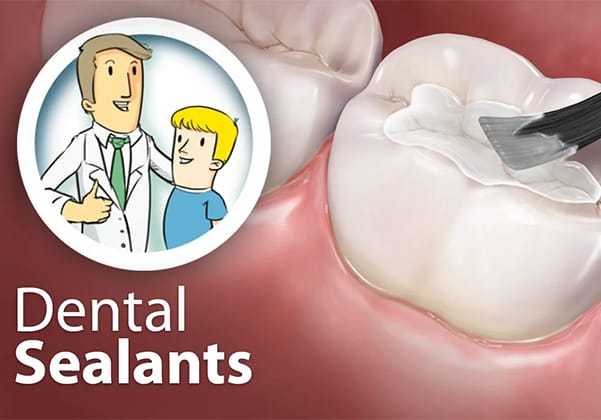
Four molars usually take less time than a cleaning, and we often do sealants at the same visit as a checkup so you're not making an extra trip from Temecula or Menifee. Your child can eat and drink normally as soon as we're done.
If your child is nervous about dental visits in general, tell us when you book. We go slowly, explain every step before it happens, and stop if they need a break. My dental anxiety page explains how I work with fearful patients of any age.
Choosing the Right Prevention
Sealants vs. Fluoride Varnish vs. Fillings
Parents sometimes ask whether fluoride can do the same job. Fluoride varnish is excellent, and I use it for kids at risk of decay, but it protects the whole tooth in a general way. It doesn't physically close the grooves. The ADA's review of three trials with close to 2,000 participants found that children who got sealants had about a 73 percent lower risk of new cavities on those chewing surfaces than children who got fluoride varnish alone.
| Question | Sealant | Fluoride varnish | Filling |
|---|---|---|---|
| When it's used | Before decay starts, or at the earliest chalky stage | Every few months for at-risk kids | After a cavity has formed |
| Protects the grooves | Yes, seals them physically | Partly, by strengthening enamel | Only the repaired area |
| Shots or drilling | None | None | Usually both |
| Removes tooth structure | No | No | Yes |
They aren't competitors. The kids who do best get sealants on the grooves, fluoride toothpaste twice a day, and varnish when their risk calls for it. A filling is what happens when prevention didn't get there in time, and once a tooth has one, it will need attention again at some point in your child's life.
After the Visit
How Long Sealants Last and How I Keep an Eye on Them
A well-placed sealant usually lasts five to ten years, according to MedlinePlus from the National Library of Medicine. They do wear, and once in a while a piece chips off, most often on a molar that was placed while it was still coming in.
I check every sealant at every checkup. If one has worn thin or lost a piece, I add material in a minute or two, and for my own patients that touch-up is usually free of charge. A worn sealant caught at a six-month visit is a non-event. One that's been missing for two years sometimes means a filling.
Call the office if you notice
- Your child says their bite feels wrong more than a day after the visit.
- You can see that a sealant is missing, or your child found a hard sliver in their mouth.
- A dark stain or a spot of discoloration appears at the edge of a sealed groove.
Sealants don't replace the basics. Cavities still form between teeth and along the gumline, where a sealant never goes. Fluoride toothpaste twice a day, flossing once your child's back teeth touch, and fewer sticky snacks between meals matter just as much. Regular professional cleanings are when I catch worn sealants early.
Transparent Pricing
What Sealants Cost at Promenade Dental Care
Sealants are priced per tooth, and what you pay depends on your plan. Rather than post a number that won't match your insurance, I give every family a written quote before any treatment, so you know the out-of-pocket figure before your child sits down.
$20
New Patient Exam & Digital X-Rays
Includes a sealant evaluation for each child
80–100%
Typical PPO Coverage
On permanent molars for children; many plans set an age limit
Quote
Per-Tooth Sealant Fee
In writing before treatment, insured or not
We accept all PPO dental plans and are in-network with Delta Dental PPO, Cigna, MetLife, Guardian, Aetna, and United Concordia. The National Institute of Dental and Craniofacial Research notes that almost all dental insurance pays for sealants, but many plans cover them only on permanent molars and only up to a certain age, often somewhere in the early-to-mid teens. We check your benefits before the visit. For families paying out of pocket, CareCredit financing is available, and the fee for sealing a tooth is a fraction of what the filling it prevents would cost.
Who Seals Your Child's Teeth
Dr. Bao Nguyen, DDS
I earned my dental degree at the UCLA School of Dentistry and spent ten years as a U.S. Navy dentist, including an Advanced Education in General Dentistry residency at Naval Hospital Camp Pendleton. A lot of my Navy patients were the kids of active-duty families who moved every few years and showed up with incomplete records. Plenty of them had six-year molars that nobody had ever sealed, and already had fillings in them by age nine. That stuck with me.
I've practiced on Date Street in Murrieta since 2010, and families come in from Temecula, Menifee, French Valley, Wildomar, and Lake Elsinore. I'm a general dentist, not a board-certified pediatric specialist. I see kids from their first tooth on, and I refer to a pediatric specialist when a child needs deep sedation or has complex medical needs.

From Our Patients
What Murrieta Families Say
These are real Google reviews from patients of the practice. They talk about the office as a whole rather than sealants specifically, which is how most people write reviews.
Absolutely love this dental office. me and my family all come for our 6months cleanings and check ups. Dr. Nguyen is super friendly to my children they even have cute stickers for the kids and little toys.
— Valeria M. • Google Review
Dr. Nguyen does a great job. He is always on time and very honest. Never has you do unnecessary treatments, just to make extra money. I love that he is a solo practitioner and runs his own shop. That keeps his overhead costs low and he knows you more personally as a patient. All my family comes to see him. Best dentist I’ve ever had.
— Tom H. • Google Review
I love coming to Promenade Dental Care. Dr. Nguyen and Edith are the best. They’re friendly and I love that I’m taken care of right away. Dr. Nguyen is thorough and efficient. He answers any questions I have and explains things clearly. I actually look forward to my biannual dentist visits now because they’re the best. Can’t recommend a dentist more!
— Kamilah C. • Google Review
Very knowledgable and good prices. Does only what is necessary. Does not just look for stuff to charge for. Got an appointment quickly when I thought it was an emergency. My favorite dentist ever!!
— Sheila O. • Google Review
Related Pages
More on Protecting Your Child's Teeth
Pediatric Dentist in Murrieta
Exams, cleanings, fluoride, space maintainers, nitrous oxide, and kids' emergencies, all in one place.
Your Child's First Dental Visit
When to come, what happens in the chair, and how to prepare a toddler for it.
$20 Exam and Digital X-Rays
The visit where I check for hidden decay and decide which teeth are worth sealing.
Tooth-Colored Fillings
What happens when a groove has already decayed, including a section on gentle fillings for kids.
Emergency Dentist in Murrieta
Same-day care for toothaches, knocked-out teeth, and broken teeth at any age.
Questions Parents Ask
Dental Sealants for Kids: Frequently Asked Questions
Is the BPA in dental sealants dangerous for my child?
No. BPA is not an ingredient in dental sealants. The American Dental Association reports that trace amounts can appear as a contaminant or by-product and may be released at exceedingly low levels for a few hours after placement, less than a person gets from breathing air or handling a receipt. There is no evidence of harm from BPA in dental sealants.
Can sealants go on baby teeth?
Yes, when a baby molar has unusually deep grooves and the child is prone to cavities. The CDC notes that sealants can be placed on baby teeth starting around age two. Most children never need them on baby teeth, so Dr. Nguyen decides tooth by tooth based on groove depth and cavity history.
Can a sealant go over a tooth that already has early decay?
Over very early decay, yes. The ADA and AAPD guideline found that sealants can stop small, non-cavitated lesions in a groove from getting worse. Once decay has broken through the enamel into an actual cavity, the tooth needs a filling instead, which is why Dr. Nguyen examines every tooth before sealing it.
Does my child need X-rays before getting sealants?
Not always on the same day, but Dr. Nguyen wants current X-rays and an exam so he is not sealing over hidden decay. New patients get both in the $20 exam with digital X-rays at the Murrieta office.
Will my child need a shot or be numbed for sealants?
No. Sealants involve no injection, no drilling, and no numbing. The tooth is cleaned, conditioned with a sour-tasting gel, painted with the sealant, and hardened with a curing light.
Can my child eat right after getting sealants?
Yes. Light-cured sealants are fully hard before your child leaves the chair, so they can eat and drink normally right away. The bite may feel slightly different for a day while they get used to it.
How long do dental sealants last on kids' teeth?
Usually five to ten years, according to MedlinePlus. Dr. Nguyen checks every sealant at each checkup and touches up any worn spots, which takes a minute or two and is usually free of charge for his own patients.
What should I do if my child's sealant comes off?
It is not an emergency. Call (951) 412-0127 and we will check the tooth at the next convenient visit. A lost sealant leaves the groove unprotected, so it is worth replacing within a few weeks rather than waiting a year.
Can people see sealants when my child smiles?
Almost never. Sealants sit only on the chewing surfaces of the back teeth, and the material is clear, white, or lightly tinted. Parents usually cannot spot them unless they look straight down onto the molars.
My child got sealants at a school program. Should you check them?
Yes. School sealant programs do valuable work, and the CDC supports them. Bring any paperwork the school sent home, and Dr. Nguyen will check those sealants at your child's exam, add any that were missed, and touch up any that did not fully bond.
Are sealants better than fluoride varnish?
For the chewing grooves, yes. The ADA reports that children who received sealants had about a 73 percent lower risk of new cavities on those surfaces than children who received fluoride varnish alone. The two work best together, since varnish protects the rest of the tooth.
Can teenagers and adults get sealants?
Yes. Teens often need sealants on second molars that come in around age twelve, and adults with deep grooves and no decay or fillings on those teeth can benefit too. Insurance coverage for adults is less common, so ask us for a written quote.
Which teeth usually get sealed?
Most often the four permanent first molars around age six and the four second molars around age twelve. Premolars with deep grooves and, occasionally, deep-grooved baby molars may also be sealed in children who are prone to cavities.
Protect Those New Molars Before a Cavity Starts
A $20 exam with digital X-rays tells you which of your child's teeth need sealants and which don't, with a written quote before anything is done.
(951) 412-0127 Contact Us Online