
Patient Guide · Murrieta, CA
Crown Lengthening in Murrieta: When Does a Tooth or a Gummy Smile Need It?
A small gum procedure that decides whether a broken tooth can be crowned, or whether it has to come out.
Most people hear the words "crown lengthening" for the first time in the chair, right after I've told them a tooth broke off at the gumline or the decay runs under the gum. The name is confusing. Nothing gets longer. I move the gum, and sometimes the edge of bone under it, so more of your own tooth is above the gumline for a crown to hold on to. It's part of the soft-tissue surgery I do in this office. This page covers when it's worth doing, when it isn't, and what the weeks afterward look like.
The Short Answer
What Is Crown Lengthening?
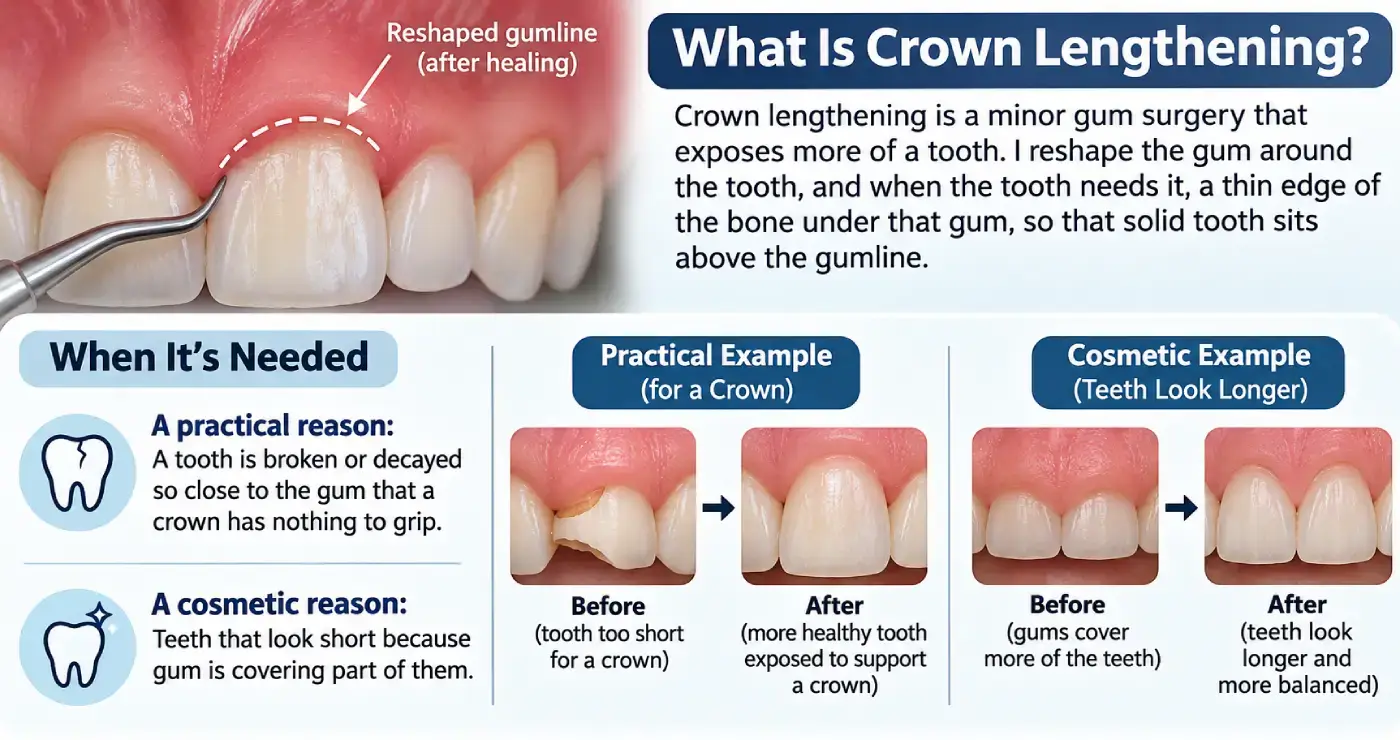
Crown lengthening is a minor gum surgery that exposes more of a tooth. I reshape the gum around the tooth, and when the tooth needs it, a thin edge of the bone under that gum, so that solid tooth sits above the gumline. It's done for two reasons. The common one is practical: a tooth is broken or decayed so close to the gum that a crown has nothing to grip. The other is cosmetic: teeth that look short because gum is covering part of them.
The "crown" in the name isn't the cap I make. It's the dental term for the part of your natural tooth that shows above the gum. A 2024 clinical review of crown lengthening splits the procedure the same way I do with patients: functional, to reach decay or a fracture below the gum, and esthetic, to change how much tooth shows.
- What it is
- Reshaping the gum, and sometimes the bone edge beneath it, to expose more of a tooth.
- Who it is for
- A tooth broken or decayed at or below the gumline that is otherwise worth saving, a tooth too short to hold a crown, and some gummy smiles.
- Who it is not for
- A tooth with a crack running down the root, a tooth with short roots or little bone left, or a gummy smile caused by the lip or the jaw.
- Who does it
- Dr. Bao Nguyen, DDS, in-office at 26957 Date St, Suite 204, under local anesthetic, with nitrous oxide available.
- Wait before the final crown
- About three months for the gum to settle, longer for front teeth. You wear a temporary in the meantime.
The Usual Reasons
Who Needs Crown Lengthening?
A crown has to end on sound tooth, and it needs a band of that tooth to wrap around. Dentists call the band a ferrule. Without it, a crown is glued to a filling instead of a tooth, and it comes off. These are the situations where I bring up crown lengthening.
The Other Half of the Decision
When Don't You Need Crown Lengthening?
This is the part I'd want to read if I were the patient. Crown lengthening saves a tooth by taking away some of the gum and bone that support it. That trade is worth making on a strong root. On a weak one, you pay for surgery, a root canal, a post, and a crown, and lose the tooth anyway a few years later.
I talk patients out of it in these cases:
- The crack runs down the root. A cracked tooth that splits below the bone can't be fixed by exposing more of it.
- The roots are short or the bone is already low. Taking more bone away leaves too little holding the tooth.
- The damage reaches the fork between the roots of a molar. Opening that area creates a spot you can't keep clean.
- The gums are swollen from gum disease. Puffy gum covering the teeth often shrinks back after gum treatment. I treat the infection first and measure again.
- The break is above the gum. Then you just need the crown, or sometimes only an onlay.
What Actually Gets Moved
Is Crown Lengthening Just Trimming the Gum?
Sometimes, but usually not, and the difference matters. Your gum attaches to the tooth in a collar a couple of millimeters tall, sitting just above the bone. The body defends that collar. If a crown edge lands inside it, the gum stays red and sore for as long as the crown is there.
So before I touch anything I measure from the edge of the damage down to the bone. When there's room, trimming gum alone is enough. When there isn't, the bone edge has to be lowered too, or the gum grows right back to where it started. Cleveland Clinic draws the same line in its patient guide to gum surgery: a gingivectomy removes gum tissue, and crown lengthening goes a step further and reshapes the bone underneath.
| Question | Gum trimming only | Crown lengthening with bone reshaping |
|---|---|---|
| When it fits | Extra gum, with bone already well below the damage | Damage close to the bone, or a gumline that has to stay where I put it |
| How it is done | Gum reshaped, often with a diode laser, no stitches | Gum lifted, bone edge smoothed back, gum stitched at the new level |
| Soreness | A few days | About a week |
| Wait before the final crown | Shorter, once the gum has healed | About three months, longer in the front |
| Chance the gum creeps back | Higher if the bone was too close | Low |
The Cosmetic Version
Can Crown Lengthening Fix a Gummy Smile?
It can fix one kind. In a lot of adults the front teeth are a normal size, but the gum never finished pulling back after the permanent teeth came in. Part of each tooth is still covered. The smile looks like small teeth and a lot of gum, and the teeth are actually fine.
For that smile, I mark a new gumline across the front teeth, match the two sides, and reshape the tissue to the line. The difference between an ordinary smile and a gummy one is usually only a few millimeters.
It won't fix the other kinds. If your upper lip lifts very high when you smile, or your upper jaw is long, the gum isn't the cause, and moving it won't change what you see in the mirror. Sorting out which kind you have is the point of the exam. If veneers are part of the plan, the gumline gets set first and the veneers are made after it settles. My cosmetic dentistry page explains how I put those steps in order.
What to Expect
What Happens During Crown Lengthening?
For one back tooth, plan on about an hour in the chair. Reshaping the gumline across several front teeth takes longer.
1How do I know the tooth is worth saving?
An X-ray shows the root length, the bone level, and how deep the damage goes. I measure the gum with a probe. If the numbers say the tooth won't last, we talk about replacing it instead.
2Will I be numb?
Yes. Local anesthetic, the same numbing you'd get for a filling. Nitrous oxide is available if you're nervous, and it's the only sedation I offer.
3What do I do to the gum and bone?
I reshape the gum to the new level. If the bone is too close to where the crown will end, I smooth a thin edge of it back so the gum has room to reattach lower on the tooth.
4Do I get stitches?
If the gum was lifted, yes, a few stitches hold it at its new height. I see you in a week or two to check the site. Gum trimming alone usually needs none.
5What covers the tooth while it heals?
A temporary crown or a core buildup protects the tooth while the gum settles. The permanent crown is made after the gumline has stopped moving.
Afterward
How Long Does Crown Lengthening Take to Heal?
The first few days are the sore ones. Ibuprofen or acetaminophen handles it for most people. Eat soft food, chew on the other side, and brush everywhere except the surgical site until I tell you otherwise. The gum looks healed in a couple of weeks.
Looking healed and being finished are different things. The gum keeps settling for months. A review in the Journal of the American Dental Association found the tissue needs at least three months to reach its final position, and it recommends waiting up to six months where the teeth show. That's why I don't rush the permanent crown. If the gum drifts after a front crown is made, you get a dark line at the edge, and the only fix is a new crown.
Plain Talk
What Are the Risks of Crown Lengthening?
It's a small surgery, and it has the risks of one: bleeding the first day, swelling, and a low chance of infection. Three others are specific to this procedure, and you should hear them before you decide.
- Sensitivity. Root surface that used to be covered is now exposed. Cold can bother it until the crown goes on.
- The tooth looks longer than its neighbors. On a back tooth nobody sees it. On a front tooth it matters, so I plan the neighboring teeth into the gumline.
- Small gaps near the gum. Lowering the gum between teeth can open a dark triangle there. The crown shape can hide some of it.
The gum can also grow partway back, mostly when it was trimmed without making room at the bone. Smoking slows all of this healing, and I'll ask you to stop for the weeks around the surgery.
Other Ways to Solve It
What Are the Alternatives to Crown Lengthening?
There are three, and I go through them at the same visit.
- Remove the tooth and replace it. A tooth extraction followed by a dental implant or a bridge. It's the better choice when the root is weak. It costs more and takes longer.
- Pull the tooth up with braces. An orthodontist can slowly move a root out of the bone so that more tooth shows. It keeps the gum and bone but takes months. I don't move teeth, so I'd refer you for it.
- Leave it and watch. Reasonable for a gummy smile that doesn't bother you. A bad idea for a broken tooth with decay under the gum, because the decay keeps going and the tooth can abscess.
Most of the teeth in this situation have had, or need, a root canal. That adds to what it costs to save the tooth, and I include it when we compare saving it with replacing it.
Money, Plainly
What Does Crown Lengthening Cost in Murrieta?
I don't publish one number for it, because the fee depends on whether bone has to be reshaped and how many teeth are involved. You get the price in writing at the exam, before anything is scheduled, along with the price of the crown that follows. A same-day crown here is $1,200 without insurance.
Promenade Dental Care is in network with all PPO dental plans, and CareCredit financing is available for qualified applicants.
Dental plans usually help pay when crown lengthening is needed to restore a tooth. Reshaping the gumline only for looks is rarely covered. My front desk checks your plan before the appointment, and the dental insurance page lists what we accept.
Who Wrote This
Who Is Dr. Bao Nguyen, DDS?

I'm a general dentist. I graduated from the UCLA School of Dentistry and spent ten years in the U.S. Navy Dental Corps, where gum surgery and crowns were part of the same day's work. In this office I do the crown lengthening and make the crown myself, so the gumline is planned by the same person who has to fit porcelain to it.
I'm conservative about it. If the tooth isn't a good bet, I'll tell you. If your case needs more than a general office should take on, such as bone reshaping across a whole smile, I'll refer you to a periodontist and build the crowns once you've healed.
Related Care
Which Pages Connect to This One?
What Other Surgery Do I Do Here?
Everything surgical I do in the office, and what I refer out.
What Crown Goes On Afterward?
The crown that goes on after the gum heals, milled in the office.
Does the Tooth Need a Root Canal First?
Often the step before crown lengthening on a badly broken tooth.
Is Your Gum Receding Instead?
The opposite problem: too little gum instead of too much.
Where Do You Start?
Where the measuring happens, and where you get the written quote.
From Our Google Reviews
What Do Patients Say About Dr. Nguyen?
★★★★★Rated 5 out of 5 stars
“Dr. Nguyen is such an amazing dentist. He is extremely honest. I thought I needed a crown after my root canal but he thought a filling was a better idea so it cost way less money than I thought it would. He got me in for a root canal at the endodontist for a bad infection/abcess I had within 2 days! Edith, his receptionist is so nice and helpful as well. Amazing dentist! Thank you both for all of your help!”
Danielle D'Souza · Google review
★★★★★Rated 5 out of 5 stars
“First visit with Dr. Nguyen, and it was a great experience! Yes, really. He kept me informed, he was accommodating, and he listens. Best experience getting a crown that I've ever had. If you're looking for a spa-like atmosphere you won't find it here, but if you need competent, quality dental care, performed using state of the art equipment, all at a reasonable price, this is the place.”
Sandy Markarian · Google review
★★★★★Rated 5 out of 5 stars
“Excellent Dentist! Dr. Nguyen never keeps me waiting. My last checkup and cleaning, I was in and out in about 20 minutes. Had a crown replaced last year and am very happy with the result. Highly recommend Dr. Nguyen!”
Kevin Wooll · Google review
★★★★★Rated 5 out of 5 stars
“The office treats you with respect and dignity. The dentist / Owner is informative and concerned with the patient and their needs. He tells the truth. No sells pitch just the right procedure advised with the patient as his prime concern. A rarity today, honesty and concern. Highly recommend. Larry Hilliard”
Larry Hilliard · Google review
Crown Lengthening FAQs
What Do Patients Ask About Crown Lengthening?
Does crown lengthening hurt?
Not during the procedure. The area is fully numb, the same as for a filling. Afterward the gum is sore for a few days, and over-the-counter pain medicine is enough for most patients.
How long after crown lengthening can I get my permanent crown?
Usually about three months, and longer for front teeth, because the gum keeps settling after it looks healed. You wear a temporary crown or a buildup in the meantime. If only gum was trimmed and no bone was reshaped, the wait is shorter.
Is crown lengthening the same as a gingivectomy?
No. A gingivectomy removes gum tissue only. Crown lengthening often reshapes the bone edge under the gum as well, which is what keeps the gum from growing back over the tooth.
Will my gums grow back after crown lengthening?
A little rebound in the first months is normal, and I plan for it. The gum growing most of the way back usually means it was trimmed without making enough room at the bone.
Will the tooth look longer than the teeth next to it?
On a back tooth, slightly, and nobody will see it. On a front tooth it would show, so the neighboring teeth are planned into the new gumline to keep the smile even.
Is it better to pull the tooth and get an implant instead?
Sometimes. If the root is short, cracked, or has little bone around it, an implant is the better long-term choice. If the root is strong, saving your own tooth usually costs less and is finished sooner.
Is crown lengthening covered by dental insurance?
Often in part, when it's needed to restore a broken or decayed tooth. Reshaping the gums only to change how a smile looks is rarely covered. The office checks your plan and gives you a written quote first.
What can I eat after crown lengthening?
Soft, cool food for the first few days: eggs, yogurt, pasta, soup that isn't hot. Chew on the other side and stay away from chips, seeds, and anything spicy until the site has closed.
Can I be sedated for crown lengthening?
Nitrous oxide (laughing gas) is available for $250 per visit, and it is the only sedation I offer. Most patients do fine with local anesthetic alone. Anyone who needs deeper sedation is referred to an office that provides it.
How long does crown lengthening take?
About an hour for a single back tooth. Reshaping the gumline across several front teeth takes longer, and I'll give you the time when we plan it.
Were You Told a Tooth Needs Crown Lengthening?
Bring the X-ray if you have one. I'll measure it and tell you whether the tooth is worth saving.
(951) 412-0127 Call Promenade Dental Care