
Patient Comfort · Murrieta, CA
Is It Going to Hurt? What to Really Expect at the Dentist
The question almost every patient thinks and almost nobody asks out loud.
I have been asked this in one form or another nearly every working day since 2010, usually by someone who has already put the appointment off for a year. The honest answer is better than most people expect. Here is what a numbing shot actually feels like, what each common procedure feels like, what soreness afterward is normal, and what to do if you are the kind of nervous that keeps you out of the chair entirely.
Start Here
Does going to the dentist hurt?
Most of the pain my patients are bracing for happened to them somewhere else, a long time ago.
For most people and most visits, no. When someone asks me whether it is going to hurt, I can usually trace the fear back to one specific appointment, and it is almost never recent. A rough extraction in the eighties. A childhood filling where the dentist started before the tooth was numb. Something a parent said in a waiting room. That memory is real, and it is also thirty years out of date.
Three things changed. Anesthetics got better and more predictable. Techniques got more conservative, so we remove less tooth and work in smaller fields. And sedation became routine rather than exotic, which means a patient who cannot get through an appointment on reassurance alone has a real option. I spent ten years in the Navy Dental Corps treating young sailors and Marines, plenty of whom had never seen a dentist and were certain it would be awful. Very few of them left thinking it had been.
The rule I work by is simple. Nothing sharp happens until the tooth is numb, I test it before I start, and you can stop me at any point without explaining yourself. Within that, what you feel during treatment is pressure, vibration, water, and noise.
The Part People Dread Most
Do dental numbing shots hurt?
Far less than you are picturing. For a lot of my patients the injection is the entire reason they asked the question in the first place, so it is worth describing honestly rather than waving it away.
A topical gel goes on the gum first and sits long enough to actually work, which is where most dentists lose people by rushing. Then the anesthetic goes in slowly. Speed is what causes the sting, not the needle. Most patients feel a brief pinch and a few seconds of pressure, and then the area goes numb and stays that way. The American Dental Association's patient guide explains how local anesthetic works: it blocks the nerves that carry pain from that part of the mouth.

What actually takes the sting out
Topical gel, given time to work. Thirty seconds of numbing gel does very little. Left in place properly, it dulls the surface enough that many patients tell me afterward they missed the needle entirely.
Slow delivery, warmed cartridge. Anesthetic is slightly acidic and cold out of the tray. Warming it and pushing it in gradually removes most of what people remember as the burn.
Somebody watching your hands, not just your tooth. Patients tense their shoulders and grip the armrests well before they say anything. That is my cue to slow down or stop. You are not supposed to be gritting through it.
What Each Visit Feels Like
What do common procedures actually feel like?

“Will it hurt” has a different answer depending on what you are in for, so here is the plain version for the procedures people ask me about most, including the two with the worst reputations.
Cleanings and Exams
Not painful for most people. You feel scaling along the gumline, a faint vibration from the ultrasonic tip, water, suction, and a gritty polish at the end. Inflamed or receded gums can be tender, and we adjust for that.
Fillings and Crowns
Done under full local anesthesia, so they register as pressure and vibration. The tooth may be cold-sensitive for a few days while it settles. A bite that feels high afterward is a two-minute adjustment, not something to live with.
Root Canals
The reputation belongs to the toothache, not the treatment. The pain comes from an inflamed nerve, and the procedure is what ends it. Numb first, pressure only, and most patients say the relief starts the same day.
Extractions
Firm pressure, rocking, and sound, but nothing sharp once you are numb. This is the procedure patients most often tell me was easier than they expected. Soreness for two to three days afterward is normal and manageable.
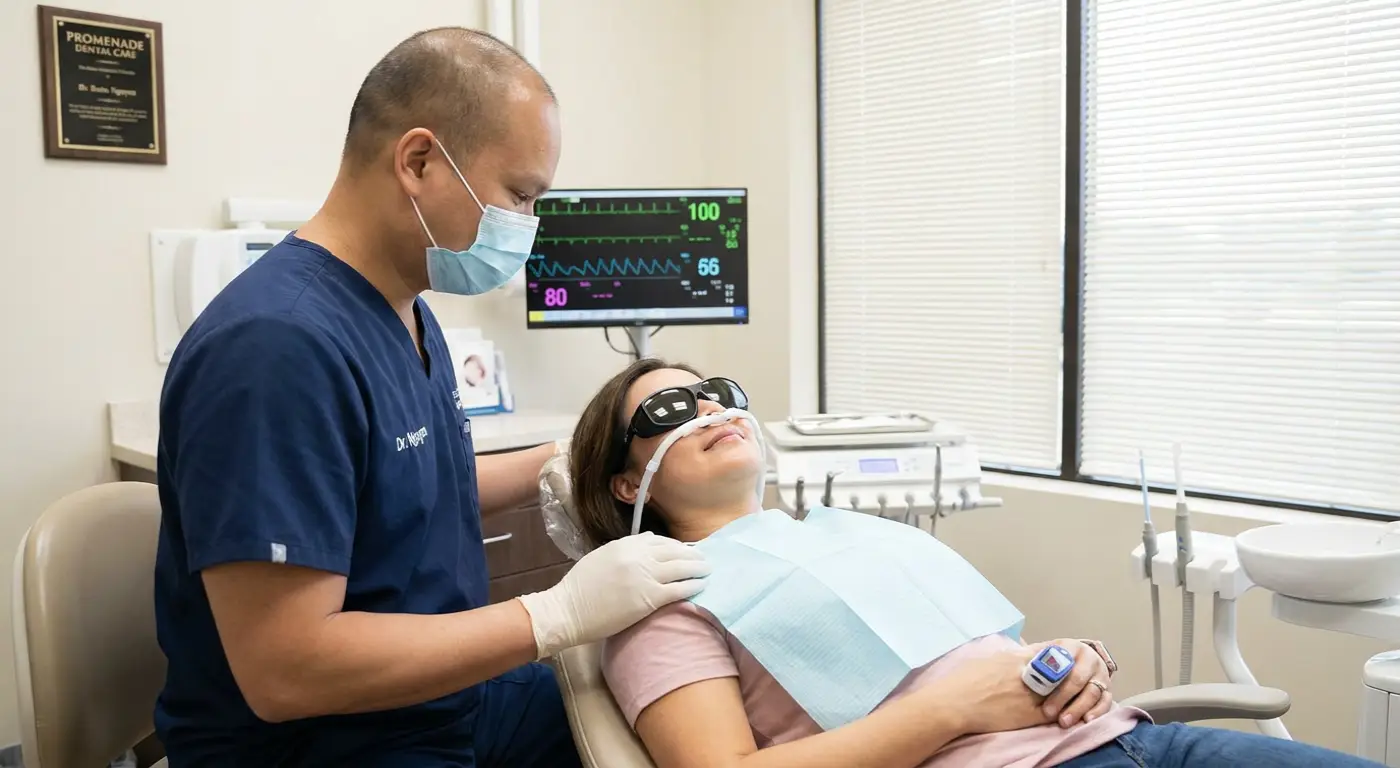
I saw doctor Bao Nguyen at Promenade Dental Care on three occasions. In these visits, Dr Nguyen took time to carefully examine my dental concerns and explained very clearly to me what my conditions are, and what treatment options available. He advised me against immediate treatments for conditions that can be improved or maintained with good oral hygiene. He was very gentle with treatments, especially with the local anaesthetic injections. Greatly appreciate his professional care. (P.S. Although we have the same surname, we are not related. I am newly relocated to the area and was looking for new dentist, happened to read other great reviews about Dr Nguyen)
— C Nguyen · Google review
After You Leave
How sore will you be once the numbing wears off?
This is the part most articles skip, and it is where patients get worried unnecessarily. The appointment itself is comfortable. Then the numbness fades, usually inside two to four hours, and the area feels tender. That is tissue that was worked on doing what tissue does. It is not a sign that something went wrong.
For most people an over-the-counter pain reliever handles it and the tenderness eases over a day or two. What is not routine is pain that climbs instead of settling, swelling that spreads, or discomfort still going strong after several days. That is worth a phone call, not a wait-and-see.

What is normal, and what to call about
Normal: tenderness at the site, brief sensitivity to hot or cold, and a numb lip or cheek for a couple of hours. Stay off that side until feeling returns so you do not bite the numb tissue, which is the single most common self-inflicted injury after an appointment. Children need watching here in particular.
Worth a call: pain that intensifies rather than fades, swelling that grows, a bite that suddenly feels high, or discomfort still there after several days. None of that means panic. It means we want to know, so call (951) 412-0127.
You Are Not Alone in This
What if fear of pain is what's stopping you?
For a good number of my patients the problem was never the procedure. It was the two weeks of dread before it. Dental anxiety is one of the biggest reasons care gets postponed, and the irony is brutal, because the appointments that genuinely are uncomfortable are almost always the ones that got delayed until a small cavity became an abscess.
Breaking that cycle is mostly about making one appointment calm enough that fear stops running the decision. Thorough numbing and an unhurried pace do most of the work. Beyond that, sedation dentistry is there for genuine phobia, a strong gag reflex, a needle fear, or a longer procedure you would rather not sit through fully aware.
Do Not Wait This One Out
When does pain mean something is actually wrong?
There is a difference between post-treatment soreness and pain that is telling you something. Throbbing that wakes you at night, sensitivity that lingers long after the hot or cold is gone, swelling in the gum or face, or a tooth that hurts to bite on usually means decay or infection has reached the nerve.
Caught at that stage it is often still a straightforward fix. Left another few months it becomes the appointment people were afraid of in the first place, and an infected tooth is also the hardest kind to get fully numb. Waiting makes both problems worse.
Set Yourself Up for an Easy Visit
How can you make your appointment more comfortable?
You have more control over how an appointment feels than most people realize. These five things make a measurable difference, and the first one matters more than the other four combined.
1Say you are nervous when you book
It changes the schedule before you arrive. We allow extra time so nothing is rushed, which is the single biggest factor in whether a visit feels gentle.
2Agree on a stop signal
A raised hand means pause, with no explanation required. Knowing the appointment stops the second you want it to removes a surprising amount of the fear.
3Ask for the play-by-play, or for none
Some patients relax when each step is described first. Others would rather not know. Both are fine, and either one is easy to accommodate if you say which you are.
4Bring headphones
The drill sounds worse than it feels, and sound is what most people are actually reacting to. A podcast or a playlist genuinely lowers how intense the whole thing registers.
5Handle small problems early
The most comfortable dentistry is the kind done before a tooth turns urgent. Regular exams and cleanings keep the difficult appointments off your calendar.
Where to Go Next
Ready to Take the First Step?
$20 Exam and X-Rays
A low-pressure first appointment. Digital X-rays, a look, and a straight answer about what your teeth actually need before anything gets scheduled.
Dental Anxiety Care
Judgment-free appointments built for people who have been avoiding the dentist. See exactly how we keep these visits calm.
Sedation Dentistry
For genuine phobia, a strong gag reflex, a needle fear, or a longer procedure you would rather not remember in detail.
Emergency Dentist
Hurting right now? Same-day care on weekdays for urgent tooth problems, and weekend emergencies by arrangement.
What Patients Say
Did it hurt? What Murrieta patients say
The practice has more than 230 Google reviews since 2010. These speak directly to comfort.
Amazing Dr. With high skills he extracted my wisdom tooth in 15 minutes no IV no broken teeth and no hassle
— Mahmoud Khairy · Google review
Very professional. Very prompt. Very polite. Very little pain. Job well done.
— Anthony Carson · Google review
I had to get a filling repaired and the Dentist was professional, fast, no pain and pleasant to chat with.
— Chris Smith · Google review
About the author
Dr. Bao Nguyen, DDS is the owner and general dentist at Promenade Dental Care in Murrieta, California. He graduated from the UCLA School of Dentistry, completed an Advanced Education in General Dentistry residency at Naval Hospital Camp Pendleton, and served ten years in the U.S. Navy Dental Corps, including deployments to Kuwait and Iraq. He has practiced in Murrieta since 2010 and sees patients in English, Spanish, and Vietnamese. More about Dr. Bao

Still Wondering Whether It Is Going to Hurt?
The fastest way to put the question to rest is one low-pressure appointment. A $20 exam with digital X-rays, an honest answer about your teeth, and a pace you set.
(951) 412-0127 See How We Help Nervous PatientsCommon Questions
What else do people ask about dental pain?
How long does dental numbing last, and will I be sore afterward?
Numbness normally fades in two to four hours, and longer-acting anesthetic used for surgery can last six to eight. As feeling returns, mild soreness or tenderness at the treated site for a day or two is normal and usually responds to an over-the-counter pain reliever. Pain that is severe, getting worse, or still there after several days should be reported to the office at (951) 412-0127.
What does a dental cleaning feel like?
A routine cleaning is not painful for most people. You feel scaling along the gumline, a faint high-pitched vibration from the ultrasonic tip, water and suction, then a gritty polish at the end. Gums that are inflamed or receded can be tender, so tell us before the cleaning starts and it gets adjusted, including numbing gel if you want it.
Will a filling or a crown hurt?
Neither procedure begins until the tooth is numb and tested, so a filling or a same-day crown appointment is felt as pressure and vibration rather than pain. For a few days afterward the tooth can be sensitive to cold or to biting while it settles, which almost always fades on its own. Call Promenade Dental Care in Murrieta if the sensitivity lingers or the bite feels high, because a bite that is a fraction of a millimeter tall is an easy adjustment.
Does a root canal hurt?
A root canal has a worse reputation than it deserves. The pain people associate with it comes from the infected nerve before treatment, not from the treatment itself, and the procedure is what relieves it. The tooth is fully anesthetized first, so most patients feel pressure and nothing sharp. An abscessed tooth sometimes needs extra anesthetic or antibiotics first to get profoundly numb, and Dr. Bao Nguyen will tell you if that is the case.
Does having a tooth pulled hurt?
Once the area is numb, an extraction is felt as firm pressure, rocking, and sound, not sharp pain. Patients regularly say afterward that it was easier than they had imagined. Expect soreness for two to three days as the site heals, managed with an over-the-counter pain reliever and the aftercare instructions you leave with. Sedation dentistry is available at Promenade Dental Care for wisdom teeth or for anyone who would rather not be fully aware of it.
What if I am terrified of the dentist or afraid of needles?
Say so when you book, and say it again when you sit down. Promenade Dental Care in Murrieta schedules extra time for anxious patients, explains each step before it happens, and stops the moment you ask. For fear that does not respond to reassurance, a strong gag reflex, or a needle phobia, sedation dentistry keeps you relaxed and comfortable through the appointment. Call (951) 412-0127 and tell the front desk you are nervous.
What should I do if I feel something during a procedure?
Raise your hand. Nothing in dentistry needs to be endured in silence, and a raised hand tells Dr. Bao Nguyen to stop immediately so more anesthetic can be added or the pace can change. Waiting and hoping it passes is what turns a manageable moment into a bad memory. Knowing you can stop the appointment at any second is one of the main reasons a modern visit stays comfortable.
Why did the numbing not work for me last time?
It happens, and it is not imaginary. An actively infected tooth sits in acidic tissue that resists local anesthetic, some people have nerve anatomy that a standard injection misses, and high anxiety genuinely lowers pain tolerance. The answer is a different injection technique, a supplemental block, more time, or treating the infection first. Tell Promenade Dental Care that numbing has failed for you before, because it changes how the appointment is planned.