
Bridge vs. Partial Denture · Murrieta, CA
Dental Bridge or Partial Denture: Which Is Better for Your Missing Teeth?
For one to three missing teeth in a row with sturdy teeth on both sides, a fixed bridge usually wins. A removable partial is the better call when the gaps are scattered, when there’s no tooth behind the gap to anchor a bridge, or when the cost up front has to stay low.
I’m Dr. Bao Nguyen, and I plan and fit both at my Date Street office in Murrieta. Neither one is right for everybody. The teeth next to your gap usually settle the question before your budget does, and a $20 exam with digital X-rays shows which side of the line you’re on.
Plain English
What’s the actual difference between a bridge and a partial denture?
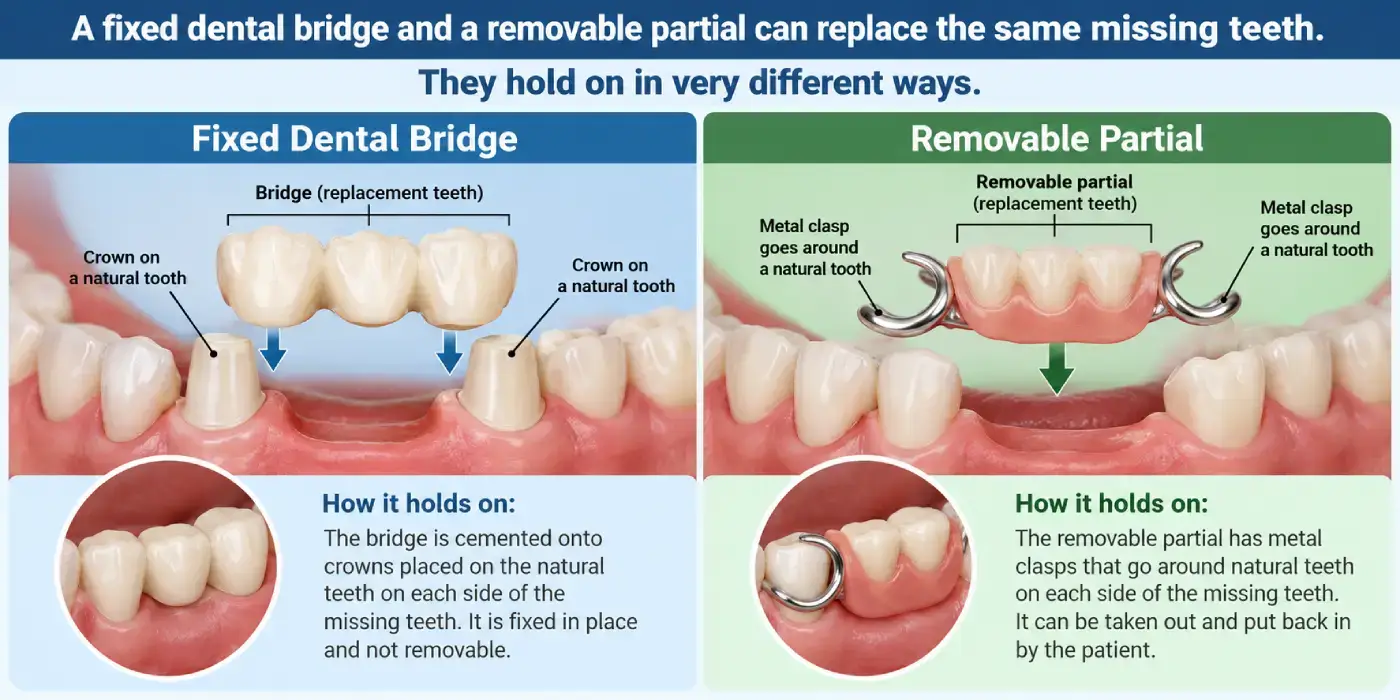
Both replace teeth you’ve lost. The difference is how they hold on, and who takes them out.
A bridge is fixed. I shape the teeth on each side of the gap, and a lab builds crowns for those two teeth with a replacement tooth joined between them. Dentists call the anchor teeth abutments and the replacement tooth a pontic. Once it’s cemented, it stays put until a dentist removes it. The Cleveland Clinic’s guide to dental bridges notes that most bridges replace one to three teeth in a row.
A partial denture is removable. It’s a set of replacement teeth on a gum-colored base, held in place by small clasps that hook around teeth you still have. You take it out to rinse it after meals and to sleep. The sturdy version sits on a thin cast-metal framework. Flexible resin partials hide their clasps better, and an acrylic “flipper” is the light, temporary kind.
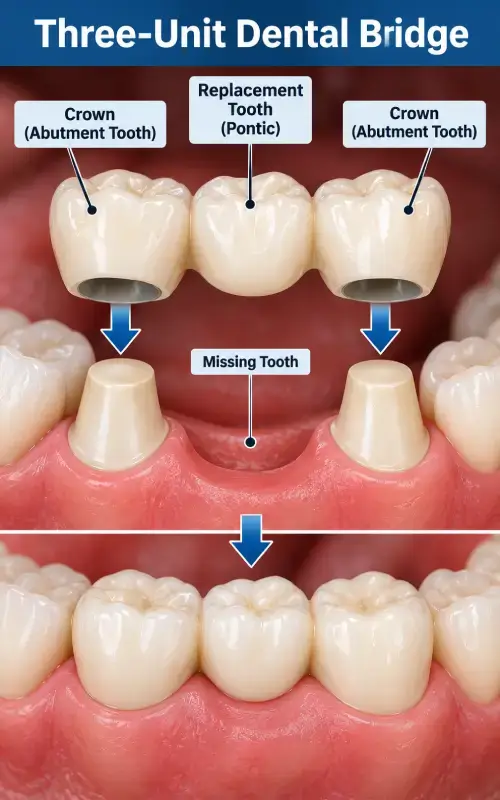
- How a bridge holds on
- Crowns cemented onto the teeth on both sides of the gap
- How a partial holds on
- Clasps on your remaining teeth, plus the gums underneath
- Who removes it
- A bridge, only a dentist. A partial, you, every day.
- Gaps it can fill
- One bridge per gap. One partial can fill several gaps on the same arch.
- Who makes it
- A dental lab, built from the impressions and bite record I take in the office
Side by Side
How do a bridge and a partial compare, line by line?
This is the table I sketch for patients in the chair. A check mark goes to the option with the edge on that row. Where neither one has a clear edge, the cell stays plain.
| Factor | Fixed bridge | Removable partial |
|---|---|---|
| Stability when you chew | Doesn’t move. You chew on it like your own teeth. | Can shift a little with sticky or hard food |
| Cost up front | Higher. Two crowns plus each replacement tooth. | Lower, especially when several teeth are missing |
| Teeth next to the gap | Reshaped for crowns, which can’t be undone | Usually left as they are; the clasps hook around them |
| Gaps in more than one spot | One bridge for each gap | One appliance can fill them all |
| How long it lasts | Often 10 to 15 years with good care | Around seven to 10 years, with relines along the way |
| Daily cleaning | Floss threader or water flosser under the replacement tooth | Take it out, brush it, and brush the teeth it clasps |
| Bone under the gap | Keeps shrinking; the bridge spans it | Keeps shrinking, which slowly loosens the fit |
| Time to finish | Two visits, two to three weeks apart | Several visits over a few weeks, with a try-in |
Those lifespans come from long-term follow-up, not brochures. In a systematic review of conventional bridges published in Clinical Oral Implants Research, about 89% were still in place after ten years, and about 2.6% had been lost to decay at an anchor tooth over that time. The Cleveland Clinic’s overview of dentures puts the average denture’s life at seven to 10 years.
Neither one replaces the root, so neither one keeps the bone. If that matters to you, an implant belongs in the comparison too, and my bridge vs. implant page goes through that one line by line.
The Case for a Bridge
When is a fixed bridge the better choice?
A bridge is the stronger pick when the gap is short and the teeth on both sides can carry it. These are the situations where I usually steer people toward one.
The second point is the one I lean on hardest. If those neighbors are going to need crowns anyway, using them to hold a bridge costs you very little you weren’t already going to spend. If they’ve never had a filling, grinding them down is a real cost that never shows up on the bill. In that case I’ll put an implant or a partial on the quote next to the bridge so you can see the trade for yourself. The kinds of bridges I make, including Maryland bridges for single front teeth, are on my dental bridges page.
The Case for a Partial
When is a removable partial the better choice?
A partial earns its place when a bridge just doesn’t fit the mouth in front of me, or when the budget has to come first.
- Teeth are missing in more than one spot on the same arch. One partial can fill three gaps; bridges would take three separate jobs.
- The last tooth in the row is gone, so there’s nothing behind the gap to anchor a bridge. A cantilever bridge can hang off one side, but it isn’t as strong as a bridge with an anchor at each end, and at the back of the mouth that matters.
- The teeth next to the gap are healthy and untouched, and you’d rather not have them cut down.
- More teeth may be lost over the next few years. A partial can often be added to; a bridge usually has to be remade.
- You need something affordable now and may move to implants later.

The three kinds of partials I make, and what goes into building one that fits, are on my custom dentures page.
Decision Boundaries
When shouldn’t you get either one yet?
A few situations call for waiting, or for something else entirely. I’ll tell you if you’re in one of them.
- Your gums bleed or the pockets are deep. A bridge is only as strong as the teeth carrying it, and a partial clasps onto teeth that gum disease is already loosening. I treat the gums first. My gum disease treatment page explains how.
- The tooth can still be saved. If the tooth you’re about to lose can be kept with a root canal and a crown, that almost always beats replacing it with anything.
- The extraction site is fresh. Gum and bone keep changing shape for a few months after a tooth comes out. A final bridge or partial made too early is built to the old shape, so a temporary flipper usually covers the gap while it heals.
- The only gap is a back molar with nothing biting against it. If the tooth above it is gone too and your bite is stable, replacing it may not buy you much. That’s a conversation, not an automatic yes.
- Keeping the bone is your priority. Neither a bridge nor a partial does anything for the bone under the gap. A single dental implant does.
I’d rather tell you to wait three months than build something on teeth or gums that won’t hold it.
How I Decide
How does Dr. Nguyen decide which one fits your mouth?
The answer comes from the exam, not the brochure. Here’s what I look at, in the order I look at it.
1Are the gums and bone healthy?
Digital X-rays and a gum check come first. Bleeding gums or bone loss around the anchor teeth change the plan before we talk about anything else.
2Can the teeth beside the gap carry a load?
I check each neighbor for decay, cracks, old fillings, and how much root it has in the bone. A strong tooth with a big filling makes a good bridge anchor. A weak one may be better left out of the plan.
3How many gaps are there, and where?
One gap with a tooth at each end points toward a bridge. Gaps on both sides of the arch, or a missing last tooth, point toward a partial.
4What do you want to live with?
Some people never want to take teeth out at night. Others want the lowest cost now and an implant later. Both are fair, and I write the quote around what you tell me.
That order is a habit from my training. Ten years as a Navy dentist, including the AEGD residency at Naval Hospital Camp Pendleton, taught me to plan from what a mouth can actually support. The easiest thing to sell doesn’t come into it.
What Happens
What happens at the appointments for each one?
What are the steps for a bridge?
- An exam with digital X-rays, $20 for new patients, so we know the anchor teeth and gums are ready.
- Visit one: I numb the area, shape the two anchor teeth, take impressions, and fit a temporary bridge you wear home.
- Two to three weeks later: the temporary comes off, I check the lab’s bridge for fit, bite, and shade, and then cement it.
What are the steps for a partial?
- The same $20 exam, plus any fillings or gum care the clasped teeth need before anything is built on them.
- Impressions and a bite record go to the lab with the shade we pick together.
- A try-in visit, so you see and feel the teeth before the final partial is finished.
- Delivery, then one or two short visits in the first couple of weeks to ease any sore spots.
A partial usually takes several weeks from impressions to delivery, because the lab builds the framework and the teeth in stages. If a tooth has to come out first, I plan the replacement before the extraction so you know the whole sequence, and the whole cost, up front. My tooth extraction page covers that part.
Cost and Insurance
What does each one cost, and how does insurance treat them?
I don’t post a flat price for either one, because the number depends on how many teeth are missing, which materials fit your mouth, and what the anchor teeth need first. What I will do is put both options on one written quote after the exam, before you commit to anything.
$20
New-patient exam
Digital X-rays included, without insurance
1 quote
Bridge and partial, side by side
In writing, after the exam, no pressure to decide that day
Up front, a partial almost always costs less than bridges replacing the same teeth, and the gap widens when teeth are missing in more than one spot. Over the years the math can flip, because a bridge often lasts longer and a partial needs relines as the gums shrink. I show you both the day-one cost and a rough cost per year of use.
How does dental insurance cover a bridge or a partial?
Most PPO plans treat both as major restorative work and pay a share after the deductible. We’re in network with all PPO dental plans, including Delta Dental PPO, Delta Dental Premier, Cigna, MetLife, Guardian, Aetna, and United Concordia. We accept only some DeltaCare USA plans, so call with your member ID to check yours, and we don’t take Medi-Cal. Ask us to look for a missing-tooth clause too, since some plans won’t pay to replace a tooth lost before your coverage started. My dental insurance page has the details, and CareCredit is available if you’d rather spread the cost out.
Honest Downsides
What are the downsides of a bridge and a partial?
A bridge: the anchor teeth are reshaped for good. Decay can start where a crown meets the tooth, and if one anchor fails, the whole bridge usually comes off with it. Food and plaque collect under the replacement tooth unless you clean there every day.
A partial: it moves a little, more on the lower jaw than the upper. A clasp near the front can show. Food slips under the base. The teeth it hooks onto take extra load and collect plaque around the clasps, so they need careful brushing. As the gum ridge shrinks, the fit loosens and it needs a reline. And some people never get used to taking teeth out at night.
Neither one stops the bone under the gap from shrinking. That’s the main reason I bring implants into the conversation even when they aren’t the plan.
Living With It
What is daily life like with a bridge versus a partial?
- The first week
- With a bridge, the anchor teeth can be sensitive to cold for a few days. With a partial, expect a fuller feeling, a slight lisp at first, and a sore spot or two that I adjust.
- Eating
- A bridge chews normally once it’s cemented. With a partial, start with softer food cut small and give it a couple of weeks.
- Cleaning
- For a bridge, brush, then clean under the replacement tooth with a floss threader or water flosser. For a partial, take it out after meals, brush it with a denture brush, and brush the teeth it hooks onto.
- At night
- A bridge needs nothing. A partial comes out, and the Cleveland Clinic recommends at least eight hours a day without a denture in.
- Checkups
- Both need regular cleanings and exams, so decay around a crown edge or a clasp gets caught while it’s small.
Who Plans Your Treatment
Who is Dr. Bao Nguyen?
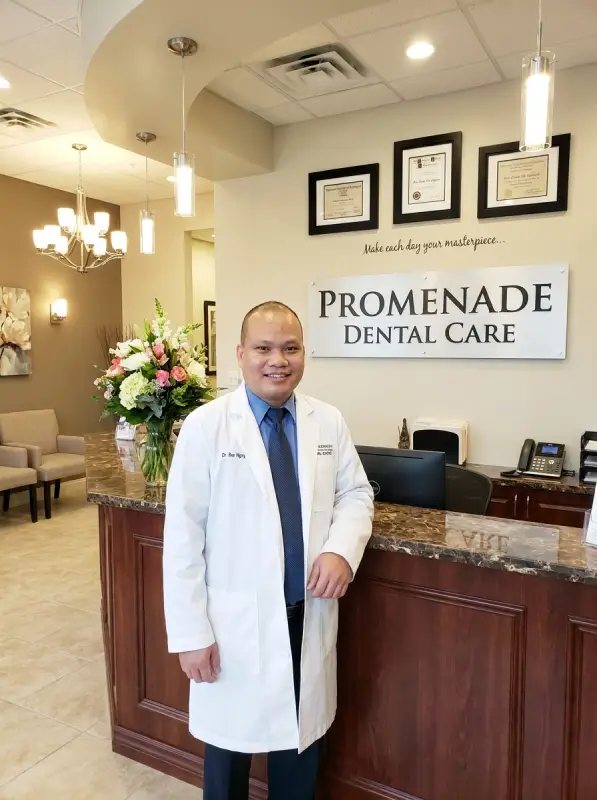
I’m a general dentist, and I’ve run Promenade Dental Care since 2010. Today the office is on Date Street in Murrieta, behind the Aldi at Murrieta Hot Springs and Winchester. I trained at the UCLA School of Dentistry and spent ten years as a U.S. Navy dentist, including the Advanced Education in General Dentistry residency at Naval Hospital Camp Pendleton and deployments to Kuwait and Iraq.
Bridges, partials, crowns, and single implants are all part of my week, so I have no reason to push one over another. I’m a member of the American Dental Association, the California Dental Association, and the Tri-County Dental Society, and I take about 40 hours of continuing education a year. My office speaks English, Spanish, and Vietnamese, and patients come from Murrieta, Temecula, French Valley, Menifee, Wildomar, and Lake Elsinore.
- License
- California dentist license 49164, verifiable with the California Department of Consumer Affairs
- Education
- DDS, UCLA School of Dentistry; AEGD residency, Naval Hospital Camp Pendleton
- Office
- 26957 Date St, Suite 204, Murrieta, CA 92563
From Our Google Reviews
What do patients say about straight answers on replacing teeth?
These are real Google reviews, copied word for word.
“Great service and skilled dentist and staff Made the entire process easy and quick. Excellent work on a bridge Dr. Nguyen did for me incredibly happy with the work.”
Victor Mora · Google review
“$20 for a second opinion. The other dentist said, I needed implants new bridges for thousands of dollars. I wanted a second opinion and found this great guy. He saved me so much money! Very nice dentist.”
Brenda Carter · Google review
“Great service, appreciated being seen immediately for a broken tooth, having no dental insurance, was relieved to be offered options that would work within my budget.”
Laurie Nunnally · Google review
“Since starting with Promenade Dental Care I have had cleanings, fillings, teeth replaced, root canal and crown replacement yesterday. I have never gone to a more gentle caring dentist. Love my dentist!”
Lucille Leake · Google review
“I had a really great experience at Promenade Dental Care. The doctor took the time to explain everything clearly, showed me exactly what was going on, and made sure I understood the treatment plan without making me feel rushed or pressured. I need quite a bit of dental work, so I was honestly expecting the cost to be overwhelming, but the pricing was beyond affordable compared to other quotes I’ve received. That alone was such a huge relief. I felt comfortable, informed, and confident in the plan, and I will absolutely be completing my treatment here. I’m very happy I found this office and would definitely recommend them to anyone looking for a dentist who is thorough, honest, and reasonably priced”
Courtney Sussman · Google review
More Questions
What else do patients ask about bridges and partials?
Can one bridge replace teeth missing on both sides of my mouth?
No. A bridge spans one gap, between the teeth at each end of it. If you’re missing teeth on the left and the right of the same arch, that’s two bridges and four crowned anchor teeth. One partial denture can fill both gaps with a single appliance, which is a big part of why partials cost less when the gaps are spread out.
Will a partial denture loosen the teeth it hooks onto?
It can, if the design or the cleaning isn’t right. The clasped teeth carry part of the chewing load, and plaque builds up around the clasps. A partial built on a proper framework, resting on the teeth and not just the gums, spreads that load, and brushing around the clasps every day keeps those teeth healthy. I check them at every visit, because they’re the reason the partial works at all.
Is a flipper the same thing as a partial denture?
A flipper is a partial, just the lightest and least expensive kind. It’s a thin acrylic plate carrying one or more replacement teeth, held by small wire clasps or a snug fit. It works best as a stopgap, for example while an extraction site heals before a bridge or implant. It isn’t built for years of chewing the way a cast-metal partial is.
Can I switch from a partial to a bridge later?
Often, yes. If the teeth on both sides of the gap stay healthy, a bridge can replace the partial down the road. The longer a gap sits empty, the more the gum and bone shrink under it, so the bridge’s replacement tooth may need to be shaped a little longer to look natural. Wearing the partial in the meantime keeps the neighboring teeth from drifting into the space, which keeps that option open.
Which one looks more natural, a bridge or a partial?
In the front of the mouth, a bridge usually does. Nothing shows but teeth, and the replacement tooth is matched to the shade of the teeth around it. A partial can look very good too, but a metal clasp near the front may show when you smile. A flexible partial uses gum-colored clasps that hide better, though it’s bulkier and harder to adjust later.
What happens if a tooth holding my bridge or partial has to come out?
With a bridge, losing an anchor tooth usually means the bridge comes off and the area needs a new plan, often a longer bridge, an implant, or a partial. A partial is more forgiving. Depending on its design, a lost tooth can often be added to the partial you already have instead of starting over. That’s one reason I suggest a partial when more teeth are likely to be lost in the next few years.
Do I have to take a partial denture out every night?
Yes. Take it out at night, brush it, and keep it in water or a denture solution so it doesn’t dry out. The Cleveland Clinic recommends giving your gums at least eight hours a day without a denture, and the teeth it clasps onto get a break too. If you grind your teeth at night, tell me, because that changes what I recommend for you.
How long after an extraction should I wait for a bridge or partial?
Usually a few months. The gum and bone keep reshaping after a tooth comes out, and a bridge or partial made too soon can leave a gap underneath once healing finishes. Most people wear a temporary flipper in the meantime so they’re never without a front tooth. If the tooth hasn’t come out yet, I plan the replacement before the extraction so you know the full sequence and cost.
Want to know which one your mouth can actually support?
Start with a $20 exam and digital X-rays. You’ll leave with a written quote for a bridge, a partial, and any other option that fits, with no pressure to decide that day.
(951) 412-0127Promenade Dental Care · Dr. Bao Nguyen, DDS
26957 Date St, Suite 204, Murrieta, CA 92563
Mon, Tue, Wed, Thu, Fri 8:00 AM–3:00 PM · Saturday by appointment and emergencies
Serving Murrieta, Temecula, French Valley, Menifee, Wildomar, Winchester, Lake Elsinore, and Canyon Lake