
Tori Removal in Murrieta: When That Hard Bump on Your Jaw or Palate Needs to Go
The hard knot your tongue found is almost always harmless bone. Here is how I confirm it, and when it should come out.
A torus is a lump of dense, completely normal bone that your own jaw built slowly over decades. Most need nothing but a note in your chart. Some stand between you and a denture that fits, or keep getting cut by tortilla chips. I examine, diagnose, and remove tori here on Date Street, and I will tell you plainly which kind yours is before any surgery is on the table.
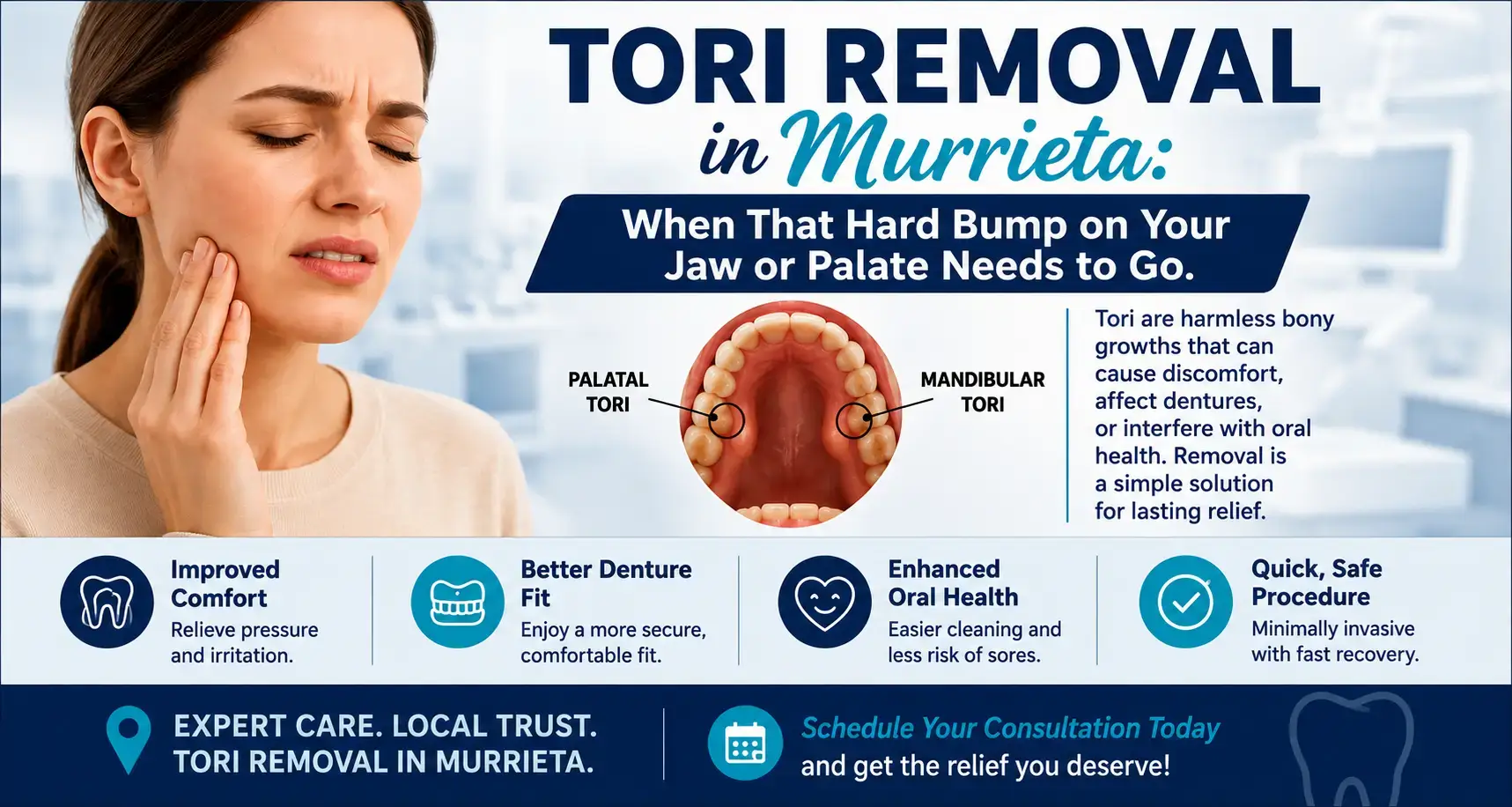
What That Hard Bump Actually Is
It usually happens at night. Your tongue wanders where it has wandered ten thousand times before and suddenly registers something it never noticed: a hard knot on the inside of your lower jaw, or a bony ridge running down the roof of your mouth. It does not hurt. It does not move. By midnight you have searched your way into a panic, and by morning you are calling my office asking about a tumor.
I take those calls seriously every time, because once in a while a lump in the mouth really is trouble. But the overwhelming majority of the time, what the tongue found is a torus: a lump of dense, completely normal bone that your own jaw built, slowly, over decades. You did not develop it last week. You discovered it last week. Those are very different things.
A torus is extra cortical bone, the same hard material that makes up the rest of your jaw, deposited in a spot where it serves no purpose and does no harm. On the lower jaw, tori form on the tongue side, usually near the premolars, and the Cleveland Clinic notes they show up on both sides at once in the great majority of people who have them. On the palate, a torus sits right on the midline, and it is more common than most people would ever guess. Cleveland Clinic clinicians put palatal tori at roughly one in five Americans, with jaw tori closer to six percent.
Why does a jaw build bone it does not need? Partly inheritance, which is why tori run in families. Partly mechanical stress. A large share of the tori I see belong to clenchers and grinders, and the connection makes sense: bone responds to force the way skin responds to friction. Work a spot hard enough for long enough and the body reinforces it. A torus is closer to a callus than to a disease.
Two more things worth knowing. Tori grow at a geological pace, which is why so many people carry them for thirty years without noticing. And they are not cancer, they do not turn into cancer, and having one does not raise your risk of anything.
How I Tell a Torus From Something That Needs a Biopsy
This is the question underneath the midnight search, so let me answer it directly. A torus announces itself:
Please do not try to make this call yourself from photos on a screen. The internet showed you a hundred lumps last night and told you nothing about yours. Looking at yours takes me about five minutes.
Most Tori Get to Stay
Now the part patients do not expect a dentist to say: if your torus is not causing a problem, I am not going to touch it, and neither should anyone else. There is no preventive argument for removing one. It is not a ticking anything. We note it in your chart, we glance at it at your cleanings, and that is the whole treatment plan for most people, forever.
When Removal Earns Its Keep
There are honest reasons to take tori out, and dentures top the list. When a torus makes itself a daily nuisance, surgery stops being optional cosmetics and becomes practical dentistry.
Dentures and partials
A lower partial or full denture rests exactly where jaw tori live, and bone does not compress. The appliance rocks on the high spot, rubs the thin tissue raw, and no amount of adjusting the acrylic fixes a foundation problem. If dentures are in your future, removing the tori first is often the difference between an appliance you wear and one that lives in a drawer.
Cuts that keep coming back
Tori covered by thin tissue get cut by tortilla chips and crusty bread, and those scrapes heal slowly because there is bone right under the wound. When the same spot is raw every other week, removing the bump ends the cycle.
Speech, night guards, and appliances
Large palatal tori can interfere with speech, catch food, or complicate the fit of a night guard or sleep apnea appliance. An appliance that cannot seat cannot work.
Daily nuisance
Some patients cannot tolerate X-ray sensors because the sensor presses straight into the bump. Others are simply tired of the tongue finding it. Quality of life is a legitimate indication.
What Removal Involves
Removal is done right here under local anesthetic, with nitrous oxide or oral sedation if you want it. I open the tissue over the growth, remove the excess bone, smooth what remains flush with the natural contour of the jaw, and close with dissolving stitches. Both sides of the lower jaw are handled in one sitting. For the palate, I often make a thin acrylic stent ahead of time that snaps over the roof of the mouth afterward, protecting the site the way a bandage would anywhere else.
The first week is more annoying than painful. Your tongue insists on visiting the surgical site, everything you eat should be soft, and the area feels bruised. Most people are comfortable within a few days and fully healed in three to four weeks. Can tori return? Slowly, over years, and mostly in patients who keep grinding, which is why I usually pair removal with a night guard. Address the force and the bone has no reason to rebuild.
Cost, and an Honest Conversation First
Fees depend on how many tori are involved and how large they have grown, so the number comes after the $20 exam with digital X-rays, in writing, with the insurance picture spelled out. When removal is needed to make a denture or partial fit, most PPO plans recognize it as a covered surgical procedure. And if your torus is small and silent, expect me to talk you out of surgery rather than into it. That is not modesty. It is just the correct answer.
The Same Chair, the Same Hands
Bone contouring like this is bread-and-butter work from my ten years as a Navy dentist, and it belongs to the same in-office surgical scope that covers extractions, grafting, and biopsies here on Date Street. Patients drive in from Murrieta, Temecula, Menifee, and Fallbrook, and the dentist who examines the bump is the same one who removes it, checks the healing, and fits the denture or night guard that comes after.
Found something hard in your mouth that was not there before, or was it? Come let me look at it. Five minutes of examination beats five hours of searching, every single time.
Questions Patients Ask About Tori
Is a torus cancer, or can it become cancer?
No and no. A torus is normal, dense bone in an unusual spot. It does not transform into anything. What matters is confirming the lump actually is a torus, which is a quick clinical call, and taking a biopsy in the rare case where something about it does not fit the pattern.
Why is mine getting bigger?
Tori enlarge very slowly, and clenching or grinding is the usual accelerant. If yours seems to be growing, I want to see it, partly to compare against your records and partly because active grinding is worth treating for a dozen reasons beyond the torus.
Do tori have to come out before dentures?
Lower tori usually do, because the denture base sits directly on them. Small palatal tori can often be worked around with a modified denture design. I make that call case by case during denture planning, not as a blanket rule.
What does recovery feel like?
A bruised jaw and an opinionated tongue for about a week, managed with over-the-counter medication and soft food. Stitches dissolve on their own, tissue closes over in three to four weeks, and the spot your tongue kept finding simply is not there anymore.
Let Me Look at That Bump
Whether it turns out to be a harmless torus, a lump that needs a biopsy, or a piece of bone standing between you and a denture that fits, the path is the same: a $20 exam with digital X-rays, a plain-language answer, and a written plan only if you actually need one.