
Gum Disease and Recession Have to Be Treated Before Veneers
Why Dr. Bao Nguyen, DDS will not bond porcelain over gums that are still moving, and a five-minute mirror check to see where yours stand
The veneers guide covers this rule in one line. This is the full version: what happens to a veneer placed over inflamed or receding gums, how the sequence at Promenade Dental Care actually runs, how long the detour usually takes, and how to check your own gumline tonight before you book anything.
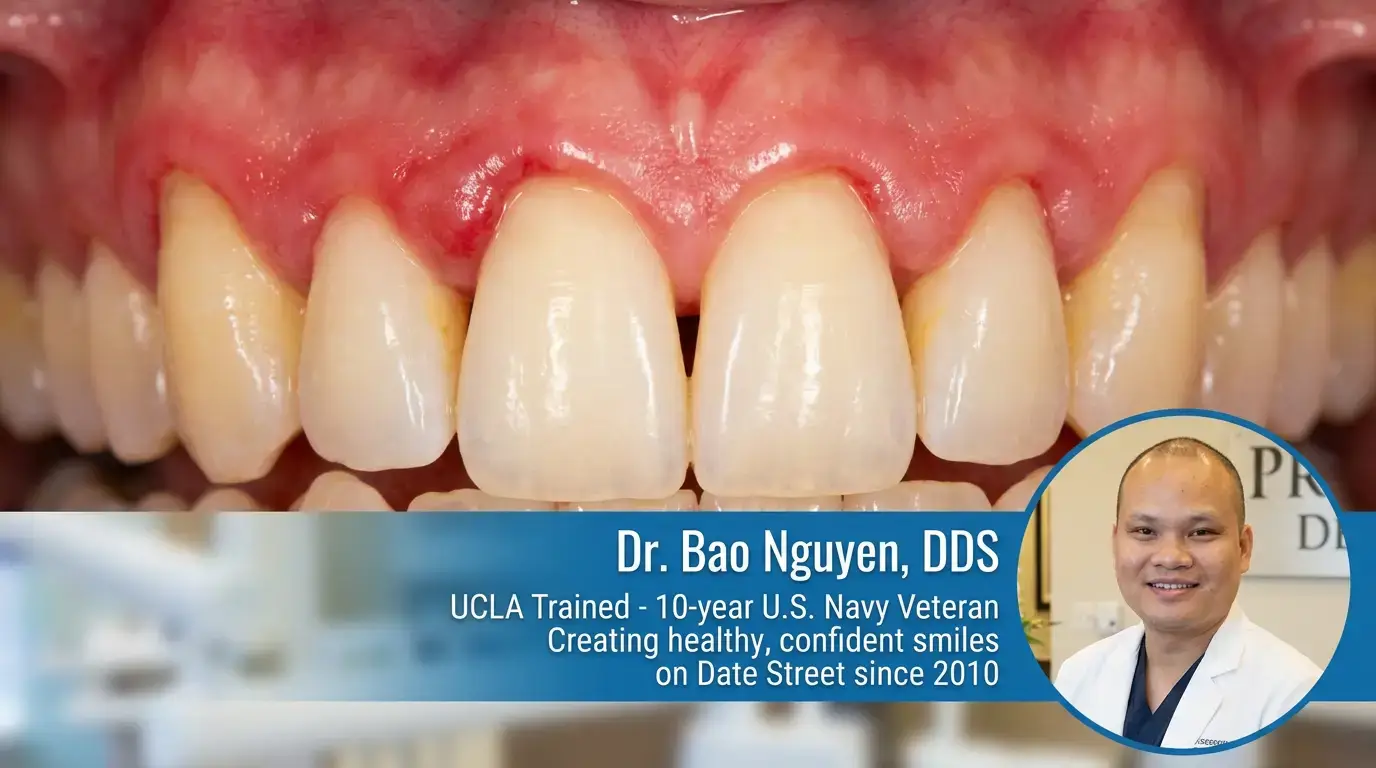
If you read the candidacy section of the Murrieta dental veneers page, you saw gum disease and bone loss on the short list of things that put veneers on hold. It gets one line there because that page has a lot of ground to cover. It gets a full article here because it is the candidacy rule that catches people off guard: you come in ready to talk about shade and shape, and you leave with a cleaning appointment and a re-check date instead.
That is not a stall, and it is not an upsell. It is the difference between veneers that still look right in ten years and veneers that have to be remade in two. Below is the mechanism, the order of operations, and a mirror check you can do at home before you book anything.
Why the Gumline Decides Whether a Veneer Works
A veneer ends at the gumline. Its edge, called the margin, is tucked right at or just under the point where gum meets tooth so that no seam shows when you smile. That edge is set on the day the tooth is scanned or impressed, and once the porcelain is fired it never moves again. The gum around it can. That is the entire problem in one sentence: a veneer is built to fit the gumline you have on impression day, and gum disease and recession are both conditions in which the gumline is on its way somewhere else.
Three specific things go wrong when porcelain goes on before the gums are healthy.
The margin shows
Inflamed gum tissue is swollen. Treat the inflammation and it deflates and tightens against the tooth, sometimes by a millimeter or more. That is exactly what you want your gums to do, and exactly what you do not want to happen next to a veneer that was made for a puffier gumline. The edge that was hidden is now sitting in open air, and on a front tooth it reads as a gray line or a small step at the neck of the tooth. No polish or adjustment fixes it. The veneer gets remade.
The bond is compromised where it matters most
Veneers stay on because resin bonds to clean, dry enamel, and that step is unforgiving. Bleeding gums, and the fluid that seeps from inflamed tissue, contaminate the field at the margin, which is the one place a veneer cannot afford a weak bond. A compromised edge is where stain creeps under the porcelain, where a chip starts, and where a veneer eventually lets go.
The frame keeps moving
Recession that has not been stopped keeps uncovering root. Root surface is not enamel. It is yellower, softer, and a poor surface for bonding, so as the gum retreats, a band of root appears below the veneer that no porcelain covers. Periodontitis is worse, because the bone under the gum is what holds the small peaks of tissue between the teeth in place. When bone is lost, those peaks flatten, and dark triangles open between veneers that were designed to meet. Advanced bone loss also loosens teeth, and nobody should invest in porcelain on a tooth whose foundation is in question. The American Academy of Periodontology describes that bone as the support system for every tooth, and it is the support system for every veneer too.
What it looks like a year later. The pattern in veneers placed over untreated gums is consistent: a gray line at the gumline, a yellow band of root below the porcelain, a zing of cold at the edge, and a quote to replace veneers that are not old. Treating the gums first costs a few weeks. Skipping it costs the veneers.
The Order of Operations at Promenade Dental Care
The veneer appointments themselves, preparation, try-in, and bonding, are laid out on the veneers page, and they do not change. What changes is what has to be true before the first one is scheduled.
Measure, do not eyeball
The $20 comprehensive exam includes periodontal probing around each tooth, recession measured in millimeters, and digital X-rays to read bone level. That is what separates puffy gums from a bad week of flossing from true periodontitis, and it is the difference between being three weeks from veneers and three months.
Treat the gums to a stable endpoint
Gingivitis usually clears with a professional cleaning and a tighter routine at home. Established periodontitis calls for scaling and root planing, and in some cases laser periodontal therapy. Active recession with exposed root or thin tissue may call for a gum graft. The target is not better. It is stopped and stable.
Wait, then measure again
Tissue keeps changing for weeks after treatment as swelling resolves and grafts mature. Final veneer impressions wait for a re-check that shows firm, pink, non-bleeding tissue at a gumline that has not moved between visits. As a rule of thumb that is several weeks after periodontal therapy and a few months after grafting, and Dr. Nguyen sets the actual date case by case.
Design to the new gumline
Only now does smile design start. Tooth length, proportion, and symmetry are set against a gumline that will still be there in ten years, and the shade is chosen against healthy pink tissue instead of red. From here the process is the one described on the veneers page.
Usually weeks, not a lost year. For many patients this detour is one cleaning and one re-check. The people who wait longest are the ones who need a graft to heal, and that wait is the reason the graft works. Either way, you know the timeline at the exam, in writing, before you decide anything.
The Five-Minute Mirror Self-Check
Nothing you do at home replaces probing depths and X-rays, but five minutes at the bathroom mirror will tell you which page to read next and roughly what to expect at the exam.
Set up properly. Use bright light, a phone flashlight held beside the mirror works well. Brush first and dry the teeth with a tissue. Then lift your upper lip with a finger so the gumline of the top six front teeth, the veneer zone, is fully in view, and run the seven checks below.

Color
Healthy gum tissue is a matte coral pink. Look at the collar of tissue that hugs each tooth. Red, dark red, purplish, or shiny and tight like a balloon means inflammation. Pale pink is fine. A white patch is a different question altogether and belongs in front of a dentist.
The scallop
The gum should trace a crisp scalloped line from tooth to tooth, rising to a sharp point between each pair. Puffy, rolled, or blunt edges mean swelling. A missing point, seen as a small dark triangle at the gumline between two teeth, means the bone beneath it has already been lost.
The floss and sink test
Floss between the front teeth and brush along the gumline, then spit into a white sink. Any pink is a fail. Bleeding is never normal, no matter how many years it has been happening, and it is the single most reliable thing a mirror can tell you.
Tooth length and the neck
Compare the two front teeth to each other, then the two eyeteeth. A tooth that looks longer than its twin, or shows a yellower band near the gum, has recession. Run a fingernail from the biting edge toward the gum. A catch or step at the neck is the border between enamel and root, and it should be covered.
The cold test
Swish cool water across the front teeth. A sharp zing on one tooth that fades within seconds usually points to exposed root, the same recession from check four, felt instead of seen. It can also mean decay, so it earns an X-ray either way.
The wiggle
Press a fingertip firmly against the front of each front tooth. Any movement you can feel is a periodontal finding, not a cosmetic one, and it moves the exam from this month to this week.
Behind the lower front teeth
Tilt the mirror to see the tongue side of the lower front teeth. A rough yellow-brown or dark crust at the gumline is tartar. It is not a veneer problem by itself, but it means the mouth needs a professional cleaning before anything cosmetic, and it is the most common finding in people who are sure they have no gum problems.
What a mirror cannot show. Pocket depth, bone level, and inflammation between the back teeth are invisible from the front. Early periodontitis in particular can look almost normal in a mirror while the X-ray tells a different story. A clean self-check is encouraging. It is not a diagnosis, and it is not a pass on the exam.
What Your Findings Mean for Veneers
| Your findings | What it means for veneers | Start here |
|---|---|---|
| Green: matte pink tissue, crisp scallop, no bleeding, even tooth lengths, no cold zing, nothing moves | Veneers can likely proceed on the normal schedule once the exam confirms it | Book the $20 exam, then read the veneers guide for what happens next |
| Yellow: red or puffy tissue, blunt or rolled edges, bleeding on floss, tartar behind the lower teeth | Gum inflammation, most often gingivitis or early periodontitis. Veneers wait for a cleaning or deep cleaning and a re-check, usually a matter of weeks | Gum disease treatment, which explains the stages and what each one involves |
| Red: one front tooth longer than its twin, a yellow band of root, cold sensitivity, open dark triangles, any movement | Recession or bone loss. Veneers wait until the recession is stopped or grafted and healed, and until any loose tooth has a clear prognosis | Gum recession treatment, which covers stabilizing, grafting, and what to expect |
Yellow and red often show up together, and they are handled in that order: infection first, then tissue. Deep cleaning or laser therapy settles the inflammation, a graft is planned only once the tissue is healthy enough to heal well, and veneers come after both. It is the longest path on this page, and it is still the one that ends with veneers you get to keep.
Gum Health and Veneers FAQs
Can you get veneers if you have gum disease?
Not while it is active. If the problem is gingivitis, which is gum inflammation with no bone loss, a professional cleaning and a re-check are usually all that stand between you and veneers, and that is measured in weeks. If it has progressed to periodontitis, the infection below the gumline has to be treated and the tissue has to be stable before any impression is taken, because a veneer bonded to inflamed, bleeding tissue shows its edge and loses its seal as the gum heals and shrinks. The $20 exam tells you which of the two you are dealing with.
How long after gum treatment can I get veneers?
It depends on what the gums needed. After a routine cleaning for gingivitis, the next step is a re-check showing firm, non-bleeding tissue, which for most people is a few weeks out. After scaling and root planing or laser therapy, the gumline keeps settling as swelling resolves, so final veneer impressions generally wait at least six to eight weeks and a re-evaluation. After a gum graft, the new tissue matures for months, and most cases wait a minimum of about three months, sometimes longer. Dr. Nguyen sets the actual date at the re-check, once the gumline has proven it is done moving.
Will veneers hide receding gums?
No. A veneer covers the front of the crown of the tooth. What recession exposes is the root below it, and porcelain cannot be reliably bonded to root surface. Stretching a veneer down onto it produces a bulky, plaque-trapping edge that makes the gum worse. Recession is treated on its own terms, first by stopping whatever is driving it and, where root is exposed or the tissue is thin, by grafting. The veneer is then made to the corrected gumline. The gum recession treatment page walks through those options.
Do I need a gum graft before veneers?
Only if the recession calls for one on its own merits: exposed root that is sensitive or decaying, thin tissue that will keep receding, or a gumline that leaves one front tooth visibly longer than its twin. Mild recession that has been stable for years, with no exposed root and no sensitivity, is often documented and monitored instead. When a graft is needed, it comes first, heals completely, and the veneer is designed to the new gumline afterward. Reversing that order means remaking the veneer once the graft changes the picture.
Can gum treatment and veneer prep happen in the same visit?
If your gums are healthy, a cleaning shortly before the veneer appointment is normal and helpful, because clean enamel bonds better. Treatment for gum disease is different. Deep cleaning, laser therapy, and grafting all leave tissue that is healing and, for a while, still bleeding and changing shape, and bonding a veneer into that field defeats the purpose of treating it. Those cases get a re-check between the gum work and the veneer work, not a same-day appointment.
Will treating my gums change how my veneers are designed?
Often, and for the better. Once swelling resolves, the teeth look slightly longer, the true gumline becomes visible, and any unevenness that inflammation was hiding shows up where it can be planned around. Shade selection is also more accurate against healthy pink tissue than against red. That is why smile design at Promenade Dental Care waits for the re-check rather than starting at the first visit. Designing against a gumline that is about to change is how veneers end up the wrong length.
Can veneers cause gum recession?
A well-made veneer with a smooth, sealed margin does not cause recession, and gum tissue can stay healthy against porcelain for decades. Recession beside a veneer usually comes from the same causes as recession anywhere, such as aggressive brushing, thin tissue, grinding, or gum disease, or from margins that were rough, overhanging, or set too deep below the gumline. That is one more reason to have the gums healthy and the margin placed precisely in the first place. If you already have veneers and the gumline is retreating, the recession page covers how that is treated.
What does a dark line at the edge of a veneer mean?
Most often it means the gum has moved away from the margin, exposing the edge of the porcelain, the bonding resin beneath it, or a strip of root, all of which are darker than the veneer. Sometimes it is stain that has settled into a rough or open margin. The fix depends on the cause: a stained edge can sometimes be polished, but an exposed margin from recession usually means treating the recession and then remaking the veneer to the new gumline. It is worth an exam either way, because an open margin is also where decay gets under a veneer.
Not Sure Which Column You Are In?
The $20 comprehensive exam includes the periodontal screening, digital X-rays, and a written plan with the sequence and the timeline. If the gums are fine, you talk veneers the same visit.