
Murrieta Dentist · Patient Guide
General Dentist vs. Specialist: The Real Difference and When to See Each
Written by Dr. Bao Nguyen, DDS — Promenade Dental Care, Murrieta, CA
When a tooth starts hurting, most people want the answer to one question: can my regular dentist fix this, or am I about to be sent somewhere else? I have answered that in this chair thousands of times since 2010. Here is how general dentists and specialists actually divide the work, what each one is trained to do, and how I decide which one you need.
Start Here
The Difference Between a General Dentist and a Specialist
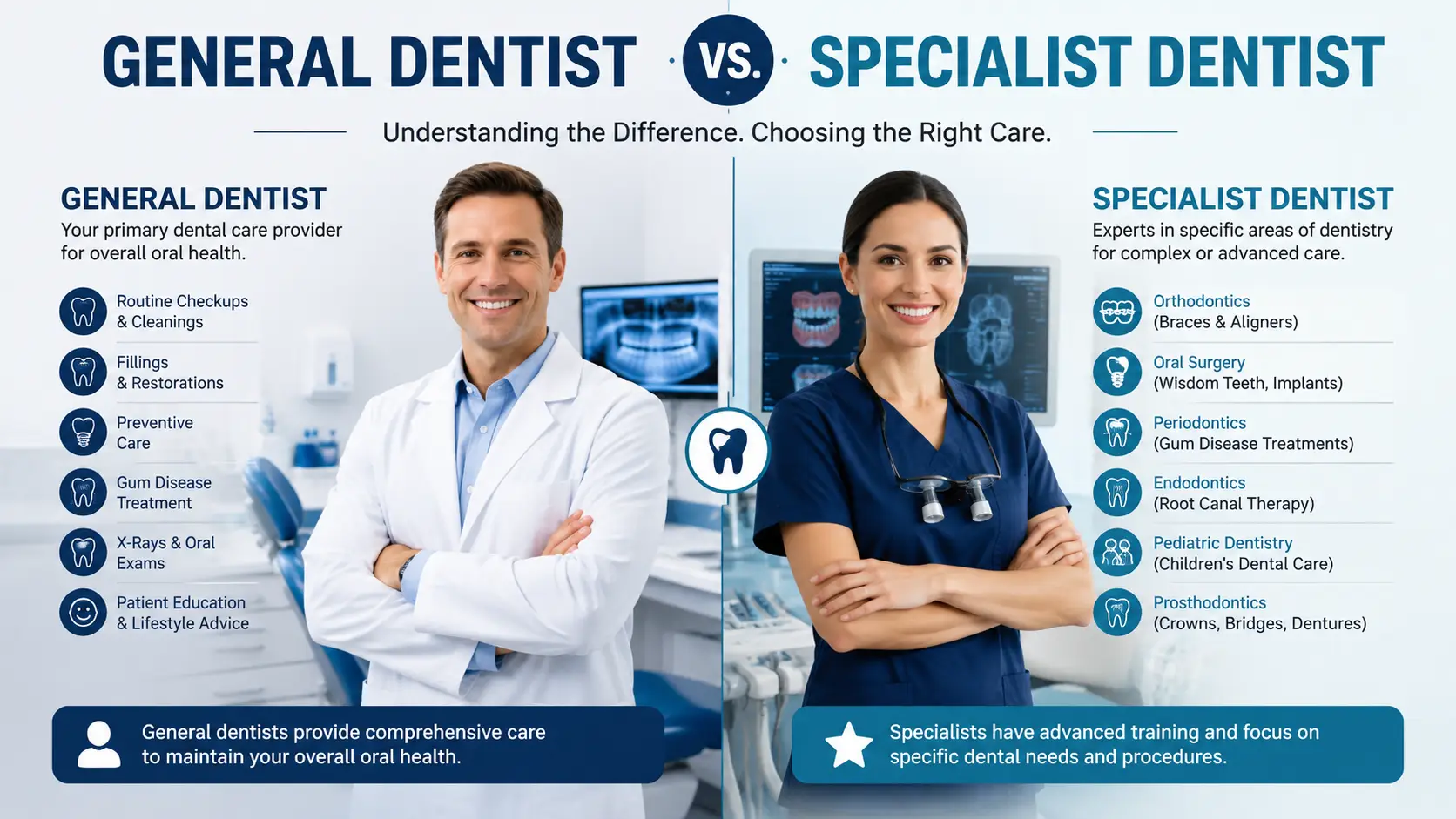
A general dentist is your primary dental home and handles the large majority of care. A dental specialist completes two to six years of residency in one narrow field after dental school and is brought in for the complicated cases inside it. That sentence answers the question for most people. The rest of this guide shows you where the line actually falls, and who to call when something goes wrong.
The quick answer
- General dentist: four years of dental school, a DDS or DMD, and a state license. Treats exams, cleanings, fillings, crowns, bridges, most extractions, routine root canals, cosmetic work, and often single implants.
- Specialist: a dentist who then finished an accredited residency in one field, such as endodontics, periodontics, oral surgery, orthodontics, or prosthodontics.
- Roughly four out of five U.S. dentists are general dentists, which is why most problems never need a referral in the first place.
- The smart move: start with your general dentist. Diagnosis comes first, and it is the diagnosis that decides whether a specialist is needed at all.
Dentistry is organized much like the rest of medicine. There is a primary provider you see for almost everything, with a handful of narrow surgical and technical specialties sitting on top of that. Once you understand the structure, you stop guessing, and you stop paying for referrals you never needed.
I have spent my whole career on the general side of that line. I trained at UCLA, completed a Navy Advanced Education in General Dentistry residency at Camp Pendleton, and served ten years as a Navy dentist, including deployments to Kuwait and Iraq. In the field you learn to handle what is in front of you, because the nearest specialist may be an ocean away. That breadth is the whole point of general dentistry, and it is what I brought to Murrieta when I opened Promenade Dental Care in 2010. Below is what a general dentist actually does, what the recognized specialists do, and how to tell when it is time to step outside your family dentist for one specific case.

At a Glance
General Dentist vs. Specialist: Side by Side
These are the factors patients ask me about most: training, scope, the relationship, and what it costs.
| Factor | General Dentist | Dental Specialist |
|---|---|---|
| Training | Dental school, DDS or DMD, state license | Dental degree plus 2 to 6 years of accredited residency in one field |
| Scope of care | Broad. Most of your everyday care | Narrow. One field only |
| Typical work | Exams, cleanings, fillings, crowns, bridges, most extractions, routine root canals, cosmetic work, single implants | Complex root canals, gum and bone surgery, jaw surgery, bite correction, full-mouth reconstruction |
| Your relationship | An ongoing dental home that knows your history | Seen for one case, then back to your general dentist |
| Cost | Typically lower for comparable procedures | Higher, reflecting advanced training and equipment |
| Referral needed | No. Your first stop | Usually arranged through your general dentist |
The overlap worth knowing about: plenty of treatment people assume belongs to a specialist, including routine root canals, single implants, early gum disease, and everyday cosmetic work, is also done by well-trained general dentists. The useful question is not whether a specialist exists for your problem. It is whether your particular case needs one.
Your Dental Home
What a General Dentist Actually Does
General dentists, also called family or primary dental care providers, are trained to diagnose and treat the full range of everyday oral health needs. We finish four years of dental school, earn a DDS or DMD, and pass national and state boards before we touch a patient. Many of us keep going after that. Continuing education in implants, cosmetic work, and CEREC same-day crowns is what lets a general practice offer genuinely modern care without shipping you out for a referral.
Care most general dentists provide in-house
Preventive care
Exams, digital X-rays, and cleanings that catch problems while they are still small. This is the cheapest dentistry there is.
$20 Exam & X-Rays →Fillings and crowns
Tooth-colored fillings and same-day CEREC crowns that rebuild a decayed or cracked tooth in a single visit.
Same-Day Crowns →Routine root canals
Non-complex root canal therapy to save an infected tooth, with no outside referral for a straightforward case.
Root Canals →Cosmetic dentistry
Bonding and veneers, handled in-house by the dentist who already knows your bite.
Cosmetic Dentistry →Implants in healthy sites
Computer-guided implant placement and restoration for a single missing tooth where the bone is sound.
Dental Implants →Gum care
Cleanings, scaling and root planing, and laser therapy for early to moderate gum disease.
Gum Disease Treatment →Why this matters to your wallet: because a modern general practice can handle so much, patients who walk in assuming they need a specialist are often treated faster, and for less, in one familiar office. The American Dental Association classes general dentists as the primary providers of oral health care in the United States, and public-health resources such as the National Institute of Dental and Craniofacial Research describe most routine care as belonging there.
Know Your Options
The Recognized Types of Dental Specialists
A specialist first becomes a general dentist, then completes two to six additional years of accredited residency in one focused field. The American Dental Association recognizes the specialties below. These are the ones patients actually encounter.
Endodontists
The root canal experts, focused on the pulp inside the tooth. They take on curved or calcified canals, teeth that need to be re-treated, and surgery at the root tip. The patient-facing authority is the American Association of Endodontists.
Periodontists
Specialists in the gums and the supporting bone. They treat advanced periodontal disease, perform gum grafts, and place many implants. For a neutral overview, see the American Academy of Periodontology.
Oral and maxillofacial surgeons
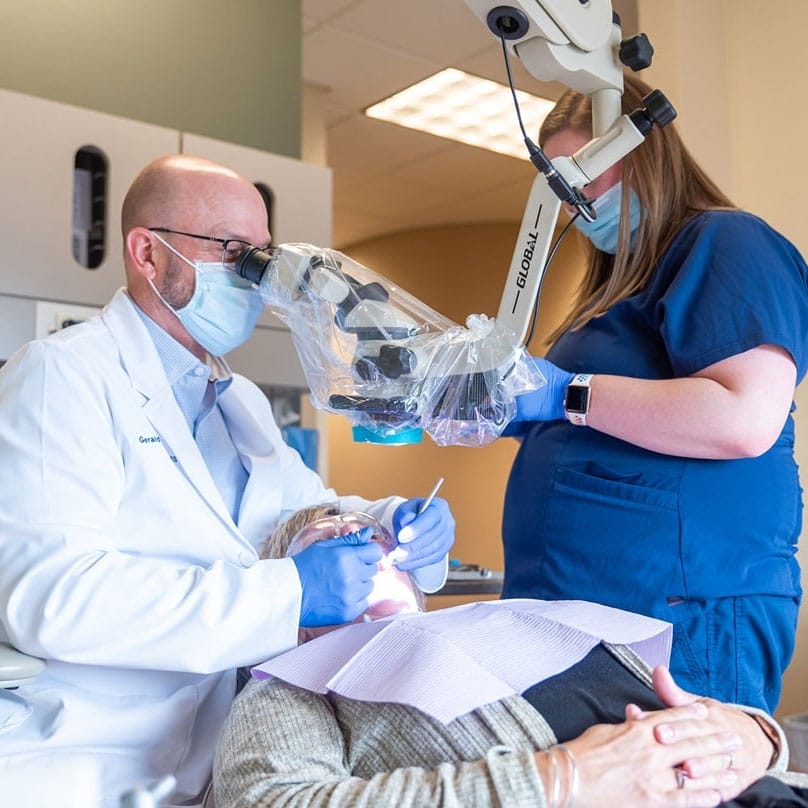
Surgical specialists for the mouth, jaw, and face. Deeply impacted teeth, jaw surgery, large bone reconstructions, and complicated extractions are theirs.
Orthodontists
Specialists in bite alignment and tooth position, correcting how the upper and lower teeth meet.
Prosthodontists
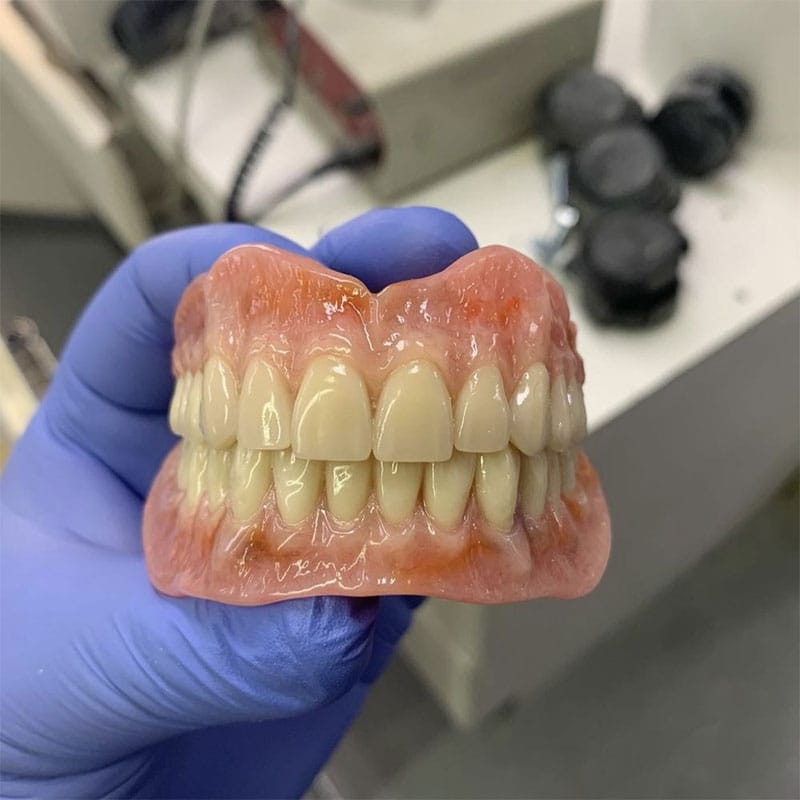
Specialists in full-mouth reconstruction and complex tooth replacement, from advanced dentures to large restorative cases.
Pediatric dentists
Focused on children's dental care, including children with special needs. At Promenade I also welcome children for routine family and kids' dentistry.
The Practical Answer
When to See a General Dentist vs. a Specialist
For most people the decision is simple. Start with your general dentist and let the diagnosis tell you whether a specialist is warranted. Here is how that breaks down in practice.
See a general dentist for
See a specialist when you need
My promise on referrals: I keep care in-house when it is safe and predictable to do so, and I refer you out the moment a case genuinely calls for a specialist. No pressure, no upselling. When you are referred, your records go ahead of you so the specialist starts fully informed. That is what a real dental home is supposed to do. If you want a neutral primer on the types of dentists before you decide, the ADA consumer site MouthHealthy.org is a good place to read.
Start With Your Dental Home
Have a Problem? Here Is Where to Begin in Murrieta
Most of the situations below are handled start to finish at Promenade Dental Care. When one is not, I tell you and point you to the right specialist. Find your situation, book a $20 exam, and get a straight answer.
Tooth pain or deep decay
Sharp or lingering pain usually means a cavity or an infected nerve. One exam tells you whether it is a filling, a crown, or a root canal.
Root Canal Therapy →Dental emergency
Broken tooth, swelling, or a knocked-out tooth. Same-day emergency appointments keep small problems from becoming specialist cases.
Emergency Dentist →Missing or failing tooth
Single implants, bridges, and crowns are often completed in-house, with no referral needed when the site is healthy.
Dental Implants →Bleeding or receding gums
Early and moderate gum disease is treated here with deep cleanings and laser therapy, long before it needs a periodontist.
Gum Recession Care →Wisdom teeth
Erupted, easy-to-reach wisdom teeth come out in the office. Deeply impacted ones are referred to an oral surgeon.
Wisdom Tooth Removal →Nervous about the dentist
Sedation options and a calm, no-judgment visit make delayed care possible again, before the problem gets complicated.
Sedation Dentistry →Not sure which one you are? That is what the exam is for. Book a $20 visit with digital X-rays and I will tell you whether it is a general-dentistry fix or a specialist case, and handle the referral if it comes to that. See the full list of services or get directions to the Murrieta office.
In Their Own Words
What Murrieta Patients Say
These are verbatim reviews posted publicly on the Promenade Dental Care Google Business Profile.
Phenomenal experience here! They reached out about a special exam for only $20 and so I went in. I was greeted immediately by name. They took me back immediately, no waiting at all! The dentist himself did the x-rays and explained what he was seen every step along the way I had a little cavity that I needed to have filled, he walked me personally from the x-ray room to the chair. Took care of the cavity, which was very reasonably priced. And I was in and out within 20 minutes!
I had a dental emergency and the dentist called me immediately and was able to get me in within an hour of speaking to him. The front desk was extremely welcoming and kind. They went over options with me and without having dental insurance they were very affordable. Would recommend to everyone!
I’ve been to a lot of different dentists through the years and have had several fillings/crowns done. I often times experience pain and pressure during procedures even after the anesthetic. This time, zero pain, zero pressure, no nonsense. I’ll be coming back for regular cleanings and any needed procedures. They have my business indefinitely!
Promenade Dental Care is fantastic! The staff are warm, professional, and genuinely care about your comfort. The office is spotless and modern, and appointments always run on time. Dr Nguyen explains everything clearly and make sure you feel at ease. You leave with a bright smile and real confidence in your care.
General Dentist vs. Specialist FAQ
Your Questions, Answered
What is the difference between a general dentist and a specialist?
The difference is training and scope. A general dentist finishes dental school, earns a DDS or DMD, and is licensed to diagnose and treat nearly everything a mouth needs day to day: exams, cleanings, fillings, crowns, bridges, gum treatment, and most extractions. A specialist earns that same dental degree and then spends two to six more years in an accredited residency inside one narrow field, such as root canals, gum and bone surgery, or oral surgery. Your general dentist is your dental home for the large majority of care. A specialist is called in for the complicated cases that sit inside their one field.
When should I see a dental specialist instead of my general dentist?
See a specialist when a case cannot be treated safely and predictably in a general practice. In my Murrieta office that usually means a difficult or previously treated root canal, advanced gum disease with bone loss, jaw surgery, or a wisdom tooth sitting against a nerve. Everything short of that I handle here at Promenade Dental Care. The practical answer for patients is to start in the general dentist's chair anyway, because the diagnosis has to happen before anyone can tell you which kind of dentist you need.
What are the recognized types of dental specialists?
The American Dental Association recognizes a set of dental specialties, and six of them come up constantly with patients: endodontists, who treat the pulp inside the tooth and perform complex root canals; periodontists, who treat the gums and the supporting bone and place many implants; oral and maxillofacial surgeons, who handle surgical extractions, impacted teeth, and jaw surgery; orthodontists, who correct bite alignment and tooth position; prosthodontists, who rebuild badly worn or missing dentition; and pediatric dentists, who focus on children, including children with special needs. Each of those titles represents a full residency completed after the general dental degree.
Can a general dentist do a root canal, or do I need an endodontist?
A general dentist can perform many root canals, and I treat routine ones at Promenade Dental Care in Murrieta. Front teeth and molars with open, reasonably straight canals are normal general-dentistry work. An endodontist is the right call when the canals are curved or calcified, when a tooth that was already treated needs to be redone, or when the case needs surgery at the root tip. If your tooth is a good candidate for general care, having it done in one familiar office is usually faster and less expensive than a referral.
Is Dr. Bao Nguyen a general dentist or a specialist?
Dr. Bao Nguyen, DDS is a general dentist. He earned his dental degree at UCLA, completed an Advanced Education in General Dentistry residency with the U.S. Navy at Naval Hospital Camp Pendleton, and served ten years as a Navy dentist, including deployments to Kuwait and Iraq, before opening Promenade Dental Care in Murrieta in 2010. As a general dentist he provides comprehensive family, restorative, and cosmetic care, and he coordinates referrals to trusted specialists when a case genuinely calls for one.
Do I need a referral to see a dental specialist?
In most cases you are not legally required to have a referral to see a dental specialist, though some dental plans ask for one before they will pay at the higher benefit level. Starting with your general dentist is still the smart move. Your general dentist already has your history, your X-rays, and the full picture of your mouth, and can confirm whether a specialist is truly necessary or whether the problem can be solved in-house for less. When a referral is warranted, Promenade Dental Care sends your records ahead so the specialist begins fully informed.
Does a general dentist cost less than a specialist?
As a rule, yes. General dentists charge less than specialists for comparable procedures, because specialty fees carry the overhead of additional training and dedicated equipment. That is one more reason to make your general dentist the first stop, since plenty of treatment patients assume requires a specialist can be finished in a general office. At Promenade Dental Care in Murrieta the fees are published, and a new-patient exam with digital X-rays is $20, so you can price the general-dentistry option before committing to specialty care.
Can a general dentist place dental implants?
Yes. Many general dentists place dental implants, and I place and restore them at Promenade Dental Care using computer-guided surgery for accuracy. Periodontists and oral surgeons also place implants, and they are the better choice when a case involves significant bone loss that needs major rebuilding, or several failing teeth at once. For a single implant in a healthy site with adequate bone, a trained general dentist can often complete the entire process, from placement through the final crown, in one office.
Who removes wisdom teeth, a general dentist or an oral surgeon?
It depends on the tooth, not on the title. A general dentist can remove wisdom teeth that have erupted normally and are easy to reach. Teeth that are deeply impacted, wrapped around bone, sitting against the inferior alveolar nerve, or that need deeper sedation belong with an oral and maxillofacial surgeon. I read every wisdom tooth on an X-ray first and tell you plainly whether it is a simple in-office extraction or a case I would rather see a surgeon handle.
What is a periodontist, and when would I need one?
A periodontist is the specialist for the gums and the bone that hold your teeth in place. You would need one for advanced periodontal disease with significant bone loss, gum grafting to cover severe recession, or complex implant cases that require rebuilding bone first. General dentists, myself included, treat early and moderate gum disease with cleanings, scaling and root planing, and laser therapy. A periodontist referral is reserved for the more serious cases that need surgical periodontal care.
Can a general dentist handle cosmetic dentistry, or do I need a prosthodontist?
General dentists handle most cosmetic dentistry, including bonding, veneers, and single crowns, and many of us take extensive continuing education in it. A prosthodontist is the specialist for full-mouth reconstruction and the most complex restorative cases, such as rebuilding a badly worn bite. For a typical smile makeover on healthy teeth, a skilled general dentist can deliver excellent, natural-looking results without a specialty referral.
Does dental insurance pay differently for a specialist?
Often, yes. Many dental plans apply the same category percentage to a procedure no matter who performs it, but specialists usually bill a higher fee, so your share of the cost goes up even when the coverage percentage is identical. Some plans also require a referral on file before they will pay specialty benefits. Promenade Dental Care accepts all PPO dental plans and is in-network with Delta Dental PPO, Cigna, MetLife, Guardian, Aetna, and United Concordia, and we will check the specifics of your plan before you commit to anything.
Should I see a general dentist or a specialist for a dental emergency?
Call a general dentist first. Most dental emergencies, including a broken tooth, a lost crown, a painful abscess, or a knocked-out tooth, are stabilized in a general office, and speed matters more than specialization in the first few hours. Promenade Dental Care keeps same-day emergency appointments open for exactly this reason, at (951) 412-0127. If the emergency turns out to involve a facial fracture or extensive jaw trauma, I stabilize what I can and get you to an oral surgeon the same day.
Does Promenade Dental Care refer patients to specialists when needed?
Yes. Promenade Dental Care keeps the large majority of care in-house, but I refer you to a trusted specialist whenever a case genuinely calls for one, with no pressure and no upselling. Your records and X-rays go ahead of you so the specialist is prepared on day one, and I stay involved to coordinate the overall treatment plan. Your dental home stays in one place from start to finish, which is the entire point of having a general dentist.
Not Sure Who You Need? Ask a Dentist Who Refers Honestly.
Bring the problem to me first. A $20 exam with digital X-rays gives you a straight answer on whether it is a general-dentistry fix or a case for a specialist, before you spend a dollar more.
(951) 412-0127 Call Promenade Dental Care