
When Tijuana or Turkey Veneers Fail, Somebody Local Has to Fix Them
A Murrieta dentist on dental tourism, "veneer techs," and what repair actually involves
Patients come back from a border clinic or an overseas package with a smile that photographed beautifully and started coming apart six months later. This is what I see when those cases walk in, what can be saved, and what the repair really costs — without the lecture.
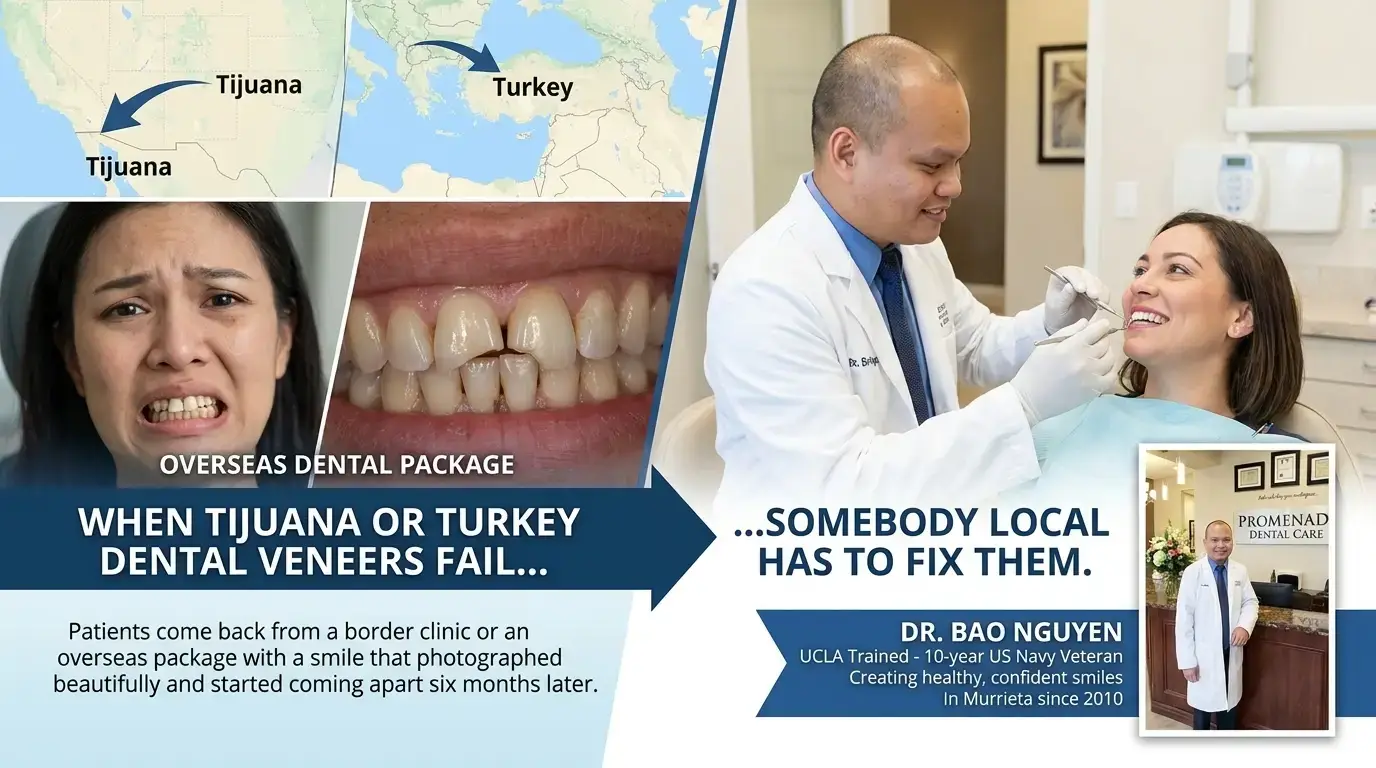
Southwest Riverside County Sits on a Dental Tourism Corridor
From Murrieta, the San Ysidro border crossing is roughly ninety minutes down the I-15 on a good day. Los Algodones, the Baja border town that markets itself as a dental destination, is a morning's drive east. And a full-arch package in Istanbul or Antalya, flights included, is one Instagram ad away from anybody in Temecula with a phone. So this is not a fringe question here. It is a Tuesday.
I want to be careful about the framing, because the honest version is more useful than the scary one. There are excellent dentists in Mexico and in Turkey, and there are patients who came home delighted. Dental tourism is not automatically bad care. What it is, structurally, is care with the follow-up sawed off. The CDC's guidance on traveling abroad for medical care makes the same point in clinical language: Mexico is the single most common destination for U.S. patients, records rarely follow the patient home, and follow-up care is often billed separately from the headline package price.
The British Dental Association surveyed a thousand of its dentists about exactly this and found that the overwhelming majority had examined patients treated overseas, and most had gone on to treat complications from that work. Crowns topped the list of restorations needing follow-up. A 2025 British Dental Journal review of media reporting on dental tourism found the same pattern repeating across a decade of case coverage. Nobody has run that survey on this side of the Atlantic, but I can tell you what my chair looks like, and it looks like theirs.
The Failures Are Boringly Predictable
After enough of these cases you stop being surprised. The same handful of problems show up over and over, and almost all of them trace back to compressing weeks of treatment into a five-day trip.
"Veneer Techs" Are Not a Cheaper Version of the Same Thing
Border clinics and unlicensed operators get discussed together, and they should not be. A dentist in Tijuana is a licensed clinician under Mexican regulation who can usually produce a radiograph if you ask. The unlicensed "veneer technicians" the ADA publicly warned about in 2024 are something else: no exam, no imaging, no diagnosis, and frequently no dental setting at all.
What that means for repair is specific and practical. With overseas work I can often reconstruct what happened. With tech work there is nothing to reconstruct — no pre-treatment films, no charting, no record of what was bonded to the tooth or with what cement. So the first appointment is entirely diagnostic. Imaging, periodontal probing, vitality testing, photographs, and only then a conversation about what to do. Anyone can verify a provider's California license for free through the Dental Board of California in about a minute, and it is worth the minute.
The First Visit Is Diagnosis, Not a Sales Pitch
People arrive braced for a scolding. I am not interested in that, and it does not treat anything. You paid for a result, the result failed, and now we need to know what is underneath. Nothing gets quoted until I know that.
Very knowledgeable and good prices. Does only what is necessary. Does not just look for stuff to charge for. Got an appointment quickly when I thought it was an emergency. My favorite dentist ever!!
What Repair Actually Looks Like
Repair is not one procedure. It runs along a spectrum, and where your case lands is decided by the tooth underneath, not by how the smile looks in a photo.
| What I find | What it usually takes |
|---|---|
| Intact restoration, debonded, sound tooth, no decay | Clean and re-bond, often same visit — the cheapest possible outcome |
| Chipped edge, tooth healthy underneath | Polish, or repair with composite bonding as an interim measure |
| Open margin, decay caught early, nerve healthy | Remove, excavate decay, re-prep, new crown or veneer |
| Nerve has died or is dying | Root canal therapy first, then rebuild and re-restore |
| Root fracture or prep below bone level | Extraction, then an implant or bridge to replace it |
| Bite never refined, chronic chipping | Occlusal adjustment and a custom nightguard before anything new goes in |
Two things surprise people. The first is that a fair number of cases are less catastrophic than feared — a re-bond and a cleaning, and the arch is fine. The second is the matching problem. Replacing one unit in a full arch of unknown material is genuinely difficult, and sometimes the honest recommendation is to redo a segment rather than chase a match that will never quite land. I will tell you which one you are looking at before you commit to either.
Get Your Records Before the Clinic Stops Answering
The single most useful thing you can do — today, before anything else — is email the clinic that did the work and ask for your file. Responsiveness drops sharply once you have been home a few months. Ask for these five items by name: pre-treatment and post-treatment radiographs, the restoration material by brand, the shade, the cement used, and any root canals performed and on which teeth. Those five details often decide whether one tooth can be matched or a whole arch has to be redone.
On money, two realities. Package warranties generally cover the lab-made restoration only, require you to return to that clinic, and exclude airfare, lodging, and biological complications like decay or a failed nerve. And U.S. dental insurance will not pay for the cosmetic portion of a redo, wherever the original work happened — but decay, endodontic treatment, periodontal disease, and fractured teeth are usually covered under the restorative benefit even when a cosmetic trip is what triggered them. My front office verifies your specific plan and gives you the out-of-pocket figure in plain numbers before we start. We take CareCredit for the rest.
If You Are Going Anyway, Go Smarter
Plenty of people have already booked, and I would rather they travel prepared than travel blind. This is the checklist I give patients who tell me they are going, from the dentist who may end up managing the aftermath.
Failed Veneers and Dental Tourism FAQs
General questions about veneers themselves — materials, cost, lifespan, enamel removal, candidacy — are answered on the Murrieta dental veneers page. These are the ones I get specifically about work done somewhere else.
Bring Me the Case, Not the Guilt
If something you paid for in Tijuana, Los Algodones, Istanbul, or a hotel room in Riverside County is failing, the useful next step is finding out what is under it. Patients come to me for this from Murrieta, Temecula, Menifee, Wildomar, Winchester, and French Valley.