
Dental Guide · Murrieta, CA
Gentle Cavity Treatment: What to Expect From a Modern, Pain-Free Filling
If the word “filling” makes your shoulders climb toward your ears, this one is for you.
A cavity does not have to mean a bad afternoon. Here is what actually happens during a gentle filling, why the numbing works better than it did when you were a kid, what it costs, and how to keep the next one from forming — written by the dentist who does the work.
Start Here
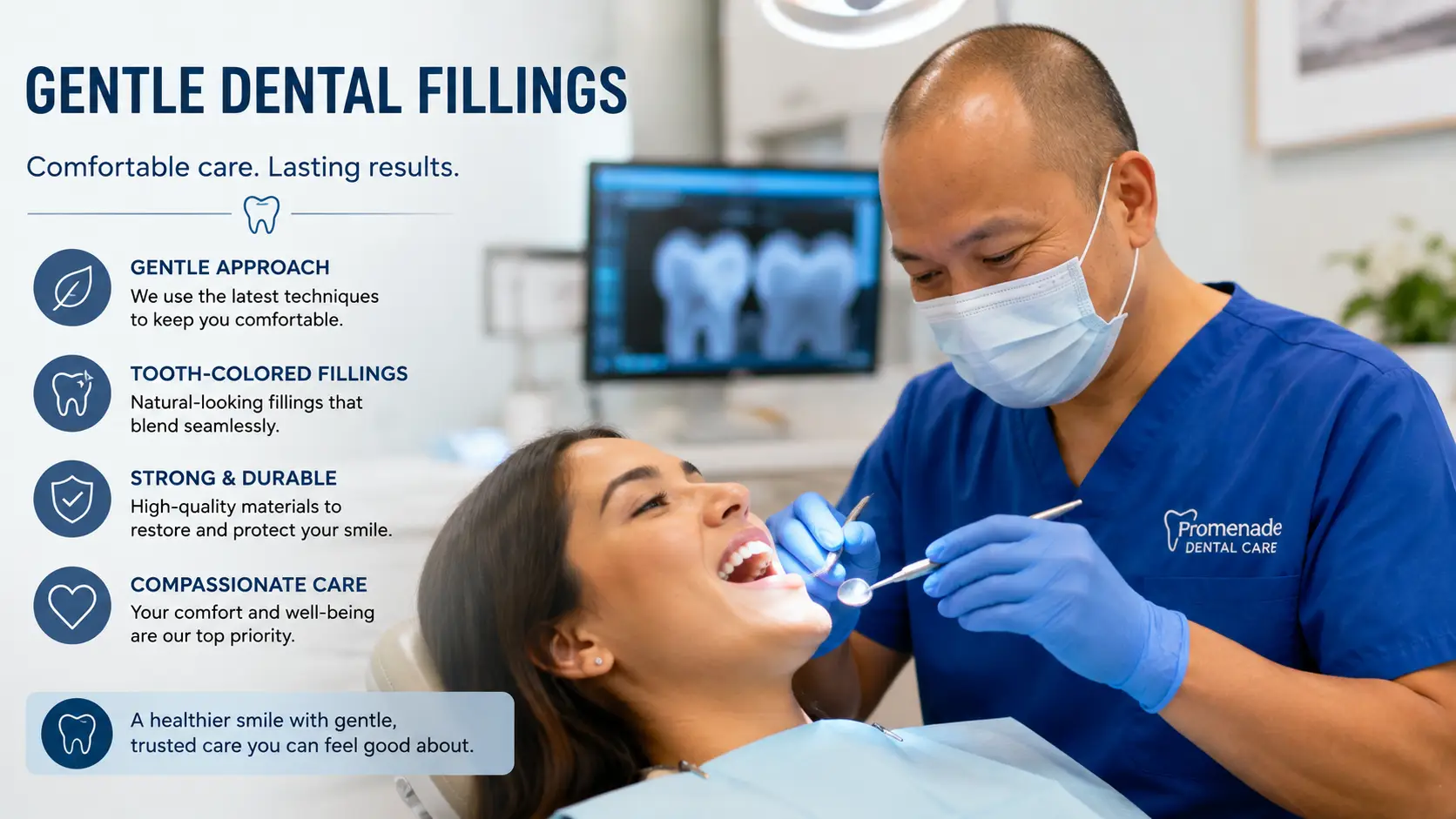
What Gentle Cavity Treatment Actually Means
Nobody walks in excited about a filling. My job is to make it a non-event.
A cavity is a hole. That is the whole thing. Bacteria in plaque turn the sugars and starches you eat into acid, that acid pulls minerals out of your enamel, and eventually the surface caves in and the softening spreads into the dentin underneath. Left alone it keeps going. Caught early it is one of the most routine repairs in dentistry — I clear out the decayed part and rebuild the tooth so it looks and chews like it did before.
The word “gentle” is about how that happens, not what gets done. It means the tooth is genuinely numb before I start, that I take out the decay and stop, that the repair is a bonded tooth-colored material rather than metal, and that the appointment moves at your speed instead of mine. I spent ten years in the Navy Dental Corps, including an Advanced Education in General Dentistry residency at Camp Pendleton, and the thing that stuck with me from treating Marines is that a calm patient is an easier patient to treat well. Comfort is not a luxury add-on. It is part of doing the restoration correctly.
- Procedure
- Tooth-colored composite filling (dental restoration for caries)
- Typical visit
- 30–60 minutes, most cavities completed in one appointment
- Anesthesia
- Local anesthetic; nitrous oxide and oral sedation available
- Discomfort
- Pressure and vibration during; mild cold sensitivity for 1–2 days after
- First step
- $20 new-patient exam with digital X-rays
- Performed by
- Dr. Bao Nguyen, DDS — Promenade Dental Care, 26957 Date St, Suite B4, Murrieta, CA 92563
The short version: a gentle filling fixes the cavity comfortably, disappears into the tooth, and — done early — keeps a small problem from turning into a root canal. If you already know you need one, our tooth-colored fillings page covers materials, durability, and published pricing.
Comfort First
Why Fillings No Longer Have to Hurt
Almost every patient who tells me they are afraid of fillings is describing something that happened decades ago: a rushed appointment, anesthetic that never fully took, and a dentist who kept going anyway. That memory is real. It is also out of date.
The single biggest change is not the drill. It is how reliably and how completely the tooth gets numb before anything starts, and the fact that a decent dentist will simply wait rather than push through.

Numbing that is checked, not assumed
I put topical gel on the gum first and give it time to work, then deliver the anesthetic slowly, because speed is what makes an injection sting. Then I wait, and I test the tooth before I pick up a handpiece. If you feel anything sharp, you tell me and I add more. There is no prize for starting early. Lower back molars in particular can be stubborn, and I would rather spend an extra four minutes than have you white-knuckling the armrest for twenty.
Taking out the decay and stopping there
Decayed dentin is soft and it looks and feels different from healthy tooth. The goal is to remove that and nothing more. Every millimeter of natural tooth I leave behind is structure that does not have to be replaced later, which means smaller restorations, less chance of needing a crown down the road, and a shorter appointment.
The sound is worse than the sensation
This is worth saying plainly, because it is the part people underestimate. When you are properly numb, a filling is pressure, vibration, water, and noise. Patients who bring headphones or earbuds routinely tell me afterward that the appointment was unremarkable. That is the goal — unremarkable.
Afterward, mild sensitivity to cold or to biting is normal for a day or two while the nerve settles. It should get better each day, not worse.
Materials
Tooth-Colored Composite vs. Old Silver Fillings
When people picture a filling they usually picture the dark metal ones they got as kids. Silver amalgam is durable and it served dentistry well for a century, but it is bonded to nothing, it requires cutting away healthy tooth to create a mechanical lock, and it darkens the tooth. Composite is what I place today for essentially every cavity, front or back.
| Compare | Tooth-Colored Composite | Silver Amalgam |
|---|---|---|
| Appearance | Shade-matched, invisible in the smile | Dark grey, visible when you laugh |
| Bonds to the tooth | Chemically bonded, seals the margin | Held by shape alone, no bond |
| Healthy tooth removed | Minimal — only the decay | More, to create undercuts |
| Contains mercury | No | Yes, in the alloy |
| Typical lifespan | Roughly 7–15 years | Often 10–15 years or more |
| Used today at Promenade | Standard for all new fillings | Not placed |
Composite is layered into the tooth in thin increments and hardened with a curing light, then shaped and polished. The tradeoff is honest: it is a more technique-sensitive material and it takes longer to place well, which is exactly why it should not be rushed.
Do old silver fillings need replacing? Not on principle. An intact amalgam that is sealing well and causing no trouble is usually best left alone. I replace one when it fractures, when the margin has opened and decay has restarted underneath, or when a patient specifically wants the appearance changed. Swapping healthy fillings wholesale is not treatment, it is billing.
Behind the Scenes
How a Gentle Filling Works, Step by Step
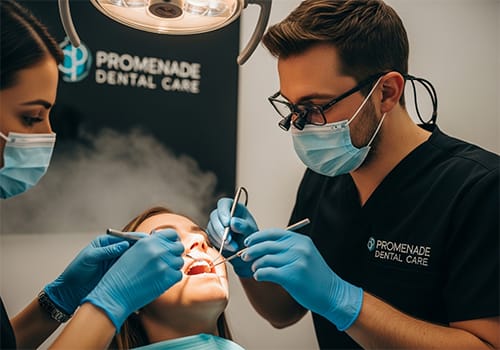
Knowing the sequence takes a surprising amount of the dread out of it. Here is the whole procedure, in order, with nothing left out.
1Numb the tooth
Topical gel first, then local anesthetic delivered slowly. I test the tooth and wait until you confirm it is fully numb before anything else happens.
2Isolate and clean
The tooth is kept dry and isolated from saliva. Composite will not bond to a wet surface, so this step is what makes the filling last.
3Remove the decay
Only the softened, decayed structure comes out. Healthy enamel and dentin stay where they are.
4Condition and bond
The prepared surface is etched and a bonding agent applied so the composite locks to the tooth and seals the margin against bacteria.
5Layer and cure
Shade-matched composite goes in a couple of millimeters at a time, each layer hardened with a curing light, then sculpted to match your natural anatomy.
6Check the bite
You bite on articulating paper and I adjust until the marks are even. A filling a fraction of a millimeter too tall will ache for weeks, and this is the step that prevents it.
Nervous about the appointment itself? Say so when you book. We schedule extra time, go through the comfort options before anything starts, and set the pace accordingly. A good number of our regulars had not seen a dentist in ten years before their first filling here.
Phenomenal experience here! They reached out about a special exam for only $20 and so I went in. I was greeted immediately by name. They took me back immediately, no waiting at all! The dentist himself did the x-rays and explained what he was seeing every step along the way. I had a little cavity that I needed to have filled, he walked me personally from the x-ray room to the chair. Took care of the cavity, which was very reasonably priced. And I was in and out within 20 minutes!
You Are Not the Only One
Gentle Cavity Treatment for Anxious Patients
Dental anxiety is the most common reason a small cavity becomes a big one. The avoidance is not irrational — it is usually a rational response to something that genuinely went badly once. The problem is that decay does not care about the reason for the delay.
What helps, in my experience, is control. Knowing what is going to happen before it happens, having an agreed signal to stop, and not being talked down to about the years you skipped. Beyond that, sedation dentistry is available for real dental anxiety, a strong gag reflex, needle phobia, or a deep cavity that is going to need more time in the chair. Sedation is not a character judgment. It is a tool, and for some people it is the difference between getting treated and putting it off another five years.
All you have to say is “I’m nervous.” Call (951) 412-0127 and tell whoever answers. That one sentence changes how the appointment gets scheduled. More on our approach is on the dental anxiety page.
For Families
Gentle Fillings for Kids
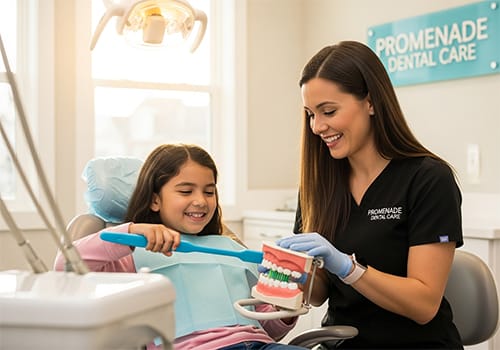
Children usually do better than their parents expect, and the difference is almost entirely in how the visit is set up. Plain language instead of clinical vocabulary, showing a child each instrument before it is used, and letting them hold the mirror all reduce the fear of the unknown, which is the actual problem. For a very anxious child, sedation is available.
Parents sometimes ask whether a baby tooth is worth filling if it is going to fall out anyway. Usually yes. That molar is holding space for the permanent tooth developing underneath it, and if it is lost early the neighboring teeth drift into the gap and the adult tooth comes in crowded or blocked out. Beyond that, a first dental experience that goes calmly shapes how a kid feels about the chair for the next forty years. That is worth protecting. More on our approach is on the kids dentist page.
Don’t Wait It Out
When a Cavity Becomes Urgent
A cavity caught early is a half-hour filling. A cavity ignored long enough is a different conversation. Once decay reaches the pulp — the nerve and blood vessels at the center of the tooth — you get pain that lingers after something cold, throbbing that wakes you up, pain on biting, or facial swelling. At that point the tooth needs a root canal or extraction, not a filling.
The signal to watch for is duration. Sensitivity that stops the moment the cold is gone is usually fine. Pain that hangs around for thirty seconds or more after the stimulus is gone, or that wakes you at night, means the nerve is inflamed and time matters.
Hurting right now? Do not wait for it to pass. We hold time each day for same-day emergency appointments in Murrieta. Call (951) 412-0127 in the morning and say it is urgent.
Straight Answers
What a Filling Costs — and the Smartest First Step
The real answer is that it depends on how many surfaces of the tooth are involved. A small pit on a single surface and a large filling wrapping three surfaces of a back molar are different amounts of work, and any office quoting one price for “a filling” is either averaging or leaving something out. What does not vary here is the process: prices are published, you get the number before treatment is scheduled, and nobody at this practice earns anything by talking you into more dentistry than you need.
Promenade Dental Care accepts all PPO dental plans, is in network with most major insurers, and offers CareCredit financing for larger treatment.
Want numbers before you commit? The tooth-colored fillings page lists options and transparent pricing, and a $20 exam with digital X-rays confirms what your specific tooth needs. No guessing and no pressure.
The Best Filling Is the One You Never Need
How to Prevent Your Next Cavity
Treating decay gently is half the job. The other half is not being back for the same thing next year. According to the National Institute of Dental and Craniofacial Research, the earliest stage of decay can be halted and even reversed before a filling is ever needed.
The one thing I wish more patients knew: with sugar and acid, duration matters more than quantity. A can of soda finished in ten minutes does less damage than the same can sipped across three hours, because each sip restarts the acid clock and never lets enamel recover.
Dental Sealants
A thin coating over the grooves of the back molars, where the great majority of childhood cavities begin. Quick, painless, and no numbing required.
Fluoride
Rebuilds mineral in weakened enamel and can reverse a white-spot lesion before it ever becomes a hole.
Cleanings and Exams
Twice a year catches problems while they are small, cheap, and painless. This is the highest-return appointment in dentistry.
Cleaning Between Teeth
Most adult cavities I find start between the teeth, where a brush has never reached. Floss, picks, or a water flosser — whichever one you will actually use.
Where to Go Next
Ready to Take Care of It?
Tooth-Colored Fillings
Materials, durability, and published prices for white composite fillings.
$20 Exam and X-Rays
The honest first step. See exactly what the tooth needs before anything is scheduled.
Emergency Dentist
In pain now? Same-day appointments are held open for urgent tooth problems.
Sedation Dentistry
For real dental anxiety, a strong gag reflex, or deeper work that needs more chair time.

Dr. Bao Nguyen, DDS
Owner and General Dentist · Promenade Dental Care, Murrieta
UCLA School of Dentistry graduate and ten-year U.S. Navy Dental Corps veteran who completed an Advanced Education in General Dentistry residency at Naval Hospital Camp Pendleton and deployed to Kuwait and Iraq. He has practiced in Murrieta since 2010 and treats patients in English, Spanish, and Vietnamese. More about Dr. Bao →
Extremely helpful! Went in for a cleaning and to repair a cavity. Quick and painless. Would definitely recommend to everyone. The Doc and his staff were nothing short of wonderful! Thanks so much for the procedure. And very reasonably priced!!!
A very professional and friendly dentist. They go out of their way to make you comfortable and pain free. No upselling, and also easy to make an appointment. Great dentist!!!
Have a Cavity? Let’s Keep It Simple.
Start with an honest look. A $20 exam with digital X-rays tells you exactly what the tooth needs, at published prices, with no pressure. Then we fix it gently.
(951) 412-0127 Explore Tooth-Colored FillingsCommon Questions
Frequently Asked Questions About Cavity Treatment
Does getting a cavity filled hurt?
For almost everyone, no. I numb the tooth completely with local anesthetic and then test it before I touch any decay, so what you notice is pressure and vibration rather than pain. If you are anxious, have a strong gag reflex, or dislike needles, sedation dentistry is available at Promenade Dental Care in Murrieta. Mild cold sensitivity for a day or two afterward is normal and settles on its own.
What makes a cavity treatment gentle?
A gentle cavity treatment comes down to four things: numbing that is verified before any work starts, removing only the decayed tooth structure and leaving the healthy part alone, rebuilding the tooth with bonded tooth-colored composite instead of metal, and working at a pace the patient sets. At Promenade Dental Care in Murrieta, nothing begins until you are numb and comfortable, and you can raise a hand to stop at any point.
How long does it take to get a cavity filled?
One tooth-colored filling usually takes 30 to 60 minutes from the time you sit down to the time you leave, and most cavities are handled in a single visit. Deeper decay, or several teeth treated in one sitting, runs longer. Dr. Bao Nguyen, DDS gives you a time estimate before treatment starts so nothing about the appointment is a surprise.
How much does a cavity filling cost in Murrieta?
The cost depends on how many surfaces of the tooth are involved, because a small one-surface filling is a different job than a large three-surface filling on a back molar. Promenade Dental Care publishes its filling prices, quotes them before treatment is scheduled, and does not upsell. The practice accepts all PPO dental plans and offers CareCredit financing. The cheapest way to get a real number is the $20 new-patient exam with digital X-rays, which shows exactly what the tooth needs.
Are tooth-colored fillings safe for children?
Yes. Tooth-colored composite is the standard restoration for children’s teeth and children generally do very well with it, particularly when the appointment uses plain kid-friendly language, a show-and-tell walkthrough of the instruments, and an unhurried pace. For a very anxious child, sedation is available at Promenade Dental Care in Murrieta. Filling a decayed baby molar also matters because that tooth holds space for the adult tooth forming underneath it.
What happens if I wait too long to treat a cavity?
Decay does not stop on its own once it is through the enamel. As it works deeper it reaches the pulp, the nerve and blood supply inside the tooth, and that is when you get lingering pain, throbbing at night, swelling, or pain on biting. At that stage a filling is no longer enough and the tooth needs a root canal or extraction. Treating a cavity early keeps the visit shorter, gentler, and far less expensive.
Can a cavity heal on its own without a filling?
Only at the very earliest stage. A white-spot lesion, where the enamel has lost minerals but no hole has formed yet, can often be remineralized with fluoride, better home care, and cutting back on acid exposure. Once decay has broken through the enamel surface into the dentin, the tooth cannot rebuild that structure and a filling is required. This is the main reason routine exams matter, because that reversible window is only visible on an X-ray or to a trained eye.
How long do tooth-colored fillings last?
A well-placed composite filling commonly lasts somewhere between seven and fifteen years, though the honest answer is that it depends more on the patient than on the material. Grinding or clenching, a diet heavy in acidic drinks, and inconsistent flossing all shorten a filling’s life. Fillings are checked at every routine exam at Promenade Dental Care so a worn margin gets caught before decay restarts underneath it.
Why is my tooth sensitive after a filling?
Short-term sensitivity to cold or to biting is common after a filling because the tooth has been worked on and the nerve inside needs a few days to quiet down. It should improve steadily. Sensitivity that gets worse rather than better, or a filling that feels tall when you bite, is worth a quick call to (951) 412-0127. A bite adjustment takes a couple of minutes and no anesthetic, and it resolves most of these cases.
Do I still need a filling if the tooth does not hurt?
Usually yes. Pain is a late signal in tooth decay, not an early one, which means a cavity is often well established by the time it hurts. Most cavities are found on a routine exam or a digital X-ray while they are still small, painless, and simple to fix. Waiting for a tooth to hurt before treating it is what turns a 30-minute filling into a root canal.
Do you treat patients who have avoided the dentist for years?
Regularly, and without any lecture about the gap. Promenade Dental Care in Murrieta sees a lot of people whose last visit was a decade or more ago, usually because of one bad experience. The approach is to start with a $20 exam and digital X-rays, lay out what is going on in plain language, and then treat one thing at a time in the order that matters most. Tell the team you are nervous when you call (951) 412-0127 and extra time gets built into the appointment.
Do you offer same-day appointments for a painful cavity?
Yes. Promenade Dental Care reserves time each day for urgent tooth problems, so a cavity that has started causing real pain can usually be seen the same day. Call (951) 412-0127 in the morning and say it is urgent. If the tooth turns out to need more than a filling, the emergency visit still gets you out of pain first and the longer-term plan is discussed afterward.