
Chipped a Front Tooth? How I Decide Between Smoothing, Bonding, a Veneer, or a Crown
Four repairs, one question: how much tooth is gone, and how deep does it go
Most chipped front teeth that come through my door in Murrieta leave the same afternoon with a bonded repair nobody can find in a photo. Some need less than that. A few need more. I am Dr. Bao Nguyen, and this is the reasoning I actually use in the chair, laid out so you know what to expect before you call.
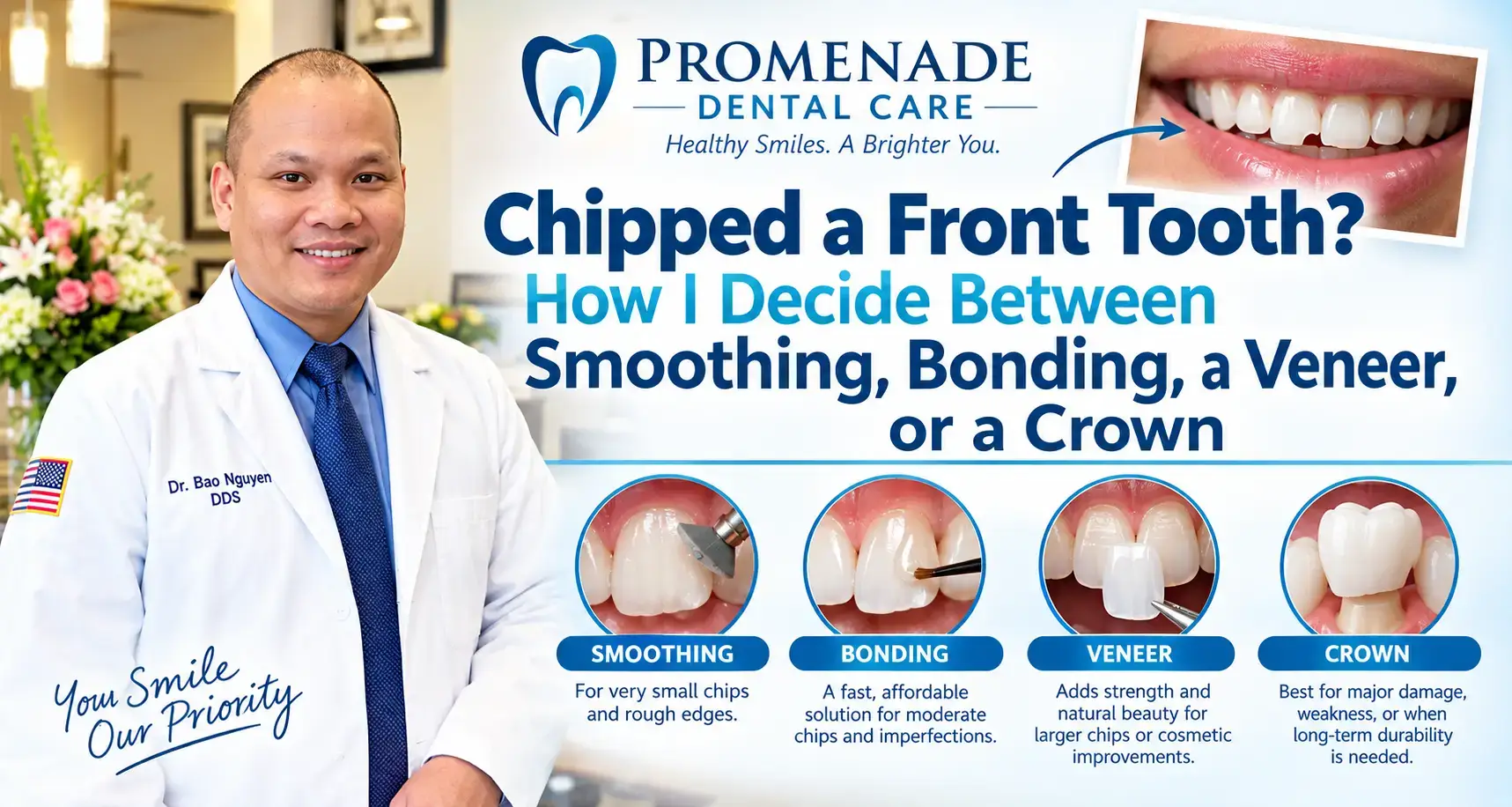
The Two-Minute Version
If you want the short answer before the long one, here is how the four repairs sort out:
Everything below explains how I tell those four situations apart, because from the mirror they can look a lot alike.
What I Look at Before I Recommend Anything
Every chipped tooth starts with a $20 exam with digital X-rays. The X-ray matters more than people expect for something that looks cosmetic, because the thing that decides the treatment is usually the part of the tooth you cannot see. Seven things drive the call.
How deep the chip goes
Dentists sort front-tooth fractures into three depths, a shorthand emergency physicians use too. A chip confined to the enamel is white all the way through, does not hurt, and is purely a cosmetic problem. A chip that reaches the dentin shows a yellow or tan patch and usually reacts to cold air or ice water. Dentin is porous, so an exposed patch is an open road for bacteria toward the nerve, and I want it covered within days, not months. A chip that reaches the pulp shows a pink or red dot, often bleeds, and throbs on its own. That third depth belongs on the emergency page, and it usually means a root canal before any cosmetic work.
How much tooth is gone
My rough rule for a front tooth: if the missing piece is less than about a third of the visible crown, composite has enough surrounding enamel to grip and bonding holds up well. As the loss approaches half the tooth, there is not enough structure left for a bond to survive biting force, and I am looking at porcelain.
Where the crack line goes
A chip is a piece that came off. A crack is a line that is still traveling. I look at the tooth under magnification and with a light shone through it, and I check the X-ray for a fracture below the gum. The American Association of Endodontists explains why the direction of a crack matters so much: a line running toward the root changes the whole plan, no matter how small the visible chip is.
Your bite and whether you grind
Front teeth that meet edge to edge, and front teeth in a mouth that grinds at night, shear composite off in a way that porcelain and ceramic resist. If your lower front teeth show flat, squared-off edges, the chip did not happen by accident and it will happen again to any repair that is not planned around your bite. Mayo Clinic has a good plain-English rundown on bruxism, which ends more front-tooth repairs than anything else I see.
What is already in the tooth
A tooth that has been root-canal treated is dry and brittle and tends to darken; it usually earns a crown rather than a bond. A tooth carrying a large old filling has less natural structure to work with. And a tooth with bonding that has already failed twice on the same edge is telling me the material is wrong for that spot.
Color, and the teeth on either side
Bonding fixes shape. It does not fix a tooth that was already a shade darker than its neighbors before it chipped. If the tooth needs both a new corner and a new color, a veneer solves both problems in one restoration, and I say so up front rather than bonding a good corner onto a tooth you still will not like.
Your age
Enamel never grows back, and a veneer or crown placed at nineteen is a commitment for the rest of that tooth's life. For teens and younger adults I lean hard toward smoothing and bonding first. There is always time to go up the ladder later. There is no way to come back down it.
Smoothing the Edge
The lightest repair is simply reshaping the chipped edge with a fine polishing disc so it no longer catches your lip or your tongue. It takes a few minutes, needs no anesthetic, and often happens right at the exam. It is the right answer for a hairline chip, a rough corner from years of wear, or a tiny flake off the biting edge.
Its limit is that it only removes tenths of a millimeter. If getting the edge smooth would leave that tooth visibly shorter than the one beside it, smoothing alone is the wrong move and I will suggest bonding instead. Sometimes the best result is both: smooth the chipped tooth slightly, take a whisper off its neighbor so the two edges match, and add nothing at all.
Bonding, the Workhorse
This is the repair the majority of chipped front teeth get. I match a tooth-colored composite to your enamel, sculpt the missing corner or edge by hand, harden it with a curing light, and polish it to the luster of the tooth next to it. Plan on 30 to 60 minutes per tooth, finished in one visit, with no lab and no temporary. For a chip that has not reached the nerve there is usually no injection, because I am adding material rather than drilling any away. Bonding starts at $250 per tooth, quoted in writing before treatment begins, and most of what I place lasts 4 to 8 years, with a chipped or dulled bond usually patchable in a short visit rather than redone.
Bonding is the right call when the chip is in enamel or shallow dentin, the tooth is otherwise healthy, and its color already matches its neighbors. It is also the protective move when dentin is exposed: covering that patch the same day is what keeps a cosmetic problem from becoming a root canal, and because it is repairing damage rather than reshaping for looks, most PPO plans treat it like a filling. The full procedure, care instructions, and pricing are on the teeth bonding page.
Bonding is the wrong call when the same edge has chipped before, when your bite lands squarely on the repair, or when more than about a third of the tooth is gone. Placing composite in those situations means seeing you back in six months, and I would rather say so now.
A Porcelain Veneer
A veneer is a thin shell of porcelain bonded over the front of the tooth. I reach for it when the chip is only part of the story: the tooth is also discolored or worn short, the same edge keeps failing in composite, or the chipped tooth is one of two or more front teeth you want to change together so they match. Porcelain resists stain and wear far better than composite and typically lasts 10 to 20 years.
The trade-offs are real. A thin layer of enamel is removed, so the decision is permanent. The veneer is made in a dental lab, so it takes two appointments roughly two weeks apart with a temporary in between. And it is quoted per case, in writing, after the exam, because the number depends on how many teeth are involved and what the enamel underneath will support. I will not bond porcelain over a tooth with active decay or inflamed gums; that is money spent twice. Details on materials, prep, and what makes someone a good candidate are on the dental veneers page.
A Crown
Some "chips" are not chips. If a large piece of the tooth has sheared away, if a crack runs from the biting edge toward the gum, if the tooth has already had a root canal, or if it is more old filling than enamel, a bond or a veneer has nothing solid to hold onto. A crown covers the whole tooth and binds it together the way a hoop binds a barrel, so the crack stops spreading under load.
I scan, design, and mill all-ceramic crowns in the office with CEREC, so a crown is about two hours in one visit with no temporary and no lab wait, starting at $1,054 cash, written down before I begin. Modern ceramic blocks come in layered shades that read like natural enamel on a front tooth. The one narrow exception I still send to a lab is a single central incisor sitting next to a flawless natural twin, where a ceramist's hand-layering earns its extra time. When and why a crown is the right structural answer is covered on the same-day crowns page.
Where a root canal fits in
If a chip has reached the pulp, if the tooth aches on its own or lingers after hot coffee, or if it starts turning gray weeks after the injury, the nerve is either exposed or dying. A root canal comes first, and then the tooth gets bonded or crowned depending on how much structure is left. One thing worth knowing: a front tooth that took a hard hit can look fine for months and then darken as the nerve quietly gives up. If a chipped tooth changes color at any point after the repair, call, because that tooth needs a second look.
The Four Repairs Side by Side
| Factor | Smoothing | Bonding | Porcelain Veneer | Same-Day Crown |
|---|---|---|---|---|
| Best for | Rough or hairline edge | Corner or edge missing, tooth otherwise sound | Chip plus color or wear, or several teeth together | Large loss, crack toward gum, root-canaled or heavily filled tooth |
| Visits | Done at the exam | One | Two, about two weeks apart | One, about two hours |
| Enamel removed | Tenths of a millimeter | None to minimal | A thin layer | Significant |
| Anesthetic | None | Usually none | Yes, for prep | Yes |
| Reversible | Yes | Yes | No | No |
| Typical lifespan | Permanent | 4 to 8 years | 10 to 20 years | 10 to 15+ years |
| Starting cost | Included in the $20 exam | $250 per tooth | Quoted per case in writing | $1,054 cash |
Why I start with the smallest repair that will hold
Enamel is the one part of you that does not regenerate. Every step up the ladder, from smoothing to bonding to veneer to crown, removes more of it and closes a door behind you. A bonded tooth can still get a veneer in ten years. A veneered tooth can still get a crown. A crowned tooth cannot go back to any of them. So when two repairs would both look good, I recommend the one that keeps the most tooth.
Keeping the Next Chip From Happening
A front tooth that chips once had a reason. A front tooth that chips twice has a pattern, and I would rather fix the pattern than keep patching the tooth. Three things prevent most repeat chips:
If a repair keeps failing in the same spot, ask me to check how your front teeth meet. Small bite adjustments have saved more bonding than any material upgrade.
Reviewed by Dr. Bao Nguyen, DDS
I graduated from the UCLA School of Dentistry and then spent ten years as a dentist in the United States Navy, including an Advanced Education in General Dentistry residency at Naval Hospital Camp Pendleton and deployments to Kuwait and Iraq. Front teeth broken on a Friday night and needed back at work on Monday were a regular part of that job, and sorting a cosmetic chip from a structural one quickly is a habit I brought home with me.
I have run this office on Date Street as the sole owner since 2010. The dentist who reads your X-ray is the one who quotes the price and the one who holds the composite, and if the right answer is the cheapest one, that is the one you will hear.
What Murrieta Patients Say
These come from our verified Google reviews.
Great experience! The staff was super friendly, and Dr. Bao Nguyen was gentle, patient, and explained everything clearly. I felt very comfortable the whole time. Highly recommend!
— Nhi H. · Google Review
Promenade Dental Care is fantastic! The staff are warm, professional, and genuinely care about your comfort. The office is spotless and modern, and appointments always run on time. Dr Nguyen explains everything clearly and make sure you feel at ease. You leave with a bright smile and real confidence in your care.
— Sabrina C. · Google Review
My husband and I carefully choose our new dentist now over 10 years ago. He is Dr. Bao Nguyen at Promenade Dental Care. When we first found Dr. Nguyen, we were looking for a dentist who had great skills, used the latest in dental technology, who offered affordable rates and provided great customer service. We found all of this with Dr. Nguyen and Promenade Dental Care and more. We very highly recommend this dentist and facility.
— Angela H. · Google Review
Chipped Front Tooth FAQs
Can a small chip on a front tooth just be smoothed out?
Often, yes. If the chip is a rough edge or a hairline flake in the enamel, I can reshape it with a polishing disc in a few minutes at the exam, with no anesthetic and nothing added. Once the missing piece is big enough that smoothing would leave the tooth shorter than its neighbor, bonding becomes the better answer.
Is a chipped front tooth an emergency?
A chip that does not hurt, is not bleeding, and has not changed color is not an emergency, but it should be seen within a week or two, because exposed dentin lets bacteria travel toward the nerve. A tooth that throbs, bleeds, shows a pink or red center, or feels loose is an emergency. Call (951) 412-0127 and we will find you a same-day slot; our emergency dentist page explains what to do in the meantime.
How can I tell if the chip reached the nerve?
Look at the center of the chip. Enamel is white, dentin is yellow, and the pulp shows as a pink or red dot that may bleed. Pain that starts on its own, lingers after hot or cold, or wakes you at night also points to nerve involvement. Any of those signs means a root canal is likely before the cosmetic repair, and it means calling today rather than next week.
Why does bonding keep chipping off the same front tooth?
Usually because your bite lands directly on the repair, or because you grind at night. Composite is strong in compression and weak in shear, so a lower tooth striking the edge of the bond will eventually pop it off. The fix is either a small bite adjustment, a nightguard, or moving that tooth to porcelain, which handles the force better. Rebonding the same edge a third time without changing anything is not a plan.
Will a chipped front tooth get worse if I leave it?
It can. An enamel-only chip mostly just stays ugly, though the sharp edge can cut your lip. A chip into dentin is a different matter: the patch is porous, it stains, it stays sensitive, and bacteria can reach the pulp and turn a $250 bond into a root canal and crown. Cracks also tend to travel under normal chewing. Seen early, almost every chipped front tooth is a small, same-day repair.
How much does it cost to fix a chipped front tooth in Murrieta?
Smoothing is included in the $20 new-patient exam. Bonding starts at $250 per tooth. A same-day CEREC crown starts at $1,054 cash. Porcelain veneers are quoted per case in writing after the exam. Every number is confirmed on paper before I pick up an instrument, and when the repair is fixing damage rather than reshaping for looks, most PPO plans pay a share.
Bring the Chip to a $20 Exam
Most front-tooth chips are one easy visit, and you will know exactly which repair your tooth needs, and what it costs, before anything is done.
(951) 412-0127Request an Appointment
Promenade Dental Care · Dr. Bao Nguyen, DDS
26957 Date St., Suite B4, Murrieta, CA 92563
Mon, Tue, Thu 9:00 AM–5:00 PM · Wed, Fri 9:00 AM–3:00 PM · Sat by appointment & emergencies · Sun closed