
Root Canal Therapy · Murrieta, CA
Murrieta Root Canal Treatment
Two words people dread, attached to the one procedure that ends a toothache instead of starting one.
I do root canals myself, in the same chair where I examined you, and often on the same day you walk in hurting. No referral across town. No two-week wait while an abscess gets bigger. If the tooth can be saved, I would rather save it today than talk about it next month.
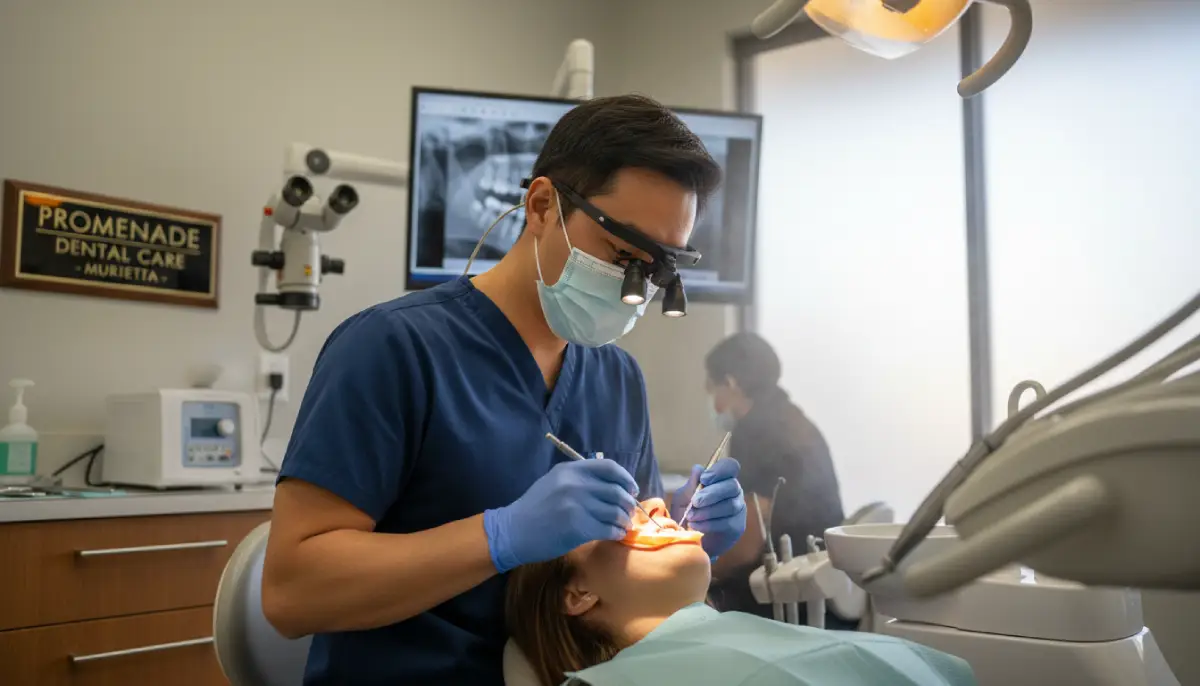
Understanding root canals
What a root canal actually is
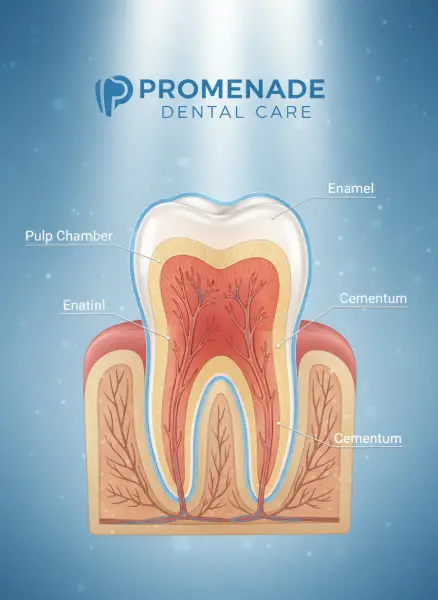
Every tooth is hollow in the middle. Under the enamel and the dentin sits a chamber of living tissue called the pulp, which holds the nerve and the blood supply that built the tooth while it was forming. Here is the part most people are never told: once a tooth is fully grown, it no longer needs that pulp. The bone and ligament holding the tooth in place keep it fed and working long after the pulp is gone.
Trouble starts when bacteria reach that inner chamber, usually through deep decay, a hairline crack, a fracture, repeated dental work on the same tooth, or an old injury. Once bacteria settle in, the pulp inflames and then dies, and it does not recover on its own. Left alone, the infection drains down the root and collects in the bone at the tip as an abscess. That is where the severe pain, the facial swelling and, occasionally, the trip to an emergency room come from. The American Association of Endodontists puts the national volume at more than 15 million root canals a year, which makes endodontics one of the most common procedures in dentistry.
The fix is straightforward. I remove the infected pulp, disinfect and shape the canal system, fill it with a biocompatible material called gutta-percha, and seal the tooth. A CEREC same-day crown then goes over the top to rebuild its strength, frequently in the same visit. The tooth stays in your mouth. The infection is gone. So is the pain that brought you in.
Why the timing matters
An infected nerve is not a problem that holds still. Every week you wait, the abscess widens and the tooth gets harder to rebuild. A tooth that needed a root canal in March can need an extraction, a graft and an implant by June.
For someone in Murrieta lying awake at two in the morning with a throbbing molar, the practical question is how fast you can get numb. The shortest route runs through my office at 26957 Date Street, not a referral waitlist forty minutes up the freeway.
- Procedure
- Root canal therapy, also called endodontic treatment
- Performed by
- Dr. Bao Nguyen, DDS, in-house at Promenade Dental Care
- Visits
- Usually one, including a same-day CEREC crown
- Chair time
- Under an hour for a front tooth, 60 to 90 minutes for a molar
- Anesthesia
- Local anesthetic; nitrous oxide or oral sedation on request
- Recovery
- Tender for two to five days, ibuprofen for most patients
- Success rate
- About 95 percent long term when the tooth is crowned
- Payment
- In network with all PPO plans, cash pricing, CareCredit at 0 percent up to six months
- Where
- 26957 Date St, Suite B4, Murrieta, CA 92563 · (951) 412-0127
Do you need one?
Seven signs the problem has reached the nerve
Not every ache means a root canal. A jolt of cold that disappears in a second or two is usually enamel wear or a small cavity. Other symptoms tell a different story. They say infection has already reached the pulp, and once it has, the window for a simple filling has quietly closed. The Mayo Clinic tooth abscess guide flags most of the same warnings.
Heat that lingers
Brief cold sensitivity is usually minor. Sensitivity to heat that keeps aching for minutes after the coffee is gone points to a pulp that is inflamed or dying.
Pain out of nowhere
A tooth that throbs at night, or with no trigger at all, usually means pressure is building inside from infection or swelling.
It hurts to bite
Sharp pressure on one specific tooth, especially a deep ache as you release your bite, often means inflammation at the root tip pressing outward into bone.
The tooth is darkening
A tooth turning gray or deep yellow next to its neighbors is a strong hint the pulp has died. The color comes from breakdown products trapped inside.
Swollen, tender gums
Localized swelling at the base of one tooth, particularly a bump that leaks a salty or bitter fluid, is a hallmark of an abscess that needs treatment, not time.
A pimple on the gum
A gum boil, or fistula, is the body improvising a drain for a chronic abscess. It does not mean the infection is healing. It means it found a way out.
An old injury
A tooth chipped or knocked years ago can die slowly and quietly. The nerve fades, infection accumulates, and there is often no sharp pain until it reaches a breaking point.
Recognize any of these? Call (951) 412-0127 and come in for a $20 exam with digital X-rays. I can tell you in one visit whether the nerve is genuinely involved, and in many cases start the root canal the same day rather than sending you home to come back while the tooth still hurts. If the chair itself is the problem, ask about sedation when you call.
What patients say
Murrieta patients on their root canal visits
“I had a crown and root canal done with zero pain. I was able to get in the same day. Hands down the best dental experience I’ve had — zero pain, zero wait time. Pricing is always upfront and affordable.”
Alicia A. · Google review
“Dr. Nguyen is extremely knowledgeable and professional. His most fantastic quality is that he genuinely cares about his patients. I would highly recommend him to anyone looking for a dentist who actually listens.”
Maria T. · Google review
“No upselling, easy to make an appointment, and he told me exactly what was going on without trying to scare me into unnecessary work. The pricing was fair and upfront. Significantly less than the corporate offices in Temecula.”
Jason R. · Google review
Step by step
What happens during a root canal at Promenade
Five stages, in order. Nothing here is a surprise, and I narrate as I go for anyone who would rather know than wonder.
1. Diagnosis and imaging
Digital X-rays show me the number and shape of the canals, how far the infection has traveled, and whether bone has been lost at the root tip. I confirm the nerve status with cold and electric pulp testing. The diagnosis is settled before an instrument touches the tooth, because the right answer for a recoverable nerve is a deep filling, and the right answer for a dead one is a root canal. Guessing wrong costs you time and money.
2. Anesthesia and isolation
I put topical gel on first, so even the injection is barely noticeable, then numb the tooth completely. Nitrous oxide or oral conscious sedation is available to anyone who wants it. A rubber dam then seals the tooth off from saliva and bacteria. From the moment I open the tooth, you should feel pressure and never sharpness. Raise a hand and everything stops for more anesthetic.
3. Cleaning and shaping
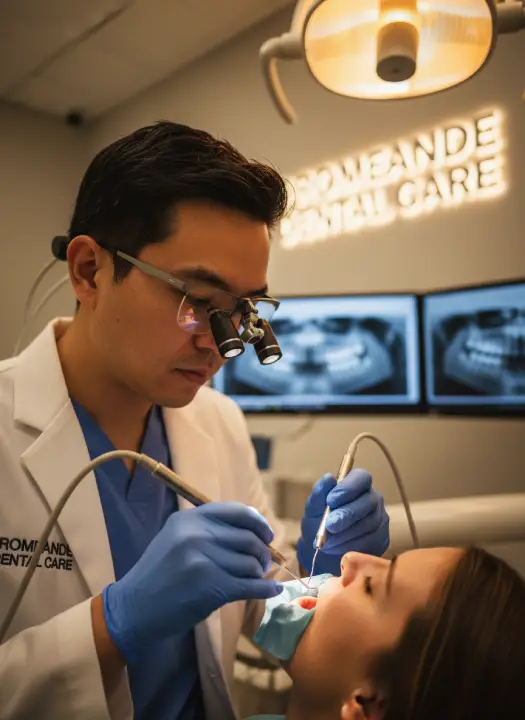
Fine, flexible endodontic files remove the infected pulp and smooth the canal walls while a sodium hypochlorite rinse flushes out bacteria and debris. An electronic apex locator measures each canal to its exact tip, so the cleaning is complete without over-instrumenting the root. This is the slow part, and it is where the outcome is decided. Missed canals are the leading cause of root canal failure, so I find, measure, clean and verify every canal before moving on.
4. Filling and sealing
The dried canals are filled with gutta-percha and sealed with adhesive cement, which creates a three-dimensional barrier against bacteria working their way back in. I close the access opening with composite, or with a temporary if the crown is going on at a later visit.
5. Same-day CEREC crown
A treated tooth has lost its internal blood supply and turns brittle, and a brittle molar without a crown eventually cracks, usually past saving. So I use an in-office CEREC milling unit to design, mill and bond a custom ceramic crown in the same appointment. Keeping your natural teeth is the foundation of long-term oral health at every age, a point the National Institute of Dental and Craniofacial Research keeps making, and a full crown is what gives a treated tooth its best shot at lasting decades.
The pain question
Does a root canal hurt? The honest answer
The reputation is worse than the reality, and it is worth knowing where the reputation came from. Those stories are decades old, from an era of cruder anesthetics and less consistent technique. In a survey by the American Association of Endodontists, patients who had actually been through a root canal were six times more likely to describe it as painless than patients who had only heard about one.
Here is what the appointment is really like. The numbing injection is the most eventful part, and topical gel takes the edge off that. Once the tooth is numb you feel vibration, steady pressure, and the odd taste of the rubber dam. A typical tooth takes 60 to 90 minutes. Most people put in earbuds and listen to something. A few fall asleep. One patient finished an entire episode of her show and was surprised when we told her we were done.
The soreness afterward is real, and I would rather be straight about it than have you find out on your own. The tooth and the tissue around it are inflamed from the infection that was just cleared out, and that settles over two to five days. Over-the-counter ibuprofen covers it for most people. When the starting infection was severe, I prescribe something stronger.
Keep the comparison honest, though. The choice is not root canal versus no pain. It is root canal versus the toothache you already have. Take out the infection and you take out the source. That is the whole point of the procedure.
Save it or pull it
Root canal vs. extraction
Some teeth cannot be rescued. A split root, severe bone loss, or so little tooth left that nothing will hold a restoration all point to extraction, and I will say so plainly. When the tooth is still restorable, a root canal and crown usually wins on cost, on timeline and on long-term oral health. Here is how the two paths compare.
| Factor | Root canal + crown | Extraction + implant |
|---|---|---|
| Natural tooth kept | Your own root stays in the jaw | The root is removed entirely |
| Jawbone health | The natural root stimulates bone as you chew | An implant preserves bone; an unfilled gap lets it resorb |
| Timeline | One to two visits, often same day with a CEREC crown | Three to nine months: extract, heal, place, integrate, crown |
| Neighboring teeth | Untouched | Untouched for an implant; a bridge would require reducing them |
| Long-term success | About 95 percent at 10 years with a crown | About 95 percent for implants at 10 years |
| Relative cost | Lower overall | Higher: extraction, graft if needed, implant, abutment, crown |
| How it feels | Full natural bite feedback, you sense pressure normally | Full function, without a real root's pressure sensation |
Each choice has its moment. I am not trying to talk you into either one. I am trying to pick the option that still looks like the right call ten years from now.
Pricing and payment
What a root canal costs in Murrieta
Price tracks the tooth. Front teeth, the incisors and canines, have a single canal and cost the least. Premolars usually have one or two. Molars carry three or four, take longer, and are priced accordingly. The crown that protects the finished tooth is a separate line item. You get one written estimate covering both before treatment starts, and the figure on that estimate is the figure you pay. No moving targets.
Most PPO dental plans classify root canal therapy as major restorative care and reimburse 50 to 80 percent after the annual deductible. Because we are in network with every PPO plan, your out-of-pocket share is usually smaller here than at an out-of-network endodontic specialist. For patients without insurance, we quote transparent cash pricing and offer CareCredit financing with up to six months at zero interest. The $20 exam gets you a diagnosis and a real number the same day, not a range pending more imaging.
One piece of arithmetic worth spelling out. A root canal and crown almost always costs less than the full extraction sequence: pulling the tooth, a bone graft if the socket needs one, a dental implant, an abutment, and finally an implant crown. That road also runs three to nine months instead of one or two visits. Saving the tooth usually saves the calendar and the wallet at the same time.
No insurance? Call (951) 412-0127 and ask what a root canal and crown costs in cash. We will give you the real number over the phone, with no surprise line items later. A CareCredit application takes about five minutes and approvals are often instant.
Your dentist
Dr. Bao Nguyen, DDS, doing root canals in Murrieta since 2010
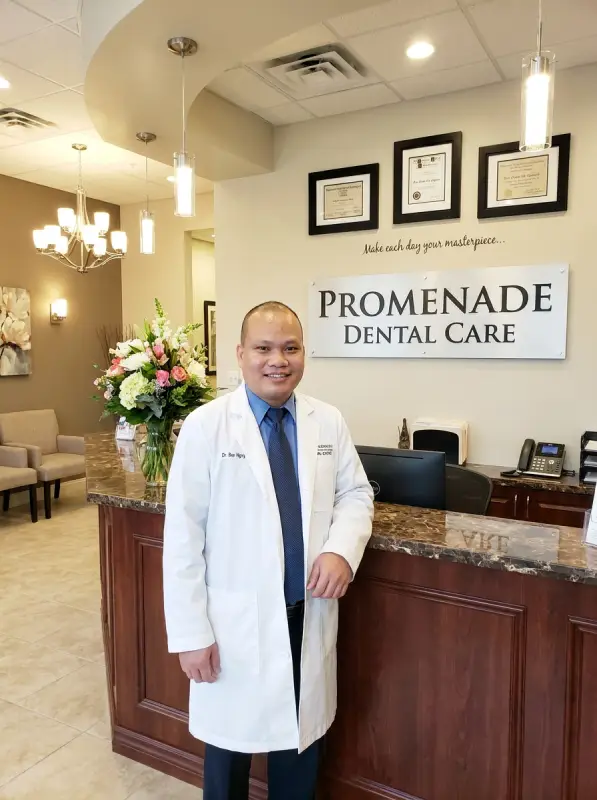
Plenty of general offices around the Temecula Valley send their root canals to an outside endodontist. That means a second appointment, a second bill, a second wait, and a specialist who never saw your original X-rays and will probably never see you again.
I keep endodontics in-house because my training prepared me for it. After earning my degree at the UCLA School of Dentistry, I completed an Advanced Education in General Dentistry residency at Naval Hospital Camp Pendleton, where root canals were part of the everyday caseload. Active duty Marines are not referred out to civilian specialists. The residency-trained dentist does the root canal, often the same day the Marine shows up in pain, because military dental readiness leaves no room for multi-week waitlists. Ten years in the Navy Dental Corps, including deployments to Kuwait and Iraq, taught me to work quickly without cutting corners. I opened the Date Street practice in 2010 and have run it the same way since.
When a case genuinely runs past general practice endodontics, whether that is severely calcified canals, a complicated retreatment, or an apicoectomy on a stubborn back tooth, I refer to an endodontist I trust and manage the handoff myself. That referral is a clinical judgment, not a reflex. The default is treating the tooth here.
Between me and my team we can walk you through the whole thing in English, Spanish or Vietnamese, which matters in a community as mixed as southwest Riverside County. People understand a procedure better in the language they think in.
Patient experience
Why Murrieta patients stay with us
“I have been a patient of Dr. Nguyen’s for over a decade. Doctor and staff are incredibly wonderful — kind, caring, compassionate, yet professional. They go above and beyond to care for their patients.”
Debby M. · Google review
“First visit, and it was a great experience — yes, really. He kept me informed, was accommodating, and actually listens. Competent, quality dental care at a reasonable price.”
William K. · Google review
“I don’t have dental insurance and was dreading the cost. Dr. Nguyen’s office was completely upfront about pricing — no hidden fees, no pressure. Significantly less than the corporate offices in the area.”
Sandra L. · Google review
Location and hours
Root canal care for southwest Riverside County
Promenade Dental Care is at 26957 Date Street, Suite B4, Murrieta, CA 92563, on the Date Street corridor near Clinton Keith Road and minutes from both the I-15 and the I-215. We keep same-day and next-day appointments open for patients in acute pain, and people in pain go to the front of the schedule. If you are looking for a root canal dentist near Temecula, an emergency appointment in Murrieta, or affordable root canal treatment anywhere in the valley, start with a phone call.
We see patients every week from Murrieta, Temecula, Menifee, French Valley, Winchester, Wildomar, Lake Elsinore, Canyon Lake, Fallbrook and Hemet. From most of southwest Riverside County you are about twenty minutes from the chair.
Office hours
| Monday | 9:00 AM – 5:00 PM |
| Tuesday | 9:00 AM – 5:00 PM |
| Wednesday | 9:00 AM – 3:00 PM |
| Thursday | 9:00 AM – 5:00 PM |
| Friday | 9:00 AM – 3:00 PM |
| Saturday | By appointment & emergencies |
| Sunday | Closed |
Frequently asked questions
Root canal questions I get asked most
Does a root canal hurt?
No, and I say that as the person holding the handpiece. The tooth is completely numb before I open it, so what you feel is pressure and vibration rather than pain. Most of my Murrieta patients tell me afterward that it felt like a long filling. If you feel anything sharp, you raise a hand and I stop and add more anesthetic. That rule does not change. The pain people associate with root canals is almost always the infection they walked in with, not the treatment that removed it. The tooth is usually tender for two to five days afterward, and ibuprofen handles it for most people. The American Association of Endodontists has found that patients who have actually had a root canal are about six times more likely to call it painless than people who have only heard the stories.
How long does a root canal take?
A front tooth with one canal is usually finished in under an hour. A molar with three or four canals runs 60 to 90 minutes, because every canal has to be found, measured, cleaned and sealed on its own. If I place a same-day CEREC crown right afterward, add about another hour for the scan, the design, the milling and the bonding. Most patients at Promenade Dental Care sit down once and leave with the root canal finished and the permanent crown already cemented.
Can a root canal be done in one visit?
Usually, yes. I do the root canal and mill the CEREC crown in the same office on Date Street, so most patients finish the diagnosis, the treatment and the permanent crown in a single appointment. When a tooth has a large active infection I sometimes split it across two visits so the tissue can settle first, but that is the exception rather than the rule. A one-visit finish matters most when the tooth is still sore and the last thing you want is another trip back.
Do I need a crown after a root canal?
On a back tooth, almost always. A treated tooth loses its blood supply from the inside and gets more brittle over the years, and a full-coverage crown is what keeps it from splitting. Published survival data is consistent on this point: root canal teeth restored with crowns last considerably longer than ones left with only a filling. I use CEREC to design, mill and bond a ceramic crown the same day, so you leave protected instead of wearing a temporary for two or three weeks. A front tooth with very little damage can sometimes get by with a bonded filling, and I will tell you if yours is one of them.
Is a root canal better than pulling the tooth?
If the tooth can still be restored, saving it is almost always the better choice. Your own root keeps stimulating the jawbone, you skip the three to nine month timeline of an extraction and implant, and you keep the natural pressure feedback that only a real root gives you. Extraction is the honest answer when a tooth has a vertical root fracture, severe bone loss around it, or too little structure left to hold a restoration. I look at your X-rays and tell you which one you actually have. I will not talk you into a root canal on a tooth that belongs out, and I will not pull a tooth I can still save.
How much does a root canal cost in Murrieta?
It depends on the tooth. A single-canal front tooth is the least expensive. A three or four canal molar costs more, because it takes longer and there is more to do. The crown that protects the tooth afterward is billed separately. Before we start, my office gives you one written estimate covering the root canal and the crown together, and the number on that estimate is the number you pay. We are in network with every PPO dental plan, we quote transparent cash pricing for patients without insurance, and CareCredit financing is available with up to six months at zero interest. Call (951) 412-0127 and we will give you a real number over the phone.
Does dental insurance cover root canals?
Most PPO plans classify root canal therapy as major restorative care and pay 50 to 80 percent after your annual deductible, though the exact split varies by plan and by which tooth it is. Because we are in network with all PPO plans, your share here is usually lower than it would be at an out-of-network endodontic specialist. My front office verifies your specific benefits before treatment, so you see your real out-of-pocket cost in writing before I pick up an instrument.
How soon can I get a root canal appointment in Murrieta?
We hold same-day and next-day openings for patients in real pain, so call (951) 412-0127 first thing if you can. In many cases I can examine you, take digital X-rays, confirm the diagnosis and start the root canal in that same visit. That is the practical reason I keep endodontics in-house: you are not waiting two weeks for a specialist appointment while an abscess gets bigger.
Can a root canal fail?
It can, but it is not common. Root canal therapy succeeds in roughly 95 percent of cases. When one does fail, it usually traces back to a canal that was never found, a seal that broke down over time, or a new crack in the tooth. Caught early, retreatment often saves it. When retreatment is not enough, the remaining options are an apicoectomy or extraction. I check treated teeth with periodic X-rays at your regular visits, so problems turn up while they are still fixable.
How long does a root canal last?
Decades, when the tooth gets a crown and normal care, and many root canal teeth last the rest of a patient's life. What shortens that lifespan is predictable: skipping the crown, new decay at the margin of the crown, or clenching and grinding that cracks the tooth. Brush and floss the treated tooth the way you would any other, keep your checkups so I can watch it on X-ray, and wear a nightguard if you grind.
Can I drive myself home after a root canal?
Yes, if you have local anesthesia only, which is the standard. You can drive, go back to work, and eat once the numbness fades. Nitrous oxide clears your system in a few minutes, so patients who choose it usually drive themselves too. Oral conscious sedation is the exception. For that you need someone to drive you, and you should plan on resting the rest of the day.
What can I eat after a root canal?
Wait until the numbness is completely gone before you eat anything, so you do not bite your cheek or tongue. If you left with a same-day CEREC crown, the tooth is fully restored and you can eat normally, though most people prefer softer food for a day while the tenderness settles. If you left with a temporary filling instead, chew on the other side and skip anything sticky or hard until the crown is bonded. Warm salt water rinses feel good for the first couple of days.
What happens if I ignore a tooth that needs a root canal?
It gets worse, not better. The infection works into the bone around the root, the abscess grows, and the tooth becomes harder to save with every week that passes. A problem that started as a straightforward root canal turns into an extraction, and that extraction may need a bone graft before an implant is even possible. In rare but well documented cases, a dental infection spreads to the jaw, neck, airway or bloodstream and becomes a medical emergency. Waiting costs more money and carries more risk than dealing with it now. If your face is swelling or you are having trouble swallowing or breathing, go to the emergency room rather than waiting for morning.
Do root canals cause illness elsewhere in the body?
No. That claim traces back to focal infection theory, discredited research from the early 1900s that used methods no laboratory would accept today. There is no credible evidence linking root canal treatment to cancer, heart disease or any other systemic illness, and the American Dental Association and the American Association of Endodontists are both clear on the point. The real health risk runs the other way: leaving an infected tooth untreated keeps live bacteria sitting in your jawbone.
Why do you perform root canals in-house instead of referring me to an endodontist?
Because my training prepared me to, and because keeping it under one roof is better for the patient. I completed an Advanced Education in General Dentistry residency at Naval Hospital Camp Pendleton, where root canals were part of the everyday caseload. Active duty Marines were not sent across town to civilian specialists. Doing the diagnosis, the root canal and the crown in one office means one set of X-rays, one estimate, and often one appointment. When a case genuinely runs past general practice endodontics, such as severely calcified canals, a complicated retreatment, or an apicoectomy on a difficult back tooth, I refer you to an endodontist I trust and handle the coordination myself.
What is the difference between a root canal and a deep filling?
Whether the nerve inside the tooth is still alive and able to recover. If the decay is deep but the pulp can heal, a condition called reversible pulpitis, a deep filling is enough. Once bacteria have infected or killed the pulp, that is irreversible pulpitis, and no filling will fix it. The diseased tissue has to come out. This is why I confirm the diagnosis with cold and electric pulp testing plus digital X-rays before recommending either one. Treating the wrong condition wastes your money and puts you right back in the chair.
Tooth pain that will not let up?
Book a $20 exam with digital X-rays. I will find the problem, tell you honestly whether a root canal is needed, and hand you a written quote before anything is done.
(951) 412-0127 Request an appointment26957 Date St, Suite B4, Murrieta, CA 92563