
Bad Breath · Murrieta, CA
What Causes Bad Breath and How to Get Rid of It for Good
Breath that comes back an hour after you brush has a source. My job is to find it.
If you've gone through mints, gum, and every mouthwash on the shelf and the smell keeps coming back, there's a place in your mouth producing it. In most people I see, it's a gum pocket, a decayed tooth, a dry mouth, or the back of the tongue. A $20 exam with digital X-rays at my Date Street office tells us which one, and what fixing it costs, in writing.
Start Here
What Causes Bad Breath? Bacteria, Sulfur, and a Place You Can Find
Nobody has ever walked into my office with bad breath that had no cause. They've walked in with a cause nobody bothered to look for.
Patients usually bring this up at the very end of a visit, almost in a whisper, after they've already stood up to leave. I get it. It's an embarrassing thing to say out loud. But from my side of the chair, bad breath is a symptom like any other. It tells me something is going on, and it usually tells me roughly where.
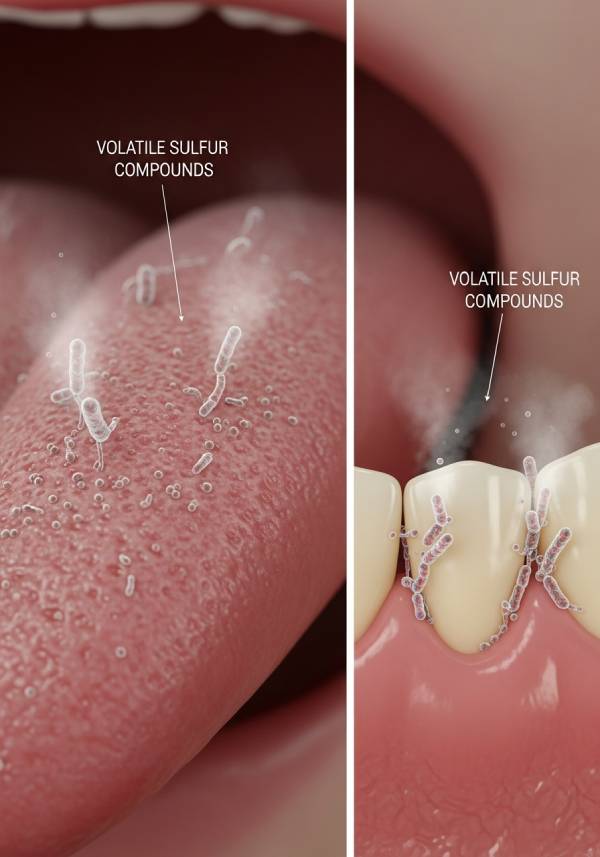
The smell itself is chemistry. Bacteria that live without oxygen break down proteins from food, dead cells, and drainage from the sinuses, and they give off volatile sulfur compounds. Hydrogen sulfide and methyl mercaptan make up most of them. That's the same family of gases as rotten eggs, which is why a mint can't win against an active source.
Research reviews put the share of bad breath that starts inside the mouth at 80 to 90 percent, mostly from the tongue coating and gum pockets. The Cleveland Clinic gives the same advice I do: if good brushing and flossing haven't fixed it, see a dentist before you buy another product.
Morning breath vs. chronic bad breath
Everybody wakes up with some odor. Saliva slows way down while you sleep, bacteria multiply overnight, and a glass of water plus two minutes with a toothbrush clears it. That's normal and I don't treat it.
Chronic bad breath, which dentists call halitosis, behaves differently. It comes back within an hour or two of brushing, it often gets worse as the day goes on, and nothing from the drugstore touches it for long. That pattern means there's a reservoir of bacteria somewhere your toothbrush doesn't reach.
Where the Smell Lives
The Four Sources Behind Most Bad Breath
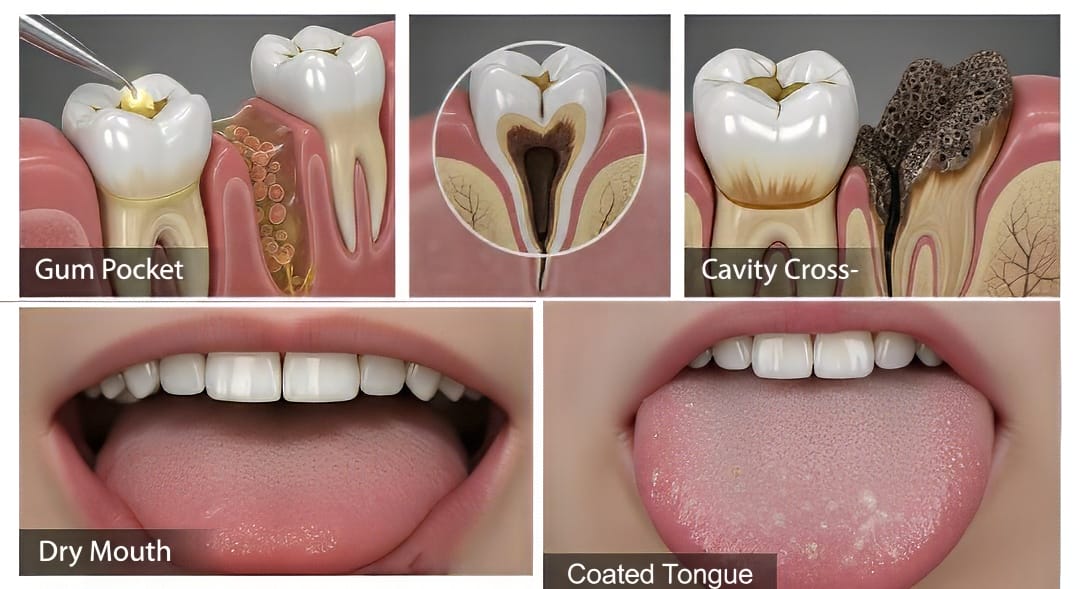
When someone tells me their breath is a problem, I'm checking four places. Each one smells a little different, acts a little differently through the day, and gets fixed a different way. That's why I don't hand anyone a treatment until I know which one it is.
Gum disease
This is the one I find most often. Early gum disease, gingivitis, shows up as puffy gums that bleed when you floss. Left alone, the infection works under the gumline and opens pockets 4mm deep or more. Those pockets are low-oxygen spaces where sulfur-making bacteria do well, and a toothbrush never gets in there. That's why the smell is back an hour after you brush.
Tooth decay
A cavity is a hole full of bacteria that traps food. When decay reaches the nerve, the tissue inside the tooth starts to break down, and patients describe the smell as a rotten tooth. It tends to sit on one side, and no amount of brushing helps because the source is sealed inside the tooth. It's also the easiest cause on this list to fix.
Dry mouth
Saliva washes the mouth, carries oxygen, and fights bacteria. Cut it back and odor follows within hours. Antihistamines, decongestants, blood pressure pills, and antidepressants are common culprits, and the American Dental Association lists many more. Mouth breathing, snoring, and simply not drinking enough water in a Murrieta August all do it too.
The back of the tongue
In patients with healthy gums and no cavities, the tongue is usually the answer. The back third is rough and low on oxygen, and it holds onto dead cells, food, and drainage in a film you can sometimes see as a white or brown coating. Rinses just perfume it. Scraping removes it.
The Most Frustrating Version
Bad Breath Even After Brushing: What the Pattern Tells Me
Bad breath even after brushing is actually one of the most useful clues I get. Brushing cleans the tooth surfaces and the front of the tongue. If the odor is back in an hour anyway, the source is somewhere the bristles never touch. The timing and the location narrow it down fast.
| What you notice | Most likely source | What I check first |
|---|---|---|
| Odor plus gums that bleed when you floss | Gum pocket infection | Pocket depths around every tooth |
| Sharp smell or bad taste on one side | Decay, a leaking filling, or an infected tooth | X-rays and filling and crown edges |
| Worst on waking and after long dry stretches | Dry mouth | Medication list, mouth breathing, saliva |
| White or brown coating on the back of the tongue | Tongue bacteria | Tongue coating and your cleaning routine |
| Recurring bad taste around a back molar | Partly erupted wisdom tooth | The gum flap and an X-ray of the area |
Two days of jotting down when it's worst (on waking, after meals, all day) makes the exam faster and more accurate. Bring the notes. I'll read them.
The Other 10 to 20 Percent
Bad Breath From the Stomach, and Other Causes Outside the Mouth
A lot of people who search for bad breath from the stomach land on scary answers. Here's the calmer version. True stomach breath is uncommon because the esophagus stays closed except when you swallow. Most patients who are sure it's digestive turn out to have a coated tongue or a gum pocket.
There are real exceptions. Acid reflux can carry a sour odor up, usually worse after meals. Tonsil stones, small white lumps of debris in the folds of the tonsils, are covered in the same sulfur-making bacteria as gum pockets. Chronic post-nasal drip feeds the bacteria on the tongue from above. The Mayo Clinic's overview of bad breath covers these well.
A few breath changes belong with your physician, and the smell itself is the clue. A fruity or nail-polish smell can go along with uncontrolled blood sugar. An ammonia-like smell can go along with kidney problems. These are rare, but they're the reason I check the mouth first. Either I find the source, which is what usually happens, or I rule the mouth out and send you to your doctor with my findings in hand.
When Breath Is the Warning
When Bad Breath Means Book a Visit This Week
While You Wait for Your Visit
How to Get Rid of Bad Breath at Home: What Actually Helps
None of this cures bad breath caused by a gum infection or a bad tooth. That takes treatment. But each step lowers the bacteria count and the smell while you get the real fix on the calendar, and they're the same habits that keep breath fixed afterward.
1Scrape your tongue
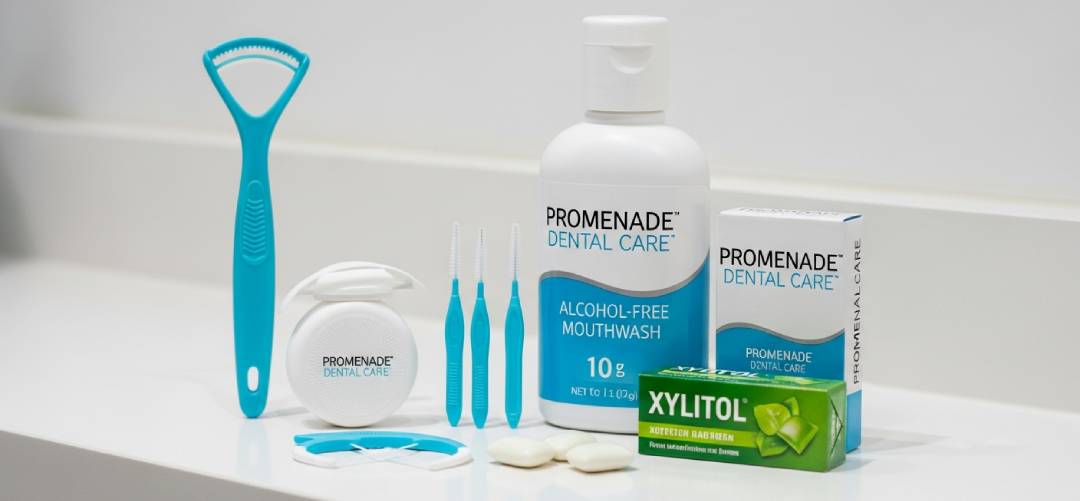
Use a real scraper. Start at the very back, pull forward with steady pressure, rinse, and repeat three to five times. Do it before you brush so the film comes off instead of getting spread around.
2Sip water all day
Saliva runs on hydration. Small sips through the day beat big glasses at meals, especially in our dry summers.
3Floss before bed
Saliva nearly stops overnight, so anything stuck between your teeth sits there for eight hours. The bedtime floss is the one that changes morning breath the most.
4Skip alcohol rinses
Alcohol mouthwash covers odor for a half hour and dries the tissue out, which feeds the problem. An alcohol-free rinse with zinc or cetylpyridinium chloride (CPC) helps without that backfire.
5Chew sugar-free gum
Chewing after meals gets saliva flowing again. Xylitol gum is a good choice. Sugared gum or mints feed the bacteria you're trying to starve.
6Track the pattern
Note when it's worst and whether brushing changes it. That record points me toward dry mouth, decay, or gums before the exam even starts.
The daily routine that keeps breath fixed after treatment
Diagnosis First
Chronic Halitosis Treatment in Murrieta: How I Find It and Fix It
Some offices answer every breath complaint with the same cleaning. I'd rather know what I'm treating. Chronic halitosis treatment in my office goes in a set order: measure, find the source, then treat that source and nothing extra.
Step one: the $20 exam
Every workup starts with my comprehensive exam and digital X-rays. I measure the gum pockets around every tooth and note where they bleed. I check the edges of every filling and crown, look for decay on the X-rays, look at the tongue, and go over your medications for anything that dries the mouth. By the end, the question isn't why your breath smells. It's which pocket, tooth, or habit is causing it.
Step two: treat the actual source
If it's the gums, most people start with my $95 ultrasonic cleaning. When the pockets are deeper, a full mouth deep cleaning is $320 for all four quadrants, and it treats the breath and the bone loss at the same time because it's the same bacteria. A decayed tooth gets the filling or root canal it needs. A wisdom tooth trapping food under a gum flap gets evaluated for removal. Dry mouth gets a plan built around what's causing it.

When I won't treat anything. Sometimes the exam comes back clean: healthy gums, no decay, a light tongue coating. When that happens I'll show you a better tongue-cleaning routine and tell you honestly that you don't need a procedure. If the mouth is clear and the smell is still there, I'll write up what I found so your physician can look at reflux, sinuses, or blood work without starting from scratch.
Every fee is in writing before we start. I accept PPO plans and I'm in-network with Delta Dental PPO, Cigna, MetLife, Guardian, Aetna, and United Concordia. CareCredit is available for larger work.
$20
Exam + Digital X-Rays
Checks all four sources, insured or not
$95
Ultrasonic Cleaning
The usual first step for gum-related odor
$320
Full Mouth Deep Cleaning
All four quadrants, when pockets call for it
Who Wrote This
Reviewed by Dr. Bao Nguyen, DDS
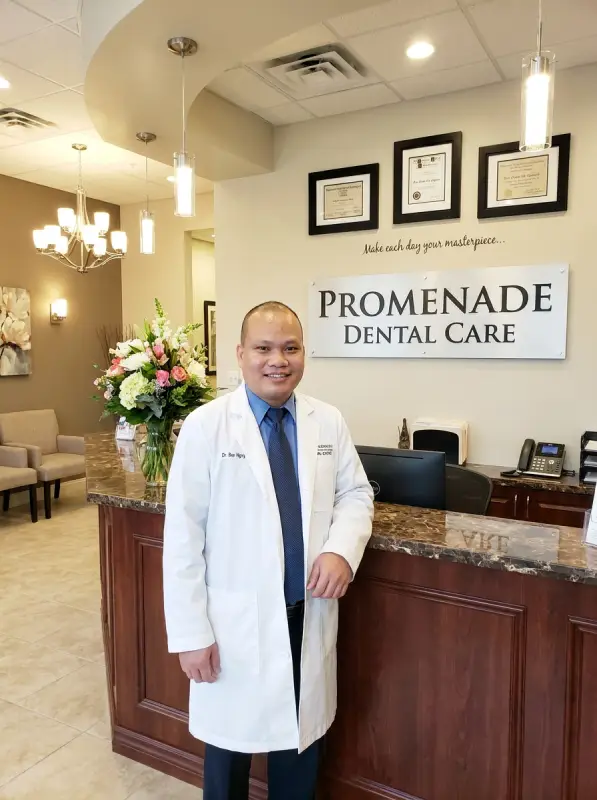
I trained at the UCLA School of Dentistry and then spent ten years in the U.S. Navy Dental Corps, including an Advanced Education in General Dentistry residency at Naval Hospital Camp Pendleton and deployments to Kuwait and Iraq. On deployment, sailors and Marines went months between cleanings, and I saw a lot of gum infection that started with a complaint about breath. That's where I learned to trust the probe and the X-ray more than how a mouth looks from the outside.
I opened Promenade Dental Care in 2010 and I still see every patient myself. People from Murrieta, Temecula, French Valley, Menifee, and Winchester tend to say the same thing in their reviews: I explain what I see before I recommend anything, and I don't sell work they don't need. That's how a bad breath visit should go, too.
Related Care
Treatments That Fix the Source
$20 Exam & X-Rays
The starting point for any breath complaint: pockets, decay, fillings, tongue, and medications.
Gingivitis Treatment
Bleeding gums and early odor, caught while the damage is still reversible.
Full Mouth Deep Cleaning
$320 for all four quadrants when pockets have formed below the gumline.
Patient Reviews
What Patients Say About Straight Answers Here
I had a really great experience at Promenade Dental Care. The doctor took the time to explain everything clearly, showed me exactly what was going on, and made sure I understood the treatment plan without making me feel rushed or pressured. I need quite a bit of dental work, so I was honestly expecting the cost to be overwhelming, but the pricing was beyond affordable compared to other quotes I’ve received. That alone was such a huge relief. I felt comfortable, informed, and confident in the plan, and I will absolutely be completing my treatment here. I’m very happy I found this office and would definitely recommend them to anyone looking for a dentist who is thorough, honest, and reasonably priced
— Courtney Sussman · Google review
The office treats you with respect and dignity. The dentist / Owner is informative and concerned with the patient and their needs. He tells the truth. No sells pitch just the right procedure advised with the patient as his prime concern. A rarity today, honesty and concern. Highly recommend. Larry Hilliard
— Larry Hilliard · Google review
Great Dentist. He answers all your questions. Never in a rush.
— Diana Javier · Google review
Bad Breath FAQs
Bad Breath: Questions Patients Ask Me
How do I get rid of bad breath permanently?
Two things together. First, treat the source: a cleaning or deep cleaning for gum pockets, a filling or root canal for a bad tooth, or a plan for dry mouth. Second, keep the bacteria from coming back with daily tongue scraping, flossing before bed, steady water, and an alcohol-free rinse. Products alone only cover the smell for a while.
Does gum disease cause bad breath?
Yes, and it's the most common cause of chronic bad breath I see. Infected gum pockets are low-oxygen spaces where sulfur-making bacteria grow, and they're the same bacteria wearing away the bone around your teeth. Even early gingivitis can cause noticeable odor. If your breath is off and your gums bleed when you floss, I treat that as gum disease until the exam says otherwise.
Can cavities cause bad breath?
Yes. A cavity traps food and bacteria, and when decay reaches the nerve the tissue inside the tooth breaks down and smells strongly. It's usually on one side and brushing doesn't help, because the source is inside the tooth. A filling, or a root canal if the nerve is infected, removes the smell along with the decay, usually within days.
Can wisdom teeth cause bad breath?
Yes, and it's the cause I see missed most often in people who otherwise take great care of their teeth. A wisdom tooth that has only partly come in sits under a flap of gum that traps food and bacteria where nothing at home can clean it. That causes a recurring bad taste and a local odor. If the tooth can't come in cleanly, removal is usually the lasting fix, and I can evaluate it on the same $20 X-rays.
Is bad breath from the stomach real?
Less often than people think. The esophagus stays closed except when you swallow, so most breath people blame on the stomach is really the tongue or the gums. Acid reflux can carry odor up after meals, and tonsil stones and post-nasal drip can add to the problem. I check the mouth first. Either I find the source or I send you to your physician with my findings.
Why is my morning breath so much worse?
Saliva slows way down while you sleep, so bacteria get eight hours to multiply, and mouth breathing or snoring makes it worse. Some morning breath is normal for everyone. Morning breath that's still there after you brush, or comes back during the day, points to gum disease, decay, or chronic dry mouth, and that's worth an exam.
Can mouthwash cure bad breath?
No. Mouthwash covers odor for a short time without removing the bacteria making it, and alcohol-based rinses can make things worse over time by drying the mouth. An alcohol-free rinse with zinc or CPC is a reasonable part of a daily routine, but the cure is finding and treating the source.
What does chronic halitosis treatment involve?
It starts with diagnosis. I measure the gum pockets, take digital X-rays for decay, check the edges of fillings and crowns, look at the tongue, and review your medications for anything that dries the mouth. Then the treatment matches what I find: a cleaning or deep cleaning for gum-related odor, a filling or root canal for a bad tooth, a saliva plan for dry mouth, or a written referral to your physician if the mouth is clear.
How much does it cost to find out what's causing my bad breath in Murrieta?
Twenty dollars. That's the exam with digital X-rays, and it checks all four main sources. You don't need insurance, and anything I recommend comes with a written price before we start. The most common first treatment, my ultrasonic cleaning, is $95. A full mouth deep cleaning, when the pockets call for it, is $320.
When is bad breath a sign of something serious?
Come in soon if bad breath comes with bleeding gums, loose teeth, pain or swelling in one spot, or a sore that won't heal, because those point to active infection or advancing gum disease. See your physician if the smell itself is unusual: a fruity smell can go with uncontrolled blood sugar and an ammonia-like smell with kidney problems. Both are rare, but they're why the workup starts with an exam instead of another product.
Stop Covering It Up. Find the Source.
A $20 exam with digital X-rays shows which of the four sources is behind your bad breath and what fixing it costs, in writing. If you don't need treatment, I'll tell you that too.
(951) 412-0127 Request an Appointment OnlinePromenade Dental Care · Dr. Bao Nguyen, DDS
26957 Date St., Suite B4, Murrieta, CA 92563
Serving Murrieta, Temecula, French Valley, Menifee, Wildomar & Winchester