
Periodontal Care · Murrieta, CA
Gum Disease Treatment in Murrieta
From bleeding gums to bone loss — and an honest answer about which one you have
Gum disease is fully reversible at the start and permanent after a certain point. This page explains exactly where that line sits, what treatment costs on each side of it, and how laser periodontal therapy fits in. I will examine your gums and tell you honestly which side you are on, because for a lot of people the right answer is a cleaning and nothing more.
The Line That Matters
Gingivitis Is Reversible. Periodontitis Is Not.
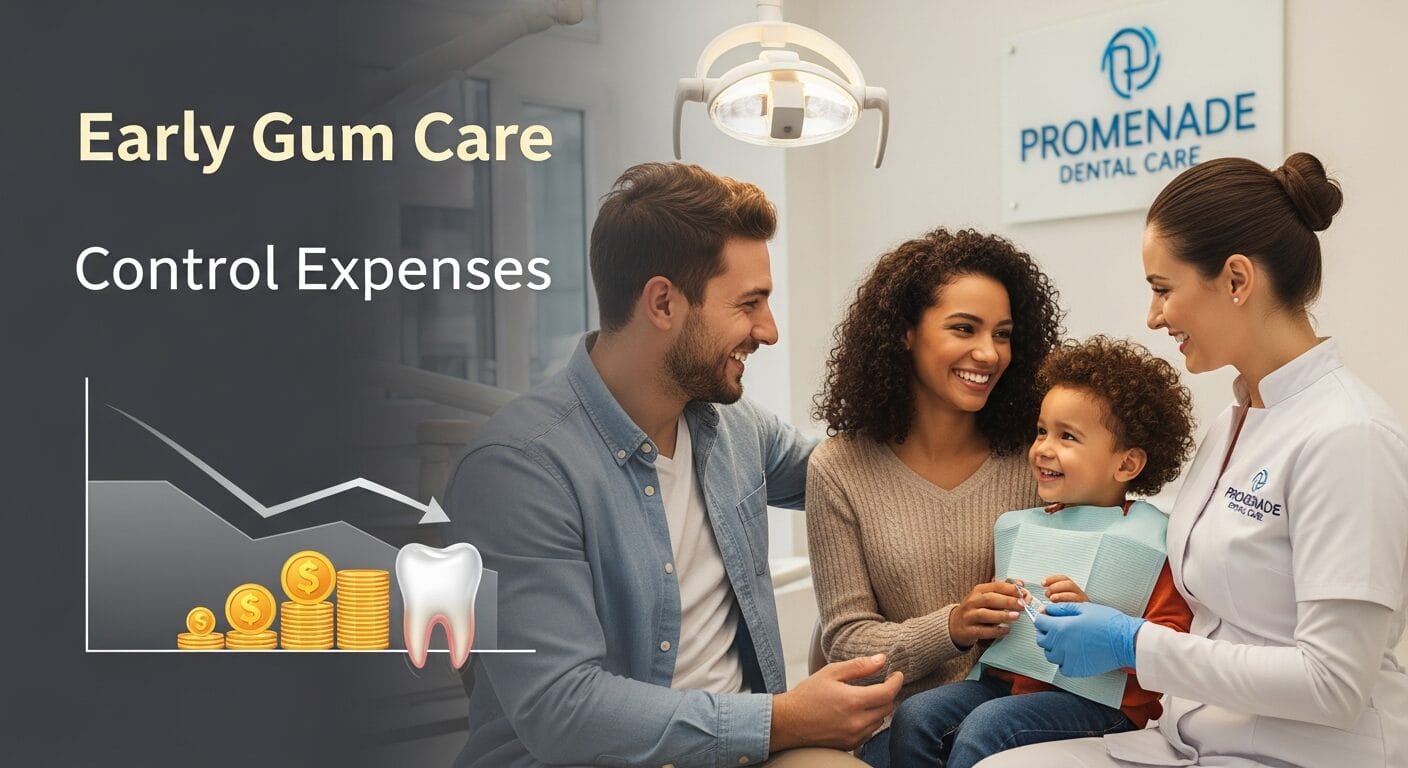
Gum disease runs on a track with one exit. In the first stage, gingivitis, plaque bacteria inflame the soft tissue at the gum line: the gums get puffy and bleed easily, but the bone holding your teeth in place is untouched, and the tissue heals once the plaque and tartar are gone. That stage has its own page. Gingivitis treatment in Murrieta covers the symptoms, the causes, how I confirm it has not progressed, the pregnancy and diabetes cases, and what a $20 exam and $95 cleaning do for it. This page picks up from the line that page describes.
Once the infection moves below the gum line and starts dissolving bone, the condition is periodontitis, and the exit is closed. Treatment from that point forward is about stopping the loss and managing it for life, not reversing it. Bone that is gone does not grow back on its own. Everything expensive about gum disease lives on that side of the line — and the CDC puts roughly four in ten American adults aged 30 and older on that side already.
Here is the part that catches people out: you cannot tell which stage you are in by looking in a mirror. Red, puffy, bleeding gums look identical either way. Only pocket measurements and X-rays showing bone level settle it, and that takes about ten minutes in a chair.
- Stage 1 — Gingivitis
- Gum tissue inflamed, no bone loss. Fully reversible, usually in about two weeks.
- Stage 2 — Periodontitis
- Infection below the gum line destroying bone and ligament. Halted and managed, never reversed.
- How to tell
- Periodontal probing plus digital X-rays. Nothing you can see at home distinguishes them.
- Early treatment
- An exam and a professional cleaning. Often nothing more.
- Later treatment
- Scaling and root planing by quadrant, sometimes laser therapy or gum surgery, then lifelong maintenance.
- What it risks
- Periodontal disease and decay are the two leading causes of adult tooth loss.
Know the Tells
The Warning Signs Almost Everyone Talks Themselves Out Of
Gum disease is painless at the stage where it is cheap to fix. That is the trap. There is no toothache to force the issue, so the signs get explained away — brushed too hard, new floss, that one sharp chip. By the time something actually hurts, the conversation has changed.
Healthy gums do not bleed
Not from brushing, not from flossing, not once in a while. If yours do, that is inflammation — and inflammation this early is the version that goes away. Healthy tissue is firm, pale pink, and hugs the tooth tightly. Gingivitis changes all three: the tissue turns red or darker, looks puffy and shiny along the margin, and pulls back slightly so teeth start to look longer.
Bad breath that returns within an hour of brushing is another common tell, and one people rarely connect to their gums.
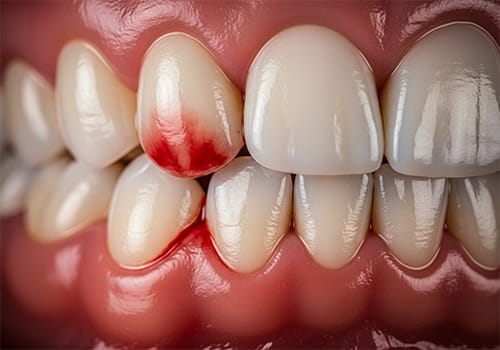
Smoking, diabetes, certain medications, pregnancy, crowded teeth, and family history all raise your risk of developing gum disease and of it progressing faster once it starts. None of them makes it inevitable. What they do is raise the standard: if two or three apply to you, a shorter recall interval is not optional maintenance, it is the treatment plan.
The Economics
What Early Gum Care Costs vs. What Waiting Costs
The price gap here is not a markup, it is a difference in what has to be done. Early, you are paying someone to clean surfaces they can see. Late, you are paying for work below the gum line, quadrant by quadrant, often across multiple appointments, sometimes with laser therapy or surgery on top.
| Caught early (gingivitis) | Caught late (periodontitis) | |
|---|---|---|
| What is happening | Plaque and tartar irritate the gum line. Bone is intact. | Bacteria are below the gum line. Bone support is being lost. |
| Typical care | Exam, digital X-rays, professional cleaning, a better home routine. | Scaling and root planing by quadrant, sometimes laser therapy, antibiotics, or gum surgery. |
| Visits | One, occasionally two. | Several, plus lifelong maintenance at a shorter interval. |
| Reversible | Yes. The tissue heals. | No. Treatment halts the loss; it does not rebuild it. |
| Cost at our office | $20 exam with X-rays, $95 ultrasonic cleaning — published, no upselling. | Quoted after diagnosis. Periodontal care runs well above a routine cleaning. |
| Downstream risk | None, if the routine holds. | Tooth loss, and then implants, bridges, or dentures to replace what was lost. |
Notice the last row. The real cost of late gum disease usually is not the periodontal treatment — it is the dental implant or bridge that replaces the tooth the periodontal treatment could not save. That is the number people do not see coming, and it is the one early gum care actually prevents.
The Standard of Care
How Gum Disease Is Normally Treated
For early disease the first line of defense is a professional cleaning. The American Academy of Periodontology is direct about this: daily hygiene plus regular visits is the foundation that stops gum disease before it advances. A hygienist or I clear the plaque and tartar a toothbrush cannot reach, above and below the gum line. A thorough $95 ultrasonic cleaning is usually where that starts.
When the infection has settled into deeper pockets, the standard treatment is scaling and root planing. Scaling lifts hardened tartar and bacteria off the tooth and out from under the gum. Root planing smooths the root surfaces so the gum can reattach cleanly. This is a non-surgical deep cleaning, it resolves a great many cases on its own, and I want to be clear that it is not a consolation prize. It works.
For severe periodontitis, some patients need traditional gingival flap surgery, where the gums are opened and folded back so the roots can be cleaned, then sutured into place. It also works. It also means incisions, stitches, and a longer, less comfortable recovery. Laser periodontal therapy is the gentler alternative worth understanding, and the earlier you come in, the more likely it is that none of this is necessary.
The Minimally Invasive Option
What Laser Periodontal Therapy Actually Is
Laser periodontal therapy uses a focused dental laser to remove infected, inflamed gum tissue and the bacteria living deep in periodontal pockets, without scalpels and without sutures. Rather than cutting tissue away, the laser disinfects the pocket, and with certain protocols it encourages the gum and the structures beneath it to reattach to the tooth.
The appeal for most of my patients is practical. There is far less bleeding during the procedure, which matters a great deal if you take a blood thinner or manage a chronic condition. There are no stitches to place or take out. And because the laser preserves healthy tissue instead of trimming it back, it does not change your bite or the shape of your smile. Almost everyone tells me afterward that it was easier than they had braced for.
Treatment is typically finished in one or two visits. It is not right for every mouth, and I get to that honestly below. But for early to moderate gum disease it is a legitimately gentler route to the same destination: stopping the infection and giving your gums a chance to heal.
Minimally invasive
No scalpels and, in most cases, no sutures. Less trauma to the gum tissue, less discomfort, and faster healing than conventional gum surgery.
Precise and selective
The laser targets diseased tissue and bacteria while leaving healthy gum intact, which protects the natural contour of your smile.
Regenerative potential
Protocols such as LANAP are FDA-cleared to support regeneration of bone and the connective tissue that anchor your teeth.
Less bleeding, less downtime
Patients report noticeably less bleeding and swelling, and most are back to a normal routine the same day or the next.
Laser therapy compared to traditional gum surgery
Both approaches can stop gum disease. They differ in how much they ask of you to get there, and in how much evidence sits behind them.
| Factor | Laser periodontal therapy | Traditional flap surgery |
|---|---|---|
| Invasiveness | No scalpels or sutures in most cases | Incisions and stitches required |
| Discomfort and bleeding | Less bleeding, swelling, and soreness | More post-operative discomfort |
| Recovery time | Often same-day or next-day return to routine | Longer healing period |
| Tissue regeneration | FDA-cleared with the LANAP protocol | Limited regenerative claims |
| Effect on bite and smile | No change to bite or appearance | Gum contour may change |
| Cost and coverage | Higher cost; carrier coverage varies | More widely covered by insurance |
| Evidence base | Promising; results mixed against conventional care | Long, well-established track record |
The short version: laser therapy is the better fit when you want a minimally invasive option for early to moderate disease, and traditional treatment stays a reliable, well-proven choice, particularly for advanced cases. Done properly, either one stops the infection.
The Gold-Standard Protocol
LANAP, and Finding a LANAP Dentist Near You
The best-known laser protocol is LANAP, the Laser-Assisted New Attachment Procedure. It is FDA-cleared for moderate to severe periodontitis, and it does something conventional cleaning cannot: it selectively removes diseased tissue while preserving healthy gum, and it carries clearance for stimulating regeneration of bone, periodontal ligament, and cementum, the structures that actually anchor a tooth. In the right case that regenerative potential can save a tooth that would otherwise come out.
Where I draw the line
Promenade Dental Care is a general and cosmetic practice, not a periodontal surgery center. If your case genuinely calls for a LANAP protocol, the right answer is to send you to a LANAP-certified provider who performs it week in and week out. So when someone searches for a “LANAP dentist near me,” I am happy to be the honest first stop. I will confirm whether LANAP is even the correct tool for your mouth, and if it is, point you to a provider I would send my own family to.
For most of the patients I see, the story is more encouraging than that. Caught early enough, gum disease is managed with a deep cleaning and consistent maintenance, and no laser surgery enters the conversation at all.
Your Visit
What Happens, Start to Finish
Nothing about the first appointment is dramatic, which is rather the point. It is a routine visit that happens to be the highest-leverage one on the schedule.
Evaluation and diagnosis
I examine your gums, measure pocket depth around every tooth, and review digital X-rays for bone loss to establish the stage of disease. Shallow and stable is one conversation; deep pockets are another. This takes a few minutes and settles the question.
A written plan and price
You get a plain explanation of what is happening, what needs treating now versus what can wait, and an itemized cost before anything starts. Nobody at this office finds out the price after the fact.
Treatment
If the gums are only irritated, the ultrasonic cleaning is the treatment and there is no step four. If it has gone further, the area is numbed and we do scaling and root planing or laser therapy, usually across one or two visits.
Quick recovery
Mild soreness for a day or two is normal and handled with over-the-counter pain relievers. Most patients are back to their routine the same day or the next.
A routine that fits your mouth
Where you are actually missing, in your actual mouth. Generic advice does not change anything. Knowing that you consistently miss the inside lowers of the back molars does.
A recall interval that matches your risk
Six months for most people. Every three to four months once gum disease has been treated, or if you build tartar quickly, smoke, or have diabetes. Longer intervals are how early problems become late ones.
Between Visits
The Home Routine That Keeps You on the Cheap Side
Plaque reforms on your teeth every single day, which is why the standard is daily rather than occasional. Disrupt that film consistently and early inflammation has nothing left to feed on. The classic experimental gingivitis research established the timeline decades ago: when volunteers stopped cleaning their teeth, their gums became inflamed within one to three weeks, and when normal brushing resumed, the inflammation resolved in a similar window.
One thing patients get backwards constantly: when a spot bleeds, the instinct is to brush it less. Backing off lets more plaque accumulate exactly where the problem started. Gentle, thorough, daily cleaning of the very area that bleeds — carried through the first uncomfortable week — is what lets the tissue firm up and stop bleeding on its own.
About Your Dentist
Dr. Bao Nguyen, DDS
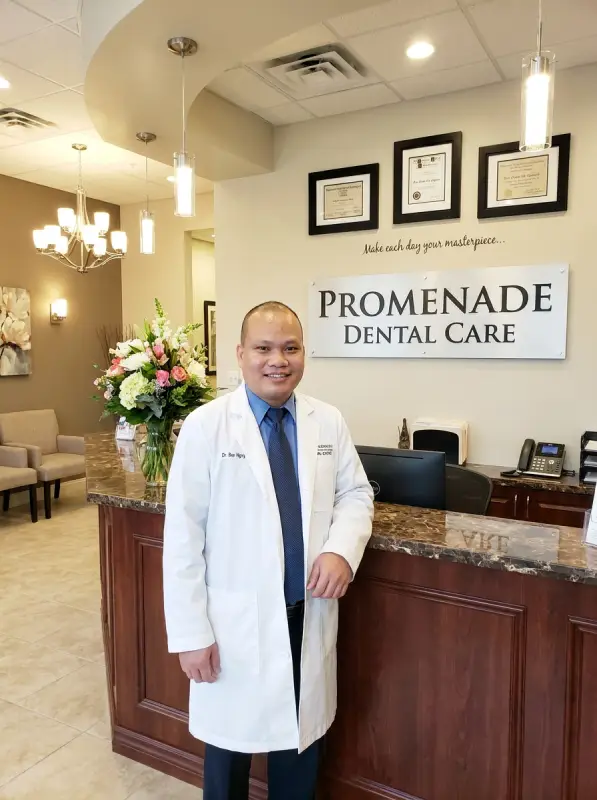
I earned my Doctor of Dental Surgery degree at the UCLA School of Dentistry, then served ten years as a United States Navy dentist, including an Advanced Education in General Dentistry residency at Naval Hospital Camp Pendleton and deployments to Kuwait and Iraq. I opened the Date Street office in 2010 and have run it the same way ever since. I own this practice and work in it every day, which means there are no corporate production quotas here and nobody pushing me to recommend treatment you do not need.
Gum disease is where that matters most, because periodontal treatment is easy to oversell. Sometimes the correct answer really is a straightforward deep cleaning and a tighter recall schedule rather than a more expensive procedure. And when a case calls for something a general office has no business doing, like a specialized LANAP protocol, I refer it out instead of keeping the work in house.
What Murrieta patients say
These reviews are posted publicly on the Promenade Dental Care Google Business Profile.
★★★★★
A very professional and friendly dentist. They go out of their way to make your comfortable and pain free. No upselling, and also easy to make an appointment. Great dentist!!!
— Google review
★★★★★
I’ve been to a lot of different dentists through the years and have had several fillings/crowns done. I often times experience pain and pressure during procedures even after the anesthetic. This time, zero pain, zero pressure, no nonsense. I’ll be coming back for regular cleanings and any needed procedures. They have my business indefinitely!
— Google review
★★★★★
I had a dental emergency and the dentist called me immediately and was able to get me in within an hour of speaking to him. The front desk was extremely welcoming and kind. They went over options with me and without having dental insurance they were very affordable. Would recommend to everyone!
— Google review
Related care at Promenade
Gum health rarely stands alone. If you have exposed roots or cold sensitivity, gum recession treatment may be the more relevant page. If infection has already reached a tooth’s nerve, a root canal can usually save it, and if a tooth has already been lost to periodontal disease, dental implants are the long-term replacement.
Serving the Temecula Valley
Patients travel to the Date Street office from Murrieta, Temecula, Menifee, French Valley, Winchester, Wildomar, Lake Elsinore, Canyon Lake, Hemet, and Fallbrook.
Questions Patients Actually Ask
Murrieta Gum Disease Treatment FAQs
What are the warning signs of gum disease?
The earliest stage, gingivitis, usually shows up as gums that look red or puffy, or that bleed a little when you brush or floss. As it advances to periodontitis you may notice bad breath that will not clear, gums pulling back from the teeth, tenderness or pus near the gum line, and teeth that feel loose or have started to shift. Because the early stage rarely hurts, most people do not realize anything is wrong until real damage is done, which is why routine exams matter. If you are seeing any of these signs in Murrieta, call Promenade Dental Care at (951) 412-0127 for an evaluation.
Can I fix gum disease at home without seeing a dentist?
Sometimes, if it is genuinely still gingivitis and the plaque is still soft. Disciplined brushing and daily cleaning between the teeth can reverse early inflammation on their own. What home care cannot do is remove tartar, which is plaque that has hardened onto the tooth and below the gum line, and tartar keeps the inflammation going no matter how well you brush. It also cannot tell you whether bone has already been lost, which only X-rays and pocket measurements can settle.
What is the difference between gingivitis and periodontitis?
Gingivitis is the early stage, affecting the gum tissue only, causing redness, swelling and bleeding, and it is reversible. Periodontitis is the advanced stage, where infection spreads below the gum line and destroys the bone and ligament holding the teeth in place. That bone loss is permanent. Periodontitis can be slowed and managed but not reversed, which is why treating gum inflammation promptly matters so much. You cannot tell the two apart by looking, which is what the X-rays and pocket measurements at an exam are for.
How do I know whether I need laser therapy or just a deep cleaning?
That is exactly what the evaluation is for. Dr. Bao Nguyen measures the depth of the pockets around your teeth, reviews your X-rays, and checks for bone loss to determine the stage of disease. Many early and moderate cases are handled well with scaling and root planing, a non-surgical deep cleaning, while more advanced cases may benefit from a laser protocol. You get a clear recommendation and the reasoning behind it before anything is scheduled.
Is laser gum treatment painful?
Most patients find laser periodontal therapy far more comfortable than traditional gum surgery. The area is numbed with local anesthetic first, and because the laser works without scalpels or sutures, there is typically less bleeding, less swelling, and less soreness afterward. Any discomfort in the day or two that follows is usually mild and responds well to over-the-counter pain relievers. Patients who deal with dental anxiety can also ask Dr. Bao Nguyen about nitrous oxide or oral sedation when they book.
What is LANAP, and does Promenade Dental Care provide it?
LANAP, the Laser-Assisted New Attachment Procedure, is an FDA-cleared laser protocol for moderate to severe periodontitis. It uses a specialized dental laser to remove diseased tissue and bacteria from deep periodontal pockets while preserving healthy gum, and it carries clearance for stimulating regeneration of the bone and connective tissue that hold a tooth in place. Promenade Dental Care is a general and cosmetic practice, not a periodontal surgery center. If your case calls for LANAP, Dr. Bao Nguyen will refer you to a LANAP-certified provider who performs it routinely rather than overselling what a general office should do.
How is laser gum treatment different from traditional gum surgery?
Traditional flap surgery involves cutting the gums and folding them back so the tooth roots can be cleaned, then stitching the gums back into place. Laser therapy targets and removes only the diseased tissue and bacteria, without scalpels or sutures. The result is generally less bleeding, less discomfort afterward, faster healing, and no change to your bite or to the look of your smile. Flap surgery remains the better answer in some advanced cases, and Dr. Bao Nguyen will say so if that is where your case stands.
Does laser treatment for gum disease actually work?
Laser therapy can be very effective for early and moderate gum disease, and protocols such as LANAP are FDA-cleared for tissue regeneration. At the same time, the research comparing lasers head-to-head with conventional scaling and root planing is mixed, and traditional deep cleaning remains highly effective and is often enough on its own. The honest answer is that laser therapy is one useful tool among several, and the right choice depends on the severity of your disease and on your individual mouth. Dr. Bao Nguyen gives a straight assessment of whether it is worth it in your case.
What is recovery like after laser periodontal therapy?
Recovery is usually quick. Mild soreness or sensitivity for a day or two is common and responds well to over-the-counter pain relievers. Because there are no incisions and no sutures, most patients return to their normal routine the same day or the next day. You will be given specific aftercare instructions, which typically include eating softer foods for a short period and brushing gently around the treated area while it heals. Most treatment is finished in one or two visits.
How much does gum disease treatment cost in Murrieta, and does insurance cover it?
Caught early the numbers are published and small: a 20 dollar exam with digital X-rays and a 95 dollar ultrasonic cleaning. Periodontal treatment costs more because more has to be done, quadrant by quadrant and often across several visits, so it is quoted after diagnosis rather than published. Most dental plans cover preventive exams and cleanings at or near 100 percent, while periodontal treatment is usually paid at a lower percentage, subject to your deductible and your annual maximum. Promenade Dental Care accepts all PPO dental insurance in-network and offers CareCredit financing, and every cost is explained before treatment begins.
Is gum disease treatment safe if I have diabetes or take blood thinners?
Laser therapy is often a good option for patients with health conditions precisely because it tends to cause less bleeding than surgery, but every case is individual. Bring a current list of your medications and medical conditions to your evaluation so Dr. Bao Nguyen can plan treatment safely and coordinate with your physician when that is needed. Managing gum disease matters especially for people with diabetes, since gum health and blood sugar control affect each other in both directions.
Worried About Your Gums? Get a Straight Answer.
Bleeding, swelling, and receding gums do not resolve on their own, but caught early, gum disease is very treatable. Come in for an honest evaluation and a written plan, with the cost explained before anything begins. Same-week appointments are usually available.
(951) 412-0127 Book a $20 Exam26957 Date St, Suite B4, Murrieta, CA 92563
Mon, Tue, Thu 9:00 AM – 5:00 PM · Wed, Fri 9:00 AM – 3:00 PM
Saturday by appointment and for emergencies · Sunday closed