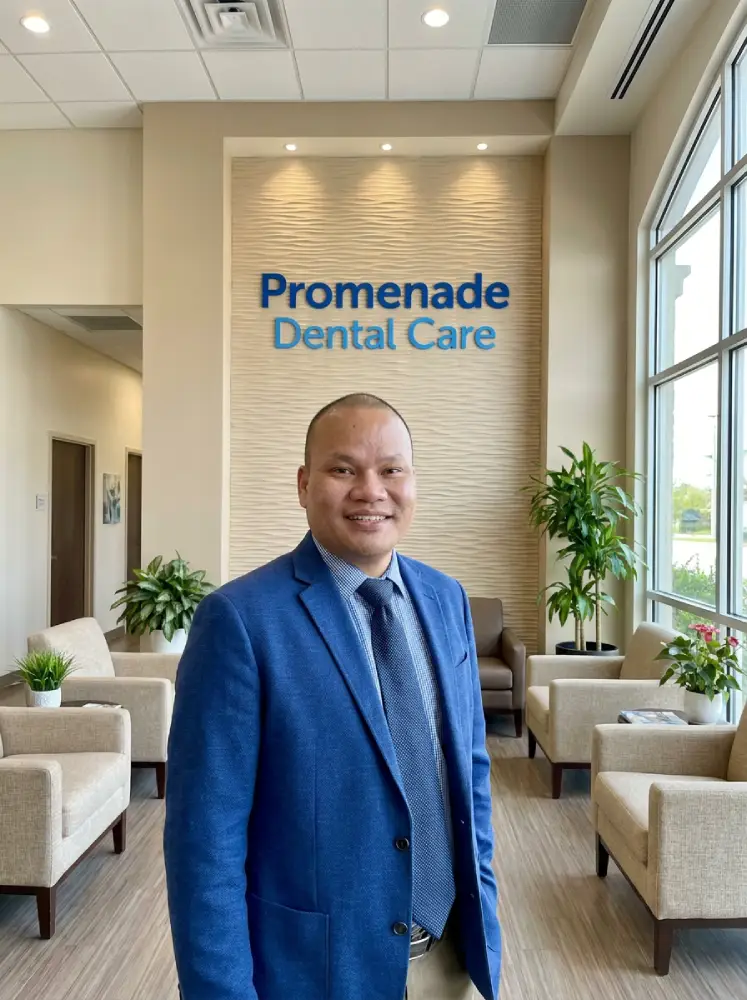
Same-Day Crowns · Murrieta, CA
Same-Day Crowns in Murrieta: One Visit, $1,200, and an Honest Answer on Whether You Need One
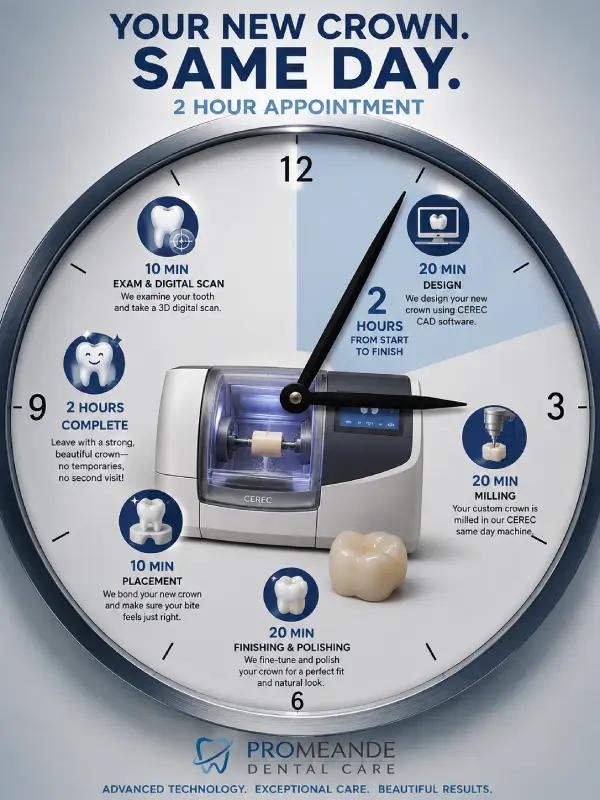
Scanned, designed, milled, and bonded in about two hours. No temporary, no lab wait, no second numbing.
I'm Dr. Bao Nguyen. I make crowns in my Date Street office while you sit in the chair, and I put the price on paper before I touch the tooth. This page walks through the questions I get asked most: do you really need a crown, what happens at the visit, what it costs with and without insurance, and what can go wrong.
1 · The Short Answer
Do I Need a Crown, and Can You Do It in One Visit?
- Procedure
- CEREC same-day ceramic crown, designed and milled in my office
- Chair time
- About two hours from numbing to final bond
- Visits
- One. No temporary crown.
- Cash price
- $1,200 starting fee, in writing before treatment. A core build-up or root canal, if the tooth needs one, is quoted separately first.
- Insurance
- Most PPO plans; same billing code as a lab crown
- Materials
- Lithium disilicate or zirconia-reinforced ceramic, metal-free
- Where
- 26957 Date St., Suite B4, Murrieta, CA 92563, serving Temecula, French Valley, Menifee, Wildomar, and Winchester
2 · In Plain English
What Is a Same-Day Crown?
A crown is a cap that covers the whole visible part of a tooth. It holds a weakened tooth together the way a steel hoop holds a barrel, so biting forces get spread around the tooth instead of prying it apart. The American Dental Association's patient guide to crowns covers the basic idea. What makes a crown "same-day" is only where it's made.
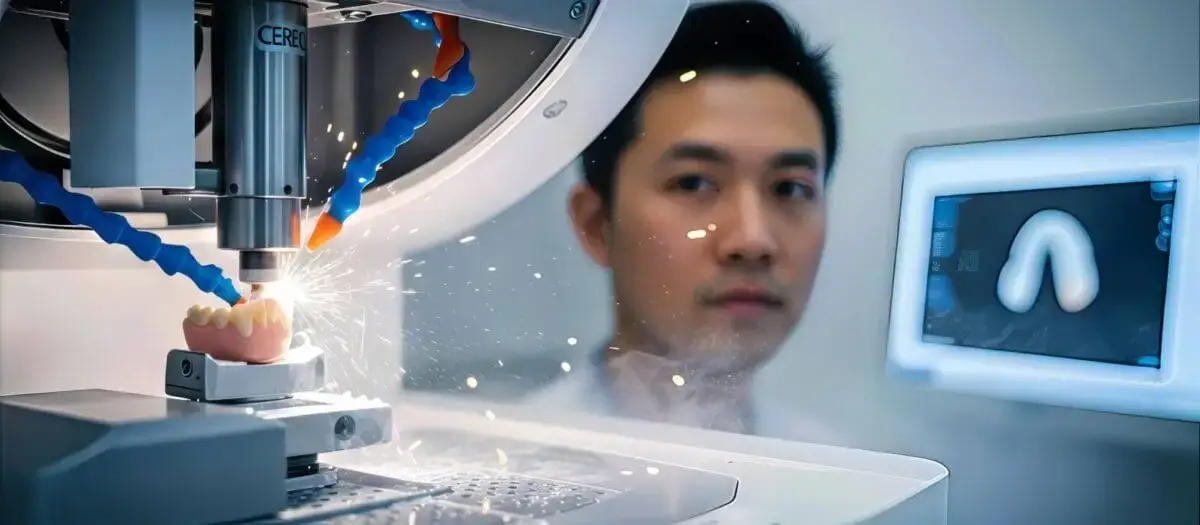
The old way sends a putty mold to an outside lab. A technician who's never met you builds the crown, it comes back in two or three weeks, and in the meantime you wear a plastic temporary held on with weak cement on purpose, so it can be pried off later. With a same-day crown, the lab is in the next room. I scan the tooth with a small camera, design the crown on a screen, and a milling machine carves it out of a solid block of ceramic while you wait. You walk out with the finished crown bonded in place.
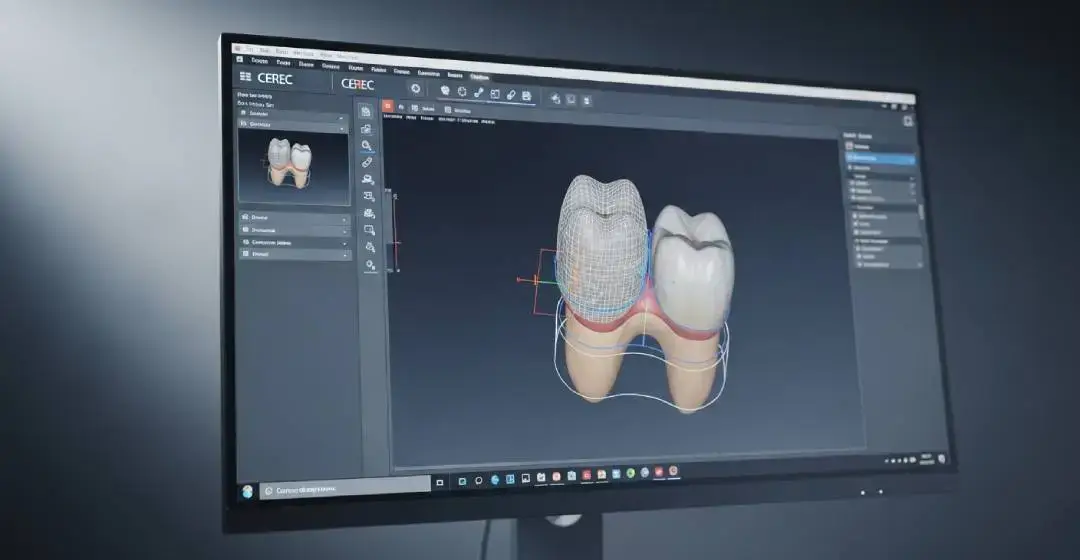
The design is the part people assume is automatic
It isn't. The software offers a starting shape from a library of tooth anatomy. I adjust where the crown touches its neighbors, how the chewing surface fits the tooth above it, and how the edge meets the gum so the tissue stays healthy. A molar for someone who grinds gets built flatter and thicker than the same molar for someone with a gentle bite. No machine makes that call.
Which ceramic goes on your tooth
I mill two families of ceramic, and I choose tooth by tooth. Lithium disilicate looks the most like real enamel and is strong enough for premolars, first molars, and anything that shows when you smile. Zirconia-reinforced ceramic gives up a little translucency for a lot more fracture resistance, so it goes on second molars and in mouths that grind. Both are metal-free. A 2023 meta-analysis of CAD/CAM crowns found milled lithium disilicate and zirconia crowns doing at least as well as conventionally made crowns. Gold and porcelain-fused-to-metal still exist; I cover when I'd pick them under alternatives below.
3 · Who It's For
Who Needs a Crown?
The test is structural. I'm asking one question: is there enough sound tooth left to hold a filling, or does the tooth need to be wrapped? These are the situations where the answer is usually "wrap it."
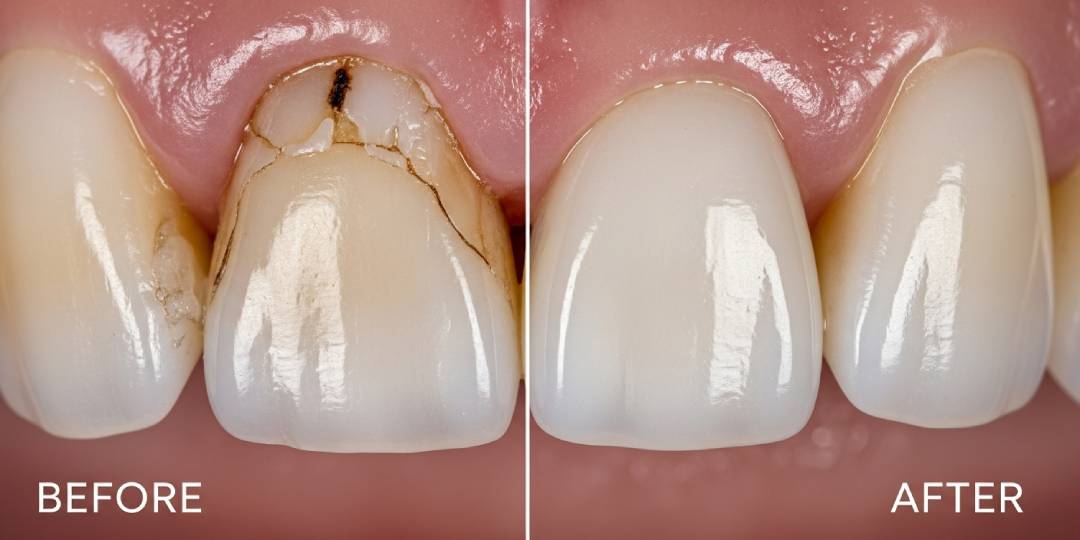
Three patients this week could have been any of these
These are composites of cases I see constantly, with details changed. A French Valley contractor with a crack line on a lower molar that only hurt on release. The crack hadn't reached the nerve, so a crown was enough, done in one morning. A Winchester mom who broke the outer wall off an upper molar on a Friday afternoon, the day before a birthday party, crowned that same afternoon. A Menifee retiree with a 25-year-old silver filling covering most of the tooth, the enamel walls around it cracked from decades of the metal expanding and contracting. Replacing that filling with another filling would just have reset the failure clock.
The pattern across all three is that waiting turns crown cases into extraction cases. A crown here starts at $1,200. A lost molar that later needs an implant costs several times that, and you go without the tooth in between.
4 · The Decision Boundary
When Don't You Need a Crown?
Every crown removes enamel that never grows back, so I want a reason before I pick up a drill. "Your insurance covers it this year" is not a reason. These are the cases where I'll talk you out of one.
| What you have | What I usually recommend instead | Why |
|---|---|---|
| A small or medium cavity with thick, healthy walls around it | A tooth-colored filling | A filling keeps far more natural tooth, and the tooth doesn't need wrapping to stay strong. |
| Fine vertical lines in the enamel that don't hurt | Watching them at your checkups | These craze lines are in nearly every adult's front teeth and are cosmetic. They aren't the same as a crack. |
| A chipped front tooth with most of the tooth intact | Bonding, or smoothing the edge | Bonding starts at $250 per tooth and removes almost nothing. See chipped front tooth. |
| Cold sensitivity with no crack, cavity, or broken filling | Finding the cause first | Gum recession and worn enamel cause most sensitivity, and a crown fixes neither. See teeth sensitivity. |
| One lost cusp on a living tooth in a patient who doesn't grind | Sometimes an onlay | It covers only the broken part. I place them rarely, for reasons on that page. |
| Active gum disease around the tooth | Treating the gums first | A perfect crown on a loose, inflamed tooth fails along with the tooth. |
| A tooth broken far below the gumline, or split down the root | Extraction, then an implant or bridge | A crown needs sound tooth to grip. Without it, the crown is an expensive delay. |
One more: an old crown that's sealed, healthy on the X-ray, and comfortable doesn't need replacing just because it's older than you'd like or a shade off. If it bothers you cosmetically, that's your call to make, and I'll give you the price. I won't tell you it's failing when it isn't.
5 · Step by Step
What Happens During a Same-Day Crown Visit?
This is the sequence in my office. It barely changes from one crown to the next, and it takes about two hours.
1Confirm the diagnosis
I look at the tooth, the X-ray, and a photo from the intraoral camera with you. If it doesn't need a crown, you go home having spent $20 on the exam.
2Numb and prepare
The tooth is numbed and shaped. Decay and cracked pieces come out. Healthy enamel stays wherever it can. Raise a hand and I stop.
3Scan
A camera wand builds a 3-D model of the tooth and your bite in a couple of minutes. No putty tray, no gagging.
4Design
I shape the crown on screen against your real bite and match the shade to your neighboring teeth in natural light.
5Mill
The machine carves the crown from a ceramic block in 15 to 25 minutes. Stay in the chair or step out for coffee.
6Fit, adjust, bond
I check the edges under magnification, adjust the bite on marking paper, glaze or polish, and bond it permanently.
Why the bite check gets so much of my time
A crown that sits even slightly high takes the whole force of your bite on one spot. You feel it as a sore tooth within a few days, and over the years it shows up as cracked ceramic or an irritated nerve. Because I designed the crown and I'm adjusting it against the same bite I scanned an hour earlier, this step is faster and more accurate than fitting a crown built from a three-week-old stone model.
Book a morning if you can. You'll be done and heading back up Clinton Keith toward French Valley or Winchester before lunch. If you're nervous, tell the front desk when you book and we'll set up nitrous oxide.
6 · First-Hand
How Does Dr. Nguyen Decide a Tooth Needs a Crown?
I spent ten years as a Navy dentist, much of it treating sailors and Marines who might not see a dentist again for months. That teaches you to get the diagnosis right the first time, because there may not be a second visit. I still work that way. Here's what I actually check before I recommend a crown.
When a crack is suspected but hard to pin down, I can take a cone-beam 3-D scan in the office. It won't show every hairline crack, but it shows bone loss along a root that tells me a crack has gone too deep to save.
Then you see what I see. I put the X-ray and the photo on the screen, point to the problem, and tell you what I'd do if it were my own tooth. Plenty of people leave having been told "that tooth doesn't need a crown yet, let's watch it." That sentence is a big part of why I've kept patients for fifteen years.
7 · The Number, Before We Start
How Much Does a Same-Day Crown Cost in Murrieta?
$1,200
CEREC same-day crown
Cash starting fee, written before treatment
$20
New-patient exam
With digital X-rays and a written diagnosis
$850
Ceramic onlay
When an onlay truly fits the tooth
What the $1,200 includes
What it doesn't include, and how you'll hear about it
Some teeth need work before they can hold a crown: a core build-up when too little tooth is left, a root canal when the nerve is involved, or gum treatment when the tissue is inflamed. Each is a separate procedure with its own written price. I show you the X-ray, explain why, and quote it before anything starts. Nobody here finds a charge after the fact.
Five questions to ask any office, including mine
| Question | Promenade Dental Care | Typical lab-crown office | Typical corporate chain |
|---|---|---|---|
| How many visits? | One, about two hours | Two or three over 2 to 4 weeks | Two or more, often a consult first |
| Will I wear a temporary? | No | Yes, for 2 to 3 weeks | Yes, sometimes with a re-cement fee |
| Digital scan or putty? | Digital scan | Often still putty | Depends on the location |
| Who designs the crown? | The dentist who prepared the tooth | An outside technician | An outside lab |
| Cash price in writing? | $1,200 starting fee, before treatment | Often a range | Commonly $1,400 to $2,000, "pending insurance" |
The last row sorts offices fastest. An office that won't write the number down before treatment is telling you something about how that number will behave afterward. If cash flow is the problem, CareCredit offers up to six months with no interest for qualified applicants.
8 · Coverage
Does Dental Insurance Cover a Same-Day Crown?
Usually, yes. Most PPO plans treat a crown as a major service and pay around 50 percent after your deductible. Insurers don't pay differently for a milled crown than for a lab crown. Both are billed under the same code, D2740 for a ceramic crown, so choosing the one-visit route costs you nothing in coverage.
We're in network with PPO plans including Delta Dental PPO, Cigna, MetLife, Guardian, Aetna, and United Concordia. Before we start, the front desk checks four things that decide what you'll actually pay:
I can't quote an insured fee on this page because it depends on your plan's percentage, deductible, and what you've already used this year. If you'd like certainty, we can send a pre-treatment estimate to your insurer before the crown. One patient below needed three crowns and got them approved and done before her benefits reset at year's end. If you don't have insurance, the $1,200 cash fee is the whole crown fee, with no membership plan to join.
9 · What Can Go Wrong
What Are the Risks and Limits of a Crown?
A crown is one of the most predictable things I do, but it isn't risk-free, and it doesn't make a tooth immortal. This is what I tell patients before we start.
| Risk | How often or how serious | What I do about it |
|---|---|---|
| Losing tooth structure | Permanent. Preparing a tooth removes enamel that never grows back. | Only crown teeth that need it, and keep every bit of healthy tooth I can. |
| The nerve dying later | A 2023 systematic review put it at about 5 percent of living teeth after crowns or similar restorations, higher in heavily filled teeth. | Test the nerve first, keep the tooth cool while I work, and tell you which teeth carry more risk. |
| Sensitivity or a sore bite afterward | Common for a few days. Lasting pain isn't normal. | Careful bite adjustment the same day. Details on tooth pain after a crown. |
| Decay at the edge | The most common reason crowns fail. The crown can't decay, but the tooth at its edge can. | A tight margin, X-rays at your checkups, and flossing the gumline. See NIDCR on tooth decay. |
| Chipping or fracture | Mostly in people who grind or chew ice. | Zirconia for grinders, a night guard, and enough ceramic thickness. |
| The crown coming loose | Uncommon with bonded ceramic. Usually decay or a short tooth underneath. | See crown fell off for what to do and why it happens. |
| Wear on the opposing tooth | A 2025 review found ceramic crowns wear the natural tooth they bite against a little faster than metal-ceramic. | Polish the biting surface smooth and factor it in when the opposing tooth is unrestored. |
The limits of making crowns in-office
There's one narrow case I still send to an outside lab: a single front tooth next to a heavily characterized natural tooth, where a ceramist layering porcelain by hand gets a better match than a milled block. A heavy grinder with almost no room for ceramic on a back molar may also be better off with gold, which has to come from a lab. If your tooth is one of those, you'll hear it at the exam, along with the lab price.
10 · Other Options
What Are the Alternatives to a Crown?
| Option | When it fits | Trade-off | Price here |
|---|---|---|---|
| Large filling | The walls are thick and less than about half the biting surface is gone | Keeps the most tooth, but a weak tooth can crack around it | Written quote at the exam |
| Ceramic onlay | One cusp is gone on a living tooth in someone who doesn't grind | Saves tooth, but in my patients onlays haven't lasted like crowns | $850 |
| Bonding | A chipped front tooth with most of it intact | Quick and conservative, but stains and chips sooner than ceramic | From $250 per tooth |
| Gold or lab-made crown | A heavy grinder with little room, or a demanding single front tooth | Two visits and a temporary in between | Written quote at the exam |
| Porcelain-fused-to-metal crown | Rarely my choice now | The porcelain layer chips, and a gray line shows as gums recede | Written quote at the exam |
| Extraction and an implant or bridge | The tooth can't hold a crown: split root, break deep below the gum | More time and money, and you lose the natural root | Written quote at the exam |
| Watching it | Craze lines, or an old filling that's sealed and symptom-free | Costs nothing now; needs checking at every exam | Included in checkups |
The Cleveland Clinic's overview of crown types is a good neutral read if you want to compare materials beyond what I use. If you want the long version of the onlay question, I wrote it up on onlay vs. crown.
11 · After the Visit
What Is Recovery Like, and How Long Will the Crown Last?
There's no healing period in the usual sense, because nothing was cut except the tooth itself. Here's what the first couple of weeks normally look like.
| When | What's normal | Call me if |
|---|---|---|
| First 2 to 3 hours | Lip and tongue still numb. Wait to eat so you don't bite your cheek. | Numbness lasts past the end of the day. |
| First 24 hours | Eat normally once numbness wears off, but skip ice, hard candy, and very sticky food. | The crown feels loose or moves. |
| Days 1 to 3 | Mild gum soreness where I worked at the edge of the crown. | The gum swells or bleeds more each day instead of less. |
| Up to 2 weeks | Some cold sensitivity on a living tooth, fading week by week. | The tooth hurts when you bite, or it throbs or wakes you up. |
A tooth that hurts when you bite down is almost always a bite that's a hair high, and it takes a few minutes to fix. Don't chew through it hoping it settles. I wrote a separate page on what pain after a crown means, because the causes and fixes are different for each kind of pain.
How long a crown lasts
Crowns commonly last 5 to 15 years, and well-kept ones go longer. A large systematic review of single crowns found most all-ceramic crowns surviving at rates similar to metal-ceramic crowns. Where your crown was made predicts very little. How the tooth was prepared, how tightly the edge seals, how the bite was adjusted, and how you take care of it predict nearly everything.
One habit that has saved a lot of crowns in this office: once a month, floss the crowned tooth and pay attention. If the floss suddenly shreds or catches where it used to glide, tell me. That one observation, reported early, turns a crown replacement into a small repair.
12 · Straight Answers
Same-Day Crown Questions Patients Ask Me
Are same-day crowns as strong as lab crowns?
Yes. Milled lithium disilicate and zirconia match or beat most hand-layered lab porcelain on strength, and long-term studies put chairside crowns in the same survival range as lab crowns. How long a crown lasts depends far more on how the tooth was prepared, how well the edge seals, and how carefully the bite was adjusted than on which room the ceramic was shaped in.
I broke a tooth today. Can you crown it the same day?
Often, yes. A freshly broken tooth is exactly what this technology is for. Call (951) 412-0127 and tell the front desk a tooth broke. If the break stays above the gumline with enough sound tooth left, I can usually examine, prepare, scan, mill, and bond the permanent crown in that one visit. If it runs below the gum or into the nerve, I'll tell you at the exam what the tooth needs instead.
Do same-day crowns work on front teeth?
Yes, for most front-tooth cases. The ceramic blocks come in layered shades that read like natural enamel, and I can mirror the matching tooth on the other side. The one case I still send to a lab is a single front tooth next to a heavily characterized natural tooth, where hand-layered porcelain gives a better match. You'll hear that at the exam, not after the crown is bonded.
What is CEREC, and is that what you use?
CEREC is the CAD/CAM system that scans a prepared tooth, lets me design the crown on screen, and mills the finished crown from a solid ceramic block in the office. It's been in clinical use since the 1980s, and today's units are several generations more accurate. Yes, it's what I use at Promenade Dental Care in Murrieta.
Can you do two crowns in one appointment?
Yes. I can prepare, scan, design, and mill several crowns in the same visit, and two neighboring teeth with old failing fillings is the common version. The appointment runs longer than two hours because the crowns mill one after another, but it's still one morning instead of four or more visits.
Zirconia or porcelain: which crown material is better?
Neither is better everywhere. Porcelain today usually means a milled glass ceramic like lithium disilicate, which looks the most like enamel and is strong enough for premolars and first molars. Zirconia-reinforced ceramic is the toughest block I mill, so it goes on second molars and in mouths that grind. Both are metal-free, both are done the same day, and both cost the same $1,200 starting fee.
Do you still make gold crowns?
Rarely, and only when the tooth calls for it. Gold has to come from an outside lab, which means a temporary and a two-to-three-week wait. The tooth that still earns gold is a back molar in a heavy grinder with almost no room for ceramic, because metal can be made thinner and is gentler on the tooth it bites against. If that's your tooth, I'll recommend it and quote it in writing.
Are ceramic crowns better than porcelain-fused-to-metal crowns?
For most people, yes. A porcelain-fused-to-metal crown has porcelain baked over a metal shell. Over the years the porcelain layer can chip, and as the gum recedes a dark metal line shows at the edge. An all-ceramic crown has no metal, so there's no gray line and no nickel for people who react to it, and today's ceramics are strong enough for molars.
Can you replace an old crown in one visit?
Usually. I remove the old crown, clean out any decay underneath, rebuild the tooth if needed, and scan, mill, and bond the new one the same day. What I find under the old crown can change the plan, so I'll show you on the screen and give you any added price before going further.
Will my new crown match my other teeth?
That's the goal, and I check it carefully. I pick the shade with a shade guide held against your wet teeth early in the visit, because teeth dry out and look lighter under the lights. Then I confirm the match near the window in natural light before bonding. If you've whitened your teeth, do it before the crown, because the ceramic won't change color afterward.
Can I still get a cavity under a crown?
Yes, and it's the most common reason crowns fail. The ceramic can't decay, but the natural tooth at the edge of the crown can, especially at the gumline where plaque sits. Brushing and flossing that edge, fluoride toothpaste, and X-rays at your checkups catch it early, while it can often be repaired without a new crown.
Does every crown need a root canal first?
No. Most crowns go on teeth with healthy nerves and never need a root canal. A root canal comes first only when the nerve is already infected or dying, which I check with a cold test, tapping on the tooth, and the X-ray. Back teeth that have had a root canal do need a crown afterward, because they become brittle.
How soon can I get an appointment for a crown?
For a broken or painful tooth, usually the same day or the next business day. We hold open time every day for urgent problems. For a planned crown on a tooth that isn't hurting yet, it's generally within about a week, in a morning slot. Hours are Monday, Tuesday, and Thursday 9 AM to 5 PM, Wednesday and Friday 9 AM to 3 PM, and Saturday by appointment and for emergencies.
Can I get a same-day crown without dental insurance?
Yes, and many of my crown patients pay cash. The fee starts at $1,200, written down before treatment, with no membership plan and no add-ons hidden in it. CareCredit offers up to six months with no interest for qualified applicants. If you aren't sure the tooth needs a crown, start with the $20 exam and X-rays.
Does getting a same-day crown hurt?
The tooth is numb for the preparation, which is the only step where you'd feel anything. After that you're sitting still while a camera scans and a machine mills. There's no putty tray and no second numbing visit to seat a lab crown. If you're anxious, ask about nitrous oxide when you book.
13 · Related Conditions
Which Tooth Problems Lead to a Crown?
Cracked Tooth
Pain when you let go of a bite. Caught early, most cracked teeth are saved with a crown.
Chipped Front Tooth
When a chip needs smoothing, bonding, a veneer, or a crown, and how I decide.
Crown Fell Off
What to do tonight, whether the same crown can go back on, and why it came off.
Tooth Pain After a Crown
What's normal in the first two weeks and what each kind of lingering pain means.
Teeth Sensitivity
Why teeth react to cold, and why a crown usually isn't the fix for it.
Root Canal Recovery
The first week after a root canal, and when the crown goes on.
14 · Related Services
Which Treatments Connect to a Crown?
Onlay vs. Crown
An $850 partial crown that covers one broken cusp, and why I place them rarely.
Root Canal Treatment
When the nerve is involved, it's treated first. Most root canals I do myself.
Cavity Fillings
When enough healthy tooth remains, still the right and cheapest answer.
Dental Bridges
Crowns on two teeth holding a replacement tooth between them.
Dental Implants
When a tooth can't be saved, the implant crown is designed the same way.
Custom Night Guards
The cheapest insurance a new crown can have if you clench or grind.
For the whole restorative picture, from fillings to implants, see restorative dentistry.
In Our Patients' Words
What Murrieta Crown Patients Say
Dr. Nguyen is an experienced and professional dentist! I needed 3 crowns and he was able to get insurance approval before my insurance ran out at the end of the year. Then, after approval he was able to get teeth prepped for the crowns and he made the crowns in the office!! I was in and out in less than 4 hours. My teeth look and feel great! Office staff is also professional! Highly recommend!
— Diana T. · Google Review
Skilled, friendly, and includes you every step of the way. Love that I could do a full cap replacement in one visit. Thank you Dr. Bao, you’re my new go-to man for dental work. Yessica at the front desk is a big help too.
— Philip C. · Google Review
I became a patient in July of last year and needed some emergency dental work. I was able to get in the same day and have a crown and root canal done with zero pain! I recently had another toothache and was again provided a prompt same day appointment. Hands down the best dental experience I’ve had — zero pain, zero wait time. Pricing is always up front and affordable.
— Alicia Alvarado · Google Review
I’ve been to a lot of different dentists through the years and have had several fillings/crowns done. I often times experience pain and pressure during procedures even after the anesthetic. This time, zero pain, zero pressure, no nonsense. I’ll be coming back for regular cleanings and any needed procedures. They have my business indefinitely!
— Dominic S. · Google Review
One Visit. One Written Price. One Crown That Lasts.
Same-day CEREC crowns from $1,200 cash, designed, milled, and bonded in about two hours. Start with a $20 exam if you're not sure the tooth needs one.
(951) 412-0127 Request an AppointmentPromenade Dental Care · Dr. Bao Nguyen, DDS
26957 Date St., Suite B4, Murrieta, CA 92563
Mon, Tue, Thu 9:00 AM–5:00 PM · Wed, Fri 9:00 AM–3:00 PM · Sat by appointment & emergencies · Sun closed
16 · Written and Reviewed By
Who Wrote and Reviewed This Page?
I'm Dr. Bao Nguyen, DDS. I graduated from the UCLA School of Dentistry and served ten years as a dentist in the U.S. Navy, including an Advanced Education in General Dentistry residency at Naval Hospital Camp Pendleton and a deployment treating sailors and Marines. That's 26 years of practice, the last sixteen in my own office, on Date Street in Murrieta since 2020. I take about 40 hours of continuing education a year and belong to the American Dental Association, the California Dental Association, and the Tri-County Dental Society.
I brought CEREC into this practice because the lab never made a crown better. It made it later. My rule hasn't changed: the crown serves the tooth, not the schedule. If a filling will do, you get a filling. If the tooth can't be saved, I'll say that too, and when a case needs a specialist, I refer you to one I trust and handle the handoff.