
Tooth-Colored Composite Fillings
Affordable Dental Fillings in Murrieta, CA
A dark spot you keep meaning to ask about. A twinge on something cold. Real pain when you chew.
Dr. Bao Nguyen, DDS treats cavities with tooth-colored composite fillings, quotes the price in writing before any instrument comes out, and finishes almost every filling in a single 30 to 60 minute visit. Walk-ins welcome, all PPO plans in-network, CareCredit financing available.
The Basics
What Are Dental Fillings?
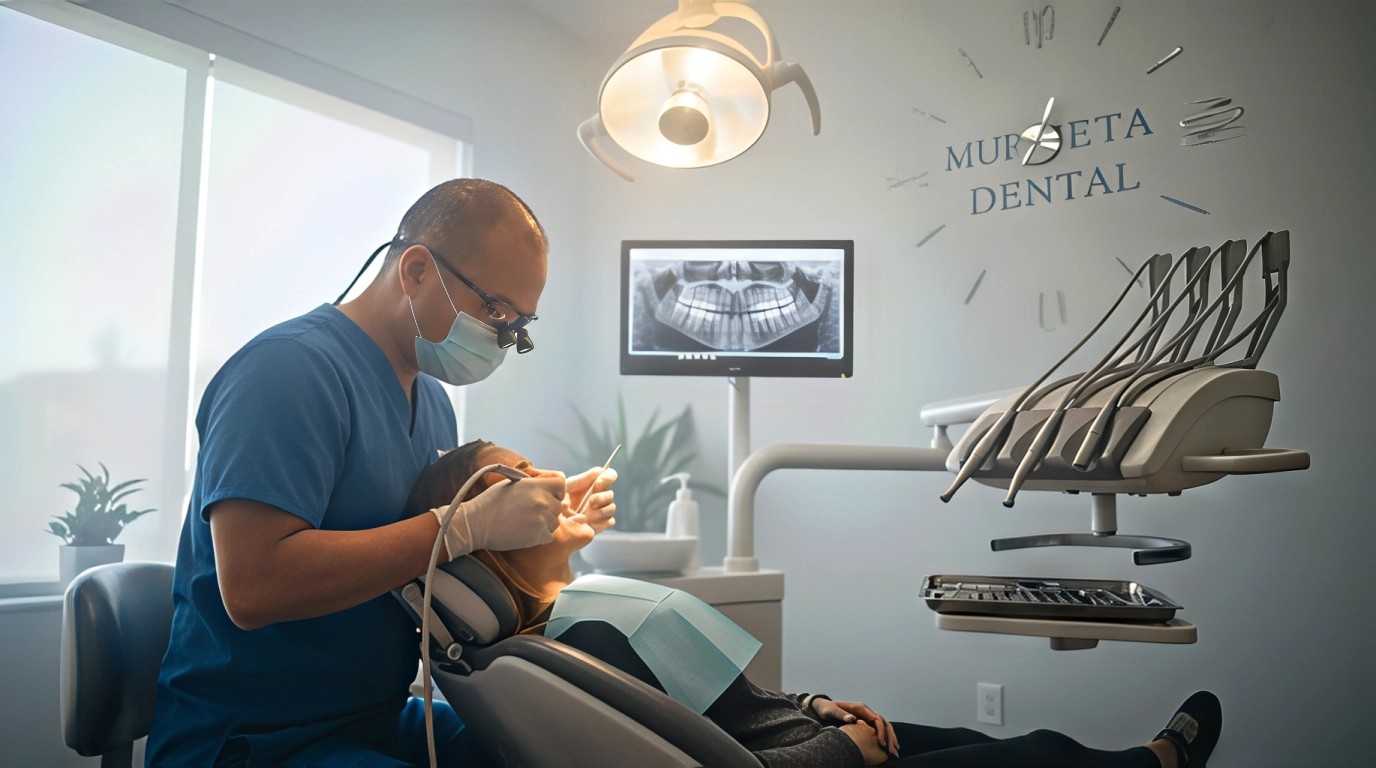
A filling is the repair. I take out the decayed part of the tooth and rebuild the hole with a material that restores its shape, its strength, and the way it meets the tooth next to it when you bite down. It is the most common thing I do, and most adults need at least one.
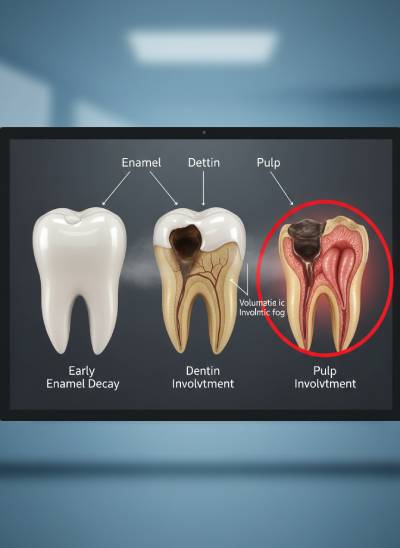
Decay starts when bacteria turn sugar into acid, and that acid works through the enamel into the softer dentin underneath. It does not pause. A small cavity is a small problem with a small fix: the filling stops the decay, seals the tooth, and keeps bacteria away from the nerve. The American Dental Association’s guide to filling options covers the clinical detail. What I tell patients is shorter. Cavities do not heal. They grow.
At Promenade Dental Care on Date Street in Murrieta, I place tooth-colored composite as the standard material, so the repair disappears into your own enamel. Most appointments run 30 to 60 minutes, you leave with the tooth finished, and you eat normally once the numbness fades. For a cavity caught early during a routine $20 dental exam, this is one of the least expensive treatments in dentistry.
- Procedure
- Tooth-colored composite filling, mercury-free resin bonded to the tooth
- Visit length
- 30 to 60 minutes, one visit, finished the same day
- Comfort
- Local anesthetic; sedation available for anxious patients
- Typical lifespan
- 7 to 15 years, longer on small low-stress fillings
- Payment
- In-network with all PPO plans; cash pricing for uninsured patients; CareCredit up to six months no interest
- Starts with
- $20 exam with digital X-rays and a written estimate
- Dentist
- Dr. Bao Nguyen, DDS, Promenade Dental Care, 26957 Date St, Suite B4, Murrieta, CA 92563
- Phone
- (951) 412-0127, answered 24 hours for dental emergencies
Symptoms to Watch
Signs You May Need a Cavity Filling
Some cavities announce themselves. Others sit quiet for months and get deeper while you assume the tooth is fine. These are the signals worth acting on, plus the one that concerns me most.
Tooth sensitivity
A sharp twinge from something cold, something sweet, or a lungful of January air. Sensitivity means the enamel has thinned enough for temperature and sugar to reach the dentin. It is the earliest sign and the easiest to dismiss as just having sensitive teeth. New sensitivity, on one tooth, getting worse week over week, is not that.
Pain when you chew
Pain on biting usually means the cavity has gone deeper. The tooth flexes under load and the damaged structure complains. This is when most people finally call, because ignoring it has stopped working. If chewing hurts, we may be closer to a root canal conversation than a filling one.
Visible holes or dark spots
A pit, a groove, or a brown-to-black spot you can see in the mirror is advanced decay. By the time it is visible it has been there a while. Not every dark spot is a cavity, since staining looks similar, but every one earns an exam and digital X-rays before we decide.
Food getting stuck
If food suddenly catches somewhere it never used to, the surface has broken down enough to make a trap. Flossing relieves the symptom. It does nothing about the cause, and trapped food feeds the bacteria doing the damage.
From Our Google Reviews
Pain-Free Fillings, In Their Words
Dr. Nguyen is a wonderful dentist. Very friendly and compassionate. Very skilled. I had a root canal done in less than 2 hours with the crown completed the same day. WOW!!!
Finding an excellent dentist is difficult! Dr. Bao offers the most affordable dental care in Murrieta. He is friendly and professional. I don’t have insurance and the pricing was explained up front, no surprises and no pressure to do more than I needed.
Materials & Options
Types of Dental Fillings
Filling materials are not interchangeable. The right one depends on the size of the cavity, where it sits in the mouth, how hard you bite, and how much it matters to you that nobody can see it. Four materials come up in conversation. Here is my honest read on each.
What I place
Composite (tooth-colored) fillings
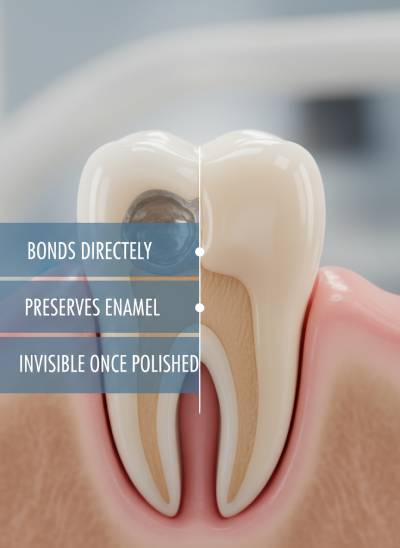
Composite resin bonds directly to the tooth and matches its color. It needs less drilling than amalgam, preserves more healthy structure, and vanishes once it is polished. It is my default because it performs on front teeth and back teeth alike, and the bonding chemistry has improved enormously since I started. The ADA reports good durability and fracture resistance for small and mid-size cavities. If you have been searching for tooth-colored fillings in Murrieta, this is the one, and it is what we place every day.
Specific cases
Amalgam (silver) fillings
The silver material dentists have used for more than a century. Strong, inexpensive, and durable in large molar cavities under heavy chewing load. The trade-offs are how it looks and how much extra healthy tooth has to come out to lock it in place. Major health bodies affirm that amalgam is safe. I do not place it routinely, but I will raise it if a very large molar cavity genuinely calls for it.
Premium aesthetics
Ceramic (porcelain) inlays
Lab-made or milled porcelain matches tooth color with real accuracy and resists staining better than composite over the years. It costs more, and it usually means two visits unless we mill it here with CEREC same-day technology. For a mid-size to large cavity in a tooth that shows when you smile, porcelain is the premium answer.
Rarely requested
Gold fillings
Cast gold inlays are exceptionally durable and can last twenty years or more, and some dentists still consider them the benchmark for molar longevity. The practical reality is that gold costs the most, takes multiple visits, and is obvious in the mouth. Almost nobody asks for it now, though it remains an option when raw mechanical durability in a molar outranks everything else.
The Popular Choice
Why Patients Choose Tooth-Colored Fillings
The move from silver to white fillings over the past two decades is not only about looks, though looks matter to people more than they usually admit. Composite bonds adhesively to tooth structure, which means I remove the decay and a thin margin around it and stop there. Amalgam relies on mechanical retention: undercuts carved into healthy enamel to lock the filling in. That sacrifices more of the tooth you came in to save.
So the advantages are practical, not cosmetic alone. The repair is invisible, less drilling is needed, the bond reinforces what is left of the tooth, and the material works front and back. The one honest trade-off is that composite is slightly less durable than amalgam in very large molar cavities under extreme force. For the great majority of cavities I see, composite gives the best balance of strength, tooth conservation, and appearance. It is what I would put in my own teeth, and what I have put in my family’s.
What to Expect
What Happens During a Cavity Filling?
A filling appointment here runs 30 to 60 minutes start to finish. Nothing about it should surprise you, so here is the whole sequence before you sit down.
-
Examination and X-rays
If you have not had a recent exam, I start with digital X-rays and a visual check to confirm how big the cavity is, how deep it goes, and how close it sits to the nerve. That decides whether a filling is the right repair or whether the decay has already gone far enough to need a crown or a root canal. You see the X-ray on the screen and I explain it in plain language.
-
Numbing
I numb the tooth and the gum around it with local anesthetic. Most patients feel a brief pinch from the injection and nothing after that. If you are anxious, we have sedation options through our dental anxiety care. Comfortable treatment is the baseline here, not an upgrade you pay extra for.
-
Removing the decay
Using a handpiece, and sometimes a dental laser, I take out the decayed structure plus a small margin of sound enamel. The goal is to leave no bacteria behind while keeping as much healthy tooth as I can, which is exactly where a conservative material like composite earns its keep.
-
Placing the filling
The tooth is kept clean and dry while I apply the composite in thin layers, curing each one with a light before the next goes in. Layering builds strength and lets me match the color and translucency of your enamel rather than approximating it. The finished filling bonds chemically to the tooth, sealing out bacteria and reinforcing what is left.
-
Bite adjustment and polish
You bite on articulating paper so I can find any high spot or interference with the way your jaw slides, then I shape and polish until it feels smooth to your tongue. Most patients cannot tell where the filling ends and the tooth begins.
You can eat and drink normally once the numbness wears off, usually within one to three hours. If you need several fillings, I can often place two or three in the same visit so you are not making a second trip.
Money, Plainly
How Much Do Affordable Dental Fillings Cost in Murrieta?
What a composite filling costs depends on the size of the cavity, how many surfaces of the tooth are involved, and the material. Any office quoting you a flat number over the phone without seeing the tooth is guessing. These are the things that actually move the price, so the estimate you get from us makes sense when you read it.
Cavity size and surface count
Fillings are classified by how many surfaces of the tooth they cover. A one-surface filling on a small cavity costs less than a three-surface filling wrapping around a molar. Bigger cavity, more material, more chair time, more precision required.
Material
Composite costs more than amalgam and less than a ceramic inlay. For most cavities it is the best value once you account for appearance, tooth conservation, and how long it lasts. I recommend the material that makes clinical and financial sense for that particular tooth, not the one that produces the biggest bill.
No insurance? You are in good company here
A large share of our patients pay cash, many of them families in Murrieta and French Valley whose employers do not offer dental benefits. The pricing here is built around them. You get a written quote before any work starts, and CareCredit financing with up to six months no interest is available for qualified patients. The $20 exam with digital X-rays exists to remove the barrier between you and simply knowing what your teeth need.
The most expensive thing you can do with a cavity is ignore it. A small filling today costs a fraction of the root canal, crown, or extraction it becomes a year from now. Affordable cavity fillings in Murrieta start with catching the problem early, and that starts with a call to (951) 412-0127.
The Cost of Waiting
What Happens If a Cavity Is Left Untreated?
Every untreated cavity follows the same path. The speed varies from person to person, the direction never does, and the cost climbs sharply at each stage. The Mayo Clinic overview of cavities and tooth decay sets out the progression. This is what it looks like in my chair.
Stage 1: small cavity
Enamel breached, dentin exposed, often no pain at all. One composite filling in one visit, the fastest and least invasive repair there is. This is where you want to catch it.
Stage 2: deep decay
The cavity works toward the nerve. Sensitivity climbs, and hot, cold, and sweet all set it off. A larger filling may still hold, but a crown enters the conversation once too much structure is gone.
Stage 3: pulp infection
Bacteria reach the nerve. Throbbing pain, sometimes swelling or an abscess. Now the tooth needs a root canal and a crown, far more time and money than the filling would have been.
Stage 4: tooth loss
If infection destroys too much tooth or spreads into bone, extraction is the only option left. Then we are talking about a bridge or an implant, both far more involved than the filling that started it.
Stage 5: systemic risk
Dental infections that spread become medical emergencies. The CDC oral health data documents the link between untreated dental disease and broader health problems. An ER visit for an abscess costs more than the filling, root canal, and crown put together.
The pattern never changes. A small problem becomes a big one, and a small bill becomes a big one. Catching decay early at a regular dental exam is the most cost-effective thing you will ever do for your teeth. If you are reading this with a tooth that already hurts, our emergency dentist line at (951) 412-0127 is answered around the clock.
More From Google
Affordable, Honest, and Painless
We were looking for a dentist who had great skills, used the latest in dental technology, offered affordable rates, and provided great customer service. We were very happy to see how clean the office and rooms are. We found all of this with Dr. Nguyen.
Doctor and staff, which includes Edith, are incredibly wonderful, so kind, caring and compassionate, yet professional. They go above and beyond, which includes painless treatments in a calming atmosphere.
Bao was a military doctor and was sent to all the best post-graduate dental clinics and courses available in the USA. Dr. Nguyen did an amazing job, not just fixed my forever-problem front teeth but also gave me a new smile!
Skilled, friendly, and includes you every step of the way. Love that I could do a full cap replacement in one visit. Thank you Dr. Bao, you’re my new go-to man for dental work. Yessica at the front desk is a big help too.
The Decision Point
Dental Fillings vs. Crowns: When Each One Is Right
Patients ask me this constantly, and the answer always comes down to how much healthy tooth is left. A filling repairs part of the tooth. A crown replaces the entire visible surface and protects what remains underneath.
| Factor | Dental filling | Dental crown |
|---|---|---|
| Best for | Small to medium cavities where most of the tooth is still intact. | Large cavities, cracked teeth, teeth weakened by root canal treatment, or old failed fillings with too little structure left. |
| Tooth removed | Only the decay and a thin margin. Most of the natural tooth stays. | The entire outer surface is reshaped to accept the crown, so more structure comes out. |
| Visits | One visit, 30 to 60 minutes, finished the same day. | Usually one visit with same-day CEREC milling, or two with a lab-made crown. |
| Cost | Lower. Fillings are the least expensive restorative option. | Higher, but necessary when a filling would not hold or protect what is left. |
| Longevity | Composite fillings typically last 7 to 15 years depending on size and location. | Crowns typically last 10 to 20 years or more; same-day zirconia and porcelain are among the most durable restorations available. |
The gray zone
Between a very large filling and a crown is where judgment actually matters, and where patients most often feel oversold elsewhere. My rule is simple. If a filling can predictably hold, I place a filling, because it costs you less and keeps more of your tooth. If the walls are too thin or already cracked, I recommend a crown and put the X-ray on the screen so you can see the reason for yourself.
When It Cannot Wait
Emergency Cavity Treatment in Murrieta
Tooth pain does not respect your calendar. If a cavity has reached the point of real pain, throbbing, swelling, or waking you at two in the morning, you do not have to wait for a routine slot to open.
Our emergency dentist line at (951) 412-0127 is answered 24 hours a day, and I keep room for same-day emergency appointments whenever the schedule allows. Emergency care starts with getting you out of pain. I numb the tooth, work out what the damage is, and begin the repair, whether that turns out to be a filling, a root canal, or a temporary restoration to stabilize things until we can finish. If you are in Murrieta, French Valley, Winchester, or anywhere in the Temecula Valley with a toothache right now, call before you do anything else.
The Difference
Why Murrieta Families Choose Promenade for Fillings
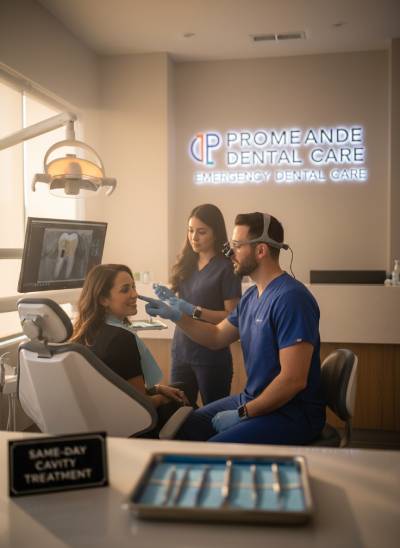
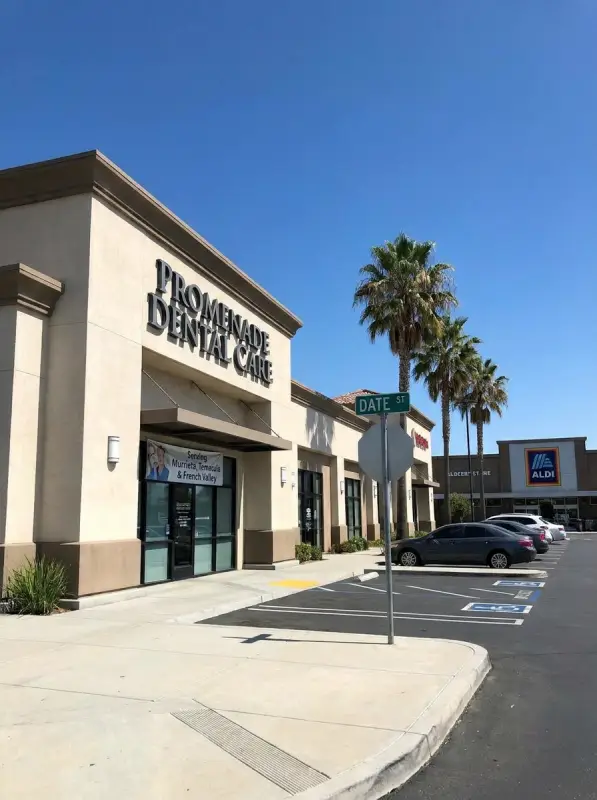
Murrieta has no shortage of dental offices along Winchester Road and Clinton Keith. Patients end up in this independent practice in the Aldi plaza on Date Street for reasons the corporate chains down the road cannot copy.
An honest diagnosis
If a tooth needs a filling, you get a filling. If it needs a crown, I say so and show you the X-ray. If it needs nothing today, you go home without treatment you did not need. I own this practice, so the plan answers to your teeth and not to a corporate production quota.
Where I trained
I graduated from UCLA School of Dentistry, then spent ten years as a U.S. Navy dentist, including an AEGD residency at Naval Hospital Camp Pendleton and deployments to Kuwait and Iraq. Military dentistry is high volume and unforgiving about time. That shows up now as fast, precise, conservative fillings.
Transparent pricing
$20 exams with digital X-rays. $95 ultrasonic cleanings. Cash-friendly rates for the many families here without dental benefits. A written estimate before treatment, and CareCredit with up to six months no interest. It is posted on the front door because we mean it.
Comfortable treatment
Thorough numbing, an unhurried pace, sedation for anxious patients, and a team, Edith and Yessica up front, that patients name individually in their reviews. If fear has kept you out of a dental chair for years, nobody here is going to lecture you about it.
A Cavity Filling Near Me, Answered
Serving the Whole Temecula Valley
Promenade Dental Care is at 26957 Date St., Suite B4, Murrieta, CA 92563, in the shopping center near the Winchester Road and Murrieta Hot Springs intersection, minutes from the 215. Patients drive in from across the valley for affordable dental fillings, routine cleanings, and the full range of restorative and preventive care.
| Mon | 9:00 AM – 5:00 PM |
| Tue | 9:00 AM – 5:00 PM |
| Wed | 9:00 AM – 3:00 PM |
| Thu | 9:00 AM – 5:00 PM |
| Fri | 9:00 AM – 3:00 PM |
| Sat | By appointment & emergencies |
| Sun | Closed |
Walk-ins are welcome for exams and same-day cavity treatment when the schedule allows, and the phone line is answered 24 hours for emergencies.
Questions We Hear Every Week
Dental Filling FAQs
How much do dental fillings cost in Murrieta, CA?
The price depends on how big the cavity is, how many surfaces of the tooth it covers, and which material the tooth needs, so I will not quote a number before I look at it. What you get at Promenade Dental Care in Murrieta is a written estimate before I start. We are in-network with all PPO plans, we keep cash pricing low for uninsured patients, and CareCredit offers up to six months with no interest. A $20 exam with digital X-rays gets you your exact number.
Are tooth-colored fillings safe?
Yes. The American Dental Association recognizes composite resin as a safe, effective material for filling cavities. It bonds straight to the tooth, needs less drilling than silver amalgam, and contains no mercury. Composite is what I place every day at Promenade Dental Care, and it is what I would want in my own mouth.
How long do composite fillings last?
Seven to fifteen years is the usual range. Where yours lands depends on the size of the filling, which tooth it is in, how hard you clench or grind at night, and how clean you keep the margins. Small fillings on teeth that take little chewing force often go longer. I check every existing filling at each exam, because catching wear early costs far less than replacing one that has already failed.
Does getting a filling hurt?
No. I numb the tooth and the gum around it completely, and I wait until you tell me you are numb before I start. Most patients say the appointment felt like pressure and nothing more, less uncomfortable than the cavity was. If fear is what has kept you out of a dental chair, we have sedation options at Promenade Dental Care, and nobody here will lecture you about the time you stayed away.
Can a cavity heal without a filling?
Once decay breaks through the enamel into the dentin underneath, no. It cannot repair itself. Very early damage, a chalky white spot that has not opened into a hole yet, can sometimes be remineralized with fluoride and better home care, and I will tell you when I see one and give it time to turn around. But once there is an actual hole in the tooth, it only gets bigger and more expensive.
What happens if I delay treatment for a cavity?
It keeps going. Decay moves through the enamel, into the dentin, then into the nerve, and the repair gets bigger at every stage. A filling becomes a root canal and a crown, and eventually an extraction. In sixteen years practicing in Murrieta I have never seen one stop on its own. Treating a small one now is faster, gentler, and a fraction of the cost of treating the infection it turns into.
Are dental fillings covered by insurance?
Most PPO dental plans treat fillings as basic restorative care and pay roughly 70 to 80 percent after your deductible, up to your annual maximum. Promenade Dental Care is in-network with all PPO plans, and my front office verifies your specific benefits before treatment, so the written estimate you sign is what you actually pay. Patients without insurance get cash pricing and CareCredit financing instead.
How long does a filling appointment take?
Thirty to sixty minutes for a single filling, start to finish. If you need two or three, I can usually place them in the same visit so you are not driving back across Murrieta a second time. You can eat and drink as soon as the numbness wears off, which normally takes one to three hours.
What is the difference between a filling and a crown?
A filling rebuilds part of a tooth. A crown covers the whole tooth. The deciding factor is how much solid tooth is left. If the walls are thick enough to hold a filling predictably, I place a filling, because it costs less and keeps more of your own tooth. If those walls are thin or already cracked, a filling will fracture, so I put your X-ray on the screen and show you why a crown is the safer repair.
Do you offer same-day or walk-in cavity fillings?
Yes. Most fillings are finished the same day in one 30 to 60 minute visit, and walk-ins are welcome for exams and same-day cavity treatment when the schedule has room. If you are in pain, call (951) 412-0127 before you drive over. Our line is answered 24 hours for emergencies and we will tell you the fastest way to get seen.
Do you place amalgam (silver) fillings?
Composite is my standard material because it conserves more tooth and nobody can see it. I do not routinely place amalgam. If you have a very large molar cavity where heavy chewing load would be hard on composite, I will say so honestly and we will talk through the trade-offs together rather than pretending there is only one right answer.
Is there a dentist for cavity fillings near me if I am outside Murrieta?
Yes. Promenade Dental Care is at 26957 Date St, Suite B4 in Murrieta, minutes off the 215, and we treat patients from Temecula, French Valley, Menifee, Wildomar, Winchester, and Lake Elsinore. Many of them book the exam and the filling around a work schedule. Call (951) 412-0127 and we will find a time that fits.
A $20 Exam Is All It Takes to Know What Your Teeth Need
Digital X-rays, a thorough exam, and a written quote with no pressure to decide on the spot. If you need a filling, I will tell you. If you do not, I will tell you that too.
Promenade Dental Care — Dr. Bao Nguyen, DDS
26957 Date St., Suite B4, Murrieta, CA 92563
Phones answered 24 hours · Mon, Tue, Thu 9 AM–5 PM · Wed, Fri 9 AM–3 PM · Sat by appointment & emergencies
Serving Murrieta, Temecula, French Valley, Menifee, Wildomar & Winchester