
Promenade Dental Care · 26957 Date St, Suite B4, Murrieta
Murrieta Teeth Cleaning: Modern Options That Go Beyond the Scrape
Ultrasonic scaling, air polishing, and deep cleaning from a UCLA-trained, Navy veteran dentist
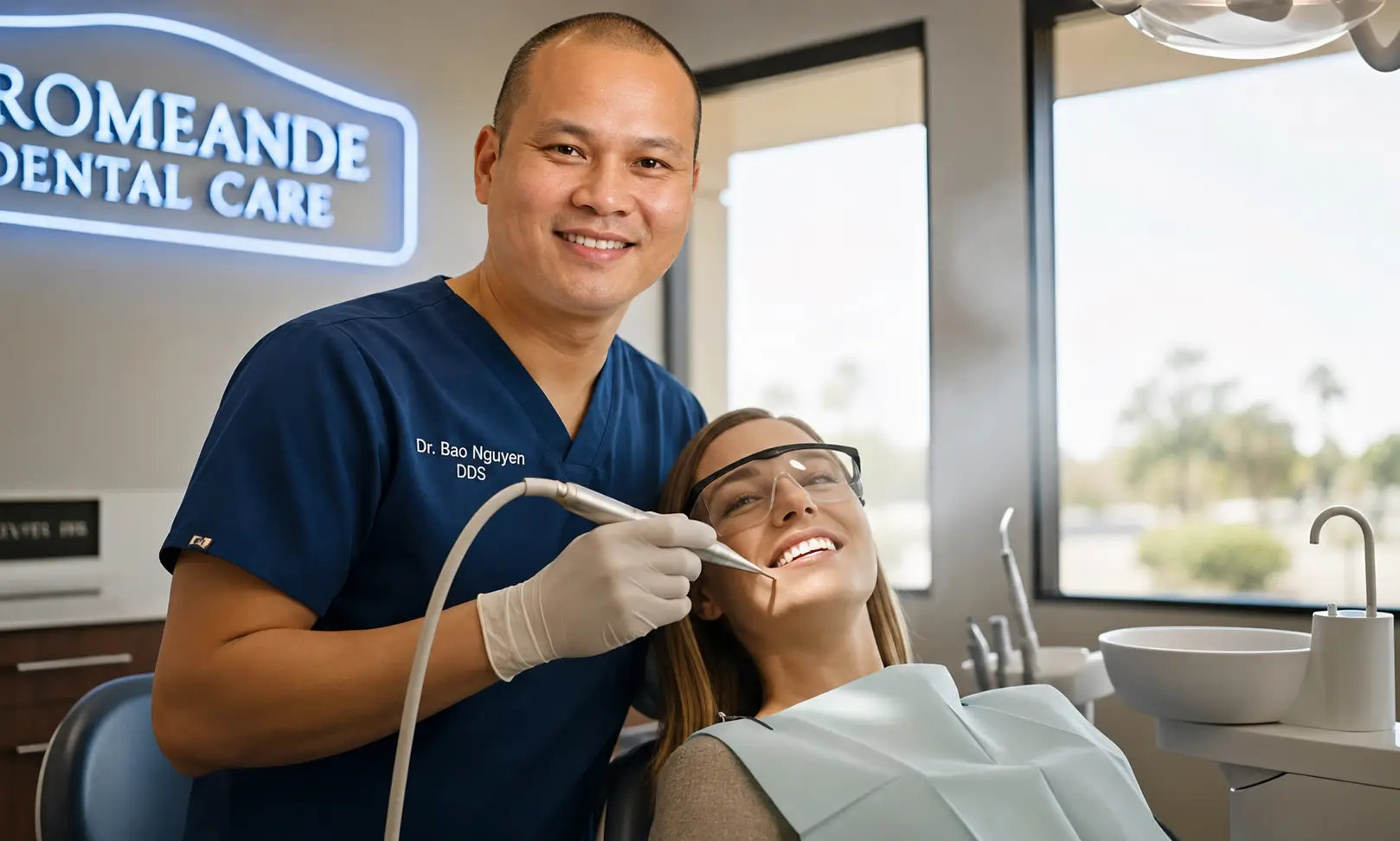
A cleaning in 2026 shouldn't feel like the metal-pick appointments you grew up with. At my Date Street office we use ultrasonic scalers, glycine air polishing, and real periodontal charting to match the cleaning to your mouth: $95 for a healthy-gum cleaning, and measured, honest advice when something deeper is going on. If you've been searching for a no-scraping teeth cleaning or a dental cleaning near you in Murrieta, start here. Every cleaning begins with digital X-rays, an intraoral camera pass, and full periodontal charting, and that charting decides which cleaning you get, not a menu.
Preventive Dentistry
Why a Professional Cleaning Still Matters, Even If You Brush Well
Brushing and flossing handle soft plaque, which is exactly what they're built to do. What they can't touch is calculus. Plaque that sits undisturbed begins mineralizing in about two weeks, and once it's hardened onto enamel or a root surface, no toothbrush on the market will take it off. It comes off with instruments or it doesn't come off. The CDC puts some form of gum disease in nearly half of American adults over 30, and hardened tartar sitting at the gumline is usually where that story starts.
I see the Murrieta version of it every week. Our water is hard, and patients here build tartar fast on the lower front teeth, right where the salivary ducts empty. Add a daily run down the I-15 with a coffee in the cupholder and by the six-month mark most adults have stain and calculus that careful brushing simply won't move. Left alone, that buildup keeps the gums inflamed, and the National Institute of Dental and Craniofacial Research ties untreated periodontal disease to tooth loss and to poorer control of diabetes and heart disease.
- Procedure
- Ultrasonic teeth cleaning (dental prophylaxis), with optional air polishing for stain
- Price
- $95 per cleaning · $20 new-patient exam with digital X-rays · scaling and root planing quoted in writing
- Chair time
- About 45 minutes for a healthy-gum cleaning; add 15 to 30 minutes for air polishing
- Anesthetic
- None needed for a routine cleaning; local anesthetic for scaling and root planing, nitrous oxide on request
- Performed by
- Dr. Bao Nguyen, DDS — UCLA School of Dentistry, 10 years U.S. Navy Dental Corps
- Recall interval
- Every 6 months for healthy gums; every 3 to 4 months on periodontal maintenance
What a modern cleaning actually means at this office
Plenty of dental websites use words like "advanced" the way a car wash uses "premium." Here is what it means at 26957 Date St: before anyone picks up an instrument, you get digital X-rays and a $20 exam, an intraoral camera pass so you can see the same tartar I see, and six-point periodontal charting on every tooth. Pockets of 3 millimeters or less mean a preventive cleaning, ultrasonic scaling plus air polishing, coded as a standard prophylaxis (D1110) on your insurance claim. Pockets of 4 millimeters or deeper with bleeding mean early gum disease, and a "regular cleaning" would polish the visible part of the problem while infection keeps working under the gumline. Those patients need scaling and root planing or laser-assisted care instead.
I have run this practice the same way since 2010: measure first, then recommend, then publish the price. Ten years as a U.S. Navy dentist, including an AEGD residency at Naval Hospital Camp Pendleton and deployments to Kuwait and Iraq, taught me that treatment decisions come from charting, not production quotas. That habit carried over. Nobody at this office is paid a commission to upgrade your cleaning.
A cleaning here isn't one appointment code applied to everybody who walks in. What follows is how I actually decide between a routine ultrasonic cleaning, air polishing, and scaling and root planing. Same explanation I give in the chair, minus the suction.
Very comfortable office. Dr. Bao N. is AMAZING! He is gentle, straight to the point and HONEST.
Rated 5 out of 5 stars. — Sharma Kliche LLP | Google Review
Option 1
Ultrasonic Scaling: The Workhorse Behind a No-Scraping Cleaning
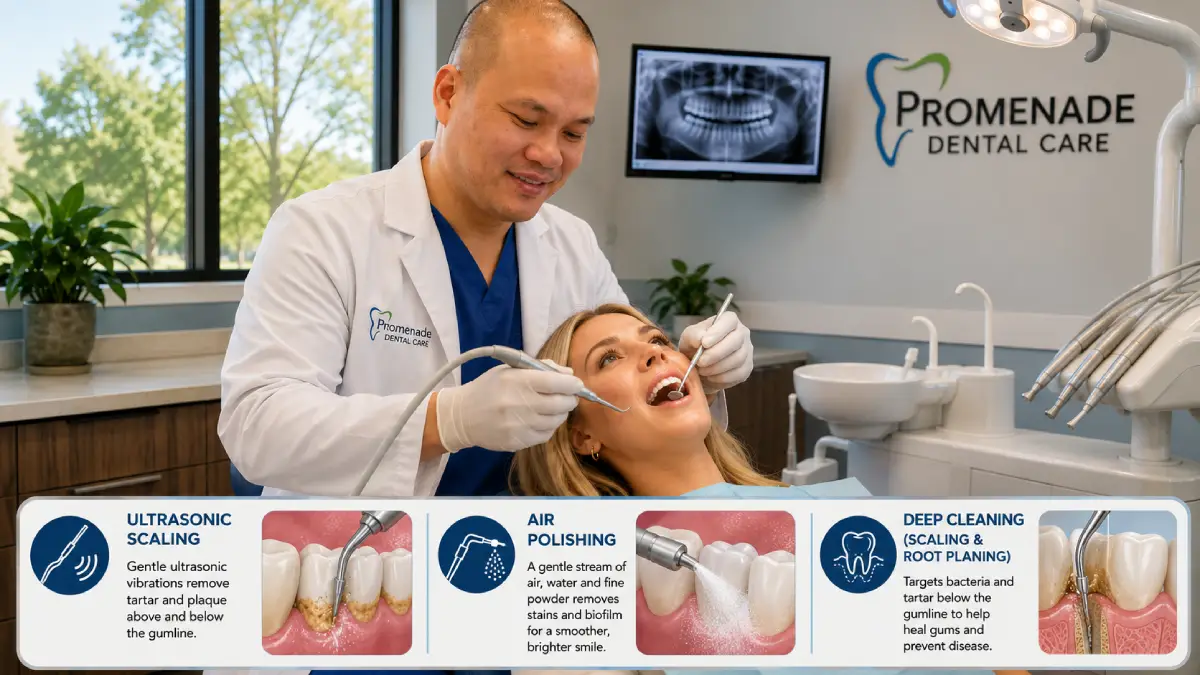
My primary instrument is an ultrasonic scaler. Its tip oscillates roughly 25,000 to 40,000 times per second against a fine water spray. The vibration fractures hardened calculus off the tooth while the water flushes debris and bacteria out from under the gumline, including places a hand curette struggles to reach. Collapsing micro-bubbles in that spray, a process called cavitation, break up bacterial colonies on contact. That's the mechanism behind what patients describe as a no-scraping cleaning.
Two things matter from where you're sitting. Comfort first: a vibrating tip puts far less pressure on the tooth than a blade drawn across it, which is why patients with sensitivity, exposed roots, or bad memories of aggressive scaling tell me they prefer it. If you like evidence, a Cochrane review of routine scale-and-polish care is a good reality check. The benefit of a cleaning comes from matching frequency and technique to your gum condition, not from scaling harder. Second is reach. Ultrasonic tips work 1 to 4 millimeters below the gumline, which is precisely where gingivitis takes hold.
Hand scalers still sit on the tray. Fine curettes reach into furcations and tight spaces between teeth better than any powered tip, so the honest answer is that ultrasonic and hand instrumentation work best together: the ultrasonic does the heavy demolition, the hand instruments do the finish carpentry.
Who benefits most from an ultrasonic cleaning
I finish with hand instrumentation only where a deposit remains, then polish. Most healthy adults are out the door in about 45 minutes. If it's been years since your last visit, tell us when you book and we'll block extra time rather than rushing you or surprising you halfway through with a second appointment.
Sensitive teeth or dental anxiety? We can numb an isolated area, warm the water, and pace the appointment around you. Nitrous oxide is available. Our safe haven for dental anxiety page explains how we handle nervous patients from the first phone call forward.
Option 2
Air Polishing: Stain and Biofilm Off Without the Grit
Traditional polishing uses a spinning rubber cup loaded with abrasive prophy paste. It works, but on veneers, bonded fillings, and implant surfaces, gritty paste can leave micro-scratches that attract new stain faster. Air polishing replaces the cup with a metered mix of air, warm water, and fine powder to lift stain and bacterial biofilm off enamel, restorations, and implant surfaces, and the spray reaches between crowded lower incisors where a cup physically cannot go. For heavy coffee, tea, red wine, and tobacco stain I use sodium bicarbonate powder, which the dental literature supports as effective on extrinsic stain without harming enamel. Around dental implants, porcelain veneers, and bonded composite fillings I switch to glycine or erythritol, which are softer and won't scratch those surfaces.
Powder selection is the whole game, and it's what separates a careful air polish from a careless one. If you have dental implants or porcelain veneers, ask whichever office you visit which powder they're about to use on them. A blank look is your answer. A typical pass takes 15 to 30 minutes and leaves teeth feeling slick. Expect a salty taste, and in some patients a day of mild gum tenderness. That's the whole list of common side effects. If you have a respiratory condition or a sodium-restricted diet, tell us before your visit so we choose the powder and technique accordingly.
The logic is the same one behind guided biofilm therapy, the Swiss-developed protocol the European Federation of Periodontology community has written about extensively: find the biofilm, remove it with air polishing, and reserve mechanical scaling for hardened calculus only.
Overdue for a Cleaning? You Won't Get a Lecture Here.
Six months or six years, the first step is identical: a $20 exam, honest periodontal numbers, and a cleaning matched to what your mouth actually needs.
Option 3
Deep Cleaning, Antimicrobial Therapy, and Laser-Assisted Care
When periodontal charting turns up pockets of 4 millimeters or deeper with bleeding, a routine cleaning is the wrong instrument for the problem. Scaling and root planing, which most people call a deep cleaning, cleans the root surfaces beneath the gumline and smooths them so the tissue has a chance to reattach. The American Academy of Periodontology treats it as the first-line, non-surgical therapy for periodontitis. I do it by quadrant under local anesthetic, which keeps you comfortable and keeps me from working in a hurry. You should feel nothing sharper than pressure. We typically treat one quadrant or one side of the mouth per visit so you are never numb on both sides at once, using the ultrasonic scaler for bulk removal and hand curettes for the root planing itself. Insurance codes it per quadrant (D4341 or D4342), and we quote the full cost before you commit to anything. Afterward you move to a 3-to-4-month periodontal maintenance schedule rather than the standard 6-month recall, because pockets that have been infected once re-colonize faster.
Antimicrobial therapy
For pockets that stay deep after mechanical cleaning, I can place a localized antimicrobial directly into the site once the roots are planed. It suppresses the specific bacteria driving that infection while the tissue heals. I use it selectively. It's an adjunct for stubborn pockets, not a line item stapled onto every deep cleaning.
Laser-assisted decontamination
A dental laser lets me reduce bacteria inside an infected pocket and remove diseased tissue with less bleeding and faster healing than instruments alone, which is useful for patients on blood thinners and for anyone whose anxiety makes conventional instrumentation difficult. Neither the laser nor antimicrobial therapy replaces scaling and root planing; both make it work better in the right mouth. If your charting shows established gum disease, our laser treatment for gum disease page covers the protocol, and if recession has already exposed root surfaces, the gum recession treatment page lays out the options. Early gingivitis, worth remembering, is still reversible with a thorough cleaning and better home care. The Mayo Clinic gingivitis overview explains that window in plain English, and MedlinePlus keeps a non-commercial library on periodontal care if you want a second source.
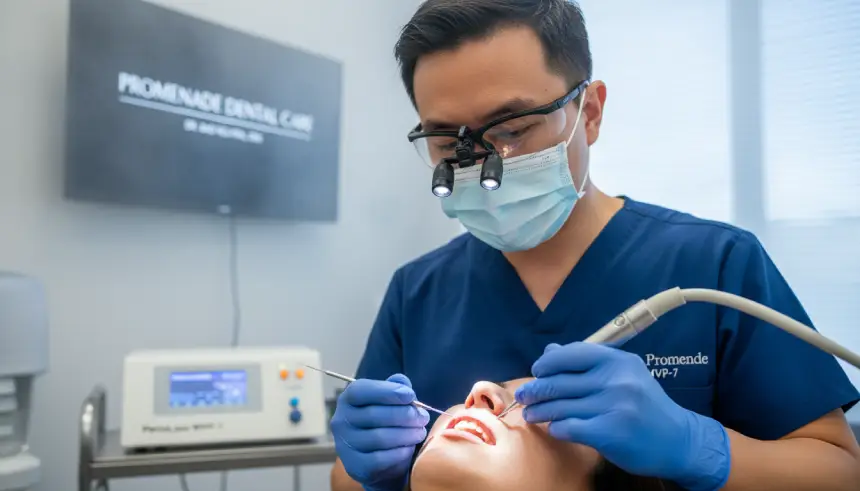
Worth saying plainly: some offices in this valley diagnose a deep cleaning on nearly every new patient who sits down. I chart your pockets, turn the monitor toward you, and recommend scaling and root planing when the measurements call for it. When they don't, you get the $95 cleaning and I tell you so.
Side by Side
Which Teeth Cleaning Option Fits You?
Read down the highlighted column to find the description that sounds like your mouth, then look left for the name of the cleaning that fits it.
| Option | Best for you if… | What happens in the chair | Typical time | Recall interval |
|---|---|---|---|---|
| Ultrasonic cleaning | Your gums are healthy, you're due for a six-month recall, or your teeth are sensitive | A vibrating tip and water spray remove tartar above and just below the gumline, then a hand finish and polish | About 45 min | Every 6 months |
| Air polishing | You have coffee, tea, or tobacco stain, or you have implants, veneers, or bonded fillings | Air, water, and fine powder lift stain and biofilm without abrasive scraping | 15 to 30 min | Every 6 months, with your cleaning |
| Scaling and root planing | Your charting shows gum pockets of 4 mm or more with bleeding on probing | Root surfaces cleaned and smoothed beneath the gums, by quadrant, under local anesthetic | 1 to 2 visits | Perio maintenance every 3 to 4 months |
| Antimicrobial therapy | Your pockets stayed deep or kept bleeding after mechanical cleaning | A targeted antibacterial is placed directly into the infected pocket after root planing | Added to SRP visit | Every 3 months until pockets stabilize |
| Laser-assisted care | You have established gum disease and prefer a minimally invasive approach | A laser reduces pocket bacteria and diseased tissue with less bleeding and faster healing | Varies by case | Matched to condition |
Not sure which one you need? You don't have to be. That's what the $20 exam and digital X-rays are for. I chart every pocket, show you the intraoral camera images on the screen, and walk you through the numbers before anything gets scheduled. Kids follow a different track entirely, with gentler instrumentation, fluoride varnish, and sealants on new molars, which the pediatric dentistry page covers. And if you found this page because something already hurts, skip the cleaning research and go straight to the emergency dentist page or call us.
What Our Patients Say
Google Reviews from Cleaning Patients
These are unedited reviews patients posted on Google. I didn't write them and I haven't trimmed them. The themes repeat: honest recommendations, gentle hands, and no invented treatment plans.
I love coming to Promenade Dental Care. Dr. Nguyen and Edith are the best. They’re friendly and I love that I’m taken care of right away. Dr. Nguyen is thorough and efficient. He answers any questions I have and explains things clearly. I actually look forward to my biannual dentist visits now because they’re the best. Can’t recommend a dentist more!
Rated 5 out of 5 stars. — Kamilah C. | Google Review
Dr. Nguyen does a great job. He is always on time and very honest. Never has you do unnecessary treatments, just to make extra money. I love that he is a solo practitioner and runs his own shop. That keeps his overhead costs low and he knows you more personally as a patient. All my family comes to see him. Best dentist I’ve ever had.
Rated 5 out of 5 stars. — Tom H. | Google Review
I am completely terrified of the dentist. I neglected getting anything done for years and years because of bad experiences and just general fear and anxiety. Well I got sick of having an aching jaw everyday so I came in and got a x-ray and consultation and they told me what work needed to be done. The price was pretty much half of what comparable dentists wanted and they were really really nice to me. The doctor gave me some anxiety meds which completely relaxed me and I can honestly say I have way less fear and anxiety about going back to the dentist. So if you have any anxiety about going to the dentist, this is the place for you.
Rated 5 out of 5 stars. — Jay D. | Google Review
Very knowledgable and good prices. Does only what is necessary. Does not just look for stuff to charge for. Got an appointment quickly when I thought it was an emergency. My favorite dentist ever!!
Rated 5 out of 5 stars. — Sheila O. | Google Review
Transparent Pricing
Teeth Cleaning Prices in Murrieta, Published Up Front
I publish my fees because guessing games help nobody. If you have PPO dental insurance, preventive cleanings are typically covered at or near 100 percent. We're in network with Delta Dental PPO, Cigna, MetLife, Guardian, Aetna, and United Concordia, and we accept all PPO plans. No insurance? The prices below are the prices. CareCredit financing is available for larger treatment plans.
New-Patient Exam & Digital X-Rays
Includes periodontal charting and a review of the findings with me
Ultrasonic Teeth Cleaning
Healthy-gum prophylaxis (D1110) with polish; air polishing added when stain calls for it
Scaling & Root Planing
Per quadrant (D4341/D4342), priced in writing before treatment; CareCredit available
One cost note from sixteen years in this community. A $95 cleaning twice a year is dramatically cheaper than the root canal, crown, or emergency visit that deferred maintenance eventually produces. Prevention is the only part of dentistry that gets cheaper the more consistently you do it. If a deep cleaning is recommended, you get the per-quadrant cost, your estimated insurance portion, and financing options before anything is scheduled, the same transparency we apply to same-day crowns and every other service here.
Plan Your Visit
Hours, Location, and Getting Here
We're at 26957 Date St, Suite B4, in the shopping center anchored by Aldi just off Murrieta Hot Springs Road, roughly four miles east of the I-15. It's an easy stop for patients driving in from Temecula, Menifee, French Valley, Winchester, and Wildomar. Same-day hygiene openings turn up most often on Wednesday and Friday mornings, so it's worth calling to ask.
Office hours
| Monday | 9:00 AM – 5:00 PM |
| Tuesday | 9:00 AM – 5:00 PM |
| Wednesday | 9:00 AM – 3:00 PM |
| Thursday | 9:00 AM – 5:00 PM |
| Friday | 9:00 AM – 3:00 PM |
| Saturday | By appointment & emergencies |
| Sunday | Closed |
Families are welcome. We clean a lot of Murrieta kids’ teeth, and the pediatric dentistry page covers how we keep those visits easy. Our team speaks English, Spanish, and Vietnamese. Thinking about smile improvements once your teeth are clean? The cosmetic dentistry page covers veneers, bonding, and other options, all of which start from a clean, healthy foundation.
If you want to know more about who is holding the instrument: I graduated from the UCLA School of Dentistry, completed my AEGD residency at Naval Hospital Camp Pendleton, and am licensed by the Dental Board of California. You can verify the license yourself, and I would rather you check than take a website's word for it. More background and training is on the About page, and you can read patient reviews on Yelp as well as Google.
Book Your $95 Murrieta Teeth Cleaning
One call gets you the $20 exam, digital X-rays, honest periodontal numbers, and a cleaning matched to what your mouth actually needs.
Common Questions
Murrieta Teeth Cleaning FAQs
How much does a teeth cleaning cost in Murrieta?
A standard ultrasonic cleaning at Promenade Dental Care is $95, and new patients can add a $20 exam with digital X-rays. That $95 is the published price whether or not you carry insurance. With a PPO plan, preventive cleanings are usually covered at or near 100 percent; we're in network with Delta Dental PPO, Cigna, MetLife, Guardian, Aetna, and United Concordia, and we accept all PPO plans. If your gums need scaling and root planing instead, Dr. Bao Nguyen, DDS quotes that fee in writing before treatment begins. Call (951) 412-0127 to book.
Is ultrasonic teeth cleaning really a no-scraping cleaning?
For a healthy-gum visit, very close to it. The ultrasonic tip vibrates tartar loose while a water spray flushes it away, and air polishing lifts stain and biofilm with a fine powder mist. Dr. Nguyen picks up a hand instrument only to finish an isolated deposit the ultrasonic tip can't fully clear, which is usually a matter of seconds per tooth. The metal-pick scraping most people remember is the exception at this Murrieta office, not the routine.
What does a teeth cleaning include at Promenade Dental Care?
Every cleaning starts with digital X-rays, an intraoral camera pass, and six-point periodontal charting so Dr. Nguyen knows where calculus and biofilm are hiding before any instrument touches a tooth. From there, most patients get ultrasonic scaling to break up hardened tartar above and below the gumline, followed by air polishing to lift surface stain and disrupt remaining plaque, then a polish. If the pocket depths show early gum disease, he recommends scaling and root planing or laser-assisted therapy instead of a standard cleaning and explains why.
Is ultrasonic scaling better than traditional hand scaling?
For most patients, yes, but the two are complementary rather than competing. The ultrasonic tip vibrates tens of thousands of times per second and uses a water stream to flush debris out of the gum pocket as it works, so it removes heavy calculus faster and with less scraping pressure than hand instruments alone. Dr. Nguyen still uses hand curettes for fine detail work in tight spaces and furcations, and the research supports using both together rather than choosing one.
Does air polishing damage tooth enamel?
No. The glycine and erythritol powders used around implants, veneers, and bonded restorations are softer than enamel and dissolve in water, which makes air polishing gentler on those surfaces than a rubber-cup polish with gritty prophy paste. Sodium bicarbonate powder is coarser and is reserved for heavy extrinsic stain on natural enamel, where the dental literature supports it as safe. If you have a respiratory condition or a sodium-restricted diet, tell Promenade Dental Care before your visit so the right powder is chosen.
Does an ultrasonic teeth cleaning hurt?
Most patients say it's easier than the hand scaling they remember, because the tip vibrates against a water spray instead of dragging across the tooth. Sensitivity still varies from person to person, so mention it when you book. At Promenade Dental Care we can numb a single area, warm the water, slow the pace, or offer nitrous oxide. Nobody here gets talked out of asking for a break.
What is the difference between a regular cleaning and a deep cleaning?
A regular cleaning, or prophylaxis, removes plaque, tartar, and stain from the tooth crowns and just under the gumline in a healthy mouth. A deep cleaning, or scaling and root planing, cleans the root surfaces further beneath the gums and is indicated when pockets measure 4 millimeters or more with bleeding. Dr. Nguyen measures every pocket with a periodontal probe and shows you the chart, so the recommendation comes from measurements rather than a sales script.
How do I know whether I really need a deep cleaning or am being upsold?
Ask to see your pocket depths. A legitimate scaling and root planing recommendation is backed by charted numbers: pockets of 4 millimeters or more, bleeding on probing, and usually bone loss visible on X-rays. At Promenade Dental Care in Murrieta you see the chart and the intraoral camera images before anything is scheduled. If your measurements are healthy, Dr. Nguyen will tell you a $95 cleaning is all you need.
Is air polishing safe for dental implants and porcelain veneers?
Yes, provided the powder matches the surface. Around implant crowns, porcelain veneers, and bonded composite restorations Dr. Nguyen uses fine glycine or erythritol powder, which clears biofilm without scratching the finish. Coarser sodium bicarbonate powder is reserved for heavy coffee, tea, and tobacco stain on natural enamel. If an office can't tell you which powder they're about to use on your implant, that's a fair reason to pause and ask.
How long does a teeth cleaning appointment take?
A routine ultrasonic cleaning on healthy gums runs about 45 minutes at Promenade Dental Care, and an air polishing pass for stain adds 15 to 30 minutes. If several years have passed since your last visit, or if scaling and root planing is needed, we schedule longer or split the work by quadrant. Rushing a heavy tartar case into one hurried appointment produces a mediocre result and a sore patient.
How often should I have my teeth cleaned?
Every six months suits most healthy adults. Patients with a history of gum disease, diabetes, heavy tartar buildup, dental implants, or dry mouth from medication usually do better every three to four months on a periodontal maintenance interval. Dr. Nguyen sets your recall from your pocket measurements and how quickly tartar returns between visits, then eases the interval back out as your gum health improves.
Can I get my exam and cleaning done in the same visit?
Usually, yes. New patients start with the $20 exam and digital X-rays so Dr. Nguyen can confirm the gums are healthy enough for a standard cleaning, and in most cases hygiene happens the same day. When the exam turns up deeper pockets, we explain why and schedule scaling and root planing instead, because cleaning above the gumline wouldn't solve that problem. Mention at booking that you want both and we'll set the time aside.
Do I still need a professional cleaning if I brush and floss every day?
Yes. Brushing and flossing control soft plaque, which is exactly what they're meant to do. Once plaque mineralizes into calculus, roughly within two weeks, no toothbrush, water flosser, or toothpaste removes it. At Promenade Dental Care in Murrieta, professional instruments take that hardened tartar off above and below the gumline, which is the one place daily home care can't reach and where gum disease begins.
Can a teeth cleaning fix bad breath and bleeding gums?
Often, yes. Persistent bad breath and gums that bleed when you brush usually trace back to bacterial buildup and inflammation at the gumline, and removing that tartar and biofilm addresses the source. Give the tissue a week or two to settle afterward. If bleeding continues past that, it points to gum disease that needs deeper treatment, which is why Dr. Nguyen charts pockets before anything else.
What is antimicrobial therapy and when is it used?
Antimicrobial therapy places a targeted antibacterial agent directly into an infected gum pocket after scaling and root planing, suppressing the bacteria driving the infection while the tissue reattaches. Dr. Nguyen uses it selectively, for pockets that stay deep or keep bleeding after mechanical cleaning. It isn't a line item added to every deep cleaning at Promenade Dental Care.
Is a professional teeth cleaning safe during pregnancy?
Yes, and it's encouraged. Hormonal changes make expectant mothers more prone to swollen, bleeding gums, and pregnancy gingivitis is common. The second trimester is usually the most comfortable window for a hygiene visit. Tell Promenade Dental Care you're pregnant when you book so Dr. Nguyen can position you comfortably, keep the appointment efficient, and defer any non-urgent X-rays.
Do you clean children's teeth, and do you see nervous patients?
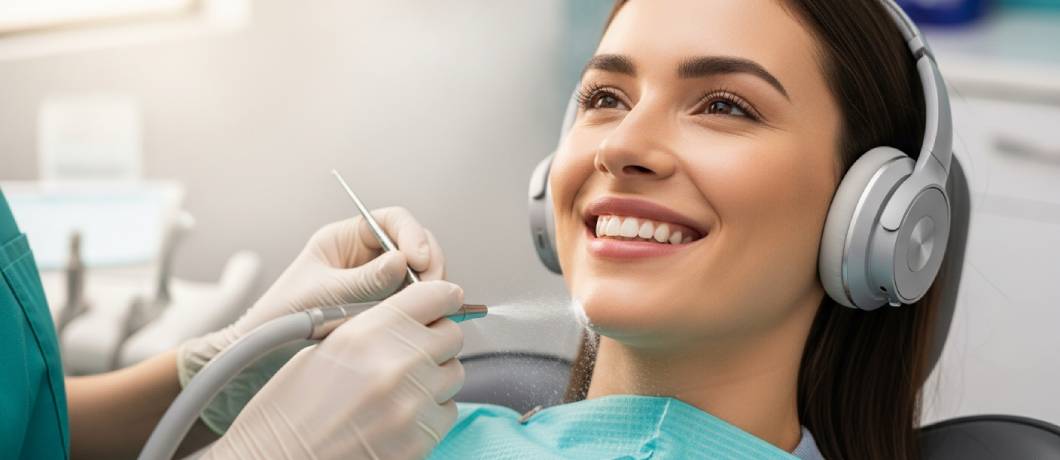
Yes to both. Dr. Nguyen has treated Murrieta families since 2010, and children's hygiene visits are shorter, gentler, and finished with fluoride varnish. Adults with dental anxiety get a slower pace, headphones, and nitrous oxide if they want it. Several of our longest-standing patients arrived after years of avoiding dentistry, and nobody here lectures them about the gap.
Does dental insurance cover teeth cleaning at Promenade Dental Care?
Most PPO plans cover two preventive cleanings a year at or near 100 percent, and Promenade Dental Care in Murrieta is in network with Delta Dental PPO, Cigna, MetLife, Guardian, Aetna, and United Concordia. We accept all PPO dental plans and file the claim for you. If scaling and root planing is needed, coverage typically drops to a percentage of the fee, so we verify your benefits and give you the out-of-pocket number in writing first. Without insurance, the $95 cleaning price stands as published.
Where is Promenade Dental Care and what are your hours?
Promenade Dental Care is at 26957 Date St, Suite B4, Murrieta, CA 92563, in the Aldi-anchored center off Murrieta Hot Springs Road about four miles east of the I-15. Hours are Monday, Tuesday, and Thursday 9:00 AM to 5:00 PM, Wednesday and Friday 9:00 AM to 3:00 PM, Saturday by appointment & emergencies, and closed Sunday. Call (951) 412-0127 to book a cleaning.