
Murrieta · French Valley · Winchester · Menifee · Temecula
Same-Day Crowns in Murrieta: One Visit. Two Hours. $1,054* in Writing.
Scanned, designed, milled, and bonded before lunch. No temporary. No lab wait.
I am Dr. Bao Nguyen. I trained at UCLA, spent ten years as a dentist for the Navy and the Marines, and have been fixing teeth on Date Street in Murrieta since 2010. When a tooth breaks here, I do not mail a mold to a lab and send you home in a plastic temporary for three weeks. I scan the tooth, design the crown on screen, mill it in the next room, and bond it the same morning. The price is $1,054* cash, and you see that number before I start.
UCLA School of Dentistry10 years, U.S. Navy Dental CorpsMurrieta since 2010
Start Here
What a Same-Day Crown Actually Is
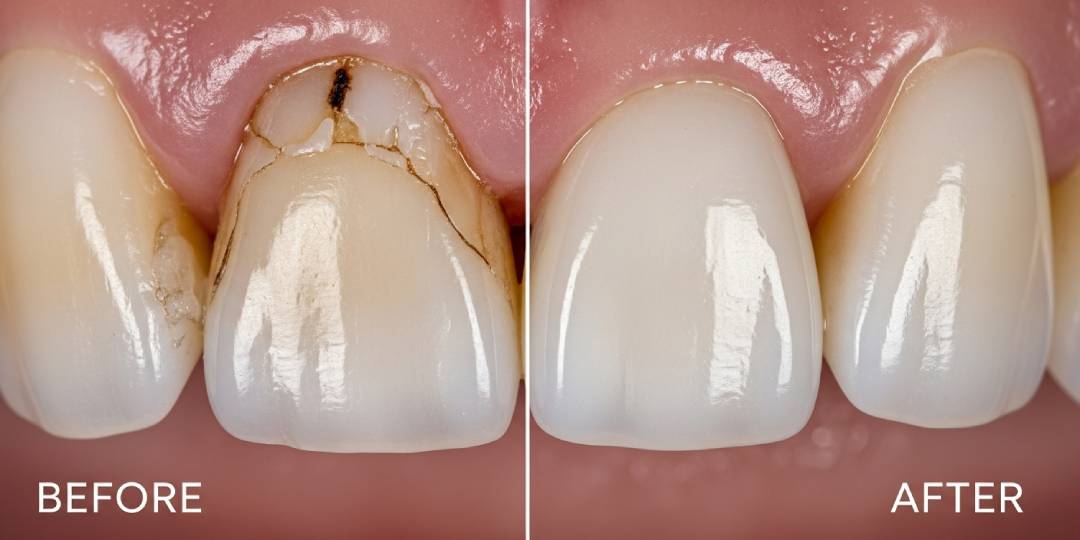
A crown is a cap that covers the whole tooth once the natural enamel has cracked, decayed, or worn past the point where a filling can hold it together. That definition has not changed since I was in school. What changed is where the crown gets made.
The old way sends a putty mold to an outside laboratory. A technician who has never met you builds the crown, it comes back in two or three weeks, and in the meantime you wear a plastic temporary set with deliberately weak cement so it can be pried off later. A same-day crown is the same restoration, manufactured in my office while you sit in the chair. You walk in with a broken tooth and walk out about two hours later with the finished ceramic crown already bonded in place. The ADA's patient guide to crowns explains why a tooth needs one in the first place. This page is about how I deliver it in a single sitting.
- Procedure
- CEREC same-day ceramic crown, designed and milled in-office
- Chair time
- About two hours, start to bonded
- Visits
- One
- Temporary crown
- None
- Cash price
- $1,054 starting fee.
* excludes any additional work that might be needed such as core build up or root canal. - Materials
- Lithium disilicate or zirconia-reinforced ceramic, metal-free
- Dentist
- Dr. Bao Nguyen, DDS — UCLA, U.S. Navy AEGD (Camp Pendleton)
- Where
- 26957 Date St, Suite B4, Murrieta, CA 92563
- Hours
- Mon, Tue, Thu 9:00 AM–5:00 PM · Wed, Fri 9:00 AM–3:00 PM · Sat by appointment & emergencies · Sun closed
How the technology works
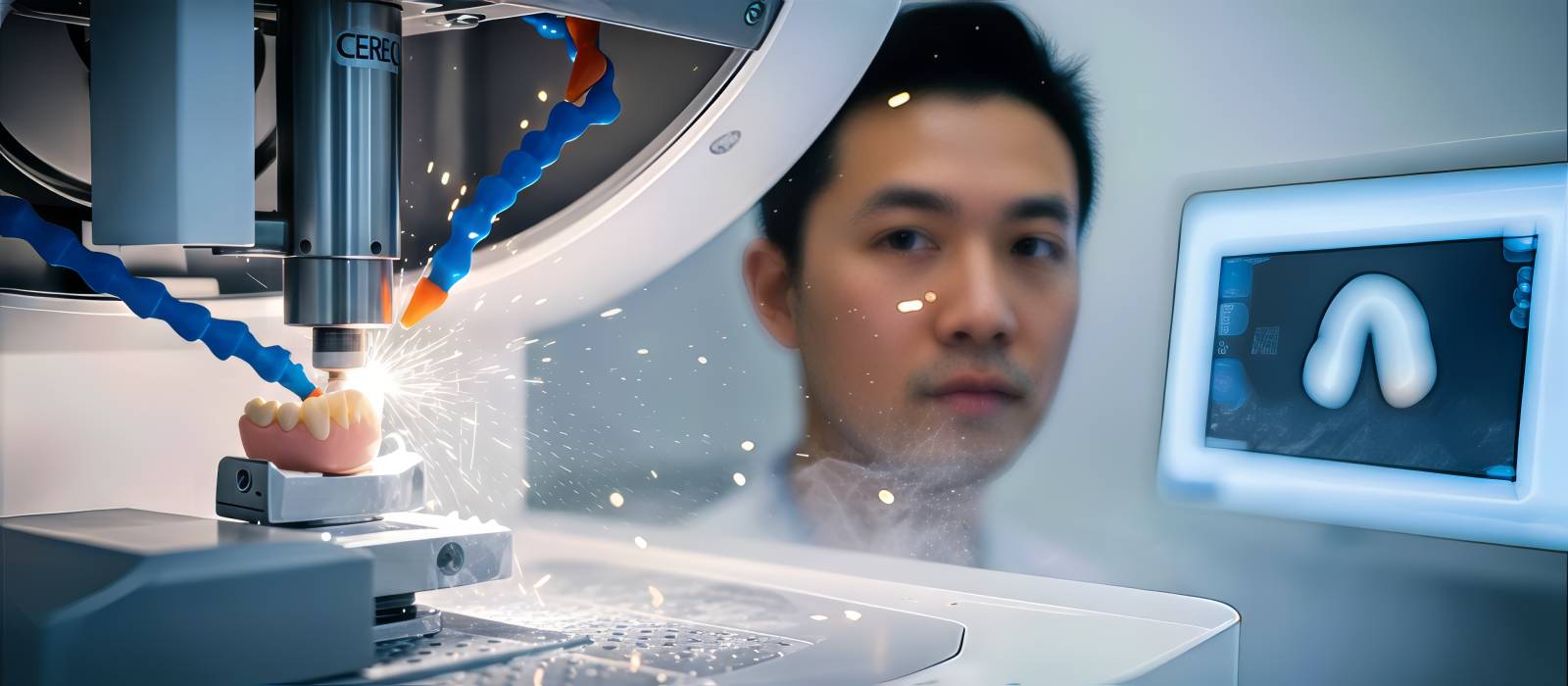
CEREC is the CAD/CAM platform behind it, and it runs in three linked stages. An optical scanner builds a three-dimensional model of the prepared tooth. Design software lets me shape the crown on screen and test it against your bite from every angle. A milling unit then carves that design out of a solid ceramic block, roughly the way a CNC machine cuts a part out of a billet of metal.
The system has been in clinical use since the mid-1980s, so this is not new technology. The units running today are simply several generations more accurate than what sat in dental offices a decade ago. The practical upshot is that the lab is in the room. Nothing ships out, nothing gets misplaced, and nothing arrives back three weeks later in the wrong shade.
The scan replaces the putty tray
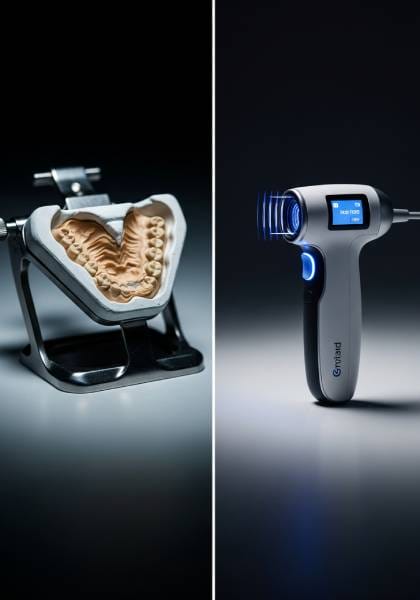
If you have had a crown the traditional way, you remember the impression. Cold putty pressed over your teeth on a tray while you breathe through your nose and try not to gag. Beyond being unpleasant, putty has accuracy problems nobody mentions at the time. The material distorts a little as the tray pulls free. Trapped air bubbles hide exactly the fine margin detail that matters most. And the whole thing then gets poured into a stone model that adds its own small errors before the technician has even started.
A digital scan is a small camera wand passed around the tooth for a couple of minutes. Software stitches thousands of frames into a model accurate to fractions of a millimeter, and I inspect it on screen right there with you. If one margin did not capture cleanly, I rescan that spot in about ten seconds instead of remaking a whole tray. For patients with a strong gag reflex, that alone is usually reason enough to go this route.
Design is where the dentist earns the fee
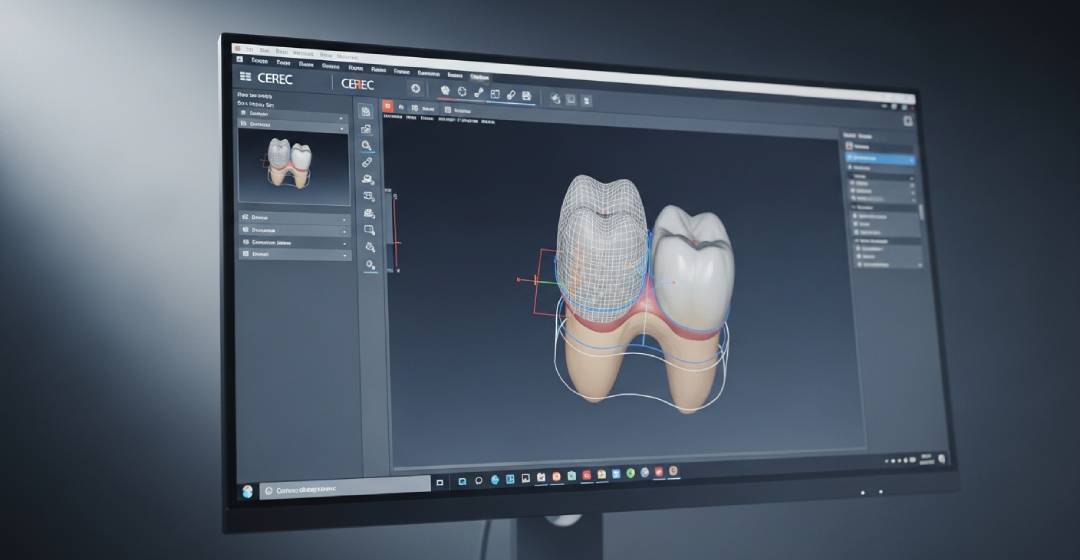
People assume this stage is automated. It is not. The software proposes an opening shape pulled from a library of tooth anatomy, and a proposal is not a restoration.
I tune the contact points where the crown meets its neighbors, shape the chewing surface so it interlocks with the tooth above it, refine the gumline contour so the tissue stays healthy at the edge, and mirror the matching tooth on the other side of your mouth. A molar built for a patient who grinds gets designed flatter and thicker than the same molar in someone with a gentle bite. No machine makes that call. I do, and I am looking at your other teeth while I make it.
Milling and material choice
Once the design is locked, the file goes to the milling chamber, where diamond burs cut the crown from a solid tooth-colored block under a stream of coolant. That runs fifteen to twenty-five minutes depending on the material, which is long enough to answer a few emails and short enough that the numbness has not started to fade.
The blocks are the quiet workhorse here. Factory-formed ceramics like lithium disilicate are denser and more uniform than porcelain layered by hand, precisely because they are pressed under controlled industrial conditions instead of brushed on in stages. They contain no metal, which matters for patients with nickel sensitivity, and I match the block to your enamel shade with a shade tab held against the wet tooth before cutting starts. Teeth dehydrate and lighten under the lights, so shade gets picked early rather than at the end.
Material is chosen tooth by tooth. Lithium disilicate gives the best balance of strength and lifelike translucency for premolars and anything visible when you smile. Zirconia-reinforced blocks trade a little of that translucency for considerably more fracture resistance, which is the right call on second molars under heavy load and for anyone with a grinding history. The ADA's clinical resources track these materials in depth. Ask me which block your crown came from and why I picked it, and you will get a straight answer.
The bite check is the part that buys you fifteen years
The milled crown gets tried on the tooth first. I check the margins under magnification, verify the contacts with floss, and confirm the shade in natural light near the window rather than under the operatory lamp. Depending on the material it then gets polished, or glazed and briefly fired.
Bonding comes last. The tooth is cleaned and conditioned, the inside of the crown is treated so the resin cement grips it chemically, and the crown is seated under firm pressure while the cement cures. I clear the excess cement from the gumline carefully, because cement left below the gum is one of the most common causes of irritation around an otherwise well-made new crown.
Then the bite adjustment. You close on marking paper, slide your jaw side to side, and I read the ink like a map. Anywhere the new crown lands before your other teeth do gets shaved by fractions of a millimeter and rechecked. A crown left even slightly high concentrates your entire bite force onto one tooth. You feel that as a sore tooth within a few days, and over years it shows up as cracked ceramic or an irritated nerve. Because I designed the crown and I am adjusting it in the same visit, against the same bite I scanned an hour earlier, this step goes faster and lands more precisely than adjusting an outside crown built from a three-week-old stone model.
What nobody puts in the brochure
A crown does not make a tooth immortal. The tooth under it can still decay at the margin, and the gum around it can still develop disease. The maintenance is unglamorous and it works: brush twice a day with real attention to the gumline of the crowned tooth, floss daily by curving around the crown rather than snapping through it, and keep your exam and X-ray appointments so I can confirm the margin is still sealed year over year. If you grind at night, wear the guard. Grinding is the single biggest crown-killer I see in Riverside County mouths.
One more thing worth filing away. A crowned tooth can later anchor a dental bridge if a neighboring tooth is lost. Clean margins and conserved structure today keep tomorrow's options open, which is why I treat a single crown as a move in a longer game rather than a one-off repair.
“Went to get a cleaning and some fillings had a great experience very professional and great customer service made me feel like family with no doubt I will continue coming back and I recommend 100% Promenade Dental Care if anyone needs Dental Services Contact them.”
Monica P. · Read all Google reviews for Promenade Dental Care
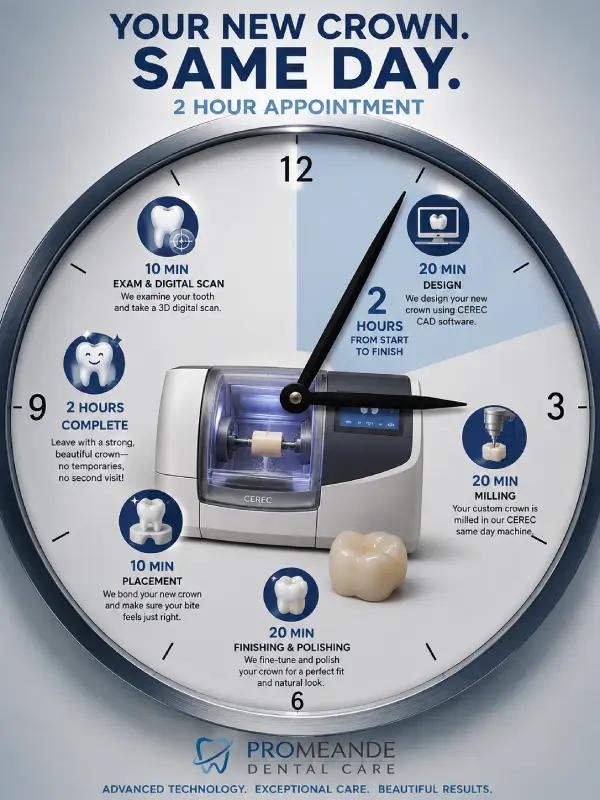
Roughly Two Hours, Start to Finish
Your Same-Day Crown Visit, Step by Step
This is the exact sequence at the Date Street office. It does not vary much from one crown to the next.
1. Exam and an honest diagnosis
I look at the tooth and your X-rays and confirm a crown is genuinely the right move. Not a smaller filling that would save more tooth. Not an extraction dressed up as a restoration. If you do not need a crown, I say so and you go home having spent $20.
2. Preparation
The tooth is numbed and shaped to receive the crown. Decay and fractured structure come out. Healthy enamel stays wherever it can. Anxious patients can pair this with our dental anxiety approach and set the pace themselves, hand up means stop.
3. Digital scan
A camera wand captures a 3-D model of the prepared tooth and your bite in a few minutes. No tray, no putty, no gagging. Any spot that needs a better image gets rescanned in seconds.
4. Chairside design
I sculpt the crown on screen: contacts, contours, chewing anatomy, gumline fit. The design follows your real bite. Flatter and thicker for grinders, finer detail where appearance leads.
5. In-office milling
Diamond burs carve the crown from a ceramic block matched to your shade. Fifteen to twenty-five minutes. You stay in the chair or step out for coffee, whichever you prefer.
6. Bond, adjust, done
Try-in under magnification, bite adjustment on marking paper, polish or glaze, then permanent bonding. You leave with the final crown, the one you will still be chewing on years from now.
Book the morning if you can. The visit runs about two hours and our hours vary by day, so an early start means you are bonded, adjusted, and heading back up the Clinton Keith corridor toward French Valley or Winchester before noon. The alternative is three weeks of this hanging over your calendar.
The Number, Before We Start
What a Same-Day Crown Costs in Murrieta
$1,054
CEREC same-day ceramic crown
Excludes any additional work that might be needed such as core build up or root canal.
Total fee excluding any additional work that might be needed such as core build-up and root canals. You get it on paper before I touch the tooth.
What the $1,054 includes
Some things it does not include
- Root canal therapy (endodontic treatment) — the most common precursor
- Post and core buildup — when too little natural tooth remains to hold a crown
- Crown lengthening — gum/bone recontouring when decay extends below the gumline
- Tooth-colored fillings — decay removal and initial restoration
- Deep cleaning / periodontal therapy (scaling and root planing) — gums must be stable before permanent restoration
- Emergency dentistry — cracked, fractured, or broken tooth that leads to the crown
- Tooth extraction
- Bone graft / socket preservation
- Dental implant with implant crown
- Dental bridge (crowns serve as the abutments)
- Partial denture
*What is not included, and why you will hear about it first. If the tooth also needs a root canal or a core build-up before it can hold a crown, those are separate procedures with their own written prices. I show you the X-ray, explain what the tooth needs, and quote it before anything starts. Nobody at this office discovers a charge after the fact.
We are networked with all PPO plans, and most cover crowns at roughly 50 percent after your deductible. Insurers do not distinguish a CEREC crown from a lab crown, so choosing the one-visit route costs you nothing in coverage. CareCredit financing with up to six months no interest is available for qualified applicants. If you are new to the practice, a $20 exam with digital X-rays is the cheapest way to find out whether the tooth actually needs a crown.
“This is a great place to go take care of your teeth. The team was very professional examining and providing with solutions by priority. I felt that I was in good hands. Very gentle and kind to me. They explained very well what was going on. The best dental care I have ever experienced! Will be coming back for all my future dental needs!”
Nancy R. · Read all Google reviews for Promenade Dental Care
The Honest Trade-Offs
Same-Day Crowns vs. Traditional Lab Crowns
Lab crowns are not bad dentistry. Millions of them are chewing happily right now, and I placed plenty of them earlier in my career. The real question is what the multi-visit process costs you in time, comfort, and risk, and whether you get anything back in exchange. Usually you do not.
The traditional sequence goes like this. Numbing and preparation at visit one. A putty impression. A plastic temporary set with intentionally weak cement. Two to three weeks of waiting. Then a second appointment to pry off the temporary, scrape away the old cement, and seat the outside crown, assuming it fits and the shade is right. When it is not, the cycle starts over and you are into week six.
Every stage has a familiar failure. Temporaries come off, usually over a weekend, because they are built to come off. The exposed prepared tooth stays sensitive to hot and cold the entire time. The second numbing visit is its own ordeal for anxious patients. And the tooth sits in a vulnerable in-between state for weeks.
A same-day crown trades all of that for one longer appointment. The materials are comparable, since modern milled ceramics rival lab-pressed porcelain in strength, as the Cleveland Clinic's crown overview notes across crown types. The fit is arguably better, because the crown is adjusted against the live bite it was scanned from an hour earlier rather than a stone model poured three weeks ago.
Lab crowns still earn their place in a handful of demanding cosmetic cases on front teeth, where a ceramist's hand-layered porcelain achieves subtleties a milled block cannot, and in certain full-mouth reconstructions. If your case is one of those, I will tell you at the exam. That is what the exam is for.
The lab was never what made the crown better. It made it later. Once milled ceramics caught up on strength, the second and third visits were solving a scheduling problem, not a tooth problem. That is why I brought CEREC into this practice.
Before You Book Anywhere
Five Questions to Ask Any Murrieta Dental Office
Plenty of offices along Winchester Road and the Clinton Keith corridor advertise crowns. Fewer mill them in-house. Fewer still will put a cash number in writing. Ask these five questions wherever you call, and that includes here.
| Question to ask | Promenade Dental Care | Typical lab-crown office | Typical corporate chain |
|---|---|---|---|
| How many visits for a crown? | One, about two hours | Two to three over 2–4 weeks | Two or more, often a separate consult first |
| Will I need a temporary crown? | No, permanent crown same day | Yes, for 2–3 weeks, and they loosen | Yes, plus a fee if it needs re-cementing |
| Do you use a digital scan? | Yes, optical scan, no putty | Often still tray-and-putty impressions | Varies by location and associate on duty |
| Is there a lab wait? | None, milled in-office in about 20 minutes | 2–3 weeks, longer if the lab remakes it | 1–3 weeks, outsourced lab |
| What is the cash price, in writing? | $1,054 excludes any additional work | Often quoted as a range | Commonly $1,200–$2,000, verbal, “pending insurance” |
The last row is the one that filters fastest. An office that will not write the number down before treatment is telling you something about how that number is going to behave afterward.
What This Looks Like in Real Mouths
Four Cases Where a Same-Day Crown Was the Right Call
These are composite cases drawn from situations I treat week in and week out. Details are generalized to protect privacy, and the outcomes are typical for each scenario.
The cracked tooth
A French Valley contractor in his forties with an old crack line on a lower molar, the kind that twinges on release rather than on the bite itself. Left alone, cracks travel. The only real question is whether the crack reaches the nerve or the root first.
A crown binds the tooth together the way a hoop binds a barrel and stops the crack from spreading under load. His crack had not yet reached the pulp, so no root canal was needed. Prep, scan, mill, bond, one morning. Cracks caught early are crown cases. Cracks caught late are extractions.
The broken molar
A Winchester mom bit a popcorn kernel and sheared the entire outer wall off an upper molar on a Friday afternoon, with a birthday party the next day. The remaining tooth was sound. It had simply lost too much structure for any filling to hold.
This is where the emergency side of the practice matters most. She was scanned, the crown was milled, and the tooth was fully restored that same afternoon. The alternative was a temporary all weekend and hoping it survived the cake.
The failing large filling
A Menifee retiree with a 25-year-old silver amalgam covering more than half the tooth. Oversized old fillings fail on a schedule. The metal expands and contracts with temperature for decades until the enamel walls around it crack, and decay creeps in along the leaking edges.
When a tooth is more filling than tooth, swapping the filling for another filling just resets the failure clock. A ceramic crown replaced the amalgam and capped the weakened walls in one visit. At his recall the margins were still sealed tight on the X-ray.
The post-root-canal crown
A Temecula patient who had just finished a root canal on a lower molar. A root-canal-treated tooth loses its internal blood supply and turns brittle over time. The research and my own chairside experience agree here: back teeth crowned soon after a root canal survive substantially longer than those left as filled shells, which tend to split.
The same-day workflow matters in this case because the window matters. Instead of wearing a temporary over an already fragile tooth for weeks, he had the permanent crown bonded within days of the root canal, closing the door on fracture and reinfection at the same time.
The pattern across all four: waiting turns crown cases into extraction cases. A crown here starts at $1,054. A lost molar that later needs an implant costs several times that, and you live without the tooth in between. If a tooth has cracked or broken, call before it decides for you.
The Dentist Behind the Machine
Why I Recommend Same-Day Crowns, and When I Won't
A milling machine makes no clinical decisions. Every crown that leaves this office reflects a particular training background and a particular view about when to pick up a drill and when to leave a tooth alone.
Military training
I trained at the UCLA School of Dentistry and then served ten years as a dentist for the U.S. Navy, working with both sailors and Marines, including a deployment to Kuwait and Iraq. The Navy put me through a one-year Advanced Education in General Dentistry residency at Naval Hospital Camp Pendleton. Military dentistry is a specific education. High volume, every flavor of trauma and breakdown, and patients who need a tooth fixed correctly the first time because the second appointment might be months and an ocean away. It produces dentists who work quickly without working sloppily, and that habit carries directly into same-day crown work.
Murrieta since 2010
That decade of service plus fifteen years of private practice here means the crown I design on screen draws on thousands of restored teeth. You also see the same dentist every visit. The person adjusting your crown today is the one who scanned it, and the one who will be checking its margins on your X-rays three years from now.
Conservative by default
My rule is plain. The crown serves the tooth, not the production schedule. Every crown removes enamel that never grows back, so the bar for recommending one is structural: a crack, a fracture, a failed large filling, a root-canal-treated back tooth. The bar is never “your insurance covers it this year.” Patients see the problem on their own X-rays and get written prices, and plenty of them hear a sentence corporate offices rarely say. That tooth does not need a crown yet. Let's watch it.
When I say no
Knowing when to hold the drill is half the job. I will steer you away from a crown when a small or moderate cavity can be handled with a conservative filling that preserves enamel. When the tooth is too far gone, fractured below the gumline or without enough sound structure, so that a crown would only be an expensive delay before an inevitable extraction. When uncontrolled gum disease around the tooth needs treatment first, because a perfect crown on a failing foundation fails along with the foundation. And when severe untreated grinding would destroy a new crown unless a night guard comes first. An honest no before a crown is worth more than a beautiful crown on the wrong tooth.
“Extremely helpful! Went in for a cleaning and to repair a cavity. Quick and painless. Would definitely recommend to everyone. The Doc and his staff were nothing short of wonderful! Thanks so much for the procedure. And very reasonably priced!!!”
Aaron D. · Read all Google reviews for Promenade Dental Care
The Part Other Pages Skip
How Long Same-Day Crowns Last, Why They Fail, and How to Beat the Average
“Durable” is a brochure word. Here are the actual numbers, the actual failure modes, and the habits that separate a seven-year crown from a twenty-year crown.
The numbers
The honest published range for dental crowns generally is five to fifteen years, with well-made and well-maintained crowns routinely running longer. Healthline's review of crown longevity notes that careful patients often see crowns last decades. Long-term CEREC studies put survival at 88 to 95 percent at ten years, which is statistically indistinguishable from traditional lab crowns.
So where the crown was made predicts almost nothing about how long it lasts. Who prepared the tooth, how tightly the margin seals, how the bite was adjusted, and how you maintain it predict nearly everything.
What actually causes crown failure
Crowns rarely just wear out. They fail in specific and mostly preventable ways.
Decay at the margin
The number-one killer. The crown cannot decay, but the tooth at its edge can. Plaque left at the gumline works its way under the margin, and the crown fails because its foundation rotted out from under it. See NIDCR's research on tooth decay.
Night grinding
Clenching forces dwarf normal chewing. Untreated bruxism chips, cracks, and flattens crowns relentlessly. It does the same thing to natural teeth.
Bite trauma
A crown seated even slightly high absorbs the full force of every closure on one spot. Sore teeth, cracked ceramic, and nerve irritation follow. That is why the adjustment step gets so much attention here.
Gum disease
Periodontal disease destroys the bone around a crowned tooth exactly as it does around any other. The crown survives fine. The tooth holding it loosens and is eventually lost.
Hard-object habits
Ice chewing, popcorn kernels, cracking nuts, opening packages with your teeth, biting nails. Ceramic handles food perfectly well. It does not handle being used as a tool.
Trauma and accidents
Sports impacts and falls fracture crowns the way they fracture teeth. A mouthguard during contact sports protects a four-figure restoration for about twenty dollars.
How to get fifteen years or more
None of this is exotic. It is a short list done consistently, and it matches the standard crown-care guidance tuned to what I actually watch succeed at recall visits.
The monthly floss test. Once a month, floss the crowned tooth and pay attention. If the floss suddenly frays or catches where it used to glide, the margin or a contact may have shifted. That one observation, reported early, has saved more crowns in this office than any product on a pharmacy shelf.
“I saw doctor Bao Nguyen at Promenade Dental Care on three occasions. In these visits, Dr Nguyen took time to carefully examine my dental concerns and explained very clearly to me what my conditions are, and what treatment options available. He advised me against immediate treatments for conditions that can be improved or maintained with good oral hygiene. He was very gentle with treatments, especially with the local anaesthetic injections. Greatly appreciate his professional care.”
C. Nguyen · Read all Google reviews for Promenade Dental Care
Straight Answers
Same-Day Crowns in Murrieta: Common Questions
How much does a same-day crown cost in Murrieta?
A CEREC same-day crown at Promenade Dental Care in Murrieta starts at $1,054 cash. That is a starting fee, written on paper before I pick up an instrument, and it covers the digital scan, the design, the ceramic block, the milling, the bonding, and the bite adjustment. Corporate and insurance-driven offices around Murrieta and Temecula generally quote $1,200 to $2,000 for the same tooth, usually verbally, and usually with imaging and the temporary billed on the side. If your tooth needs a root canal or a core build-up first, those are separate procedures with their own written prices, and you hear about them before we start rather than after.
Are same-day crowns as strong as lab crowns?
Yes. Milled ceramics such as lithium disilicate and zirconia match or beat most hand-layered lab materials on strength, and ten-year survival studies place CEREC crowns in the same range as laboratory crowns. Durability depends far more on how the tooth was prepared, how well the margin seals, and how carefully the bite was adjusted than on which room the ceramic was shaped in. It is a dentist question, not a machine question.
How long does a same-day crown appointment take?
About two hours from the time you sit down to the time you leave with the permanent crown bonded. The sequence runs: numbing and preparing the tooth, a few minutes of digital scanning, fifteen to twenty minutes of design, fifteen to twenty-five minutes of milling, then try-in, bite adjustment, and bonding. Book the first slot of the day and you are usually finished before noon. One morning away from work instead of two or three.
I broke a tooth today. Can you crown it the same day?
Often, yes. A freshly cracked or broken tooth is the case this technology was built for. Call (951) 412-0127 and tell the front desk a tooth broke. We hold room in the schedule for urgent problems, and if the fracture stays above the gumline with enough sound structure left, I can usually examine, prepare, scan, mill, and bond the permanent crown in that one visit. If the break runs below the gum or into the nerve, I will tell you at the exam and explain what the tooth actually needs instead.
How soon can I get an appointment for a same-day crown in Murrieta?
For a broken or painful tooth, usually the same day or the next business day. We hold open blocks each day specifically for urgent problems, which is the whole point of running a mill in-house. For a planned crown on a tooth that is not hurting yet, we generally schedule within about a week and put you in a morning slot so the two-hour appointment is finished before lunch. Office hours are Monday, Tuesday, and Thursday 9:00 AM to 5:00 PM, Wednesday and Friday 9:00 AM to 3:00 PM, Saturday by appointment and emergencies, and closed Sunday. Call (951) 412-0127 and say a tooth broke, and the front desk will work you in.
Can I get a same-day crown without dental insurance?
Yes, and a large share of my crown patients pay cash. The uninsured price starts at $1,054, written down before treatment starts, with no membership plan to join and no bundled add-ons. CareCredit financing with up to six months no interest is available to qualified applicants if you would rather spread it out. If you are not yet sure the tooth needs a crown, start with the $20 exam and digital X-rays and get a written diagnosis first. Plenty of people come in expecting a crown and leave with a filling.
Do same-day crowns work on front teeth?
Yes, for the large majority of front-tooth cases. Modern ceramic blocks come in layered shades and translucencies that read like natural enamel, and the design software lets me mirror the tooth on the other side of your midline. There is one narrow category I still send out: a single central incisor sitting next to a heavily characterized natural tooth, where a ceramist building porcelain by hand will produce a visibly better match. If yours is one of those, you will hear it at the exam rather than after the crown is bonded.
Does dental insurance cover same-day CEREC crowns?
Most PPO plans cover crowns at roughly 50 percent after the deductible, and no insurer I have ever billed treats a CEREC crown differently from a lab crown. They carry the same procedure code. Promenade Dental Care is networked with all PPO plans, including Delta Dental PPO, Cigna, MetLife, Guardian, Aetna, and United Concordia. Without insurance the cash price starts at $1,054, and CareCredit financing with up to six months no interest is available to qualified applicants.
Does getting a same-day crown hurt?
The tooth is numb for the preparation, which is the only step where you would feel anything. After that you are sitting still while a camera scans and a machine mills. There are no impression trays, no putty, and no second numbing appointment three weeks later to seat the crown. Patients with dental anxiety can arrange nitrous oxide or oral sedation ahead of time by mentioning it when they book. Mild gum soreness for a day or two afterward is normal. Sharp pain when you bite is not, and it usually means the bite needs a small adjustment.
Can I eat right after a same-day crown?
Almost immediately, which is one of the real advantages over a temporary. Wait for the numbness to wear off, usually two to three hours, so you do not bite your cheek or tongue. Then eat normally. Skip ice, hard candy, and very sticky food for the first day while the cement finishes curing. There is no two-week stretch of chewing on one side and hoping a plastic temporary stays put.
How long do same-day crowns last?
Published research puts dental crowns generally in a five to fifteen year range, and long-term CEREC studies show 88 to 95 percent still in service at the ten-year mark. Well-maintained crowns routinely run longer than that. What decides where you land is not exotic: whether the margin stays sealed, whether the bite was adjusted properly on day one, whether you grind at night without a guard, and whether you keep flossing the gumline around the crown. The ceramic itself rarely wears out. What fails is the tooth underneath it, and that part is largely in your hands.
What is CEREC, and is that what Promenade uses?
CEREC stands for Chairside Economical Restoration of Esthetic Ceramics. It is the CAD/CAM system that scans a prepared tooth optically, lets me design the crown on screen, and mills the finished restoration from a solid ceramic block in the office while you wait. Yes, it is what we use at Promenade Dental Care in Murrieta. Nothing ships to an outside lab, nothing comes back three weeks later in the wrong shade, and there is no temporary crown in between.
Are milled ceramic crowns better than porcelain-fused-to-metal crowns?
For most patients, yes. A PFM crown is porcelain baked over a metal substructure. Over the years that porcelain layer chips, and as the gum recedes a dark metal line shows at the edge. All-ceramic milled crowns carry no metal, so there is no gray line and no nickel for patients who react to it, and current materials are strong enough for molars. A few situations still favor metal, including heavy grinders with almost no vertical clearance, where gold remains the most honest answer. I will say so plainly if your tooth is one of those.
Can you do two crowns in one appointment?
Yes. Multiple CEREC restorations can be prepared, scanned, designed, and milled in the same visit, and adjacent teeth with old failing fillings are the common version of this. The appointment runs longer than two hours because the crowns mill one after another. It still beats the four to six visits the traditional lab route would take for the same two teeth.
What happens if my crown chips or breaks years from now?
Call the office. Small chips can often be smoothed or repaired in the mouth. If the crown needs replacing, your original digital design is still on file, so a new one can usually be milled and bonded the same day you come in rather than sending you home under a temporary again. If the real problem turns out to be decay or a fracture in the tooth beneath the crown, you will see it on the X-ray yourself and hear the options with prices attached before anything gets started.
How do I know whether I need a crown or just a filling?
The deciding factor is how much sound tooth is left, not how large the cavity looks on the X-ray. A filling works when enough healthy enamel and dentin remain to support it. A crown becomes the right answer when the tooth is cracked, when a cusp has broken away, when an old filling already covers more than about half the biting surface, or when a back tooth has had a root canal and turned brittle. I show patients the X-ray and the intraoral photo and explain which category their tooth falls into. Plenty of people leave this office having been told a tooth does not need a crown yet.
One Visit. One Written Price. One Crown That Lasts.
Same-day CEREC crowns in Murrieta from $1,054 cash, designed, milled, and bonded in about two hours. Serving Murrieta, French Valley, Winchester, Menifee, and Temecula from 26957 Date St, Suite B4, off Murrieta Hot Springs Road.
(951) 412-0127 Call to Book Your One-Visit Crown