
Murrieta Oral Surgery, Done In-Office by the Dentist You Already See
Extractions, wisdom teeth, bone grafting, and implant-site surgery. No hospital, no cross-town referral.
Most of the oral surgery people walk in worried about does not need a specialist. I do extractions, wisdom tooth removal, bone grafting, and implant-site preparation here on Date Street, in the same chair where you get your cleanings. I spent ten years doing surgical dentistry in the U.S. Navy and brought that training into this practice. You get a written price before I start, and often an appointment the same day you call.
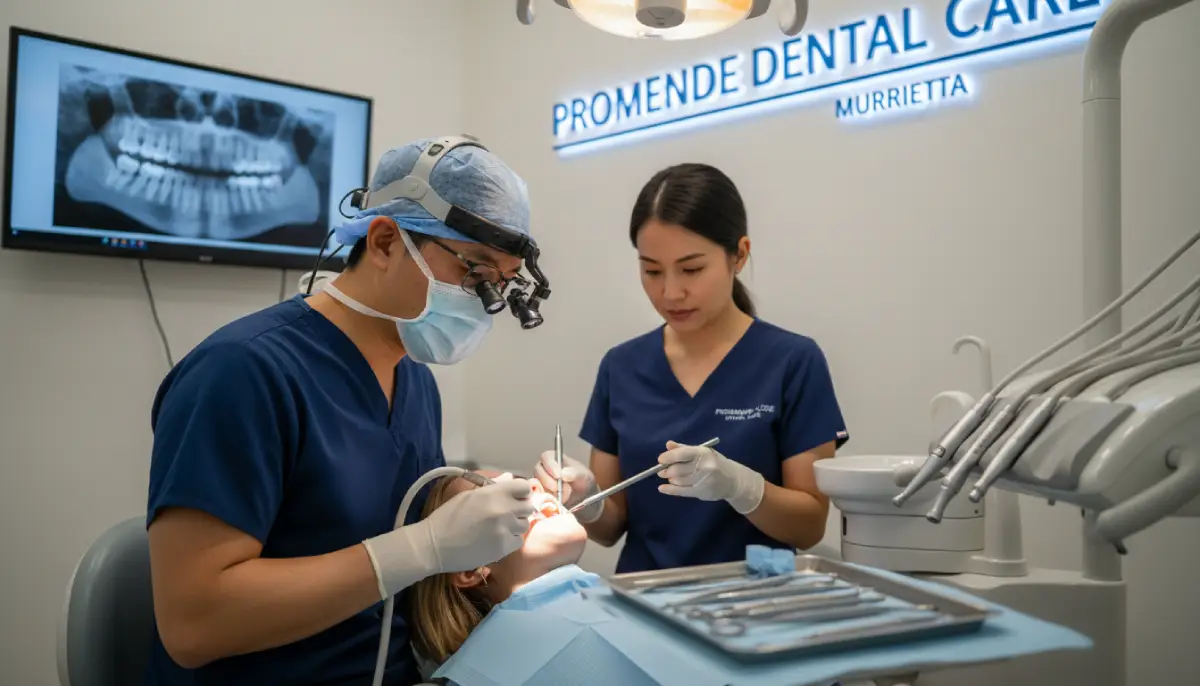
What “Oral Surgery” Actually Means in a General Practice
The phrase lands harder than the reality usually does. Clinically, oral surgery is any procedure that cuts, removes, or reshapes tissue inside the mouth, and that description covers a large share of ordinary dentistry. Pulling a tooth qualifies. So does lifting out an impacted wisdom tooth, grafting bone so a jaw can hold a dental implant, reshaping gum tissue, or taking a sample from a sore that will not heal. If you have been typing “oral surgeon near me” into your phone, the useful thing to know first is that a general dentist with real surgical training can handle most of what sent you searching.
I do the full scope of general-practice oral surgery in this office. I am not going to send you across the valley for a routine surgical extraction or put you on a six-week waitlist with someone who has never opened your chart. There are real exceptions. Jaw fractures, corrective jaw surgery, and advanced pathology belong with an oral and maxillofacial surgeon, and when a case is one of those I tell you plainly and make the call myself. Everything short of that gets done here, for patients from Murrieta, Temecula, Menifee, and French Valley.
- What it covers
- Simple and surgical tooth extractions, wisdom tooth removal, bone grafting, implant-site preparation, soft-tissue surgery, and biopsies, all performed in this office.
- Anesthesia
- Local anesthesia on every case, with nitrous oxide or oral conscious sedation available. General anesthesia is a hospital-level service we do not perform here.
- Appointment length
- Usually 30 to 90 minutes, depending on how complex the case turns out to be.
- Recovery
- Two to five days of soreness for most extractions. Bone grafts need three to six months of integration before an implant can go in.
- Cost
- Quoted in writing after a $20 exam with digital X-rays. Most PPO plans cover surgical procedures at 50 to 80 percent after the deductible.
- Referred out
- Jaw fractures, corrective jaw surgery, and advanced pathology belong with an oral and maxillofacial surgeon, and I make that call myself.
One office, from the X-ray to the healed socket
Because I read the films, do the surgery, and see you at the follow-up, nothing gets lost in translation between offices. I already know your medical history and which medications you take. I know why that molar cracked. And when someone from our team calls the next morning to ask how you slept, it is a person who has your chart in front of her, not a call center reading a script. That continuity is the practical reason to keep oral surgery in-house instead of splitting it across three buildings.
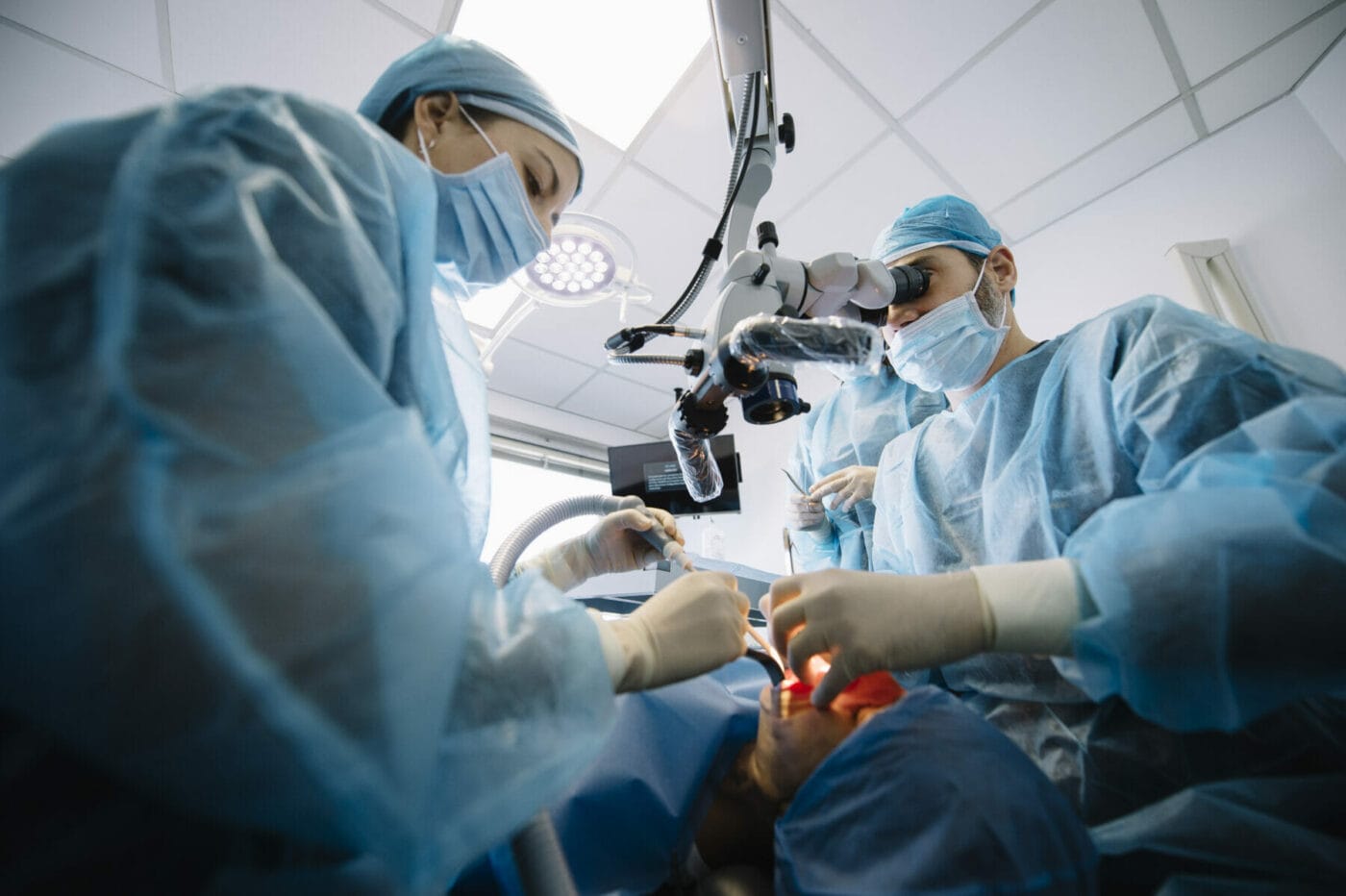
Oral Surgery Procedures I Perform on Date Street
When the clinical picture calls for surgery, I am working with hands that learned this on active-duty Marines, where putting a procedure off until next month was not an option. These are the cases I see most often.
Tooth Extractions
Simple extractions for teeth that are visible and reachable, and surgical extractions for teeth broken below the gumline, badly decayed, or anchored by curved roots. My first instinct is always to keep the tooth. A tooth extraction in Murrieta should happen only when saving it no longer makes clinical sense.
Wisdom Tooth Removal
Impacted or partly erupted third molars that cause pain, infection, crowding, or damage to the tooth next door. I confirm the root position relative to the nerve on a panoramic film before I make any incision. Most cases finish under local anesthesia, with sedation available. More on wisdom tooth removal.
Bone Grafting
When a jaw has lost volume to an old extraction, infection, or trauma, grafting rebuilds the foundation an implant needs. I place graft material in the site, cover it with a resorbable membrane, and let it integrate for three to six months before the implant goes in. Rushing that window is how implants fail. Socket preservation is $500 per site here, membrane included. When the bone that is missing sits under an upper back molar, the fix is a sinus lift instead.
Soft-Tissue Surgery
Gum and oral-lining work: grafting for gum recession, crown lengthening to expose sound structure before a same-day crown, frenectomy for a tight lip or tongue tie, and gingivectomy to reshape excess tissue. Most of these sites look normal again in two to four weeks.
Biopsies and Lesion Removal
Any sore, white patch, red patch, or swelling still there after two weeks deserves a look. I take the biopsy here and send every specimen to an oral pathology lab. The CDC’s oral health data is blunt on this point: oral cancers found early do far better than the ones found late.
Pre-Prosthetic Surgery
Before dentures or implant-supported restorations can seat correctly, the jaw sometimes needs contouring. Bony tori, a sharp ridge crest, or excess fibrous tissue will all fight the fit. Smoothing the foundation first is what lets the finished appliance sit comfortably and stay that way.
When a Dental Problem Crosses Into a Surgical One
Not every toothache needs a scalpel, and I will not push surgery where a filling or a crown does the job. But some conditions pass a point where conservative treatment stops working, and knowing roughly where that point sits helps you act while the problem is still small.
A tooth fractured below the gumline
No bonding or crown rescues a root split vertically. Surgical extraction takes the fragments out cleanly and preserves the socket for whatever restoration comes next.
Infection that outlasts antibiotics
When an abscess keeps coming back after a course of medication, the source has to go. Surgical drainage or extraction removes it before it spreads into neighboring teeth or deeper tissue. That is also an emergency dental visit, not a next-month problem.
Impacted wisdom teeth
Third molars trapped in bone or growing sideways cannot erupt normally. The Cleveland Clinic recommends removal once impaction is causing pain, cysts, or damage to the adjacent tooth.
Bone loss before implants
Implants need bone volume to grip. If a tooth came out years ago and the ridge has resorbed since, bone grafting has to rebuild the site before an implant can be placed in it.
A lesion that will not heal
A sore lasting more than two weeks, a lump, or a color change in the tissue is worth a biopsy. Getting a diagnosis early changes what the treatment looks like.
A failed root canal
When root canal retreatment is not realistic, an apicoectomy can remove the infected root tip and keep the tooth. If the tooth is past saving, we plan the extraction and the replacement together.
Before, During, and After Your Oral Surgery Appointment
Before surgery
Every surgical case starts with a $20 exam and digital X-rays, plus 3D imaging when I need to assess bone. I go through your medical history, your medications, and any blood thinners that could affect clotting. Then you get a written treatment plan covering the procedure, the sedation method, the cost, and the post-op instructions, and you read it before you sign anything. If we are planning sedation beyond nitrous oxide, we settle the fasting window and the driver at this visit rather than the morning of.
During the procedure
Local anesthesia numbs the site completely, and I test it before starting. Nitrous oxide keeps most patients comfortably relaxed. Oral sedation goes deeper for longer cases or heavier anxiety. I narrate what I am doing as I work, because most of what makes people tense is not knowing what the next sound is. We monitor your vitals throughout. Most visits run 30 to 90 minutes depending on complexity.
After surgery
You leave with written post-op instructions, gauze, ice-pack guidance, a prescription when the case warrants one, and a follow-up already on the books, usually a week out for a healing check and suture removal. The next morning someone from our team calls to see how the night went. If something is wrong at 9 p.m. on a Saturday, call the office line anyway. We monitor it.
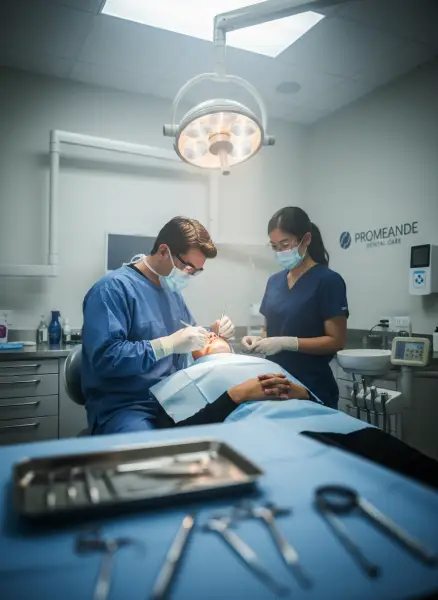
Anesthesia and Sedation Options
Most of what makes people dread oral surgery is the anesthesia question, so here is the whole ladder, including the rung we do not offer.
| Option | What it feels like | Typical use | Driver needed |
|---|---|---|---|
| Local anesthesia | Site is fully numb, you are completely alert. | Every surgical case, on its own for simple extractions. | No |
| Nitrous oxide | Light, floaty calm. Clears in five to ten minutes of breathing oxygen. | Mild to moderate nerves, wisdom teeth, longer appointments. | No |
| Oral conscious sedation | Deep relaxation. Most patients remember very little of the visit. | Heavier anxiety, grafting, multiple extractions in one sitting. | Yes, both directions |
| IV sedation or general anesthesia | Asleep or near-asleep, with monitored airway support. | Hospital-level cases. Not performed at our office; referred out when a case truly needs it. | Not applicable here |
How to Prepare the Week Before
What Recovery Actually Looks Like
Recovery varies by procedure, but most of my patients follow a predictable arc. Knowing what counts as normal removes most of the worry.
Days 1 and 2. Swelling peaks, usually around the 48-hour mark. Discomfort is managed with what I prescribed or with over-the-counter medication. Eat soft and lukewarm: yogurt, scrambled eggs, smoothies by spoon, broth-based soup. Ice in 20-minute intervals. No straws, no spitting, no vigorous rinsing, since all three can pull the clot off the site.
Days 3 to 5. Swelling starts backing off. Bruising along the jawline or down the neck looks alarming and is normal; it resolves on its own. Firmer food comes back as comfort allows. Start gentle saltwater rinses, half a teaspoon in eight ounces of warm water, several times a day.
Weeks 1 and 2. Most people feel close to themselves again. Sutures either dissolve or come out at the follow-up. The site is still healing under the surface, so keep crunchy, sharp, and very hot food away from it, and brush everywhere except directly over the healing tissue.
Weeks 3 to 6 and beyond. Soft tissue is essentially healed. Bone grafts take longer, typically three to six months of integration before an implant can be placed, and I track that with periodic imaging so you know exactly when the site is ready rather than guessing.
| Procedure | Back to your routine | Site fully healed |
|---|---|---|
| Simple extraction | 1 to 2 days | 1 to 2 weeks |
| Surgical or impacted wisdom tooth | 3 to 5 days | 2 to 4 weeks |
| Soft-tissue surgery | 1 to 3 days | 2 to 4 weeks |
| Bone graft | 3 to 5 days | 3 to 6 months before an implant |
| Implant placement | 2 to 3 days | 3 to 6 months to integrate |
What Can Go Wrong, and What I Do About It
Oral surgery is safe and predictable, and it is still surgery. I would rather you hear the honest list from me before the procedure than read it on a forum at midnight afterward. Every one of these is uncommon, every one of them is manageable, and every one of them is a reason to call the office rather than wait it out.
Dry socket
The most common complication after an extraction, and still uncommon. The clot comes loose before the bone underneath has healed, usually three to five days out. I pack the socket with medicated dressing and the pain drops within an hour.
Infection at the site
Swelling that grows instead of shrinking after day three, a bad taste, or fever. It is treated with antibiotics and sometimes drainage. Following the post-op rinse instructions is what keeps the number low.
Nerve irritation
Lower wisdom teeth sit near the inferior alveolar nerve, which is why I map the root position on a panoramic film before any incision. Temporary numbness or tingling in the lip or chin resolves on its own in the large majority of cases.
Prolonged bleeding
Some oozing for the first day is normal. Bleeding that soaks gauze after several hours is not, and it is more likely on blood thinners, which is exactly why I review your medication list first.
Sinus communication
Upper back molars sit close to the sinus floor. Occasionally an extraction opens a small connection. It usually closes on its own with sinus precautions, and I check for it before you leave the chair.
Reaction to medication
Rare, and the reason your allergy history and current prescriptions get reviewed at every surgical visit rather than filed once and forgotten.
What Oral Surgery Costs in Murrieta, and Why I Quote It in Writing
Price depends on the procedure, how complicated it turns out to be, the sedation involved, and whether grafting or a membrane is part of the plan. A simple extraction costs less than surgically removing an impacted wisdom tooth, which costs less than a graft with implant-site preparation. Quoting a flat number for a tooth I have not looked at would be guessing, and guessing is how patients end up with a bill that does not match what they were told.
So here is what happens instead. After the exam and the imaging, you get a written estimate before any work starts. The number on that paper is the number you pay. Nothing gets discovered mid-procedure that mysteriously doubles the total.
| Procedure | Commonly published U.S. range | At Promenade Dental Care |
|---|---|---|
| Simple tooth extraction | $75 to $300 per tooth | Quoted in writing after the exam and X-ray |
| Surgical or impacted wisdom tooth | $150 to $400 and up per tooth | Quoted in writing after the exam and X-ray |
| Bone graft for socket preservation | $300 to $1,200 per site | $500 flat per site, membrane included |
| Dental implant | $1,500 to $6,000 per implant | Quoted in writing after 3D imaging |
| Corrective jaw surgery | $20,000 to $40,000 or more | Outside general-practice scope, referred to a specialist |
Those ranges are the national figures patients find published online. They are useful for a sanity check and useless as a quote, because they say nothing about your tooth, your bone, or your insurance. The only number that matters is the one on your written estimate.
Dr. Bao Nguyen, DDS: Surgical Training Built in the U.S. Navy
There is a reason I keep most oral surgery in this office. My training was surgical from the beginning. After I graduated from the UCLA School of Dentistry, I joined the U.S. Navy Dental Corps and completed an Advanced Education in General Dentistry residency at Naval Hospital Camp Pendleton. That year was not classroom work. It was surgical extractions on active-duty Marines, grafts on trauma patients, emergency abscess drainage, and restorative work for a population whose deployment date did not move because a tooth hurt.
After the residency I deployed to Kuwait and Iraq. Dental readiness downrange means handling whatever comes through the door with the instruments already on the tray, whether that is a cracked wisdom tooth or a laceration through the lip. Ten years of that builds a certain calm. I opened Promenade Dental Care here in Murrieta in 2010 and brought the calm with me.
The approach has not changed since: examine thoroughly, image before deciding, explain honestly, work gently, follow up personally. My California license is verifiable through the Dental Board of California. The reviews say roughly what I would hope they say. Patients do not describe me as fast or aggressive. They describe me as careful and clear, and for surgical care those are the qualities that matter.
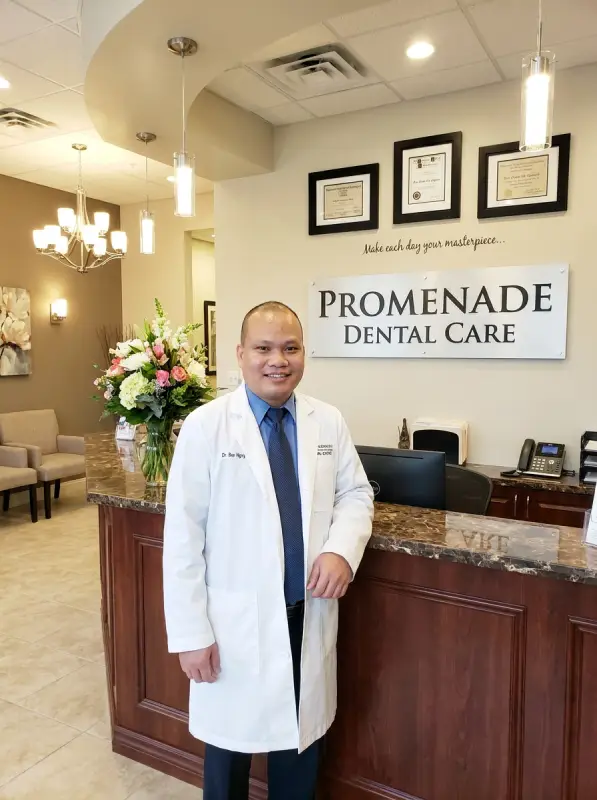
Surgical Care, Reviewed by the People Who Sat in the Chair
“I got a tooth extraction, a crown, a handful of cavities, and a deep cleaning all done at the exact same time. The doctor gave me some anxiety meds which completely relaxed me. Three days later everything is healing beautifully.”
“Very knowledgeable and good prices. Does only what is necessary, does not just look for stuff to charge for. Got an appointment quickly when I thought it was an emergency. My favorite dentist ever.”
“Dr. Nguyen is very quick but very gentle. He has more practical experience than most others, so my wife and I recommend his fine dentistry.”
“I have been a patient of Dr. Nguyen’s now for over a decade. Doctor and staff are incredibly wonderful, so kind, caring and compassionate, yet professional. Dr. Nguyen met me at his office for an emergency visit during the height of COVID and I will forever be thankful for it!”
Oral Surgery for Southwest Riverside County
Promenade Dental Care is at 26957 Date St, Suite B4, Murrieta, CA 92563, in the Aldi shopping center on the Date Street corridor near Murrieta Hot Springs Road, a few minutes from either the I-15 or the I-215. Surgical patients drive in from across the valley: Murrieta, Temecula, Menifee, French Valley, Winchester, Wildomar, Lake Elsinore, Canyon Lake, Fallbrook, and Hemet. If you have been searching “oral surgeon near me,” that whole map is a short drive to this chair.
Murrieta Oral Surgery Questions, Answered
Does oral surgery at Promenade Dental Care hurt?
No, not during the procedure. I numb the surgical site with local anesthesia and I test it before I pick up an instrument, so you feel pressure and movement but not pain. Nitrous oxide or oral conscious sedation is available if you want it. Afterward, most patients describe two to five days of soreness that ibuprofen and acetaminophen handle well. I prescribe something stronger when the case calls for it, and we go over your pain plan before you leave.
How long does an oral surgery appointment take?
Most surgical visits at our Murrieta office run 30 to 90 minutes. A simple extraction is often done in 20 minutes. A surgical extraction of an impacted wisdom tooth usually takes 45 to 60 minutes. Bone grafting with a membrane runs closer to 90 minutes. I give you a realistic time estimate at the consultation so you can plan the rest of your day around it.
Will I be put to sleep for oral surgery?
No. We use local anesthesia with conscious sedation, not general anesthesia. You stay awake, you breathe on your own, and you can answer me during the procedure. Nitrous oxide gives mild relaxation and wears off within minutes. Oral sedation goes deeper and works well for longer surgeries or heavier anxiety, though you will need a driver. General anesthesia is a hospital-level service and we do not perform it here.
How soon can I go back to work after oral surgery?
Most patients go back to desk work in one to two days. Physical labor, heavy lifting, and hard exercise should wait three to five days, because a spike in blood pressure can restart bleeding at the site. Wisdom tooth removal and bone grafting usually need the longer end of that range. I write return-to-activity guidance specific to your procedure on your post-op sheet.
What can I eat after oral surgery?
Soft, lukewarm food for the first two to three days: yogurt, scrambled eggs, mashed potatoes, applesauce, broth-based soup, and smoothies eaten with a spoon. Add firmer food back gradually as comfort allows. Keep anything crunchy, spicy, acidic, or very hot away from the site for about a week. Skip straws entirely, because the suction can pull the blood clot out of the socket and cause dry socket.
What is dry socket, and how do I avoid it?
Dry socket happens when the blood clot protecting an extraction site comes loose before the bone underneath has healed, exposing the nerve. It usually shows up three to five days after the extraction as a deep, throbbing ache that radiates toward the ear. You avoid it by not using straws, not smoking or vaping, not spitting forcefully, and not rinsing hard for the first 72 hours. If it happens anyway, call us. I can pack the socket with medicated dressing and the pain drops within an hour.
Can I drive myself home after oral surgery?
Yes, if we used local anesthesia alone or local plus nitrous oxide. Nitrous clears out of your system in five to ten minutes of breathing oxygen, and we keep you in the chair until it does. If you have oral conscious sedation, you need someone to drive you both directions and stay with you for the rest of the day. We confirm that arrangement when we schedule the appointment, not on the morning of surgery.
Does dental insurance cover oral surgery in Murrieta?
Most PPO dental plans do. They classify extractions, wisdom tooth removal, and bone grafting as major restorative care and cover them at 50 to 80 percent after your deductible. Promenade Dental Care is in-network with all PPO plans, so your share is usually lower here than at an out-of-network office. We verify your exact benefits before treatment and put the number in writing. Without insurance, you get straightforward cash pricing and CareCredit financing with up to six months at zero interest.
How much does a tooth extraction cost in Murrieta at Promenade?
It depends on whether the tooth comes out simply or surgically, and whether sedation or bone grafting is part of the plan. I will not quote a flat fee over the phone for a tooth I have not seen. What I do instead: examine the tooth, take digital X-rays, and hand you a written estimate before any work starts. The number on that paper is the number you pay. Everything begins with the $20 exam.
Do you place dental implants in your Murrieta office?
Yes. I handle the whole implant sequence in-house: digital imaging, bone grafting when the ridge needs rebuilding, placing the implant, and making the final crown or restoration. Keeping every step under one roof means I already know your bone anatomy from the extraction, you make fewer trips, and nothing stalls waiting on a referral to open a chart.
What is the difference between a general dentist and an oral surgeon?
An oral and maxillofacial surgeon finishes a four- to six-year hospital residency focused on complex jaw surgery, facial trauma, and advanced pathology. A general dentist with surgical training can perform the majority of what patients actually need: extractions, wisdom teeth, bone grafts, biopsies, and soft-tissue procedures. My training came from a Navy AEGD residency at Camp Pendleton plus ten years in the Dental Corps. When a case genuinely exceeds general-practice scope, I say so, refer you to a specialist I trust, and stay involved in the plan.
Can I get oral surgery the same day I call?
Often, yes. I hold surgical time open each week for straightforward extractions and emergencies, so a broken or abscessed tooth rarely waits more than a day. Cases that need 3D imaging, graft planning, or oral sedation arrangements usually go on the schedule within a few days. That is a different experience from the multi-week wait that referral-based surgical offices typically quote.
I am terrified of surgery. What are my options?
You are in good company, and being afraid does not disqualify you from care. A large share of my practice is anxious patients. Nitrous oxide takes the edge off mild nerves. Oral sedation produces deep relaxation and most people remember very little of the visit. I explain each step before it happens, and I stop the moment you raise a hand. Start with a $20 exam so you can meet me and see the office with no obligation to book treatment that day.
What are the risks of oral surgery?
The realistic list is short: dry socket after an extraction, infection at the site, temporary numbness if a nerve near a lower wisdom tooth is irritated, prolonged bleeding, a small sinus opening after an upper back molar, and rarely a reaction to medication. All of them are uncommon and all of them are manageable. I review your medical history and medications before every surgical case specifically to lower those odds, and I would rather you call the office about something minor than wait on something that is not.
How long after an extraction or bone graft can I get an implant?
If the site does not need grafting, an implant can often be placed within two to three months of the extraction. When I place graft material at the time of the extraction, the site needs roughly three to six months to integrate before the implant goes in. I track that with periodic imaging so you know when the bone is actually ready rather than working off a calendar guess. Rushing that window is the most common reason implants fail.
Need Oral Surgery in Murrieta?
Start with a $20 exam. I will image the problem, walk you through the options, and hand you a written quote. No pressure, no upsell, no referral runaround.