
Custom Dentures in Murrieta, CA
Murrieta Custom Dentures: Full, Partial & Snap-On Sets That Fit
If it doesn’t fit, nothing else about it matters.
I’m Dr. Bao Nguyen, and I’ve been making dentures for Murrieta patients since 2010. The sets that work all have one thing in common: somebody took the time to measure properly before the lab ever got involved. Digital impressions, a real bite registration, and a wax try-in you get to look at and talk through before anything is final. Pricing in writing before we start.
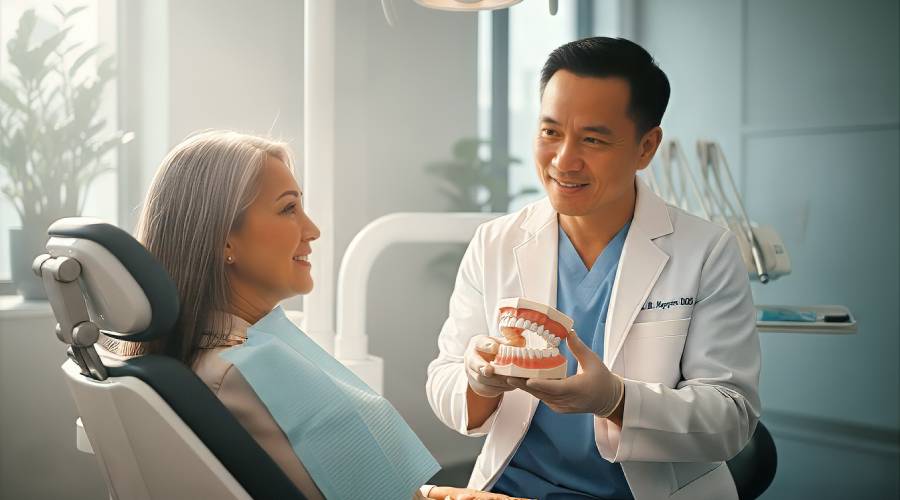
Dentures in Murrieta, CA
Most Denture Problems Start Long Before the Lab Sees Your Case
Nearly every office between Winchester Road and Clinton Keith lists dentures on the services page. What almost none of them explain is why one set feels like part of your mouth while another one lifts the moment you bite into a sandwich. It is rarely the acrylic. It comes down to how many measurements were taken before anything got shipped to a lab.
My office is at 26957 Date St., Suite B4, in the Aldi plaza off Winchester Road and Murrieta Hot Springs, about two minutes from the 215. I treat a denture the way a tailor treats a jacket. The shape of your ridges, the way your jaw slides sideways when you chew, the proportions of your face, the sounds you have trouble with. Each of those gets recorded rather than assumed. That takes more chair time than the corporate offices in this valley tend to schedule, and it is why people drive past a few of them to get here.
If you have been searching for Murrieta custom dentures, affordable dentures in Murrieta, partial dentures near me, or snap-on dentures, the sections below cover fit, cost, timing, and whether dental implants belong in your plan. If you would rather skip the reading, a $20 exam with digital X-rays gets you a written answer. Call (951) 412-0127 and we can usually see you the same week.
Tooth loss is far more common than most people assume. The CDC’s adult oral health data shows how many Americans are living without teeth they should still have, and cost is the reason more often than anything clinical.
- Dentist
- Dr. Bao Nguyen, DDS — UCLA School of Dentistry, ten years U.S. Navy Dental Corps, practicing in Murrieta since 2010
- Denture services
- Full (complete) dentures, partial dentures, immediate dentures, snap-on implant-supported overdentures, relines and repairs
- First visit
- $20 comprehensive exam with digital X-rays, gum evaluation, and a written quote for every option
- Typical timeline
- 4–6 weeks from impressions to delivery; 3–6 months when implants are part of the plan
- Address
- 26957 Date St, Suite B4, Murrieta, CA 92563 (Aldi plaza at Winchester Rd & Murrieta Hot Springs)
- Phone
- (951) 412-0127
- Office hours
- Mon, Tue, Thu 9:00 AM–5:00 PM · Wed, Fri 9:00 AM–3:00 PM · Sat by appointment & emergencies · Sun closed
- Payment
- All PPO dental plans accepted; published cash pricing; CareCredit with up to six months at zero interest for qualified patients
- Areas served
- Murrieta, Temecula, French Valley, Menifee, Wildomar, Winchester
Fit Is the Whole Job
Six Things I Do Before Your Denture Goes to the Lab
Every office uses the word “custom.” Here is what it means when I say it, in the order it happens. The American Dental Association’s patient guide to dentures covers the categories well. What it cannot tell you is how much the fabrication process varies from one chair to the next, and that variation is where comfort is won or lost.
1. Digital impressions
A putty tray gives a rough outline. A digital scan records the actual topography of your ridges and palate down to fractions of a millimeter, so the base loads evenly instead of pivoting on a high spot nobody can see by eye.
2. Bite registration
Jaws do not just open and close. They slide forward and sideways, and the teeth have to be set where that motion puts them. A bad bite is behind most sore spots and most loose lower dentures, and you cannot detect it until you chew.
3. Shade matching
The right shade is not the brightest one. I match it to your complexion, your age, and whatever natural teeth you still have, under lighting calibrated to daylight. Teeth chosen under office fluorescents look wrong the moment you step outside.
4. Facial support
Teeth hold your lips and cheeks where they belong. Lose them and the lower third of the face folds inward. I build to the vertical dimension your face actually had, which restores lip support and chin position. Cheap sets underbuild this because it saves a step, and people can tell.
5. Speech check
Palate thickness and front-tooth position change how you say s, f, and th. At the try-in I listen for whistling, lisping, and air leaks, and I move things before anything is finished. If an old set made you sound different, you were not imagining it.
6. Wax try-in
You see the teeth in your own mouth before they are locked into acrylic. Look, bite, speech, all of it, and I change what you do not like right there. Some people need a second try-in. That visit costs an hour and prevents the one repair nobody wants to pay for, which is a remake.
From Our Google Reviews
What Murrieta Patients Say
“The office treats you with respect and dignity. The dentist / Owner is informative and concerned with the patient and their needs. He tells the truth. No sells pitch just the right procedure advised with the patient as his prime concern. A rarity today, honesty and concern. Highly recommend.”
Larry H. — New patient, with spouse
“Found Dr Bao years ago when I needed emergency care on a weekend. Started going to him while I still lived in the area. Moved a few years ago, but recently felt like I was being scammed by my new dentist (new insurance), drove over an hour to get a second opinion from Dr Bao. He is as straight forward, efficient, and affordable as ever. Work was still needed but not nearly to the extent and cost as was being told to me by the other dentist.”
P Hooper— Crown & restorative patient
Your Options
Full, Partial, or Snap-On: Which One Fits Your Situation
The right type comes down to how many teeth are missing, the condition of the ones still standing, and how much stability you want to invest in. Here is how I think through each.
Full (complete) dentures
A full denture replaces every tooth on an arch. The upper holds by suction across the palate and usually needs little or no adhesive when the impression was accurate. The lower rests on a much smaller ridge with a tongue pushing against it, which is why lower stability is the harder engineering problem and why so many people give up on their lower set. A custom lower built from a proper impression and bite registration performs on a different level than a stock-tray denture.
Partial dentures
Partials fill the gaps while healthy teeth still anchor the arch. Cast-metal frameworks are stronger and thinner; flexible resin partials hide the clasps better. Either way, a partial also stops the remaining teeth from tipping into the empty spaces, which is a problem most people do not notice until the bite has already shifted. If you have been searching partial dentures near me around the Temecula Valley, ask whichever office you visit to show you the framework options side by side against your own X-ray.
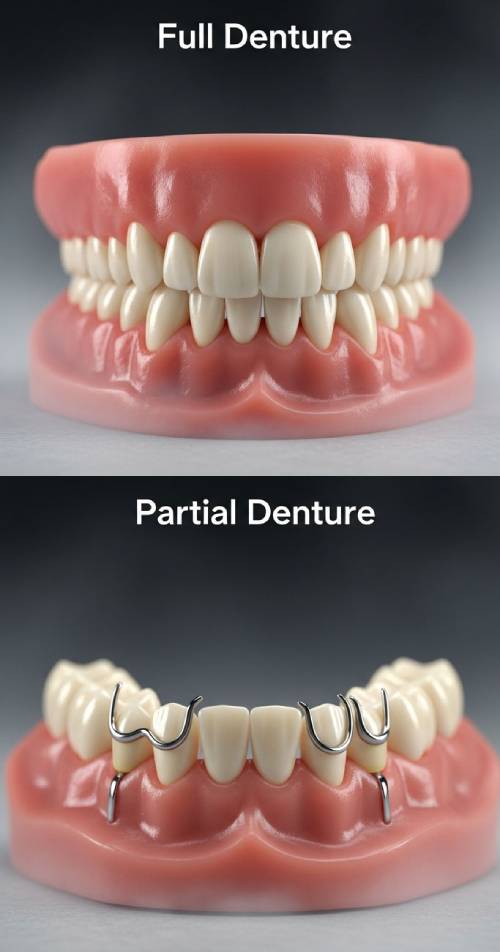
Custom full denture and partial denture, both built for Murrieta patients.
Snap-on (implant-supported) dentures
Two to four dental implants give a full denture something to lock onto. No sliding, no adhesive, and chewing force that gets close to natural teeth. A snap-on set unclips for cleaning and clicks back in. A fixed hybrid, the All-on-4 style, is screwed down and cleaned in your mouth the way you would clean dental bridges.
Implants also solve the slow problem that eventually defeats every conventional denture, which is bone loss. Without roots, or implants standing in for roots, the jaw under a denture keeps resorbing, and the set that fit beautifully on delivery day wobbles two years later. The Cleveland Clinic’s denture overview explains that bone-to-fit relationship in plain language.
Snap-on versus fixed, how many implants each one needs, which parts of a full-arch case are done by a periodontist, and what each costs are covered in full on the implant-supported dentures and All-on-4 page.
Side by Side
Conventional Dentures vs. Snap-On vs. All-on-4
Most people researching dentures are quietly wondering whether implants are the smarter long-term play. Here are the trade-offs laid out, so you walk into the consultation already understanding them instead of hearing them for the first time while somebody holds a mirror.
| Factor | Conventional denture | Snap-on (implant) | All-on-4 (fixed) |
|---|---|---|---|
| Stability | Suction and adhesive. Lowers are less stable than uppers. | Locks onto 2–4 implants. Virtually no slipping. | Screwed to 4–6 implants. Does not move at all. |
| Bone preservation | None. Bone keeps resorbing, so relines are periodic. | Good. Implants stimulate bone at the attachment points. | Best. Load spreads across the whole arch. |
| Chewing strength | About 25–40% of natural. Some foods need modifying. | About 60–80% of natural. Large improvement. | Near natural. Steak, apples, and corn are back. |
| Surgery | None. | Minor. 2–4 implants under local anesthetic. | Moderate. 4–6 implants, sometimes with extractions. |
| Timeline | 4–6 weeks, impression to delivery. | 3–6 months to integrate, then the denture. | Often a same-day provisional; final 4–6 months later. |
| Cost | Lowest up front. Higher long term with relines and replacements. | Moderate. Surgery adds cost but cuts maintenance. | Highest up front. Often lowest cost per year over 20 years. |
| Removable | Yes. Out nightly for cleaning. | Yes. Unclips to clean, snaps back. | No. Fixed, and cleaned like a bridge. |
I go through this table with every denture patient with their own X-rays on the screen. The right answer is not always the most expensive one. For someone with limited bone and a tight budget, a well-made conventional denture still changes daily life more than anything else I do. If you have already decided on implants, choosing between snap-on and fixed is its own decision, and the implant-supported dentures page walks through it.
The Foundation
Healthy Gums Decide Whether a Denture Works
A denture sits on gum tissue and bone. If that tissue is inflamed or that bone is shrinking, the denture will not fit, today or three months from now. Periodontal health is the single best predictor of long-term comfort, and it barely comes up in most denture consultations.
Bone loss and ridge preservation. After teeth come out, the bone that held them starts to resorb, fastest in the first six months. A denture on a shrinking ridge is a shoe on a shrinking foot. It loosens because the ground moved. Ridge-preservation technique at the time of tooth extraction slows that loss and leaves the denture a fuller ridge to grip.
Active gum disease moves the target. Swollen tissue changes shape unpredictably, so an impression taken over it captures anatomy that will not exist next month, and the finished denture is loose once the swelling settles. Laser gum disease treatment and gum recession treatment stabilize the tissue first. Fabrication starts once the gums have healed to their true contour. The National Institute of Dental and Craniofacial Research reports that periodontal disease affects a large share of adults over 30, and most of them have never been told.
Keeping the gum and bone healthy after delivery also stretches your reline intervals and keeps the door open to upgrading to snap-on support later. Let bone loss run unchecked for a decade and you may be looking at extensive grafting, or hearing that implants are no longer realistic. Preventive care now is what keeps every option available later.
What to Expect
The Process, Visit by Visit
1. Consult and exam
$20 exam with digital X-rays. I evaluate the teeth you have left, your gums, your bone, and your bite, and you leave with a written plan and the real cost of each option.
2. Impressions and bite
Digital impressions capture your ridges at sub-millimeter accuracy. A bite registration records how your jaws meet and move. Those go to the lab along with your shade and facial-support specs.
3. Wax try-in
You preview the denture in wax with the teeth set. We verify the bite and check how it looks and how you sound, with you in the chair. Changes at this stage are quick and free.
4. Delivery
The finished set is seated, pressure-checked, and fine-tuned. You practice speaking, biting, and inserting it before you leave. A snug feeling on day one is the fit doing its job.
5. Adjustment visits
Sore spots in the first two weeks are normal. One or two short visits relieve the pressure points and refine the bite. That is expected, not a sign that something went wrong.
6. Follow-up care
An annual check monitors fit and bone. Relines every two to three years re-contour the base to your current ridge. Nobody gets handed a denture here and sent off to figure it out alone.
More From Google
Affordable, Honest, and Gentle, in Their Words
“My name is Debby and I have been a patient of Dr. Nguyen’s now for over a decade at Promenade Dental. Doctor and staff, which includes Edith, are incredibly wonderful — so kind, caring and compassionate, yet professional. They go above and beyond to care for their patients.”
Debby — Google Review · Patient for 10+ years
“Finding an excellent dentist is difficult! Dr. Bao offers the most affordable dental care in Murrieta. He is friendly and professional. I don’t have insurance and the pricing was explained up front — no surprises and no pressure to do more than I needed.”
David C. · Cash-pay patient, no insurance
Money, Plainly
What Custom Dentures Cost in Murrieta
The honest answer is that it depends on four variables, and any office quoting a firm price before examining you is guessing. Here is what actually moves the number, so the estimate you get from me makes sense instead of feeling arbitrary.
Full dentures
A single-arch custom full denture costs less here than most of the corporate chains charge for comparable lab work, partly because there is no franchise fee built into my overhead. Upper and lower together roughly doubles it. Material is the real variable: standard acrylic with composite teeth is the baseline, while high-density teeth and reinforced frameworks cost more and last longer.
Partial dentures
Partial cost scales with complexity. How many teeth are being replaced, whether the framework is acrylic, cast metal, or flexible resin, and how many clasps the design needs. A simple three-tooth flipper costs a fraction of a cast-metal partial spanning both sides of the arch. I show you the options side by side and let the materials compete for your budget.
Snap-on dentures
Adding implant retention raises the initial number because it includes minor surgery: implant placement, sometimes grafting, a healing period, and the abutments. Spread over the working life of the prosthesis, which is considerably longer than a conventional denture, the cost per year usually comes out lower. I put both figures in front of you, the day-one cost and the twenty-year cost. A fixed full arch, the All-on-4 style, is priced differently, because a periodontist places the implants and I build the teeth; how those two fees come together is explained on the implant dentures page.
Insurance and financing. Most PPO plans treat dentures as major restorative work and cover a portion after the deductible, commonly around half, up to your annual maximum. We are in-network with all PPO plans and verify your specific benefit before treatment starts, so the estimate you sign is the bill you get. A large share of my denture patients have no dental insurance at all, and the cash pricing is built for them. CareCredit financing with up to six months at zero interest is available for qualified patients.
The Mayo Clinic’s denture overview notes that cost is the leading reason people put off treatment. My job is to take that barrier down, not add to it. The first step is $20: a full exam with digital X-rays, a gum evaluation, and a written quote for every option. Call (951) 412-0127.
Meet Your Murrieta Dentist
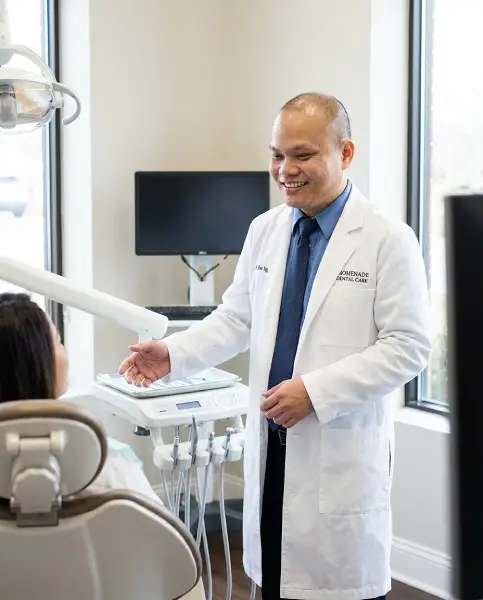
About Dr. Bao Nguyen, DDS
Denture outcomes come down to two things: how accurately the prosthesis is built, and how well the tissue underneath it is managed. My training covers both.
I trained at UCLA School of Dentistry, then spent ten years in the U.S. Navy Dental Corps. I completed an Advanced Education in General Dentistry residency at Naval Hospital Camp Pendleton and deployed to Kuwait and Iraq before opening my practice in Murrieta in 2010. Military dentistry is a crash course in volume and range: trauma, full-mouth rehabilitation, complex prosthetics, and more extractions in a month than a suburban office sees in a year. I brought that work back to Date Street with me.
For denture patients, two things matter most. The gum and bone evaluation is not an afterthought, it is the first appointment, and I treat disease before I restore anything. And for conventional and snap-on cases I handle the whole sequence under one roof: extractions, ridge preservation, single-implant placement, same-day crowns, and the prosthetic work itself. The one exception is the surgery for a fixed full arch, the four to six implants behind an All-on-4, which I refer to a periodontist while I plan the case and build the teeth. Either way, one plan, one point of contact, and no paying for the same X-ray twice.
If dental fear is what has kept you out of a chair, say so when you call. Sedation and a slower pace are available, and our dental anxiety approach is the single thing patients mention most often in 200+ five-star Google reviews.
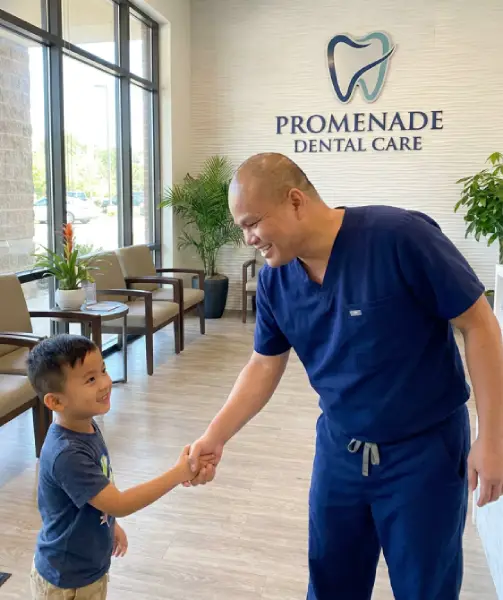
The Difference
Why People in Murrieta Come Here for Dentures
Gentle care
Thorough numbing, an unhurried pace, and sedation for patients whose anxiety has kept them away for years. Pain-free treatment is what the reviews mention first, and consistently.
Straight recommendations
If a conventional denture suits your mouth and your budget, I will not talk you into implants. If your remaining teeth are failing, I will tell you that too, and show you why on the X-ray. This is an independent practice, so the plan answers to your mouth and not to a corporate quota.
Written pricing
Every path, full, partial, and snap-on, comes with its real timeline, its trade-offs, and its dollar figure, in writing, before anything starts. Take a week or a month to decide. You will not get a follow-up sales call.
Custom means custom
Digital impressions, bite registration, shade matching, facial-support analysis, wax try-in, and post-delivery adjustments. Every step described on this page actually happens, in this office, for every denture patient.
Where to Find Us
Serving Murrieta, French Valley, and the Temecula Valley
Promenade Dental Care is at 26957 Date St., Suite B4, Murrieta, CA 92563, in the Aldi shopping center just off the Winchester Road and Murrieta Hot Springs intersection, two minutes from the 215. From French Valley we are probably the closest full-service prosthetic office to your door. From Temecula, by way of Winchester or Clinton Keith, the drive runs ten to fifteen minutes.
| Monday | 9:00 AM – 5:00 PM |
| Tuesday | 9:00 AM – 5:00 PM |
| Wednesday | 9:00 AM – 3:00 PM |
| Thursday | 9:00 AM – 5:00 PM |
| Friday | 9:00 AM – 3:00 PM |
| Saturday | By appointment & emergencies |
| Sunday | Closed |
The phone line at (951) 412-0127 is monitored around the clock for dental emergencies. You can see everything else we do on the Murrieta dentist page.
Questions I Answer Every Week
Murrieta Denture FAQs
How much do custom dentures cost in Murrieta?
Cost depends on four things: whether the set is full, partial, or implant-supported; the materials and teeth you choose; how many extractions have to happen first; and whether the ridge needs grafting. Any office that quotes a firm number before looking in your mouth is guessing. At Promenade Dental Care the $20 exam includes digital X-rays and ends with a written quote covering every option that fits your case. We accept all PPO dental plans, and CareCredit is available with up to six months at zero interest for qualified patients. Our cash prices are set for people paying out of pocket, which is a large share of the denture patients I see.
What is the difference between custom dentures and cheap economy dentures?
Economy dentures are made from stock trays, one or two appointments, and off-the-shelf teeth in a handful of shades. Custom dentures start with a digital scan of your own ridges, a full bite registration, teeth matched to your face and skin tone, and at least one wax try-in you approve before anything is finished. You notice the difference the first time you eat a real meal and the first time you see a photo of yourself. Economy sets are not a scam. They are a compromise, and it helps to know which one you are buying.
How long does it take to get dentures?
Plan on four to six weeks from your first impressions to the day you walk out wearing them. That covers impressions, bite registration, a wax try-in, the lab work, delivery, and the first adjustment. If teeth have to come out first, immediate dentures can be placed the same day as the extractions so you are never without teeth, but the gums keep shrinking for three to six months afterward and that set will need a reline, and often a final denture, once healing finishes.
Do you make snap-on dentures in Murrieta?
Yes. A snap-on denture clips onto two to four dental implants, so it stays put without adhesive and still lifts out for cleaning. I place the implants and make the overdenture in the same office at 26957 Date St., which means no referral across the valley and no paying twice for imaging. The other advantage is bone. Implants keep the jaw stimulated, so the ridge holds its shape instead of shrinking out from under the denture the way it does with a conventional set.
Can you eat normally with dentures?
Yes, after a learning period of two to four weeks. Start with softer foods, cut everything smaller than you think you need to, and chew on both sides at once instead of favoring one side. A conventional denture gives back roughly 25 to 40 percent of natural chewing force. Snap-on implant-supported dentures bring that up to about 60 to 80 percent. If steak, corn on the cob, and apples matter to you, that gap is worth a conversation before we start.
Are implant-supported dentures worth the extra cost?
For most people who can manage the upfront investment, yes. You get stability, roughly double the chewing force, and bone preservation that a conventional denture cannot provide. Spread across the life of the prosthesis, the cost per year often lands below a conventional denture once you add up adhesive, relines every two to three years, and earlier replacement. That said, a well-made conventional denture still changes someone’s daily life completely, and if the budget or the bone is not there I will tell you that instead of pushing implants.
Do custom dentures look natural?
They can look convincingly natural, and the details that get you there are small ones. Teeth shade-matched to your complexion rather than bleached white. Tooth size proportioned to your face. Slight irregularity in the arrangement instead of a straight picket fence. Gum-colored acrylic tinted to your own tissue tone rather than a generic pink. Every one of those choices gets made with you in the chair looking at the try-in, not by a lab technician guessing from a prescription form.
How do I take care of my dentures?
Rinse them after meals. Brush them daily with a soft denture brush and a non-abrasive denture cleanser, never regular toothpaste, which is abrasive enough to scratch acrylic, and those scratches hold stain and bacteria. Soak them overnight in water or a denture solution so the acrylic does not dry out and warp. Brush your gums, tongue, and palate every morning before you put them back in. Then come in once a year so I can check the fit before a small change turns into a sore spot.
What is the difference between full and partial dentures?
A full denture replaces every tooth on an upper or lower arch. A partial fills the gaps around teeth you still have, using clasps or a cast framework that grips those teeth for support. Which one you need depends on how many teeth are left and whether they are healthy enough to carry the load. Sometimes the honest answer is that two or three failing teeth should come out so a full denture can seat properly, rather than building a partial around anchors that will fracture within a year.
Can I get dentures if I have gum disease?
Not until the gum disease is treated and the tissue has settled. Inflamed gums are swollen, so an impression taken over them records a shape that disappears once the swelling goes down, and the finished denture ends up loose. Inflammation also speeds up the bone loss underneath, which is the thing that ruins denture fit over time. I treat the periodontal problem first, wait for the tissue to heal to its true contour, then start fabrication. It adds a few weeks and saves years of trouble.
How often do dentures need to be relined or replaced?
Expect a reline every two to three years and a new set every five to eight years. The acrylic itself often outlasts that, but your jawbone keeps resorbing and the ridge underneath changes shape, especially when there are no implants holding it. A reline rebuilds the underside of the denture to match your current ridge and restores the fit you had on delivery. An annual check catches that drift early, while a reline is still enough to fix it.
What are immediate dentures?
An immediate denture is made in advance from impressions taken before your extractions, then placed the same day the teeth come out, so you are never in public without teeth. It also acts like a bandage over the extraction sites during the first days of healing. The trade-off is that gums and bone shrink significantly over the following three to six months, so an immediate denture almost always needs a reline and usually a final denture once healing is complete. I put that second cost in the written estimate up front so it is not a surprise.
Do you offer affordable dentures without dental insurance?
Yes. A large share of my denture patients pay out of pocket, and our cash prices are built for them rather than marked up around them. You get the full figure in writing at the $20 consultation, before you commit to anything. CareCredit financing with up to six months at zero interest is available for qualified patients. Nobody in this office works on commission, so there is no pressure to buy more dentistry than your mouth needs.
Are "permanent dentures" the same thing as All-on-4?
Usually, yes. "Permanent dentures" is the everyday name for a full arch that is fixed to dental implants rather than resting on the gums, and All-on-4 is the most common way that is done. The arch does not come out at night and does not need adhesive. Snap-on dentures are the middle ground: they clip onto implants for stability but still come out for cleaning. Which one fits depends on bone, budget, and how much you want to be able to remove it yourself.
Let’s Find Out Which Denture Is Right for You
Start with a $20 exam and digital X-rays. You will leave knowing whether full, partial, or snap-on dentures make the most sense for your mouth, in writing, with nobody asking you to decide on the spot.
(951) 412-0127 Request an Appointment